
The Culmination of a Colonial Era: Spain’s Declining Hegemony
The story of the United States’ acquisition of Puerto Rico is intrinsically linked to the twilight years of the Spanish Empire and the burgeoning expansionist ambitions of the United States. For over four centuries, Puerto Rico had been a Spanish colony, a strategic military outpost in the Caribbean guarding vital trade routes. Its history was marked by periods of relative neglect, interspersed with moments of strategic importance, particularly during conflicts involving European powers.
A Strategic Prize in the Americas
Spanish attempts to fully colonize and develop Puerto Rico were often hampered by limited resources and persistent challenges, including devastating hurricanes and raids by rival European powers and pirates. Despite these difficulties, the island’s strategic location remained undeniable. It commanded access to the passages between the Atlantic Ocean and the Caribbean Sea, making it a crucial point of defense for Spanish interests in the Americas. The fortifications, such as those in San Juan, stand as testaments to its military significance throughout the colonial period.

Shifting Global Power Dynamics
By the late 19th century, the global geopolitical landscape was undergoing a profound transformation. The Spanish Empire, once the dominant force in global exploration and colonization, was in a state of considerable decline. Internal political instability, coupled with a series of costly wars and the successful independence movements in many of its former American colonies, had severely weakened its imperial grasp. Meanwhile, the United States was rapidly emerging as a major world power. Its industrial capacity, growing economy, and increasing military strength fueled a desire for international influence and territorial expansion, often referred to as the “Manifest Destiny” of the era, extending beyond the continental borders.
The Spark of Conflict: The Spanish-American War
The immediate catalyst for the acquisition of Puerto Rico was the Spanish-American War of 1898. Tensions between the United States and Spain had been escalating for some time, fueled by humanitarian concerns over the Spanish suppression of a rebellion in Cuba and the mysterious explosion of the USS Maine in Havana Harbor. When the war broke out, the U.S. military strategy included attacking Spanish possessions in both the Pacific and the Caribbean.
The Military Campaign: From Invasion to Occupation
The invasion of Puerto Rico was swift and decisive, marking a significant turning point in the war and in the island’s history. U.S. forces landed on the southern coast, initiating a campaign that, while met with some resistance, ultimately proved short-lived. The island’s inhabitants, many of whom had long harbored aspirations for greater autonomy or even independence from Spain, found themselves at the center of a rapidly unfolding international drama.
The Landing and Advance
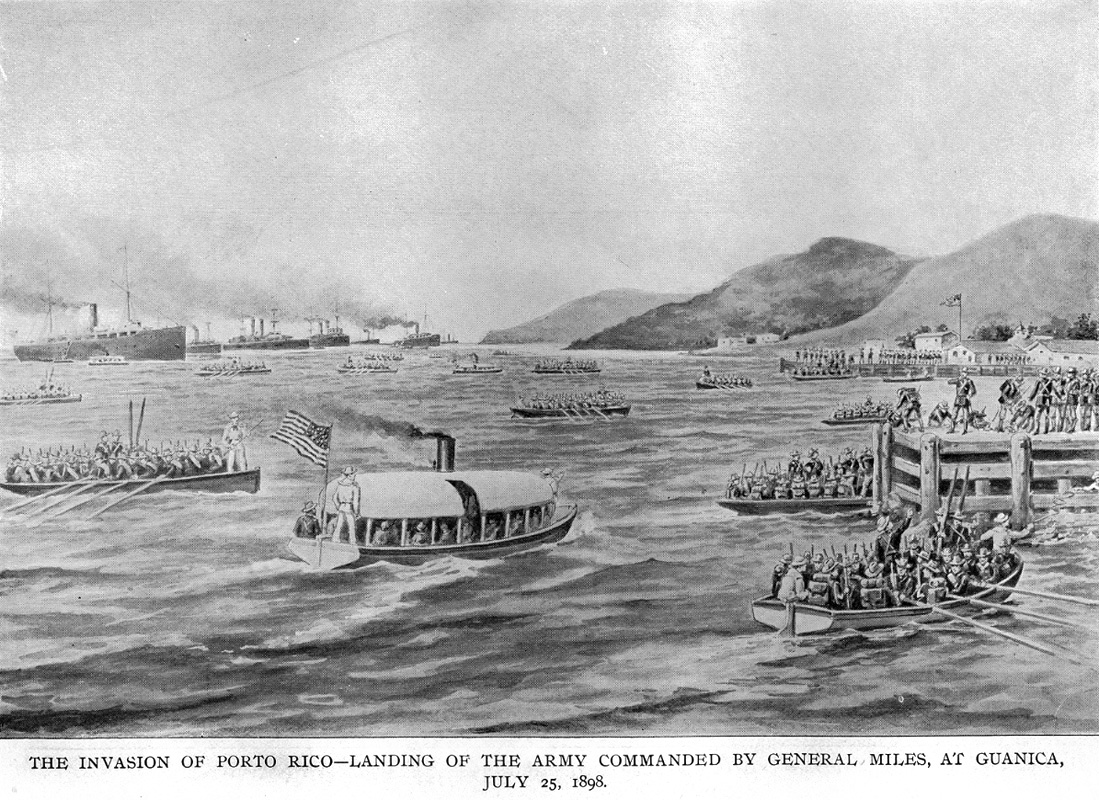
On July 25, 1898, U.S. troops under the command of Major General Nelson A. Miles landed at Guánica, a small port town on the southern coast. The landing was met with minimal resistance. From there, the American forces advanced inland, encountering scattered skirmishes with Spanish troops. The campaign was characterized by the superior organization and firepower of the U.S. military. While the Spanish defenders fought bravely in some instances, they were largely outnumbered and outmatched. The advance was not a slow, arduous conquest but rather a rapid occupation, with American forces moving towards key strategic locations across the island.
Puerto Rican Reactions and Expectations
The arrival of the U.S. forces was met with a complex mix of reactions among the Puerto Rican population. Some saw the Americans as liberators, hopeful that this new power would usher in an era of political and economic reform, potentially leading to self-governance or even statehood. There were certainly elements within Puerto Rico that had been advocating for greater autonomy and had looked to the United States as a potential ally against Spanish rule. Others, however, remained wary of any foreign power and harbored nationalist sentiments that favored complete independence. The transition from Spanish to American rule was not universally welcomed with open arms, and the future remained uncertain for many.
The End of Hostilities and the Treaty of Paris
The Spanish-American War concluded with an armistice on August 12, 1898, and a formal peace treaty, the Treaty of Paris, was signed on December 10, 1898. This treaty officially ended the war and, most significantly for Puerto Rico, stipulated that Spain would cede Cuba, Guam, and Puerto Rico to the United States. In exchange, the United States paid Spain $20 million for the Philippines. This treaty marked the formal transfer of sovereignty and the beginning of the U.S. colonial administration of Puerto Rico.
The Treaty of Paris and the Forging of a New Relationship
The Treaty of Paris was the legal instrument that formalized the United States’ acquisition of Puerto Rico. While the war provided the military means, the treaty provided the diplomatic and legal basis for the transfer of sovereignty. This marked the end of over 400 years of Spanish rule and the commencement of a new, complex chapter in the island’s history as a territory of the United States.
Provisions of the Treaty
The terms of the Treaty of Paris were definitive regarding the status of Puerto Rico. Spain relinquished all claims of sovereignty over the island, and the United States gained full control. The treaty did not grant Puerto Rico independence, nor did it immediately establish a clear path to statehood. Instead, it placed the island under the authority of the U.S. Congress, which would determine its future governance and political status. This left the question of Puerto Rico’s ultimate destiny open-ended.
The Foraker Act and Early Governance
Following the ratification of the Treaty of Paris, the U.S. Congress enacted the Foraker Act (officially the Organic Act of 1900). This legislation established a civilian government for Puerto Rico and defined its territorial status. The Act declared that Puerto Rico was an unincorporated territory, meaning that the U.S. Constitution did not fully apply to the island unless specifically extended by Congress. The governor and other high-ranking officials were appointed by the U.S. President, and while a local legislature was established, its powers were significantly limited. This marked the beginning of a period of direct U.S. administration, often characterized by a paternalistic approach and a focus on integrating the island into the U.S. economic system.
The Path to Citizenship and Commonwealth Status
The relationship between the United States and Puerto Rico continued to evolve over the following decades. A significant milestone was the passage of the Jones-Shafroth Act in 1917, which granted statutory U.S. citizenship to Puerto Ricans. This was a crucial development, though it did not grant full political rights such as the right to vote in U.S. presidential elections or representation in Congress with voting power. Later, in 1952, following a period of internal self-governance development, Puerto Rico adopted its own constitution and established a commonwealth relationship with the United States, known as Estado Libre Asociado. This status has remained a subject of ongoing debate and aspiration for various political factions on the island, with calls for statehood, independence, or the continuation of the commonwealth status in different forms.
Legacy and Ongoing Debates
The acquisition of Puerto Rico by the United States remains a pivotal event with lasting repercussions. The island’s journey from a Spanish colony to a U.S. territory has shaped its culture, economy, and political identity in profound ways. The legacy of this historical transition continues to be a source of discussion and aspiration among Puerto Ricans and policymakers alike.
Economic and Cultural Transformation
Under U.S. administration, Puerto Rico experienced significant economic changes. U.S. investment and policies aimed at industrialization, particularly through programs like Operation Bootstrap in the mid-20th century, transformed the island’s economy from one largely based on agriculture to a more diversified manufacturing and service-based sector. However, this development also led to new economic challenges, including dependence on external markets and fluctuating employment rates. Culturally, the influence of the United States has been considerable, with the English language, American media, and consumer culture becoming increasingly prevalent, coexisting with and influencing the island’s vibrant Spanish and Taíno heritage.
The Question of Self-Determination
The political status of Puerto Rico has been a persistent and complex issue since 1898. The island’s residents are U.S. citizens but lack full political representation and the right to vote in presidential elections. This has fueled ongoing movements and referendums advocating for different forms of self-determination: statehood, independence, or an enhanced commonwealth status. Each option presents its own set of potential benefits and challenges, and the debate is deeply intertwined with Puerto Rico’s economic viability, cultural preservation, and its relationship with the United States. The historical act of acquisition by the U.S. continues to inform these contemporary discussions.

Historical Echoes in Present-Day Puerto Rico
The historical context of how Puerto Rico became a U.S. territory is not merely an academic exercise; it has tangible implications for the island today. Understanding the Spanish-American War, the Treaty of Paris, and the subsequent U.S. governance reveals the roots of many of the island’s current challenges and opportunities. Landmarks such as the forts in San Juan serve as physical reminders of its colonial past, while the ongoing dialogue about its political future reflects the enduring impact of its acquisition. The story of Puerto Rico is a testament to the complex and often contentious nature of imperial expansion and its long-lasting consequences for the populations involved.
LifeOutOfTheBox is a participant in the Amazon Services LLC Associates Program, an affiliate advertising program designed to provide a means for sites to earn advertising fees by advertising and linking to Amazon.com. Amazon, the Amazon logo, AmazonSupply, and the AmazonSupply logo are trademarks of Amazon.com, Inc. or its affiliates. As an Amazon Associate we earn affiliate commissions from qualifying purchases.