
The story of how Texas became part of the United States is a complex tapestry woven with threads of exploration, revolution, diplomacy, and ultimately, annexation. It’s a narrative that significantly shaped the trajectory of both Texas and the United States, leading to the vast, diverse state we know today, a state brimming with iconic landmarks, vibrant local culture, and endless opportunities for travel and tourism. Understanding this acquisition is key to appreciating the history and spirit of Texas, from its famous places and architecture to its enduring lifestyle influences.
From Spanish Province to Mexican State
The journey of Texas into American hands began long before its eventual annexation. Initially, the territory that would become Texas was claimed by Spain. However, Spain’s hold was often tenuous, and after Mexico gained its independence from Spain in 1821, Texas became a Mexican state. This transition marked a significant shift in governance and policy.
Early American Settlements and Growing Tensions
As part of Mexico, Texas was sparsely populated by Mexicans. Recognizing the need for development and defense against Native American tribes, the Mexican government began encouraging immigration. They offered vast tracts of land to individuals known as empresarios, who were tasked with recruiting and settling colonists, primarily from the United States.
One of the most prominent empresarios was Stephen F. Austin, often hailed as the “Father of Texas.” Austin successfully brought hundreds of families to settle along the fertile lands between the Brazos and Colorado rivers. These early settlers, many of them Americans, brought with them their customs, their language, and importantly, their desire for self-governance.
However, as the American population in Texas grew, so did the cultural and political differences with Mexico. Mexico had abolished slavery in 1829, a policy that clashed directly with the economic interests of many Texan settlers, who relied on enslaved labor for their cotton plantations. Furthermore, the Mexican government’s attempts to centralize power and impose stricter regulations, including customs duties and limits on further American immigration, created significant friction. The Texans felt increasingly disconnected from the distant Mexican government in Mexico City, desiring more autonomy and control over their own affairs.
These growing tensions culminated in a series of events that would ignite the flames of revolution. Disagreements over laws, representation, and fundamental rights fueled a growing sense of separate identity among the Texans.
The Texas Revolution and Independence
The year 1835 marked a turning point. Increased military presence and perceived oppression by the Mexican government led to open rebellion. The Texan colonists, though outnumbered and outgunned, were determined to fight for their rights.
Key Battles and the Republic of Texas
The Texas Revolution was a bloody and arduous struggle. Early skirmishes, such as the Battle of Gonzales, where Texans famously defended a cannon with the slogan “Come and Take It,” signaled the beginning of hostilities. The Texans captured Goliad and San Antonio, but their victories were often hard-won and came at a great cost.
The most iconic and tragic event of the revolution was the Battle of the Alamo. In 1836, a small band of Texan defenders, including Davy Crockett and Jim Bowie, held out against a much larger Mexican army led by President Santa Anna for 13 days. Though the defenders were ultimately overwhelmed and killed, the Battle of the Alamo became a powerful symbol of Texan courage and sacrifice, galvanizing support for the independence movement. The rallying cry “Remember the Alamo!” echoed throughout Texas, fueling the resolve of the revolutionary army.
Just weeks after the fall of the Alamo, General Sam Houston led the Texan army to a decisive victory at the Battle of San Jacinto. In a swift and unexpected attack, Houston’s forces routed Santa Anna’s army, capturing the Mexican president himself and effectively ending the revolution.
On March 2, 1836, even as the fighting continued, delegates at Washington-on-the-Brazos adopted the Texas Declaration of Independence, formally severing ties with Mexico. A new nation was born: the Republic of Texas. For the next nine years, Texas existed as an independent nation, forging its own identity and seeking recognition on the world stage. This period saw the establishment of its own government, currency, and military, all while grappling with economic challenges and border disputes with Mexico.
The Road to Annexation: Diplomacy and Debate
The establishment of the Republic of Texas did not end the aspirations of many Texans to join the United States. This desire for annexation was met with considerable debate and political maneuvering on both sides.
American Interests and the Annexation Debate
For the United States, the acquisition of Texas presented a complex proposition. Proponents saw it as a significant expansion of territory, furthering the concept of “Manifest Destiny”—the belief that America was divinely ordained to expand its dominion and spread democracy across the North American continent. The fertile lands of Texas promised agricultural wealth, and its strategic location offered potential naval bases and control over important trade routes.
However, annexation was far from a done deal. The primary obstacle was the issue of slavery. Texas, like many southern states in the United States, practiced slavery. Admitting Texas as a slave state would upset the delicate balance of power between free and slave states in the U.S. Congress, a tension that was already a significant source of political strife and contributed to the growing sectionalism that would eventually lead to the Civil War.
Furthermore, Mexico had never formally recognized the independence of Texas and viewed annexation by the United States as an act of aggression. This posed a significant diplomatic challenge, as it could lead to war with Mexico.

The Joint Resolution and Texas Statehood
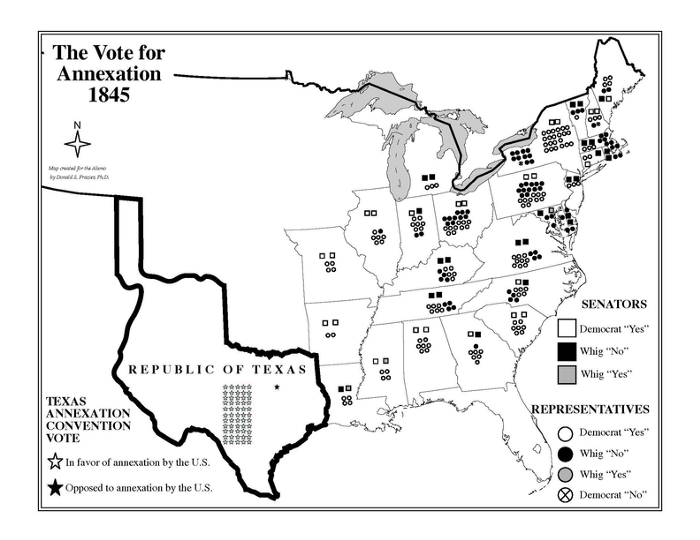
Despite the opposition, the idea of Texas annexation gained momentum. Key figures, including President James K. Polk, a strong proponent of expansion, were instrumental in pushing the agenda. In 1845, after years of debate and diplomatic wrangling, the United States Congress passed a joint resolution for the annexation of Texas.
This joint resolution offered Texas the opportunity to be admitted as a state of the Union. The Texan Congress ratified the annexation treaty on July 4, 1845, and on December 29, 1845, President Polk signed the bill admitting Texas as the 28th state. This marked the formal end of the Republic of Texas and its incorporation into the United States.
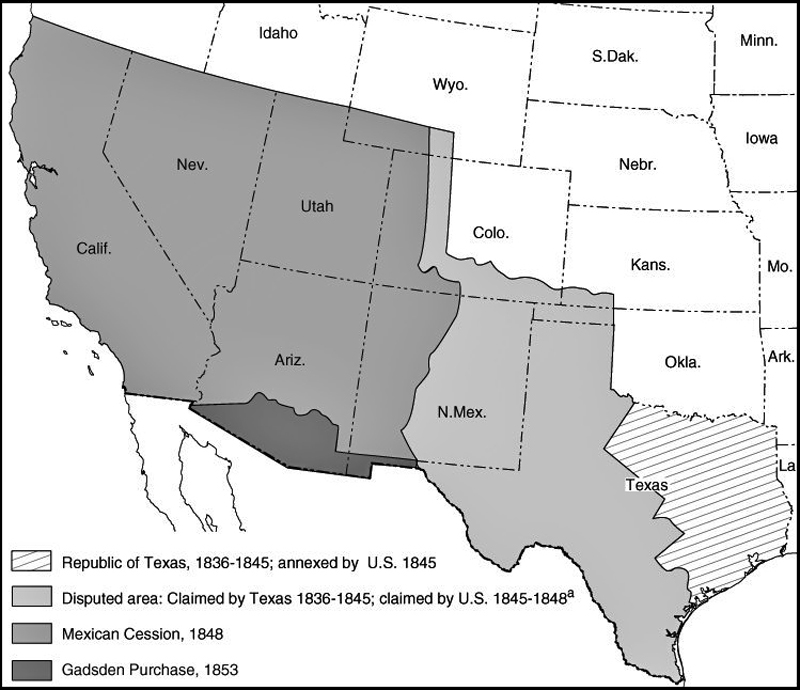
The annexation, however, did not resolve all disputes. Mexico continued to dispute the border, leading to the Mexican-American War (1846-1848). The United States’s victory in this war not only solidified its claim over Texas but also resulted in Mexico ceding a vast territory, including present-day California, Nevada, Utah, Arizona, and parts of New Mexico, Colorado, and Wyoming.
The acquisition of Texas was a pivotal moment in American history, a testament to the complex interplay of ambition, conflict, and negotiation. It significantly expanded the United States, paving the way for further westward expansion and profoundly shaping the nation’s geography, economy, and political landscape. For visitors to Texas today, from exploring its historic landmarks and vibrant cities to enjoying its diverse tourism offerings and unique lifestyle, understanding this historical acquisition adds a rich layer of appreciation to the Lone Star State. Whether one is staying in a luxurious resort, exploring the local culture, or simply enjoying the travel opportunities, the echoes of this foundational chapter in Texan and American history are ever-present.
LifeOutOfTheBox is a participant in the Amazon Services LLC Associates Program, an affiliate advertising program designed to provide a means for sites to earn advertising fees by advertising and linking to Amazon.com. Amazon, the Amazon logo, AmazonSupply, and the AmazonSupply logo are trademarks of Amazon.com, Inc. or its affiliates. As an Amazon Associate we earn affiliate commissions from qualifying purchases.