
The story of how the United States acquired California is a captivating saga, rich with exploration, imperial ambitions, cultural clashes, and geopolitical maneuvering. Today, California stands as one of the most vibrant and diverse states, a global hub for innovation, entertainment, and tourism, drawing millions to its sun-drenched beaches, majestic mountains, and bustling cities like Los Angeles and San Francisco. Its unique lifestyle, from luxury retreats in Beverly Hills to budget-friendly adventures along the Pacific Coast Highway, is a testament to its multifaceted history. But before it became the Golden State we know and love, it was a frontier land, coveted by multiple nations, each leaving an indelible mark on its landscape and culture. Understanding its journey into American hands offers profound insights not just into a pivotal moment in US history, but also into the enduring spirit of exploration and the pursuit of new destinations that continues to define travel to this day.
Early Explorations and Spanish Influence
Long before the concept of the United States even existed, California’s shores were home to diverse indigenous peoples, vibrant cultures thriving amidst bountiful natural resources. Their sophisticated societies and deep connection to the land defined the region for millennia, untouched by European presence.
First European Contact
The first European to document contact with the California coast was Juan Rodríguez Cabrillo, a Portuguese explorer sailing under the flag of Spain. In 1542, Cabrillo navigated his ships into what is now San Diego Bay, claiming the territory for the Spanish Empire. His expedition continued northward, charting much of the coastline, although the full extent of his journey remains debated among historians. This initial foray, however, was primarily for reconnaissance, as Spain’s primary focus lay in the lucrative silver mines of Mexico and the trade routes across the Pacific Ocean to the Philippines. For over two centuries, California remained largely undeveloped by Spain, a distant outpost on the fringes of its vast New World empire. Sailors occasionally stopped for supplies or shelter, but no permanent European settlements were established during this prolonged period.
The turning point came in the late 18th century, driven by strategic concerns rather than immediate economic gain. Reports of Russian fur traders expanding south from Alaska along the Pacific Coast spurred Spain into action. Fearful of losing its claim to the valuable coastal territory, the Spanish Crown dispatched an expedition to colonize Alta California (Upper California), establishing a defensive line against foreign encroachment.
Spanish Missions and Colonization
The colonization effort began in earnest in 1769 with the joint military and religious expedition led by Gaspar de Portolá and Father Junípero Serra. This ambitious undertaking aimed to establish a chain of missions and presidios (forts) along the California coast. The first mission, Mission San Diego de Alcalá, was founded in San Diego in 1769, marking the true beginning of European settlement in Alta California.
Over the next five decades, 21 missions were established, stretching from San Diego in the south to Sonoma in the north. Each mission, separated by roughly a day’s ride, served as a center for religious conversion, agricultural production, and strategic defense. Iconic landmarks such as Mission San Juan Capistrano and Mission San Carlos Borromeo de Carmelo became self-sufficient communities, developing vast ranches and vineyards, and contributing significantly to the early economy of California. The mission system, while foundational to California’s European development, also had a devastating impact on the indigenous populations, who were forcibly relocated, converted, and subjected to harsh labor and disease.
Alongside the missions, presidios were built at key strategic locations like San Diego, Monterey, San Francisco, and Santa Barbara. These military outposts provided protection for the missions and civilian settlements that slowly began to form around them, known as pueblos. These early settlements, like the Pueblo de Nuestra Señora la Reina de los Ángeles (modern-day Los Angeles) and San Jose, laid the groundwork for the major cities that would eventually dominate the state. The Spanish colonial period introduced European livestock, crops, and architectural styles that continue to influence California’s cultural landscape, making its missions popular historic sites and attractions for those interested in exploring the region’s rich past.
The Mexican Era and Seeds of Change
The grip of Spain on its New World colonies began to weaken in the early 19th century as movements for independence swept across Latin America. The vast distance and neglect from the Spanish Crown meant that Alta California had always been a remote and lightly governed province, making it particularly susceptible to the tides of change.
Mexican Independence and Governance
In 1821, after a decade-long struggle, Mexico achieved its independence from Spain, and Alta California became a northern province of the new Mexican Republic. This transition brought significant changes to California. One of the most impactful policies was the secularization of the missions in the 1830s. The immense mission lands, which had been held in trust for the indigenous populations, were largely privatized and granted to politically influential families, often former soldiers or wealthy individuals. These land grants, known as ranchos, gave rise to a powerful class of Californios (Californians of Spanish or Mexican descent) who built vast cattle empires.
The rancho era was a romanticized period characterized by large landholdings, haciendas, and a thriving hide-and-tallow trade with foreign ships, particularly from the United States and Great Britain. Cities like Monterey, which served as the capital of Alta California under both Spanish and Mexican rule, flourished as ports for this trade. The lifestyle of the Californios was distinct, a blend of traditional Spanish customs and frontier independence, still celebrated in local culture and historical reenactments across the state today. However, the Mexican government’s authority over Alta California remained relatively weak, hampered by political instability in Mexico City and the vast distances involved. Local Californio leaders, such as Mariano Guadalupe Vallejo, often held considerable de facto power.
American Interest and Manifest Destiny
Even as Mexico took control, the siren call of California’s fertile lands and strategic Pacific ports began to draw increasing attention from the United States. The concept of Manifest Destiny – the belief that the US was divinely ordained to expand across the North American continent – fueled this interest. American traders and whalers frequently visited California’s ports, fostering economic ties and sparking stories of its potential.
By the 1840s, a trickle of American settlers began to arrive overland, crossing the arduous Sierra Nevada mountains. These pioneers, often seeking new opportunities and attracted by the sparse population and abundant resources, gradually established small communities, particularly in the Sacramento Valley. Figures like John Sutter, who founded a prominent agricultural and trading post known as Sutter’s Fort near present-day Sacramento, became magnets for American immigrants.
The US government, under President James K. Polk, openly expressed its desire to acquire California and other northern Mexican territories. Offers to purchase the land were made to Mexico but were repeatedly rejected, as Mexico considered such proposals an insult to its national sovereignty. The growing presence of American settlers, combined with US geopolitical ambitions and Mexico’s inability to effectively govern or defend its distant northern territories, set the stage for an inevitable confrontation. The dream of a transcontinental nation, with access to the lucrative Pacific trade, was a powerful motivator for American expansionists, and California became the ultimate prize in this grand vision.
The Mexican-American War and Treaty of Guadalupe Hidalgo

The simmering tensions between the United States and Mexico over disputed territories, particularly Texas and California, finally erupted into open conflict, irrevocably changing the map of North America.
Rising Tensions and Conflict
The immediate trigger for the Mexican-American War was a border dispute in Texas following its annexation by the United States in 1845. However, President James K. Polk’s broader expansionist agenda, focused on acquiring California and other southwestern territories, was a core underlying cause. As diplomatic efforts to purchase California failed, Polk began to prepare for military action.
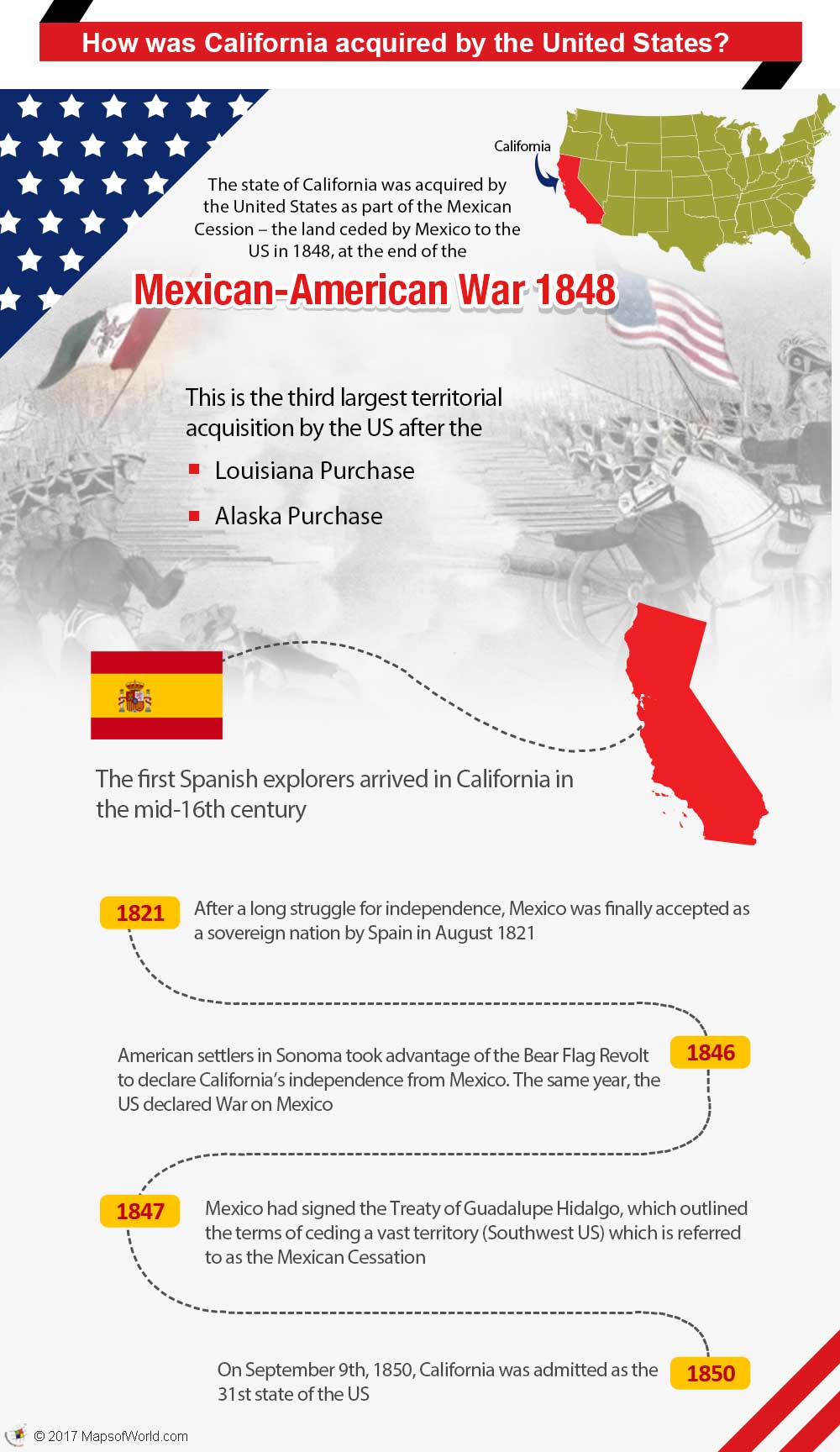
In California itself, the American settlers, encouraged by certain US agents, grew increasingly restive under Mexican rule. A significant event foreshadowing the larger conflict was the Bear Flag Revolt. In June 1846, a small group of American settlers, aided by American explorer and military officer John C. Frémont, captured the Mexican garrison at Sonoma. They declared California an independent republic and hoisted a crudely made flag featuring a grizzly bear – the iconic Bear Flag that is now part of California’s state flag. Though short-lived, as US naval forces soon arrived to claim California for the United States, the revolt demonstrated the growing American presence and their determination to separate from Mexico.
Significant Battles and American Victories
The official declaration of war between the United States and Mexico came in May 1846. In California, American forces moved swiftly. Commodore John D. Sloat of the US Pacific Squadron raised the American flag in Monterey in July 1846, effectively taking control of the provincial capital. Soon after, Commodore Robert F. Stockton and General Stephen W. Kearny’s “Army of the West,” which had marched overland from New Mexico, joined forces with Frémont’s volunteers.
The Californios, led by figures like General José Castro and Captain Andrés Pico, initially offered resistance, most notably during the Battle of San Pascual in December 1846, where Kearny’s forces suffered significant casualties. However, the superior numbers and organization of the American military, coupled with the long-standing challenges of Mexican governance in Alta California, ultimately proved insurmountable.
By January 1847, the main resistance had ended with the signing of the Treaty of Cahuenga near Los Angeles, which effectively concluded hostilities in California. The American forces had secured control over the territory, laying the groundwork for its eventual incorporation into the United States. Meanwhile, the war continued further south, with decisive American victories led by Generals Zachary Taylor and Winfield Scott culminating in the capture of Mexico City.
The Treaty and Its Aftermath
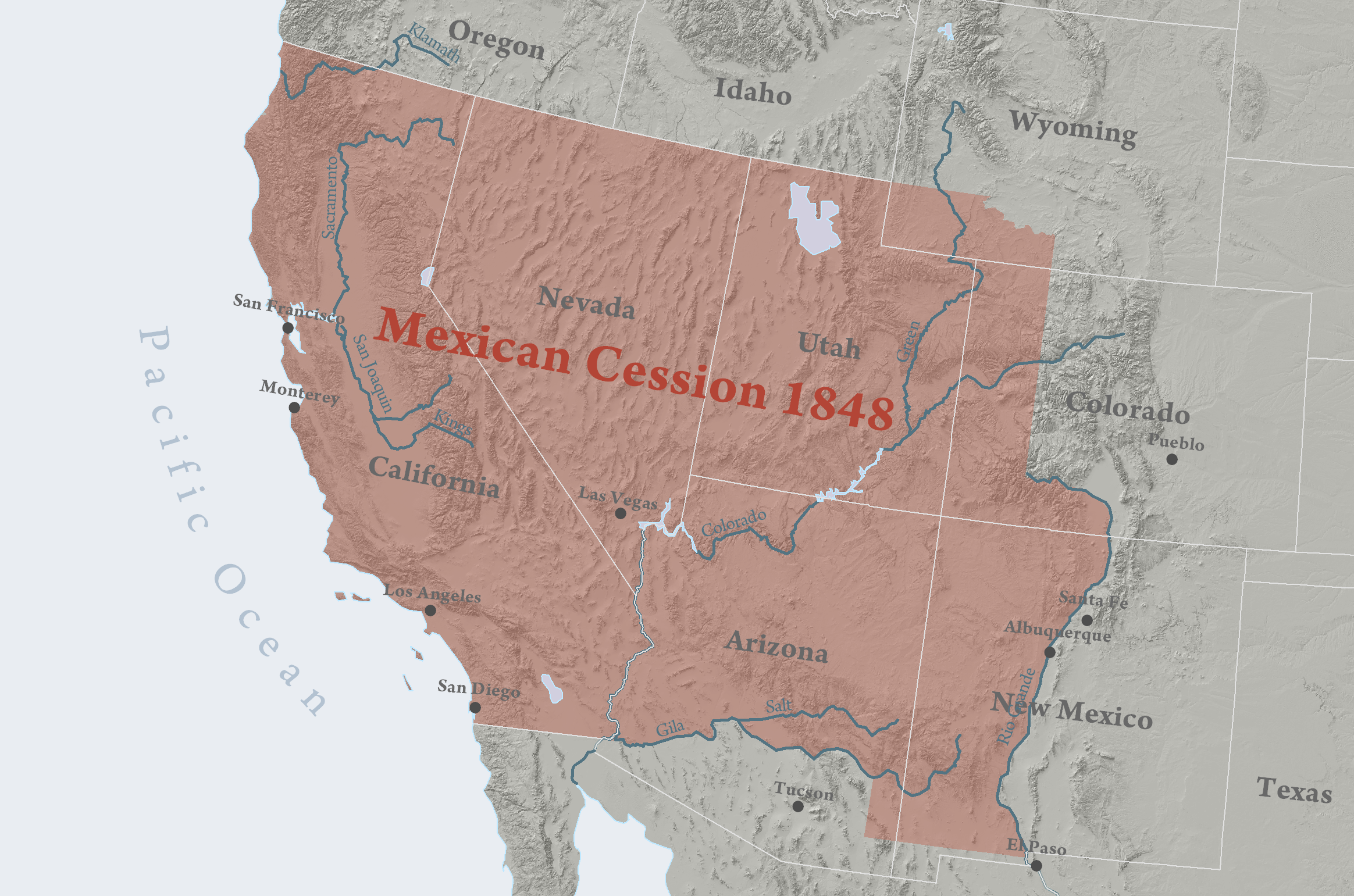
The Mexican-American War officially concluded with the signing of the Treaty of Guadalupe Hidalgo on February 2, 1848. Under the terms of this treaty, Mexico ceded vast territories, including California, Nevada, Utah, and parts of Arizona, New Mexico, Colorado, and Wyoming, to the United States. In return, the US paid Mexico $15 million and assumed about $3.25 million in claims by American citizens against Mexico.
The Treaty of Guadalupe Hidalgo dramatically reshaped the continental United States, fulfilling the vision of Manifest Destiny and granting the nation its long-sought access to the Pacific Ocean. For the Californios, the treaty granted them the option of becoming US citizens and promised to respect their property rights, though in practice, many Californios faced significant challenges in retaining their land in the face of an influx of American settlers and a changing legal system. This period of transition was tumultuous, setting the stage for the dramatic social, economic, and political transformations that were about to sweep through California.
The Gold Rush and Statehood
Just days before the signing of the Treaty of Guadalupe Hidalgo, an event occurred in California that would accelerate its trajectory towards statehood and forever change its character: the discovery of gold.
Discovery of Gold and Influx of Migrants
On January 24, 1848, James W. Marshall, while overseeing the construction of a sawmill for John Sutter at Sutter’s Mill on the American River near Coloma, spotted shining flecks in the water that proved to be gold. Initially, Sutter tried to keep the discovery a secret, fearing it would disrupt his agricultural empire. However, word spread quickly. By March, San Francisco newspapers were reporting the finds, and by late 1848, the news had reached the eastern United States and beyond.
The ensuing California Gold Rush triggered one of the largest mass migrations in human history. Prospectors, dubbed “forty-niners” after the peak year of 1849, poured into California from every corner of the globe. They came from the Eastern United States, Europe, South America, Australia, and particularly China, all seeking their fortune in the goldfields of the Sierra Nevada foothills. The journey was arduous, whether by sea around Cape Horn or across the treacherous Isthmus of Panama, or overland trails fraught with danger.
This unprecedented influx transformed California almost overnight. Sleepy towns like San Francisco, which was a small port village known as Yerba Buena before the gold rush, exploded in population, becoming a bustling cosmopolitan city. New towns, often rough-and-tumble mining camps, sprang up wherever gold was found. The demand for goods and services surged, creating immense wealth for merchants, saloonkeepers, and entrepreneurs, even more so than for many miners. The Gold Rush established California as a land of opportunity, a destination where fortunes could be made (and lost) and where people from diverse backgrounds converged, shaping a unique and dynamic culture. This era cemented California’s image as a land of dreams and innovation, a perception that continues to attract visitors and residents seeking new experiences and lifestyles.
Rapid Growth and Path to Statehood
The exponential population growth fueled by the Gold Rush quickly overwhelmed the rudimentary civil administration established by the US military after the Mexican-American War. Lawlessness was rampant in many mining districts, and there was an urgent need for stable governance, infrastructure, and legal systems. The diverse population, ranging from established Californios to recent American immigrants and a global assortment of fortune-seekers, clamored for effective representation and order.
Recognizing the urgent need for a more formal structure, the residents of California quickly organized. A constitutional convention was held in Monterey in 1849, where delegates drafted a state constitution, prohibiting slavery and outlining the framework for a new government. Despite the US Congress being deeply divided over the issue of slavery’s expansion into new territories, [California](https://lifeoutofthebox.com/california]’s unique situation and rapid development presented a compelling case for immediate statehood.
To resolve the impasse, California was admitted to the Union as a free state on September 9, 1850, as part of the Compromise of 1850. This compromise allowed California to bypass the traditional territorial phase, reflecting its extraordinary population boom and economic significance. With statehood, California solidified its place as a fully integrated part of the United States, bringing with it immense resources, a strategic Pacific coastline, and a burgeoning economy. The journey from a distant Spanish outpost to an independent Mexican province, and finally to a foundational American state, was complete, punctuated by the dramatic discovery of gold that catapulted it onto the national and international stage.
The legacy of this transformative period is still evident throughout California today. From the preserved mission sites that offer a glimpse into its Spanish colonial past, to the historic towns of the Gold Country that echo with the dreams of the forty-niners, these landmarks serve as vital attractions. Visitors can explore the well-preserved architecture of Monterey’s Old Town, walk the historic streets of San Juan Capistrano, or delve into the mining history around Sutter’s Mill. These sites not only offer educational insights into California’s complex history but also provide unique experiences for travelers interested in local culture, historical landmarks, and the diverse lifestyle that this incredible state has fostered over centuries. From luxury resorts in San Diego to charming boutique hotels near Sonoma, California’s historical journey has shaped it into a premier global destination.
LifeOutOfTheBox is a participant in the Amazon Services LLC Associates Program, an affiliate advertising program designed to provide a means for sites to earn advertising fees by advertising and linking to Amazon.com. Amazon, the Amazon logo, AmazonSupply, and the AmazonSupply logo are trademarks of Amazon.com, Inc. or its affiliates. As an Amazon Associate we earn affiliate commissions from qualifying purchases.