
The story of how the United States came to possess California is a complex tapestry woven from imperial ambition, geopolitical strategy, localized rebellion, and a monumental war. Far from a simple transaction, it was a culmination of decades of westward expansionist ideology and the ultimate collision of two distinct national interests. This acquisition fundamentally reshaped the North American continent, forever altering the course of U.S. history and the destiny of California’s diverse populations.
California’s Early History: Spanish and Mexican Rule
Before the arrival of American settlers and military forces, California had a rich and multi-layered history stretching back millennia with its indigenous inhabitants. By the 18th century, it had become a frontier province under European control.

The Era of Spanish Missions
The first European power to establish a lasting presence in California was Spain. Beginning in 1769 with the expedition of Gaspar de Portolá and the Franciscan friar Junípero Serra, a chain of twenty-one missions, presidios (forts), and pueblos (towns) was established along the coast. This colonial system, headquartered in Monterey, aimed to Christianize the native populations, exploit natural resources, and solidify Spanish claims against potential incursions from Russia and Great Britain. These missions, while architecturally significant landmarks today, fundamentally altered indigenous societies, culture, and lifeways, often with devastating consequences. Despite their efforts, Spanish control over Alta California (Upper California) remained relatively tenuous, characterized by vast distances, sparse population, and limited economic development.
Mexican Independence and Secularization
In 1821, Mexico achieved independence from Spain, and Alta California became a remote northern province of the new Mexican Republic. The Mexican government implemented a policy of secularization in the 1830s, dismantling the mission system and distributing much of their vast lands to prominent Mexican families as large ranchos. This era, known as the Rancho Period, saw the rise of a distinct Californian culture centered around cattle ranching and a hierarchical social structure. However, Mexico’s grip on California was weak. Internal political instability, a largely undefended frontier, and a growing influx of American trappers, traders, and settlers began to erode Mexican authority, setting the stage for future conflicts.
The Allure of Manifest Destiny and American Ambition
By the early 19th century, the concept of Manifest Destiny had firmly taken root in the United States. This belief held that America was divinely ordained to expand its dominion and spread democracy across the North American continent, from the Atlantic to the Pacific. California, with its vast potential and strategic location, became a primary target of this expansionist vision.
Geographic and Economic Imperatives
The acquisition of a Pacific coastline was seen as crucial for the United States’ future. Control of ports like San Francisco Bay would open lucrative trade routes with Asia and provide a strategic naval presence in the Pacific Ocean. The fertile lands of California promised agricultural wealth, while the discovery of valuable mineral resources was a persistent rumor. Furthermore, the burgeoning fur trade and the Oregon Trail had already drawn thousands of American pioneers westward, creating a continuous demand for new territories. The existence of a weakly controlled Mexican province on the Pacific coast was an irresistible temptation for a nation increasingly confident in its continental destiny.
Growing American Presence
Throughout the 1830s and 1840s, the trickle of American settlers into California became a steady stream. These immigrants, often arriving via overland routes or by sea, began to outnumber the Californios (residents of Mexican California) in certain areas, particularly in the Sacramento Valley. Many of these settlers harbored little loyalty to the Mexican government, viewing it as distant and ineffective. Their presence, often encouraged covertly by U.S. agents, created a volatile demographic shift that ultimately fueled calls for annexation or independence. Figures like Thomas O. Larkin, the U.S. consul in Monterey, played a significant role in fostering American sentiment and intelligence gathering, reporting on the political instability and vulnerability of the province to Washington.
From Rebellion to War: The Bear Flag and Mexican-American Conflicts
The escalating tensions between the United States and Mexico over Texas and other border disputes provided the opportune moment for the U.S. to seize California. Events on the ground in California quickly dovetailed with the broader national conflict.
The Bear Flag Revolt Ignites
In June 1846, even before news of the official declaration of the Mexican-American War reached California, a group of American settlers, encouraged by the enigmatic U.S. Army officer John C. Frémont, launched a preemptive strike. On June 14, 1846, they captured the Mexican garrison at Sonoma and proclaimed the independent California Republic. They hoisted a crudely fashioned flag featuring a grizzly bear and a star—the origin of California’s iconic “Bear Flag.” While short-lived, this revolt served to destabilize Mexican authority further and provide a pretext for direct American intervention. Frémont’s role in instigating the revolt remains a subject of historical debate, but his presence certainly emboldened the settlers and hastened the shift towards American control.
Naval and Land Campaigns
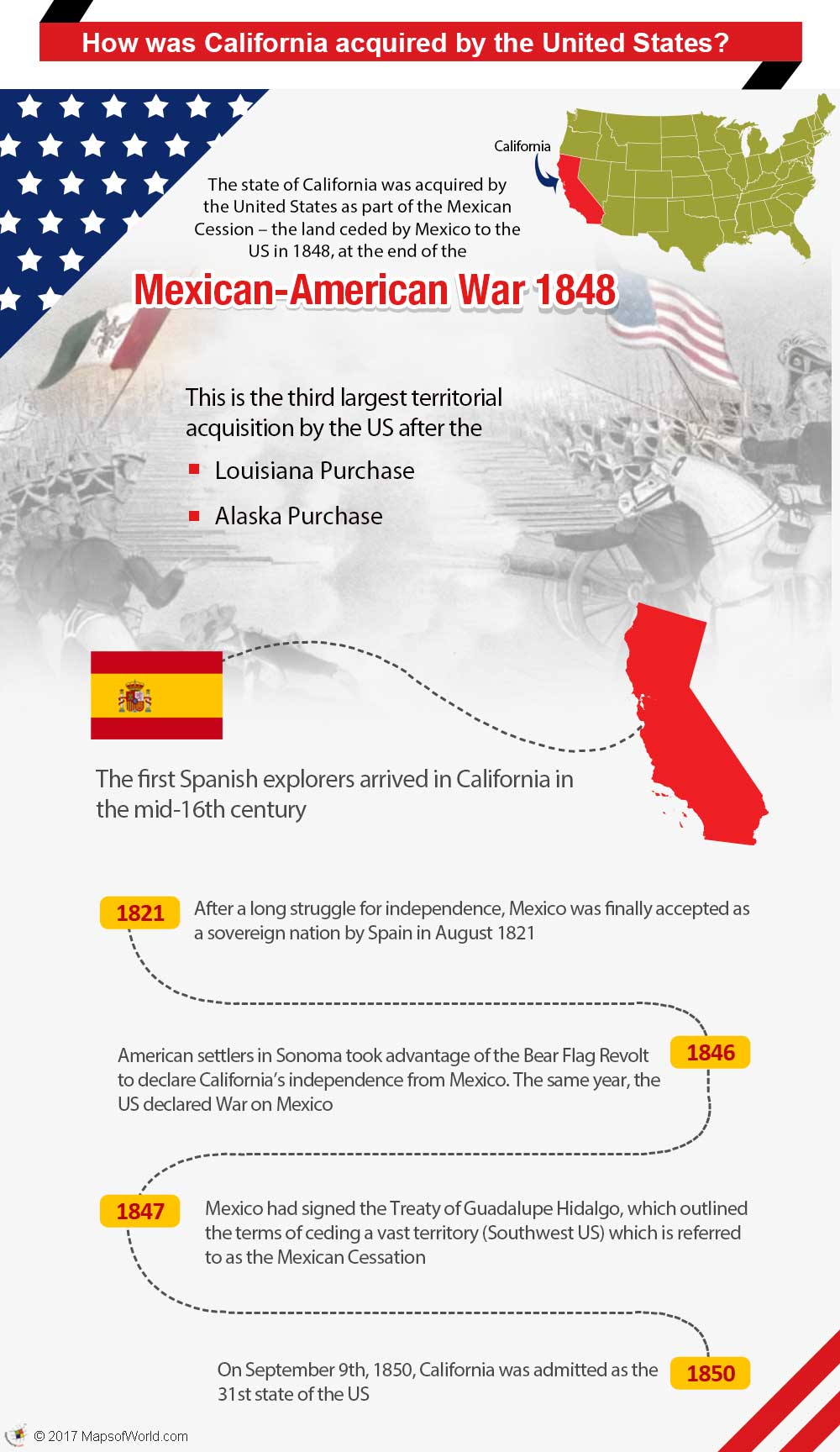
Simultaneously, the formal declaration of the Mexican-American War on May 13, 1846, brought direct military action to California. President James K. Polk, a staunch advocate of Manifest Destiny, had already dispatched orders for the Pacific Squadron to seize Californian ports in the event of war. On July 7, 1846, Commodore John D. Sloat landed marines in Monterey and raised the American flag, declaring California part of the United States. Within days, San Francisco was also secured. Stephen W. Kearny’s “Army of the West” arrived overland, linking up with forces under Robert F. Stockton and Frémont. Despite a few instances of Californio resistance, most notably at the Battle of San Pasqual and the Battles of Rio San Gabriel and La Mesa, American forces quickly established control over the major settlements. The fighting in California officially concluded with the signing of the Treaty of Cahuenga on January 13, 1847.
The Treaty of Guadalupe Hidalgo and California’s Rapid Rise
The formal transfer of California to the United States was a direct consequence of Mexico’s defeat in the larger Mexican-American War.
Terms of Cession
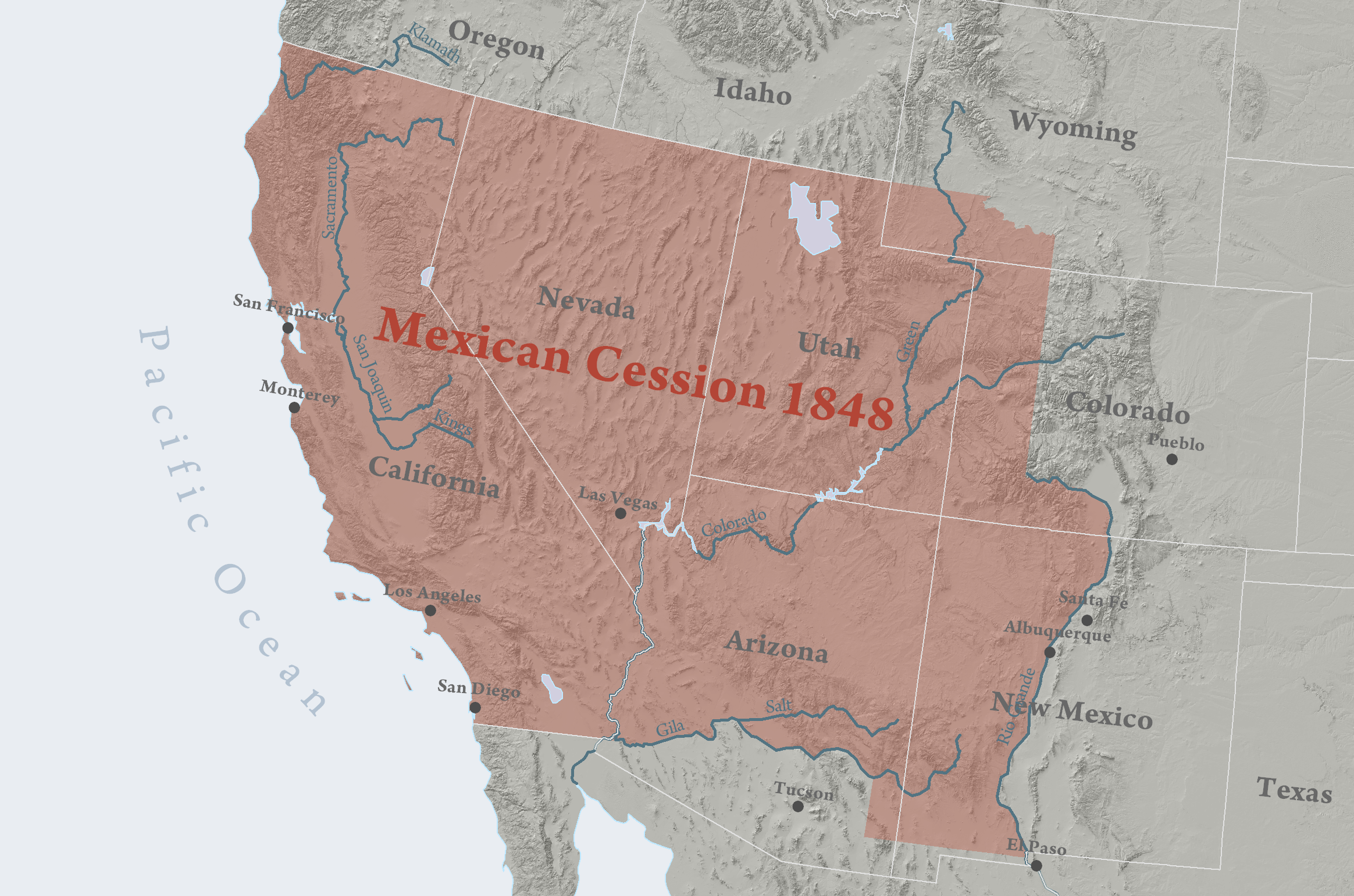
The Treaty of Guadalupe Hidalgo, signed on February 2, 1848, officially ended the war. Under its terms, Mexico ceded vast territories—approximately 525,000 square miles—to the United States for $15 million. This massive land transfer, known as the Mexican Cession, included all of present-day California, Nevada, Utah, and parts of Arizona, New Mexico, Colorado, and Wyoming. The treaty also established the Rio Grande as the boundary between Texas and Mexico. For the United States, this treaty fulfilled the ultimate ambition of Manifest Destiny, extending the nation’s reach to the Pacific Ocean and securing an immense new frontier for settlement and resource exploitation.
The Gold Rush and Statehood
Remarkably, just nine days before the Treaty of Guadalupe Hidalgo was signed, James W. Marshall discovered gold at Sutter’s Mill on January 24, 1848. News of the discovery triggered the legendary California Gold Rush, an event that would profoundly accelerate the integration of California into the United States. Hundreds of thousands of prospectors, adventurers, and entrepreneurs from across the globe flocked to California, swelling its population almost overnight. This massive influx of people, coupled with the immense wealth being generated, necessitated the rapid establishment of governmental structures. Within just two years of its formal acquisition, and largely due to the unique circumstances created by the Gold Rush, California was admitted to the Union as the 31st state on September 9, 1850, as part of the Compromise of 1850. This quick transition from a remote Mexican province to a vibrant American state underscores the dramatic and multifaceted process by which California became an integral part of the United States.
LifeOutOfTheBox is a participant in the Amazon Services LLC Associates Program, an affiliate advertising program designed to provide a means for sites to earn advertising fees by advertising and linking to Amazon.com. Amazon, the Amazon logo, AmazonSupply, and the AmazonSupply logo are trademarks of Amazon.com, Inc. or its affiliates. As an Amazon Associate we earn affiliate commissions from qualifying purchases.