
The story of how the United States acquired Hawaii is a complex tapestry woven with threads of economic interest, political maneuvering, and ultimately, military force. It’s a narrative that begins not with an outright invasion, but with a gradual entanglement that ultimately led to the overthrow of a sovereign nation and its annexation. For travelers drawn to the aloha spirit and the breathtaking landscapes of the Hawaiian Islands, understanding this history offers a deeper appreciation for the destination and the resilient spirit of its people.
The Hawaiian Islands, a chain of volcanic islands in the Pacific Ocean, were once an independent kingdom, a thriving Polynesian society with its own rich culture, traditions, and governance. For centuries, these islands remained isolated, developing a unique identity. However, with the arrival of European and American explorers and missionaries in the late 18th and early 19th centuries, Hawaii’s destiny began to shift.
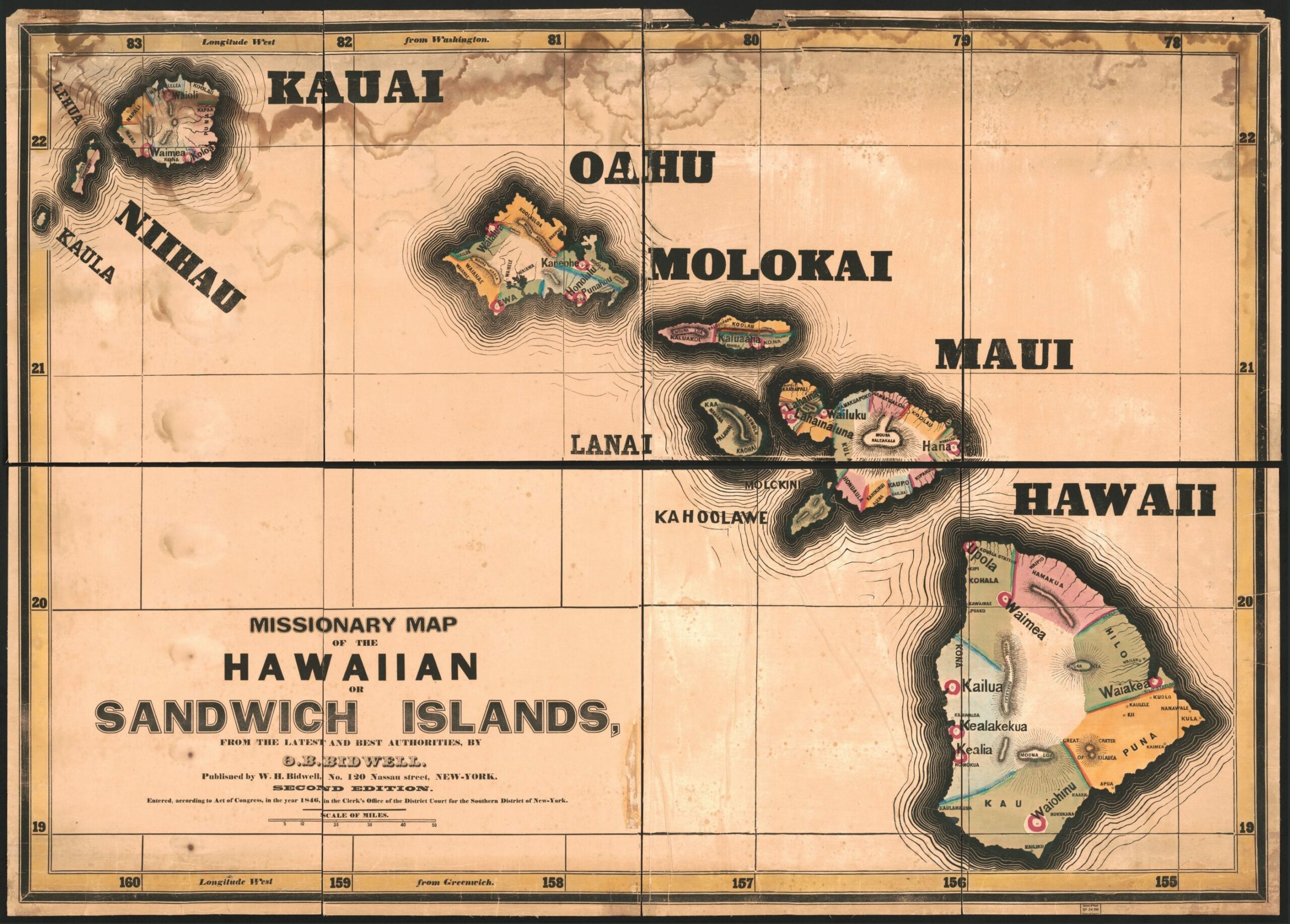
The Seeds of American Influence: Trade, Missionaries, and Economic Entanglements
The initial American presence in Hawaii was largely driven by trade and religious fervor. Whaling ships, en route to the Arctic, found Hawaii a vital refueling and provisioning stop. This brought American sailors and merchants into contact with the native population, fostering trade relationships.
The Rise of Sugar and the Economic Imperative
By the mid-19th century, the economic landscape of Hawaii was dramatically reshaped by the burgeoning sugar industry. American businessmen, often associated with missionary families, began establishing large sugar plantations. The fertile volcanic soil and favorable climate proved ideal for sugarcane cultivation. This influx of capital and enterprise, however, came with a significant cost to the native Hawaiians.
The economic power of these American businessmen grew exponentially, and with it, their political influence. They began to advocate for policies that would benefit their businesses, often at the expense of native Hawaiian interests. The Reciprocity Treaty of 1875 between the United States and the Kingdom of Hawaii was a pivotal moment. This treaty allowed Hawaiian sugar to enter the United States duty-free, a tremendous boon for the plantation owners. In return, the United States secured exclusive rights to use Pearl Harbor as a naval base. This agreement solidified American economic dominance and established a crucial military foothold in the strategically important archipelago.
The terms of the treaty, while economically beneficial to the American planters, were detrimental to the Hawaiian monarchy and its people. It further entrenched the dependence of the Hawaiian economy on the United States and increased the power of foreign business interests. Land ownership laws were also altered, making it easier for foreigners to acquire vast tracts of land for plantations. This led to a significant decline in native Hawaiian land ownership and a disruption of traditional agricultural practices.
The Missionary Legacy and Cultural Impact
Alongside economic interests, American missionaries played a significant role in shaping Hawaii’s trajectory. Arriving in the early 19th century, they sought to convert the native population to Christianity. While their intentions were ostensibly religious, their actions had profound cultural and social consequences. The missionaries established schools, introducing Western education and languages. They translated the Bible into the Hawaiian language, but in doing so, also contributed to the marginalization of traditional Hawaiian beliefs and practices.
Over time, the missionary families became deeply integrated into Hawaiian society, often intermarrying with the aliʻi (chiefs) and accumulating considerable wealth and influence. Their descendants would become key figures in the business and political elite that eventually sought annexation by the United States. This intertwining of religious, economic, and social power created a fertile ground for future political action.
The Downfall of the Monarchy: Revolution and Annexation
As American influence deepened, the native Hawaiian monarchy found itself increasingly constrained. The reigning monarchs, particularly Queen Liliuokalani, recognized the growing threat to Hawaiian sovereignty and sought to restore power to the native people and curb foreign influence.
Queen Liliuokalani’s Attempt to Restore Power
In 1893, Queen Liliuokalani ascended to the throne. She harbored a deep love for her people and a strong desire to protect their heritage. One of her first acts was to propose a new constitution that would disenfranchise the foreign elite and restore voting rights to native Hawaiians. This move was seen as a direct threat by the powerful American businessmen and their allies, who had come to dominate the political and economic landscape.
The Queen’s efforts to revise the constitution were met with fierce opposition. A group of predominantly American businessmen, known as the Committee of Safety, saw her actions as an insurmountable obstacle to their ambitions. They feared losing their economic and political dominance.
The Overthrow of the Monarchy
With the backing of American Minister to Hawaii John L. Stevens, and with the tacit support of the United States military, the Committee of Safety orchestrated a coup. On January 17, 1893, the monarchy was overthrown. The United States military, ostensibly present to protect American lives and property, landed troops from the USS Boston, effectively lending military force to the coup.
This act of overthrow was controversial from the outset. The provisional government established after the coup was composed almost entirely of American businessmen. They immediately began lobbying the United States government for annexation.
President Grover Cleveland, upon learning of the events in Hawaii, sent a special investigator, James H. Blount, to assess the situation. Blount’s report concluded that the United States had acted improperly and that the overthrow was orchestrated by American citizens. President Cleveland publicly condemned the annexationist movement and attempted to restore Queen Liliuokalani to her throne. However, his efforts were ultimately unsuccessful due to the strong influence of pro-annexation forces in the United States Congress.
The Path to Statehood: From Republic to Territory to State
Despite President Cleveland’s opposition, the pro-annexation forces persisted. The Spanish-American War in 1898 provided a critical turning point, highlighting Hawaii’s strategic importance as a coaling station and naval base for the United States in the Pacific.
Annexation in 1898
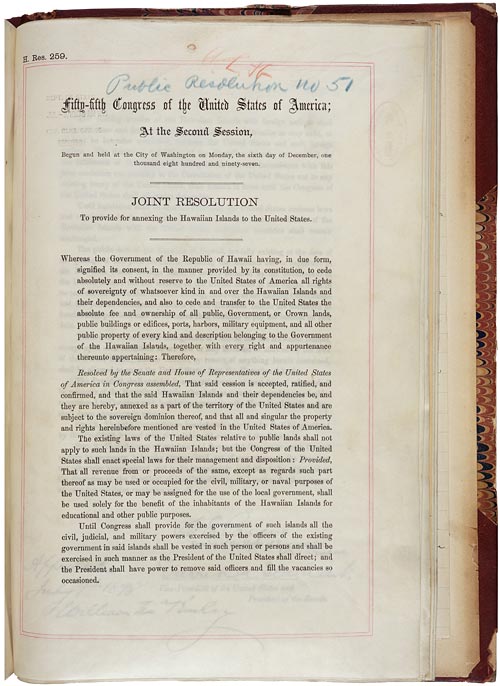
With the political climate shifting in favor of expansionism, the United States annexed Hawaii on July 7, 1898, through the Newlands Resolution. This resolution was passed by Congress, despite a petition signed by over 21,000 native Hawaiians protesting annexation. The Republic of Hawaii, established by the coup leaders, ceased to exist, and the islands became a territory of the United States.
The annexation was met with mixed reactions. For the American business elite, it was the culmination of decades of effort. For native Hawaiians, it was a tragic loss of sovereignty and a betrayal of their right to self-determination. The unique cultural identity of Hawaii faced further challenges as American laws and customs were imposed.

From Territory to Statehood
For nearly six decades, Hawaii remained a U.S. territory. During this time, the islands continued to develop economically, heavily reliant on agriculture, particularly sugar and pineapple. The strategic importance of Hawaii was further underscored by its role in World War II, culminating in the attack on Pearl Harbor.
The desire for statehood grew over the years, fueled by a combination of factors, including the islands’ significant contributions to the United States during wartime and a growing recognition of the inequities of territorial status. Native Hawaiians, while still grappling with the legacy of annexation, also participated in the movement for statehood, hoping it would grant them greater political representation and rights.
Finally, on August 21, 1959, Hawaii was admitted to the Union as the 50th state. This marked the official end of Hawaii’s colonial past and its transformation into an integral part of the United States.
Today, Hawaii is a vibrant melting pot of cultures, a testament to the resilience of its native people and the diverse influences that have shaped its history. For travelers, visiting Hawaii offers an opportunity to experience its stunning natural beauty, from the dramatic cliffs of the Na Pali Coast to the volcanic landscapes of Volcanoes National Park, and to engage with its rich cultural heritage, a legacy of a proud kingdom that once stood independently. Understanding the complex history of its acquisition adds a profound layer to any journey to these enchanting islands, reminding us that paradise is built on a foundation of intricate historical events.
LifeOutOfTheBox is a participant in the Amazon Services LLC Associates Program, an affiliate advertising program designed to provide a means for sites to earn advertising fees by advertising and linking to Amazon.com. Amazon, the Amazon logo, AmazonSupply, and the AmazonSupply logo are trademarks of Amazon.com, Inc. or its affiliates. As an Amazon Associate we earn affiliate commissions from qualifying purchases.