
The story of how the United States came to acquire Puerto Rico is a fascinating chapter in both American and Puerto Rican history, deeply intertwined with global power shifts, military conflict, and the evolving political landscape of the late 19th century. Far from a simple land grab, the annexation of Puerto Rico was a consequence of the Spanish-American War, a pivotal event that reshaped the geopolitical map and marked the emergence of the United States as a major world power. Understanding this acquisition requires delving into the context of the war, the treaty that sealed the deal, and the initial period of American governance.

The acquisition of Puerto Rico was not a pre-meditated strategic goal for the United States at the outset of the Spanish-American War. Instead, it emerged as a significant territorial gain during the conflict, alongside other former Spanish colonies like Cuba and Guam. The war itself was ignited by a complex mix of humanitarian concerns, nationalistic fervor, and economic interests, all largely focused on the plight of Cuba, which had been struggling for its independence from Spain for decades.
The Spanish-American War: A Catalyst for Acquisition
The late 1890s saw increasing unrest in Cuba as nationalist rebels fought for liberation from Spanish rule. The brutal tactics employed by the Spanish military, including the establishment of reconcentration camps where thousands of Cubans perished from disease and starvation, captured the attention and outrage of the American public and press. Sensationalized reporting, often referred to as “yellow journalism,” by newspapers like William Randolph Hearst’s New York Journal and Joseph Pulitzer’s New York World, fueled anti-Spanish sentiment and called for American intervention.
Adding to the tinderbox atmosphere was the mysterious explosion and sinking of the U.S.S. Maine in Havana harbor on February 15, 1898. While the cause of the explosion remains debated to this day, the American public, swayed by the press, largely blamed Spain. This incident became the immediate pretext for war. On April 25, 1898, the United States declared war on Spain, initiating a conflict that would be remarkably swift and decisive for the Americans.
The Caribbean Front: Battles and Strategic Shifts
The Spanish-American War was fought on two main fronts: in the Caribbean and in the Pacific. In the Caribbean, the U.S. Navy quickly established dominance, blockading Spanish ports and engaging Spanish fleets. The land campaign in Cuba, though not without its challenges and infamous moments like the charge of the Rough Riders at San Juan Hill, ultimately led to the surrender of Spanish forces.
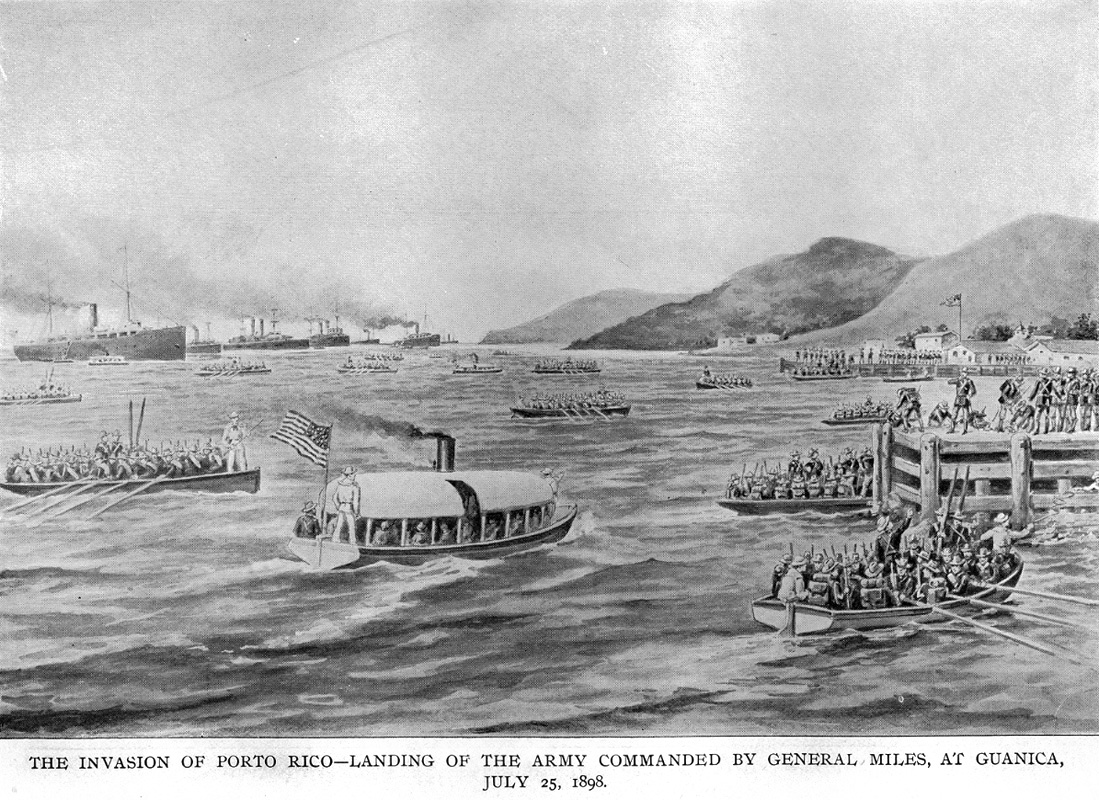
It was during these military operations that Puerto Rico entered the American strategic calculus. On July 25, 1898, U.S. forces, under the command of Major General Nelson A. Miles, landed on the southern coast of Puerto Rico near Ponce. The American invasion was met with relatively little resistance from the Spanish forces, who were already demoralized and stretched thin by the war. The Puerto Rican population, for the most part, viewed the Americans as liberators from Spanish colonial rule, which had been characterized by economic exploitation and political marginalization. The initial welcome for the U.S. troops was often enthusiastic, with many Puerto Ricans hoping for greater autonomy and prosperity under the new administration.
The military campaign in Puerto Rico was brief, lasting only a few weeks before an armistice was declared on August 12, 1898. The island’s capture, along with Cuba and Guam, solidified American military success and significantly boosted the nation’s prestige on the world stage. The strategic implications of controlling these territories, particularly Puerto Rico with its deep natural harbors, were quickly recognized by American policymakers.
The Treaty of Paris: Formalizing the Acquisition
The formal end of the Spanish-American War came with the signing of the Treaty of Paris on December 10, 1898. This treaty, negotiated in Paris, France, dictated the terms of Spain‘s surrender and the transfer of its remaining colonies. The United States, represented by a commission that included prominent figures like Secretary of State John Hay and former Senator George Gray, negotiated from a position of overwhelming strength.
The Treaty of Paris was a landmark agreement with profound consequences for the territories involved. Under its terms, Spain ceded Cuba, Puerto Rico, and Guam to the United States. In return for Guam and Puerto Rico, the United States agreed to pay Spain a sum of $20 million. The fate of Cuba was more nuanced; while Spain relinquished all claim to the island, it was not directly annexed by the United States but rather placed under a period of military occupation and governance before eventually gaining nominal independence, albeit with significant American influence.
For Puerto Rico, the Treaty of Paris marked the end of over 400 years of Spanish colonial rule and the beginning of a new, albeit complex, relationship with the United States. The treaty did not grant Puerto Ricans full citizenship or immediate self-governance. Instead, it established Puerto Rico as an unincorporated territory of the United States, meaning that the U.S. Constitution did not automatically apply in its entirety to the island. This distinction would have long-lasting implications for Puerto Rico‘s legal status, political rights, and economic development.
The acquisition of Puerto Rico was part of a broader imperialistic trend that saw the United States expanding its influence and territorial holdings across the globe. While some Americans lauded this expansion as a fulfillment of Manifest Destiny, others expressed concerns about the implications of governing overseas populations and the potential for colonial exploitation. The debate over America‘s role as a colonial power was intense, but the strategic and economic advantages of acquiring these new territories ultimately prevailed.

Early American Governance and the Foraker Act
Following the ratification of the Treaty of Paris, the United States began establishing its governance over Puerto Rico. The initial period was characterized by military rule, overseen by U.S. governors. However, it quickly became clear that a more formal legal framework was needed to define the relationship between the island and the mainland.
This led to the passage of the Foraker Act (also known as the Organic Act of 1900) by the U.S. Congress in 1900. The Foraker Act officially established a civilian government in Puerto Rico and formally defined the island’s status as an unincorporated territory. Under the Foraker Act, Puerto Rico was granted a governor appointed by the U.S. President, a legislative assembly with both appointed and elected members, and a judicial system. Crucially, it also established a unique economic relationship, making Puerto Rico a customs territory of the United States, which meant that goods could move freely between the island and the mainland without tariffs.
While the Foraker Act provided a structure for governance, it was often criticized for limiting Puerto Rican self-determination. The appointed governor and the U.S. President’s power to veto legislation passed by the Puerto Rican assembly meant that ultimate authority rested with Washington. Furthermore, Puerto Ricans were not granted full U.S. citizenship until 1917, with the passage of the Jones-Shafroth Act.
The early years of American administration also saw significant changes in Puerto Rico‘s economy and social structure. American investment flowed into the island, particularly in the sugar industry, leading to increased production but also to the concentration of land ownership in the hands of a few large corporations. While some aspects of life improved, such as public health initiatives and the development of infrastructure, the colonial relationship and the economic policies implemented often favored American interests over those of the Puerto Rican people.
The acquisition of Puerto Rico by the United States was a pivotal moment, born out of war and formalized by treaty. It marked the beginning of a complex and enduring relationship that continues to shape the identity and future of the island today. For travelers, understanding this history adds a deeper layer to appreciating the vibrant culture, stunning landscapes, and unique heritage of Puerto Rico, a destination rich in history and natural beauty, from the historic streets of Old San Juan to the lush rainforests of El Yunque. Whether you’re exploring ancient fortifications or relaxing on pristine beaches, the echoes of this historical acquisition are palpable, offering a profound glimpse into the island’s journey.
LifeOutOfTheBox is a participant in the Amazon Services LLC Associates Program, an affiliate advertising program designed to provide a means for sites to earn advertising fees by advertising and linking to Amazon.com. Amazon, the Amazon logo, AmazonSupply, and the AmazonSupply logo are trademarks of Amazon.com, Inc. or its affiliates. As an Amazon Associate we earn affiliate commissions from qualifying purchases.