
A legal name change in Florida is a significant life event that can stem from various personal circumstances, from marriage and divorce to personal preference or gender affirmation. While the process may seem daunting, understanding the specific steps and requirements can demystify the journey, allowing individuals to navigate this important transition with clarity and confidence. Changing one’s name legally impacts every facet of identity, from official documents to daily interactions, making it a crucial aspect of personal lifestyle management. This comprehensive guide outlines the procedural requirements for an adult seeking a legal name change in the Sunshine State.

Understanding the Legal Landscape for Name Changes in Florida
The process for legally changing your name in Florida typically involves petitioning a circuit court. Unlike simpler administrative changes that occur with marriage or divorce decrees, a change for personal preference requires a formal court order. This judicial oversight ensures the integrity of public records and prevents fraudulent activities. It is a civil action that requires adherence to specific legal protocols and forms, primarily governed by Florida Statutes.
Who Can Petition for a Name Change?
Any adult resident of Florida can petition for a name change, provided they meet certain criteria. Minors have a slightly different process, usually requiring parental consent and often involving a guardian ad litem. For adults, the primary requirements include:
- Residency: You must be a bona fide resident of the county in Florida where you file your petition.
- No Intent to Defraud: The court will scrutinize petitions to ensure the name change is not intended to defraud creditors, escape criminal prosecution, or for any other unlawful purpose.
- Clear Justification (Optional but Recommended): While not always legally required to state a reason, having a clear and legitimate reason can facilitate the court’s approval process. Common reasons include personal preference, aligning a name with gender identity, or simply disliking one’s given name.
Exclusions and Considerations
It’s important to note that certain individuals may face additional hurdles or be unable to change their name through this process. For instance, registered sex offenders or individuals with pending criminal charges might have their petitions denied or face stricter scrutiny. Individuals seeking a name change due to marriage or divorce generally follow a simplified administrative process through their marriage certificate or divorce decree, which automatically allows for updating identity documents. However, if the desired new name differs from the name on those certificates, a separate court petition will be necessary.
Initiating Your Name Change Petition
The first substantive step in legally changing your name in Florida is to prepare and file a Petition for Change of Name. This document formally requests the court to issue an order recognizing your desired new name.
Gathering Necessary Information
Before drafting your petition, compile all relevant personal information. This typically includes:
- Your current full legal name.
- Your desired full legal name.
- Your date and place of birth.
- Your current address and how long you’ve resided in Florida and your current county.
- The names of your parents.
- Any previous names you have used.
- A statement affirming you are not seeking the name change for fraudulent purposes.
- Details of any past criminal convictions or judgments (if applicable).
- Whether you have any outstanding warrants or bankruptcy proceedings.
Completing the Petition Forms
The Florida Courts provide standardized forms for name changes, usually available on the website of the Clerk of the Court for your specific county. These forms are typically styled as “Petition for Change of Name (Adult).” Carefully fill out all sections, ensuring accuracy and completeness. Any errors or omissions can lead to delays or rejection. It is crucial to use your full, proper legal name as it currently appears on official documents.
Filing the Petition
Once completed, the petition must be filed with the Clerk of the Court in the circuit court of the county where you reside. At the time of filing, you will be required to pay a filing fee. These fees vary by county and are subject to change, so it’s advisable to check the current fee schedule with your local Clerk of the Court’s office. If you are unable to afford the filing fee, you may be eligible to file a “Motion to Defer Payment of Filing Fees,” also known as an indigency application.
The Crucial Role of Background Checks and Fingerprinting
A mandatory component of the adult name change process in Florida is a criminal background check. This step is critical to ensure that individuals are not attempting to change their name to evade legal obligations or criminal records.
Fingerprinting Requirements
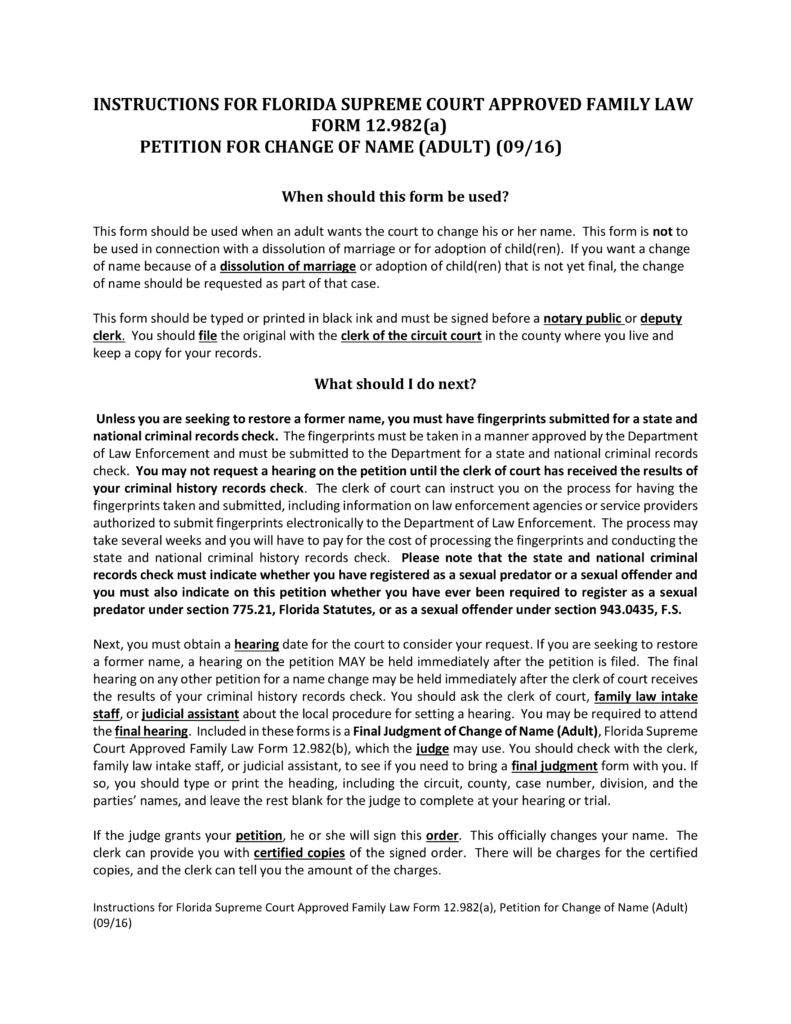
Upon filing your petition, the court will typically issue an order requiring you to undergo fingerprinting. You must obtain a set of fingerprints from a law enforcement agency or an authorized private vendor. The fingerprints are then submitted to the Florida Department of Law Enforcement (FDLE) and potentially the Federal Bureau of Investigation (FBI) for a comprehensive criminal history check.
Understanding the Background Check Process
The results of the background check are usually sent directly to the court. This report will indicate any past arrests, convictions, or other relevant criminal history. The court reviews this information to assess if there are any legal impediments to granting your name change. The time it takes to process fingerprints and receive the background report can vary, often being the most time-consuming part of the pre-hearing phase. It’s essential to complete this step promptly after filing your petition to avoid unnecessary delays.
The Court Hearing and Finalizing the Order
After the petition is filed, and the background check results are received, the court will schedule a hearing. This is a critical juncture where the judge reviews your petition and ultimately decides whether to grant your request.
Attending the Hearing
You are generally required to attend the hearing. During the hearing, the judge may ask you questions about your petition, your reasons for the name change, and confirm that you understand the implications of the change. It’s an opportunity for the court to ensure your motivations are legitimate and that granting the name change is in the public interest. While usually straightforward, it is important to be prepared to answer truthfully and confidently.
The Order Granting Name Change
If the judge approves your petition, they will sign an “Order Granting Change of Name.” This official court document is your legal proof that your name has been changed. It is imperative to obtain certified copies of this order from the Clerk of the Court. You will need multiple certified copies to update your identity documents with various government agencies and private institutions. The number of copies you need will depend on how many documents and accounts you need to update; typically, at least 5-10 certified copies are recommended.
Updating Your Identity: Post-Court Steps
Obtaining the court order is just the first step in fully transitioning to your new legal name. The next, equally crucial phase involves updating all your identification and official records. This systematic process ensures that your new name is consistently recognized across all personal and professional platforms, seamlessly integrating it into your lifestyle.
Social Security Administration
Your first priority should be to update your name with the Social Security Administration (SSA). This is fundamental because most other agencies will require your updated Social Security card as proof of your new name. You will need to complete Form SS-5, Application for a Social Security Card, and present your certified court order and proof of identity (e.g., old driver’s license, passport). The SSA will mail you a new card with your updated name.
Department of Highway Safety and Motor Vehicles
Once your Social Security record is updated, you can proceed to change your name on your Florida driver’s license or state identification card. Visit a local Department of Highway Safety and Motor Vehicles (DHSMV) office. You will need to bring your certified court order, your new Social Security card, and your old driver’s license or ID. There may be a fee associated with issuing a new card.
U.S. Passport Agency
If you have a U.S. Passport Agency, updating it is essential, especially if you plan to travel internationally. The specific form and process depend on how recently your passport was issued. Generally, you will need to submit your current passport, your certified court order, and a new passport photo. Review the U.S. Passport Agency’s website for detailed instructions and the correct forms (DS-82 or DS-11).

Financial Institutions and Other Accounts
Beyond government IDs, you must update your name with all financial institutions, including banks, credit card companies, and investment firms. Contact each institution directly to inquire about their specific requirements, which will almost always include a certified copy of your court order. Do not forget to update:
- Bank Accounts: Checking, savings, and loan accounts.
- Credit Cards: Request new cards with your updated name.
- Investment Accounts: Brokerage and retirement accounts.
- Utility Companies: Electricity, water, gas, internet providers.
- Insurance Policies: Health, auto, home, and life insurance.
- Employment Records: Inform your employer’s HR department for payroll and benefits.
- Educational Institutions: If you have degrees or are currently enrolled.
- Professional Licenses: If applicable to your career.
- Voter Registration: Update your name on the voter rolls.
- Post Office: Inform them of your name change for mail forwarding.
- Internal Revenue Service: Though not always immediately necessary, it’s wise to ensure the Internal Revenue Service (IRS) has your updated name, especially before filing taxes. They typically receive updates from the SSA, but checking helps.
This comprehensive update process, though time-consuming, is vital for ensuring your new identity is fully recognized and to prevent any future discrepancies or complications. By meticulously following these steps, you can successfully transition to your new legal name, integrating it fully into your personal and professional lifestyle in Florida.
LifeOutOfTheBox is a participant in the Amazon Services LLC Associates Program, an affiliate advertising program designed to provide a means for sites to earn advertising fees by advertising and linking to Amazon.com. Amazon, the Amazon logo, AmazonSupply, and the AmazonSupply logo are trademarks of Amazon.com, Inc. or its affiliates. As an Amazon Associate we earn affiliate commissions from qualifying purchases.