
The question of the distance between Alaska and Russia often conjures images of vast, frozen expanses, yet the truth is far more astonishingly close than many people realize. This geographical proximity has profound implications for history, culture, geopolitics, and, indeed, travel. For those fascinated by the extremes of our planet, the Bering Strait represents a boundary where two of the world’s largest landmasses almost touch, separated by a mere sliver of water and a peculiar twist of time. Understanding this unique border is not just a lesson in geography but an invitation to explore a region unlike any other.

The Astonishing Proximity: A Geographic Overview
At its absolute narrowest point, the distance separating Alaska, a state of the United States, and Russia’s Siberia is incredibly small. This isn’t merely a matter of miles or kilometers; it’s a profound geographical feature that has shaped global history and continues to hold significant relevance. The physical and temporal closeness of these two giants of the world stage is primarily defined by the Bering Strait and the small islands nestled within it.
The Bering Strait: Nature’s Narrow Corridor
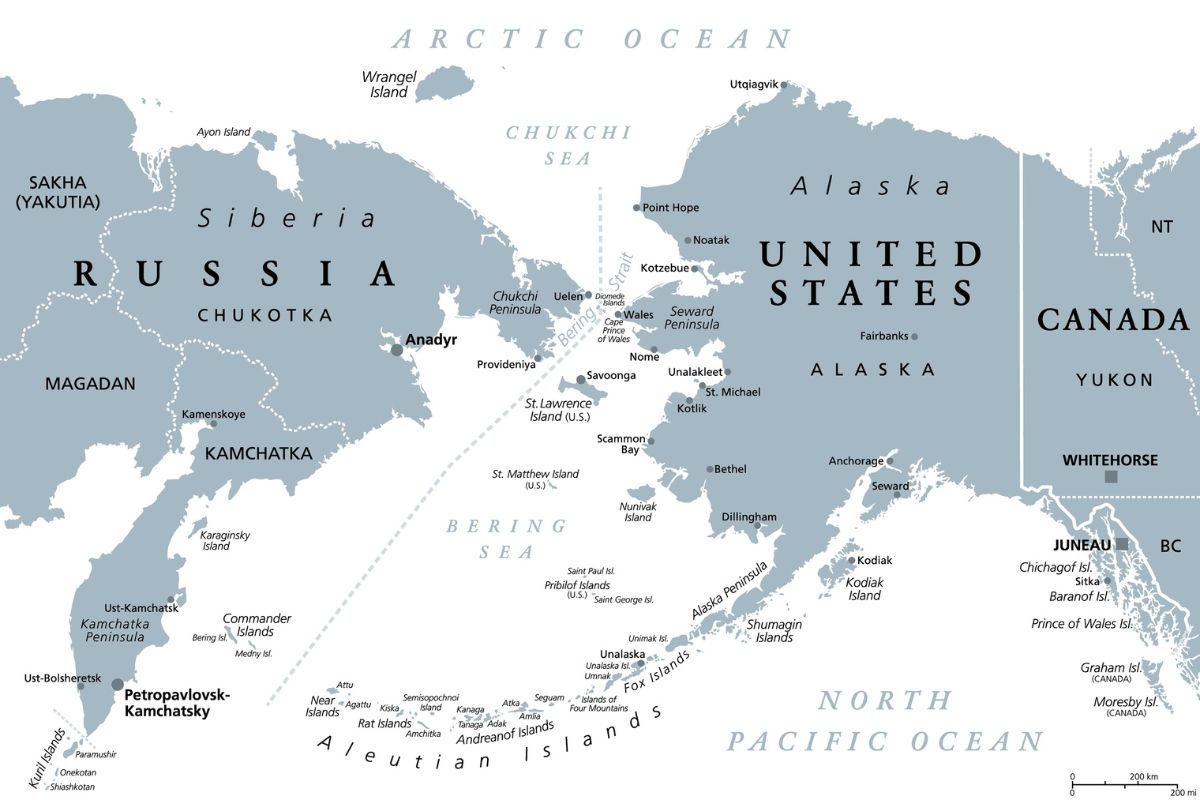
The Bering Strait is a waterway that connects the Pacific Ocean (specifically the Bering Sea) to the Arctic Ocean (the Chukchi Sea). It is situated between the Chukotka Peninsula in Russia and the Seward Peninsula in Alaska. The narrowest point of the strait is approximately 82 kilometers (51 miles) wide. While this might still seem like a considerable distance, it’s an incredibly short gap when considering two continents. On clear days, from certain vantage points, one can actually glimpse the opposing continent. For instance, from Cape Prince of Wales in Alaska, it’s possible to see Russia’s Cape Dezhnev on the horizon. This strait is not only a geographical marvel but also a crucial migration route for marine life and birds, and historically, for humans. Its depth varies but averages around 30-50 meters (100-160 feet), making it relatively shallow compared to other major ocean passages.
The Diomede Islands: Bridging Continents
The true marvel of proximity, however, lies in the Diomede Islands, two small, rocky islands situated right in the middle of the Bering Strait. These islands are often referred to as “Yesterday and Tomorrow Islands” due to their unique geographical and temporal separation.
- Little Diomede Island: This island belongs to the United States and is part of Alaska. It has a small Inuit community, which is part of the Nome Census Area. The community lives in the city of Diomede.
- Big Diomede Island: This island belongs to Russia and is uninhabited, primarily serving as a military base.
These two islands are separated by approximately 3.8 kilometers (2.4 miles) of water. This is the shortest distance between Alaska and Russia. In winter, the sea often freezes over, theoretically making it possible to walk between the two continents, albeit illegally and extremely dangerously due to currents and geopolitical sensitivities. The sight of these two islands, so close yet so distinct in their national allegiance, is a powerful symbol of the geographical closeness and political divide.
The International Date Line: A Day Apart, Yet So Close
Adding another layer of fascination to the Diomede Islands’ proximity is the fact that the International Date Line passes directly between them. This means that Little Diomede Island (US) is almost a full day behind Big Diomede Island (Russia). When it’s, for example, Saturday morning on Little Diomede, it’s already Sunday morning on Big Diomede. This makes the residents of Little Diomede literally able to look across the strait and see “tomorrow.” This temporal anomaly, coupled with the minimal physical distance, makes the Bering Strait one of the most uniquely defined borders in the world.
A Journey Through Time and Ice: Historical and Cultural Connections
The narrowness of the Bering Strait has not just been a geographical curiosity but a critical conduit for human migration and historical events that have profoundly shaped the populations of the Americas and the geopolitical landscape.
Ancient Migrations: The Bering Land Bridge
Perhaps the most famous historical significance of the Bering Strait relates to the Bering Land Bridge, also known as Beringia. During the last glacial maximum, vast amounts of water were locked up in ice sheets, causing global sea levels to drop significantly. This exposed a wide land bridge across the Bering Strait, connecting Asia and North America. For thousands of years, this land bridge served as a pathway for ancient peoples, including the ancestors of Indigenous Americans, to migrate from Asia into the Americas, populating a new continent. This massive movement of people, flora, and fauna demonstrates the ancient and profound connection between these seemingly distant landmasses.
The Alaska Purchase: From Russia to the United States
Fast forward to the 19th century, the proximity between Alaska and Russia took on a new dimension with the momentous Alaska Purchase. In 1867, the United States Secretary of State William H. Seward negotiated the purchase of Alaska from the Russian Empire for $7.2 million. Initially mocked as “Seward’s Folly,” this acquisition dramatically expanded the United States’ territory and positioned it directly adjacent to Russia across the Bering Strait. This historical transaction transformed a shared imperial border into an international frontier between two rising global powers, setting the stage for future geopolitical dynamics in the Arctic region.
Indigenous Peoples and Shared Heritage
Despite the political separation, the Bering Strait region has long been home to Indigenous communities, such as the Yupik and Inuit peoples, who have lived on both sides for millennia. These communities share deep linguistic, cultural, and familial ties that predate national borders. Their traditional ways of life, centered around hunting, fishing, and survival in the harsh Arctic environment, reflect an intimate understanding of the land and sea. For centuries, these groups engaged in trade, cultural exchange, and even intermarriage across the narrow strait. While modern borders have imposed restrictions, the underlying cultural continuity remains a powerful testament to the shared heritage of the region.
Exploring the Remote Frontier: Travel and Tourism Implications
For adventurous travelers, the Bering Strait region offers a unique blend of extreme geography, rich history, and untouched wilderness. While cross-strait travel for tourists is heavily restricted due to political sensitivities, understanding this border enhances any travel experience to either Alaska’s western reaches or Russia’s Chukotka.
Challenges and Opportunities for Cross-Continental Travel
Direct tourist travel between Alaska and Russia across the Bering Strait is currently not possible for the general public due to complex visa requirements, lack of infrastructure, and political restrictions. There have been various proposals over the years, including a hypothetical “Bering Strait tunnel” or bridge, but these remain ambitious, far-off dreams.
However, for those determined to experience the proximity, opportunities exist to visit the respective coastlines. In Alaska, towns like Nome or communities on the Seward Peninsula offer a glimpse into life at the edge of the continent. Specialized Arctic cruises sometimes navigate the Bering Sea and Chukchi Sea, offering views of the Diomede Islands and the respective coastlines, bringing travelers as close as legally possible. These expeditions typically focus on wildlife viewing, scientific exploration, and cultural encounters with Indigenous communities.
Unique Wildlife and Untouched Wilderness
The remote and harsh environment of the Bering Strait region has preserved vast areas of pristine wilderness, making it a haven for unique Arctic wildlife. Travelers to the Alaskan side, often departing from cities like Fairbanks or Anchorage to reach more remote airstrips, can experience unparalleled opportunities for wildlife viewing. The waters teem with marine mammals such as bowhead whales, gray whales, walruses, seals, and polar bears. The skies are filled with millions of migratory birds, making it a critical habitat for ornithologists and nature photographers. This untouched natural beauty is a significant draw for adventure tourism, emphasizing eco-friendly and responsible travel practices.
Visiting the Edge: Tourist Perspectives on the Bering Strait
While a direct hop across the strait is off-limits, the journey to understand and observe this unique boundary is an adventure in itself. Visitors to western Alaska can engage with Yupik and Inuit cultures, learning about their resilience and traditional knowledge. The experience of standing on the Alaskan coast, gazing across the water toward Russia, offers a profound sense of geographical wonder and historical reflection. It highlights the immense scale of the continents and the remarkable way in which they almost converge. This travel experience is less about conventional sightseeing and more about appreciating the vastness of the world, the intricacies of human history, and the raw power of nature at the planet’s northern edge.
The Strategic Importance: Geopolitical and Environmental Aspects
Beyond its historical and travel appeal, the Bering Strait’s close proximity between Alaska and Russia also holds significant strategic and environmental importance, influencing international relations and conservation efforts in the Arctic.
A Strategic Waterway
During the Cold War, the Bering Strait was a highly militarized and closely monitored border, often referred to as the “Ice Curtain.” Today, while tensions have changed, its strategic value persists. It serves as a maritime chokepoint, controlling access between the Pacific and Arctic Oceans. With increasing interest in Arctic shipping routes (such as the Northern Sea Route) due to climate change and melting ice, the strait’s importance for international trade, security, and resource exploitation is growing. Both the United States and Russia maintain a military presence and monitor activities in the region, underscoring its enduring geopolitical significance.
Environmental Concerns and Climate Change
The Bering Strait is also on the front lines of climate change. The Arctic is warming at a rate faster than the global average, leading to significant reductions in sea ice extent and thickness. This has profound implications for the region’s ecosystems, Indigenous communities whose livelihoods depend on sea ice, and global climate patterns. Increased shipping traffic through a less ice-bound strait brings risks of pollution, oil spills, and increased disturbances to marine life. Scientific research in the area is crucial for understanding these rapid changes and their broader impacts, making the strait a focal point for environmental study and conservation efforts.

Future Outlook: Connection or Division?
The future of the Bering Strait region remains an open question. Will it become a more accessible corridor for trade and cultural exchange, or will it remain a geopolitical divide? The answer lies in the complex interplay of environmental changes, international cooperation, and the political will of nations. What is certain is that the unique proximity of Alaska and Russia across this narrow, time-bending strait will continue to captivate explorers, historians, and travelers alike, marking it as one of the planet’s most compelling geographical anomalies.
LifeOutOfTheBox is a participant in the Amazon Services LLC Associates Program, an affiliate advertising program designed to provide a means for sites to earn advertising fees by advertising and linking to Amazon.com. Amazon, the Amazon logo, AmazonSupply, and the AmazonSupply logo are trademarks of Amazon.com, Inc. or its affiliates. As an Amazon Associate we earn affiliate commissions from qualifying purchases.