
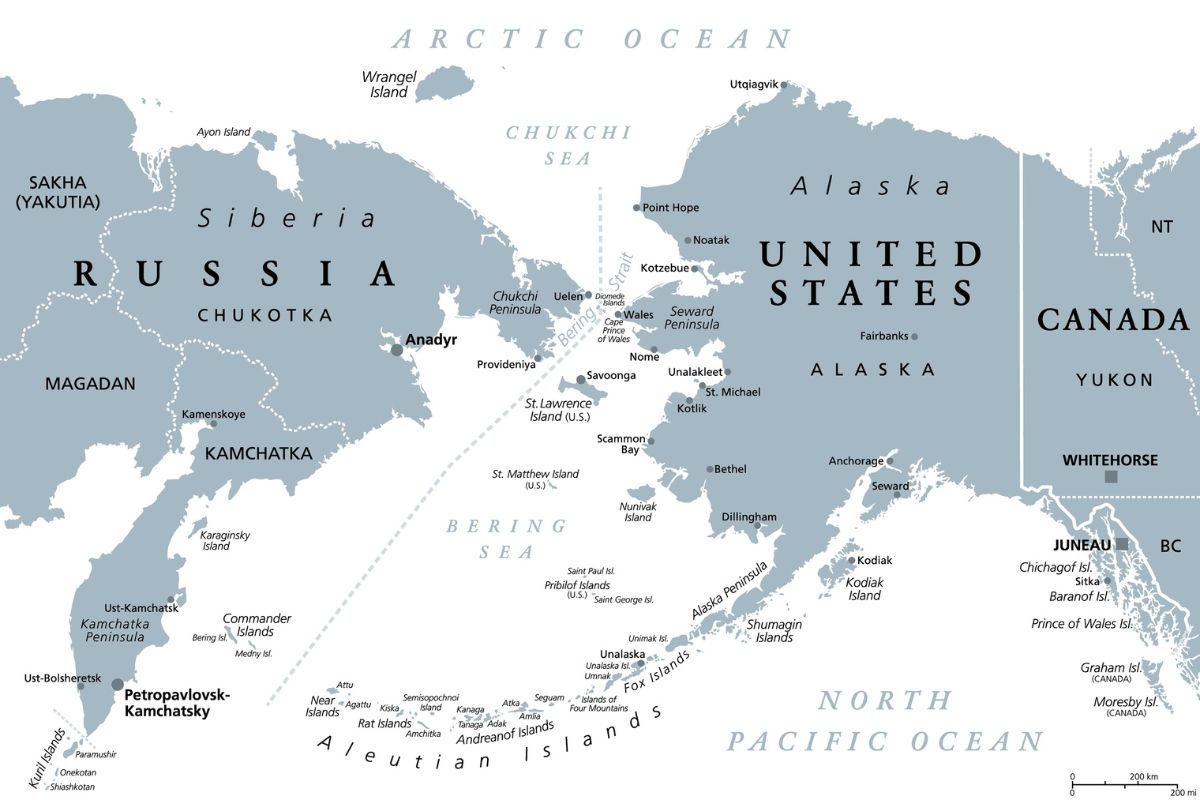
The question of distance between Alaska and Russia often sparks curiosity, conjuring images of vast, icy expanses and the remote corners of the globe. While geographically Alaska is part of the United States and Russia is its own distinct nation, their proximity across the Bering Strait is a remarkable geographical fact. This strait, a narrow band of water, separates the two continents by a mere 55 miles (88 kilometers) at its closest point. However, understanding this distance involves more than just a simple mileage calculation. It encompasses historical context, geographical features, and the logistical realities of travel between these two distinct territories.

The Bering Strait: A Narrow Divide
The Bering Strait is the most crucial geographical feature when discussing the distance between Alaska and Russia. Named after the Danish explorer Vitus Bering, who sailed through it in the 18th century, this strait is a dynamic body of water that connects the Arctic Ocean to the Pacific Ocean.
Geographical Narrowness
At its narrowest point, the Bering Strait is approximately 55 miles (88 kilometers) wide. This is a relatively short distance, especially when compared to other continental separations. To put this into perspective, it is roughly the distance from Manhattan to Stamford, Connecticut. This proximity has had profound implications throughout history, influencing migration patterns, trade, and even geopolitical considerations.
The Diomede Islands: A Midpoint Landmark
Within the Bering Strait, a cluster of islands known as the Diomede Islands further illustrates the proximity. The Big Diomede Island belongs to Russia, while the Little Diomede Island is part of Alaska, United States. These islands are separated by just 2.4 miles (3.9 kilometers) of water and are often covered by ice in winter, forming a potential, albeit challenging, land bridge. The International Date Line also passes between these two islands, meaning that Big Diomede Island is almost a full day ahead of Little Diomede Island, despite their close proximity. This creates a unique situation where one can be in the United States and, by traveling a short distance across the ice or water, be in Russia, but effectively in the “future.”
Historical Significance: The Bering Land Bridge
The narrowness of the Bering Strait is a constant reminder of the ancient Bering Land Bridge, a landmass that once connected Asia and North America during the last Ice Age. This land bridge was a crucial pathway for the migration of early humans and animals between the continents. While the strait now separates Alaska and Russia, its existence is a testament to a time when the continents were physically joined. The geological history of this region underscores the fluidity of landmasses and the profound impact of climate on geographical connections.
Travel Considerations: Alaska to Russia
While the physical distance between Alaska and Russia is surprisingly short, actual travel between the two is not as straightforward as crossing a bridge. The remoteness of the regions, political borders, and logistical challenges create a unique travel landscape.
Direct Travel Options
Direct travel between Alaska and Russia is exceptionally limited. There are no regular ferry services or direct flights operating between major cities on either side. The primary gateway for any such journey would typically be from Nome, Alaska, to Chukotka, Russia. However, this is not a route for casual tourism.
The Role of Charters and Expeditions
Most travel between Alaska and Russia is facilitated through specialized expedition cruises or private charters. These journeys often cater to adventure travelers, wildlife enthusiasts, or researchers. Such expeditions leverage the proximity of the Bering Strait to explore the unique ecosystems and cultures of both the Alaskan Arctic and the Russian Far East. These voyages are typically expensive and require extensive planning due to the remote nature of the destinations and the need for permits and specialized logistical support.
Visa and Border Crossings
For individuals planning to travel from Alaska to Russia, or vice-versa, navigating visa requirements and border crossing procedures is paramount. Russia has specific visa regulations for foreign nationals, and obtaining the necessary permissions to enter can be a complex process. Similarly, United States entry requirements apply for those traveling from Russia to Alaska. Given the remote and often sensitive nature of the border region, border control is stringent, and unauthorized crossings are strictly prohibited.
Cultural and Environmental Connections
The proximity of Alaska and Russia has fostered a unique historical and cultural exchange, particularly among the indigenous peoples of the region.
Indigenous Heritage
The Yupik and Chukchi peoples, among others, have inhabited the coastal areas of the Bering Strait for millennia. Their cultural heritage, languages, and traditions often show significant connections due to their historical interactions across the strait. These indigenous communities share a deep understanding of the Arctic environment and have developed unique ways of life adapted to its challenges. Understanding the distance between Alaska and Russia also means appreciating the human element and the shared history of these communities.
Environmental Similarities and Differences
Both Alaska and the Russian Far East share similar Arctic environments, characterized by tundra, permafrost, and extreme seasonal variations. This shared environment leads to similarities in flora, fauna, and ecological challenges. However, differences in governance, economic development, and conservation efforts can lead to distinct environmental management approaches on either side of the Bering Strait. Observing these environmental connections and divergences offers a fascinating perspective on conservation and resource management in the Arctic.
Practicalities of the Shortest Distance
While the 55-mile figure is the shortest distance across the Bering Strait, actual travel planning involves more nuanced considerations.
Navigational Challenges
The Bering Strait is known for its challenging navigational conditions. Frequent fog, strong currents, and unpredictable ice floes can make sea travel hazardous, especially outside the main summer shipping season. These factors influence the feasibility and safety of any journey, whether by sea or by air.
Nearest Settlements
The closest inhabited settlements are Little Diomede Island (USA) and Big Diomede Island (Russia) in the strait, and Wainwright, Alaska, on the Alaskan mainland, and Uelen, Chukotka, on the Russian mainland. Traveling between these points, even though they are geographically close, requires significant planning and often involves specialized transportation like helicopters or ice-strengthened vessels, particularly during winter months when the strait may freeze over.

The Perception of Distance
The perception of distance can be profoundly altered by the nature of the terrain and the available infrastructure. While the miles might be few, the effort and resources required to bridge them are substantial. This highlights how geographical proximity does not always translate to ease of access, a crucial point for anyone contemplating travel or understanding the relationship between these two geographically intertwined regions. The journey from Alaska to Russia is less about a simple measurement and more about an immersive experience in a frontier land.
LifeOutOfTheBox is a participant in the Amazon Services LLC Associates Program, an affiliate advertising program designed to provide a means for sites to earn advertising fees by advertising and linking to Amazon.com. Amazon, the Amazon logo, AmazonSupply, and the AmazonSupply logo are trademarks of Amazon.com, Inc. or its affiliates. As an Amazon Associate we earn affiliate commissions from qualifying purchases.