
The journey from New Jersey to Florida is a quintessential American migration, whether for a sun-drenched vacation, a seasonal escape, or a permanent relocation. Understanding the distance, travel time, and various transportation options is crucial for anyone planning this significant trip. This expanse covers a considerable portion of the United States East Coast, linking the Mid-Atlantic region with the subtropical Southeast.
Understanding the Geographical Divide
The physical distance between New Jersey and Florida can vary significantly depending on the specific starting and ending points, as both are large states. For instance, traveling from northern New Jersey to northern Florida is a different proposition than going from southern New Jersey to the tip of South Florida.
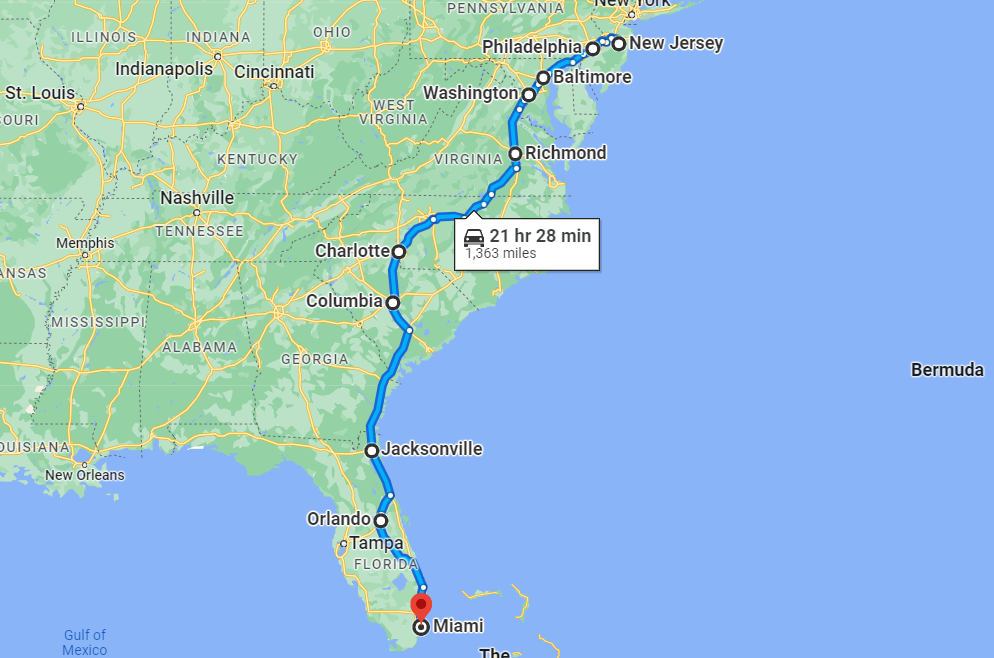
Straight-Line vs. Driving Distance
In terms of straight-line (as the crow flies) distance, the northernmost point of Florida (near Jacksonville) is approximately 750-800 miles from central New Jersey. However, this aerial measurement is largely irrelevant for ground travel.
The driving distance is the most practical metric for most travelers. From a central point like Trenton, New Jersey, to a common Florida destination:
- To Jacksonville, Florida: Approximately 850-900 miles. This journey typically takes 13-14 hours of continuous driving.
- To Orlando, Florida: Around 1,000-1,050 miles. Expect 15-16 hours of driving time.
- To Miami, Florida: Closer to 1,200-1,250 miles. This is a substantial drive, requiring 18-20 hours behind the wheel.
These driving times do not account for stops for fuel, food, rest, or unexpected traffic delays, which are almost inevitable on such a long journey. Consequently, a single-day drive is often impractical and unsafe, leading most travelers to split the journey into at least two days.
Navigating the Journey: Modes of Transport and Timelines
Choosing the right mode of transportation is pivotal in defining your travel experience from New Jersey to Florida. Each option presents a unique balance of cost, convenience, and time.
The Classic American Road Trip
Driving is arguably the most popular way to travel between these two states, offering flexibility and the opportunity for exploration.
- Time Commitment: As noted, plan for at least two full days of driving. A comfortable itinerary would involve 8-10 hours of driving per day, with an overnight stop roughly halfway. Ideal stopover cities often include areas in North Carolina, South Carolina, or southern Virginia or Georgia.
- Cost: The primary costs are fuel, tolls (especially prevalent along Interstate 95), and overnight accommodation. Vehicle maintenance, food, and potential emergency repairs should also be factored in.
- Pros: Freedom to set your own pace, explore attractions along the way, carry extensive luggage, and travel with pets. It can be cost-effective for groups or families.
- Cons: Demanding on the driver, prone to traffic delays, and potentially exhausting. Requires careful planning for rest stops and overnight stays.
Air Travel: Speed and Convenience
For those prioritizing speed, flying is the most efficient option. Direct flights significantly reduce travel time, transforming an arduous two-day drive into a few hours in the air.
- Time Commitment: A direct flight from a major New Jersey or nearby Northeast airport (like Newark Liberty International Airport – EWR, or Philadelphia International Airport – PHL) to a major Florida airport (e.g., Orlando International Airport – MCO, Miami International Airport – MIA, or Fort Lauderdale-Hollywood International Airport – FLL) typically ranges from 2.5 to 3.5 hours.
- However, total travel time includes getting to/from airports, security checks, boarding, and potential delays. Door-to-door, this often means 6-8 hours.
- Cost: Airfare can vary wildly based on booking time, season, airline, and destination. Early booking often yields better prices. Factor in baggage fees, airport parking or transport, and rental car costs upon arrival.
- Pros: Fastest option, minimal physical exertion, ideal for short trips or those with limited time.
- Cons: Can be expensive, especially for last-minute bookings or multiple travelers. Less luggage flexibility, and the experience lacks the scenic variety of a road trip.
Rail and Bus Options
For travelers seeking an alternative to driving or flying, intercity bus services and trains offer a more relaxed journey, albeit with longer travel times.
- Train (Amtrak): Amtrak’s Silver Meteor and Silver Star routes connect the Northeast with various Florida cities.
- Time Commitment: A train journey from New Jersey (e.g., Newark Penn Station) to Orlando can take anywhere from 18 to 24 hours, depending on connections and specific routes. To Miami, it can extend to 24-28 hours. These are often overnight trips.
- Cost: Fares are generally competitive with or slightly higher than budget airline tickets, especially if booked in advance. Sleeper cars are available for an added cost, offering a private, more comfortable experience.
- Pros: Relaxing travel, scenic views (especially in daylight), ability to walk around, access to dining cars, often more generous luggage allowance than airlines. Avoids driving stress and airport hassles.
- Cons: Slower than flying, not as flexible as driving, limited direct routes.
- Bus (Greyhound, etc.): Bus services offer the most budget-friendly option but are also the slowest.
- Time Commitment: A bus trip from New Jersey to Florida can take anywhere from 20 to 30+ hours, with multiple stops and transfers. This often involves traveling overnight.
- Cost: Typically the least expensive option.
- Pros: Very economical, good for budget travelers, extensive network of routes.
- Cons: Long travel times, less comfortable than train or plane, frequent stops, potential for delays, limited amenities.

Popular Routes and Scenic Detours
For those embarking on a road trip, the route from New Jersey to Florida is predominantly dictated by Interstate 95 (I-95), but there are opportunities for scenic detours.
The Interstate 95 Corridor
I-95 is the primary artery connecting the Northeast to Florida. It spans the entire distance, passing through Delaware, Maryland, Virginia, North Carolina, South Carolina, and Georgia before entering Florida.
- Pros: Direct, well-maintained, numerous services (gas stations, restaurants, hotels) readily available, relatively straightforward navigation.
- Cons: Heavy traffic, especially around major metropolitan areas like Washington, D.C., Richmond, and through parts of North Carolina. Can feel monotonous with long stretches of highway. Tolls are prevalent in some sections, notably in Delaware and Maryland.
Coastal Drives and Inland Pathways
While I-95 is the most direct, travelers with more time can consider alternative routes for a more scenic experience.
- Coastal Detours: Portions of the journey can be enhanced by veering off I-95 to explore coastal areas.
- In North Carolina, a detour to the Outer Banks offers stunning beaches and historic lighthouses, though it adds significant time.
- South Carolina boasts charming coastal towns like Charleston and the bustling resort area of Myrtle Beach, both accessible with slight deviations.
- Georgia’s coast features the historic city of Savannah and the tranquil Golden Isles.
- Upon entering Florida, the historic city of St. Augustine is a popular coastal stop.
- Inland Alternatives: For those who prefer mountains over coastlines, a route incorporating the Blue Ridge Mountains and Shenandoah National Park in Virginia and North Carolina offers breathtaking views, but it is a considerably longer and more winding drive, adding many hours to the journey. This route is better suited for dedicated scenic drives rather than direct travel.
Planning Your Trip: Key Considerations
Regardless of your chosen mode of transport, a well-planned trip ensures a smoother and more enjoyable experience.
Best Time to Travel
- Spring (March-May) and Fall (September-November): These are often considered the ideal seasons for travel. Temperatures are mild, making driving comfortable, and hurricane season in Florida is less active (though still a possibility in late fall). Crowds at popular Florida attractions like Disney World and Universal Studios are generally lower than peak winter or summer.
- Winter (December-February): Popular for escaping the cold New Jersey winters. Expect higher prices and larger crowds in Florida. Driving conditions can be challenging in the Northeast due to snow or ice, potentially causing delays.
- Summer (June-August): While popular for family vacations, summer travel means hot, humid weather throughout the route, and peak hurricane season in Florida. Traffic can also be heavy with other vacationers.
Essential Packing and Preparation
- For Road Trips: Ensure your vehicle is in excellent condition (tires, oil, fluids). Pack an emergency kit, first-aid supplies, snacks, water, entertainment, and a good navigation system (GPS and physical maps as backup). Plan your overnight stops in advance.
- For Air Travel: Book flights and rental cars well in advance, especially during peak season. Check baggage allowances and restrictions. Have all necessary identification ready.
- For Train/Bus Travel: Pack light if possible, especially for bus travel with limited overhead space. Bring entertainment, snacks, and a neck pillow for comfort during long stretches.

Stopover Cities and Attractions
Breaking up a long drive is essential for safety and enjoyment. Consider stopping in cities like:
- Richmond, Virginia: Historic capital with civil war sites and vibrant food scene.
- Raleigh, North Carolina: State capital with museums and a lively downtown.
- Charleston, South Carolina: Renowned for its history, architecture, and culinary scene.
- Savannah, Georgia: Charming historic district, moss-draped squares, and southern hospitality.
- Jacksonville, Florida: Florida’s largest city, offering beaches and cultural attractions, serving as a gateway to the rest of the state.
Exploring nearby natural wonders such as the Everglades National Park or the beaches along the Atlantic Ocean can also enhance the overall travel experience, transforming a mere journey into an adventure.
Ultimately, the “how far” from New Jersey to Florida isn’t just a matter of miles, but a consideration of time, cost, comfort, and the kind of travel experience you desire. With careful planning, the journey itself can become an integral part of your Florida adventure.
LifeOutOfTheBox is a participant in the Amazon Services LLC Associates Program, an affiliate advertising program designed to provide a means for sites to earn advertising fees by advertising and linking to Amazon.com. Amazon, the Amazon logo, AmazonSupply, and the AmazonSupply logo are trademarks of Amazon.com, Inc. or its affiliates. As an Amazon Associate we earn affiliate commissions from qualifying purchases.