
The allure of Hawaii, with its pristine beaches, lush rainforests, and active volcanoes, captivates millions of travelers each year. Yet, beneath the postcard-perfect scenery lies a monumental geological saga – a story of fire, water, and inexorable movement that has shaped these islands over millions of years. Far from being a random collection of landmasses, the [Hawaiian Archipelago] is the striking visible evidence of a unique geological phenomenon, the [Hawaiian Hotspot], which continues to create new land even today. Understanding [Hawaii]’s fiery birth and ongoing evolution not only deepens our appreciation for its natural wonders but also illuminates why it remains one of the most dynamic and fascinating travel destinations on Earth. From ancient [seamounts] to burgeoning new land, the geological processes at play have sculpted a paradise unlike any other, inviting exploration into its origins as much as its present-day splendor.

The Hawaiian Hotspot: A Fiery Beginning
The formation of [Hawaii] stands as a testament to the immense power hidden beneath the [Pacific Ocean]. Unlike most volcanic activity, which occurs at the boundaries of [tectonic plates], the [Hawaiian Islands] are born from what scientists call a “hotspot” – a fixed plume of superheated rock rising from deep within the Earth’s [mantle]. This geological anomaly is the singular engine driving the creation of this iconic chain of islands and [seamounts].
Plate Tectonics and the Pacific Plate
To fully grasp the [Hawaiian Hotspot] theory, we must first understand the fundamental concept of [Plate Tectonics]. Our planet’s outermost layer, the lithosphere, is broken into several massive slabs called [tectonic plates]. These plates are constantly, albeit slowly, moving across the Earth’s surface, driven by convection currents in the underlying [mantle]. The [Pacific Plate], which underlies the vast expanse of the [Pacific Ocean], is the largest of these plates, moving roughly northwestward at a rate of about 7-10 centimeters (3-4 inches) per year – roughly the speed at which your fingernails grow.
Most volcanic activity, like the “Ring of Fire” that encircles the [Pacific Ocean], happens where these plates collide, pull apart, or slide past each other. However, [Hawaii] is located thousands of miles from the nearest plate boundary, making its volcanic origins particularly intriguing. The conventional wisdom of plate boundary volcanism simply couldn’t explain the existence of such a prolific volcanic chain in the middle of a major plate. This paradox led to the development of the [hotspot] theory.
The Mantle Plume Explained
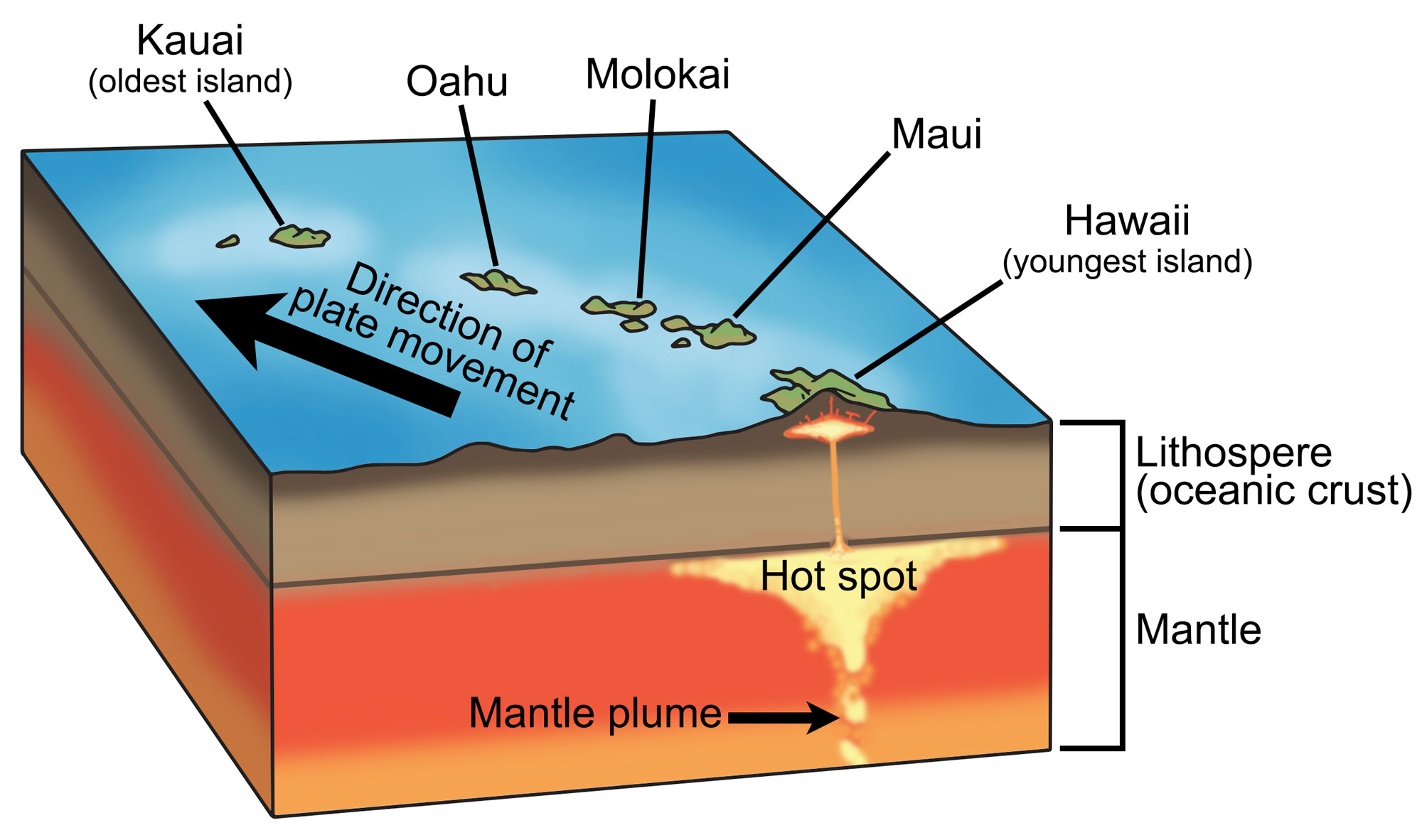
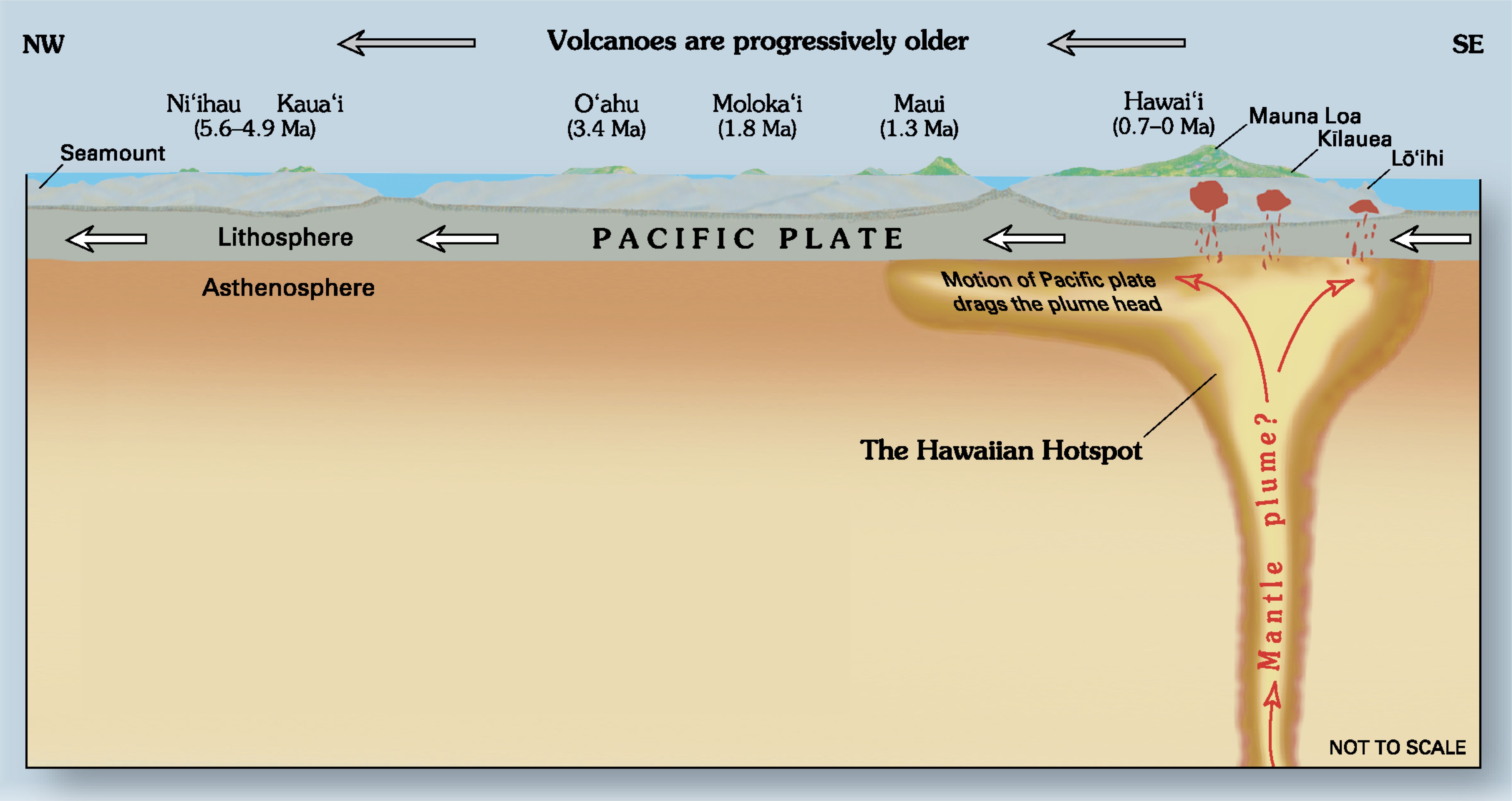
The [Hawaiian Hotspot] is essentially a deep-seated, stationary source of intense heat and molten rock, known as a [mantle plume]. Imagine a giant, narrow straw extending thousands of kilometers down to the Earth’s core-mantle boundary, through which superheated material rises. As the [Pacific Plate] slowly glides over this fixed [mantle plume], the intense heat causes the overlying crust to melt, leading to the formation of magma. This magma then rises to the surface, erupting through weaknesses in the [oceanic crust] to form volcanoes.
Because the [mantle plume] itself remains largely stationary while the [Pacific Plate] moves, the result is a conveyor belt of volcanic activity. A volcano forms directly over the hotspot, growing larger and larger through successive eruptions. As the [Pacific Plate] continues its slow journey, the newly formed volcano is carried away from the hotspot. Once a volcano moves far enough, it is cut off from its magma supply and becomes dormant, eventually ceasing all eruptive activity. A new volcano then begins to form directly over the hotspot, perpetuating the cycle. This continuous process has, over millions of years, carved out the distinctive linear chain of islands and [seamounts] that defines the [Hawaiian Archipelago].
For visitors, this ongoing geological process is not merely an academic concept; it’s a living, breathing aspect of the [Hawaiian experience]. The fact that these islands are continuously being born and transformed creates a landscape that is perpetually new, offering unique natural landmarks and attractions. From the youngest, actively growing islands to the ancient, eroded remnants, each island tells a part of this incredible story, inviting travelers to witness the raw power of Earth’s creation.
Building an Archipelago: From Seamount to Island
The story of [Hawaii]’s formation is one of continuous construction and eventual, slow decay. Each island in the chain represents a different stage in this grand geological lifecycle, a visible timestamp of its journey away from the life-giving [Hawaiian Hotspot]. This process creates not just land, but also the incredibly diverse ecosystems and breathtaking landscapes that draw tourists from across the globe.
The Cycle of Island Growth and Decline
The birth of a [Hawaiian island] begins deep beneath the [Pacific Ocean]. As magma from the [Hawaiian Hotspot] breaches the [oceanic crust], it erupts onto the seafloor, forming underwater volcanoes known as [seamounts]. Over hundreds of thousands of years, or even millions, these [seamounts] grow taller and wider with countless lava flows. Eventually, after accumulating enough material, the volcano breaks the ocean’s surface, marking the official birth of a new island. This “shield-building” stage is characterized by massive, effusive lava flows that create the gentle, sloping profiles of the [Hawaiian volcanoes]. A prime example of this stage is the Big Island of Hawaiʻi, home to the world’s most active volcanoes, Kīlauea and Mauna Loa, which are still actively growing and expanding the island’s landmass.
Once an island is carried away from the [hotspot]’s direct influence by the moving [Pacific Plate], its main period of growth ends. Erosion, primarily from wind and rain, then begins its relentless work, carving dramatic valleys and cliffs from the once-smooth volcanic slopes. Over millions of years, the island gradually subsides back into the ocean, partly due to the cooling and shrinking of the underlying oceanic crust, and partly due to the sheer weight of the island itself. As the island sinks, coral reefs often build up around its perimeter, forming fringing reefs, barrier reefs, and eventually, if the island fully submerges, an [atoll] – a ring-shaped coral reef enclosing a lagoon. This entire cycle, from nascent [seamount] to submerged [atoll], can span tens of millions of years, illustrating the vast timescales involved in geological processes.
The Hawaiian-Emperor Seamount Chain: A Geological Record
The continuous movement of the [Pacific Plate] over the stationary [Hawaiian Hotspot] has left an unmistakable trail: the [Hawaiian-Emperor Seamount Chain]. This colossal underwater mountain range stretches for approximately 5,800 kilometers (3,600 miles) across the [Pacific Ocean] floor. It comprises over 80 identified volcanoes, extending from the active volcanoes on the [Big Island of Hawaiʻi] northwestward through the main [Hawaiian Islands], continuing past the uninhabited [Northwestern Hawaiian Islands], and then making a distinct bend to the north, forming the [Emperor Seamounts].
The bend in the chain, occurring roughly 43 million years ago, provides a crucial geological marker, indicating a significant change in the direction of the [Pacific Plate]’s movement. This remarkable chain is a clear geological record, allowing scientists to trace the history of the [Pacific Plate]’s motion over the [Hawaiian Hotspot] back at least 80 million years. Each [seamount] and island along this chain is a relic of a time when it was directly over the hotspot, a silent monument to its fiery birth. For visitors, this translates into an incredible diversity of landscapes – from the rugged, recently formed shores of [Hawaiʻi Island] to the deeply eroded, ancient valleys of [Kauaʻi], each offering a distinct experience shaped by its age and geological journey. Exploring these different islands is like stepping through a living geological timeline, a unique aspect of [Hawaiian travel] that blends adventure with education.
A Journey Across the Islands: Age and Evolution
The visible landscape of [Hawaii] offers a living timeline of its geological history, showcasing islands at various stages of formation and erosion. From the youngest, still-growing giants to the deeply weathered elders, each island in the chain presents a unique tableau shaped by millions of years of volcanic activity, plate movement, and the relentless forces of nature. This progression is not just a scientific curiosity; it directly informs the distinct character, natural landmarks, and diverse tourist attractions found across the archipelago.
The Older Islands: Erosion’s Masterpiece (Kauaʻi and Oʻahu)
Journeying northwestward along the [Hawaiian-Emperor Seamount Chain], we encounter the older, more eroded islands. Kauaʻi, often called the “Garden Isle,” is the oldest of the main inhabited islands, estimated to be around 5 million years old. Its age is evident in its dramatic, verdant landscapes, characterized by deep canyons like Waimea Canyon and the breathtaking cliffs of the [Na Pali Coast]. Millions of years of wind, rain, and stream erosion have sculpted these features from what were once massive shield volcanoes. The island’s volcanic past is softened by time, replaced by a landscape dominated by lush vegetation and ancient geological formations. Visitors to [Kauaʻi] can experience this geological maturity through activities like hiking through its profound valleys, exploring ancient lava tubes, or marveling at the sheer scale of its eroded coastlines – a testament to the power of nature’s patient hand.
Oʻahu, home to the vibrant city of Honolulu and iconic landmarks like [Diamond Head], is younger than [Kauaʻi] but still significantly older than the [Big Island]. At approximately 3.7 million years old, [Oʻahu]’s volcanoes, Koʻolau and Waiʻanae, are dormant and heavily eroded. The famous [Diamond Head] crater, for instance, is a volcanic tuff cone formed by a single explosive eruption around 300,000 years ago, representing a late stage of volcanism long after the main shield-building phase. The fertile valleys and plains of [Oʻahu] are products of volcanic ash and eroded soil, supporting its agricultural history and urban development. The geological evolution of these islands provides the backdrop for a diverse range of accommodations, from secluded resorts nestled in ancient valleys to bustling city hotels with views of dormant craters, appealing to various travel lifestyles.
The Younger Islands: Still Growing (Maui and the Big Island of Hawaiʻi)
Moving southeast, closer to the [Hawaiian Hotspot], we find the younger, more volcanically active islands. Maui, the second-largest island, is a composite of two massive shield volcanoes: the older West [Maui] Mountains and the younger, much larger [Haleakalā]. While the West [Maui] Mountains are heavily eroded, [Haleakalā], rising over 10,000 feet, is considered dormant but potentially active. Its last eruptions occurred only a few hundred years ago, a mere blink in geological time. The vast, often barren, and otherworldly landscape of [Haleakalā]’s crater offers a stark contrast to the lushness of older islands, providing incredible opportunities for stargazing and sunrise viewing – experiences directly linked to its youthful volcanic geology. The famed Road to [Hana] showcases [Maui]’s dramatic coastline, carved by erosion but still retaining the ruggedness of its volcanic youth.
The [Big Island of Hawaiʻi] is the youngest and largest island, and the current site of active volcanism directly over the [Hawaiian Hotspot]. Home to five volcanoes, including the colossal [Mauna Loa] (the world’s largest active volcano) and the highly active [Kīlauea], this island is continuously growing. Fresh lava flows frequently extend its coastline, create new black sand beaches, and reshape the landscape in real-time. Visitors to the [Big Island] can witness the raw power of creation firsthand, often able to see active lava flows within [Volcanoes National Park] or experience the otherworldly terrain forged by recent eruptions. This unique opportunity to observe geological processes in action makes the [Big Island] an unparalleled destination for adventure and eco-tourism, offering a lifestyle experience that is both thrilling and deeply educational.
The Future: Lōʻihi Seamount
The story of [Hawaii]’s formation is far from over. Approximately 30 kilometers (19 miles) off the southeast coast of the [Big Island of Hawaiʻi] lies the Lōʻihi Seamount, an active submarine volcano. [Lōʻihi] is currently about 975 meters (3,200 feet) below the ocean surface and continues to erupt and grow, steadily increasing its height. Geologists predict that in another 10,000 to 100,000 years, [Lōʻihi] will eventually break the ocean’s surface, becoming the newest island in the [Hawaiian Archipelago]. This future island serves as a powerful reminder that [Hawaii] is not a static paradise but a dynamic, ever-changing landscape, constantly being reborn from the depths of the [Pacific Ocean]. This ongoing process ensures that [Hawaii] will remain a focal point for scientific research and a source of wonder for generations of travelers, eager to witness Earth’s creative forces at work.
The Enduring Legacy: How Geology Shapes the Hawaiian Experience
The remarkable geological history of [Hawaii] is more than just a scientific narrative; it is the very foundation upon which the islands’ unique identity, unparalleled beauty, and vibrant culture are built. The forces that formed these islands millions of years ago continue to shape every aspect of the [Hawaiian experience], from the dramatic vistas that awe travelers to the distinctive ecosystems that thrive there. For anyone planning a trip, understanding this geological legacy enriches every encounter, transforming a simple vacation into a profound journey through Earth’s epic story.
Unique Landscapes for Travel and Exploration
The age progression of the [Hawaiian Islands] directly translates into an incredible diversity of landscapes, offering a broad spectrum of experiences for every type of traveler. On the [Big Island of Hawaiʻi], the youngest landmass, visitors can trek across desolate lava fields that shimmer with recent volcanic activity, explore vast volcanic craters, and witness the mesmerizing spectacle of Kīlauea’s glow – a raw, untamed display of Earth’s creative power. This provides a truly unique adventure tourism opportunity, appealing to those seeking an active lifestyle and a connection to primal forces. Accommodation options here range from eco-lodges close to [Volcanoes National Park] to luxury resorts offering unparalleled views of the ocean where new land is being formed.
As one moves to older islands like [Maui], the landscapes transition to include verdant valleys and the majestic, dormant shield volcano of [Haleakalā], where sunrises paint the clouds in ethereal hues. [Maui]’s blend of active coastlines and ancient volcanic peaks provides opportunities for surfing, snorkeling, and scenic drives along routes like the Road to [Hana], which winds through lush rainforests and past countless waterfalls – all products of volcanic soil and heavy rainfall.
On [Oʻahu], the eroded remnants of two shield volcanoes have created the iconic backdrop for [Honolulu]’s urban sprawl, with famous landmarks like [Diamond Head] offering panoramic views. Here, the volcanic past blends seamlessly with modern tourism, providing both historical sites and bustling city life. Finally, [Kauaʻi], the oldest of the main islands, showcases the ultimate power of erosion. Its dramatic [Na Pali Coast] and the vast Waimea Canyon, often dubbed the “Grand Canyon of the Pacific,” are staggering natural landmarks, drawing hikers and photographers to witness the breathtaking artistry of nature. These deeply sculpted landscapes offer a different kind of adventure, one that emphasizes exploration of ancient beauty and serene natural environments, making it ideal for those seeking relaxation and natural wonder.
Biodiversity and Cultural Heritage
Beyond the stunning scenery, [Hawaii]’s unique geological formation has profoundly influenced its biodiversity. Emerging from the [Pacific Ocean] as barren volcanic rock, these isolated islands became ecological laboratories. Over millennia, a small number of “founder” species – carried by wind, waves, or wings – arrived and, in the absence of many competitors and predators, evolved into thousands of endemic species found nowhere else on Earth. The varied elevations, rainfall patterns, and soil types across the different islands, all stemming from their volcanic origins, created a multitude of microclimates that fostered this incredible evolutionary radiation. From the native Hawaiian goose (nēnē) to the vibrant ʻōhiʻa lehua forests, [Hawaii]’s natural heritage is directly linked to its isolation and geological birth. Responsible tourism in [Hawaii] often emphasizes understanding and protecting these fragile ecosystems, a vital part of the [Hawaiian lifestyle] and the travel experience.
Furthermore, the geological story is interwoven with [Hawaiian] local culture and traditions. Ancient [Hawaiian mythology] is rich with tales of Pele, the goddess of fire and volcanoes, whose powerful presence continues to shape the land. The very act of creating new land is revered, and traditional chants and hula dances often recount the formation of the islands and the forces of nature. The fertile volcanic soils have historically supported abundant agriculture, shaping local food traditions and the availability of unique produce. From surfing on waves shaped by ancient lava flows to tasting taro grown in volcanic soil, the geological narrative is not just about rocks and magma; it’s about the very soul of [Hawaii] and the profound connection its people have to their dynamic homeland. Embracing this rich tapestry of geology, nature, and culture makes any visit to [Hawaii] a truly transformative experience, connecting travelers to the ancient forces that continue to sculpt this extraordinary destination.
LifeOutOfTheBox is a participant in the Amazon Services LLC Associates Program, an affiliate advertising program designed to provide a means for sites to earn advertising fees by advertising and linking to Amazon.com. Amazon, the Amazon logo, AmazonSupply, and the AmazonSupply logo are trademarks of Amazon.com, Inc. or its affiliates. As an Amazon Associate we earn affiliate commissions from qualifying purchases.