
Florida, often affectionately known as the Sunshine State, beckons millions of visitors each year with its pristine beaches, vibrant cities, world-class attractions, and unique natural landscapes. From the magical theme parks of Orlando and the energetic nightlife of Miami, to the tranquil shores of the Florida Keys and the wild beauty of Everglades National Park, there’s an adventure for every traveler. Whether you’re planning a dream vacation, considering a long-term stay, or even relocating for a new lifestyle, the freedom of the open road is an integral part of experiencing all that Florida has to offer. Renting a car to explore the diverse regions, driving to your chosen resort, or simply commuting for work as a new resident, navigating the state’s roadways is almost inevitable.
However, with this freedom comes responsibility, particularly when it comes to understanding local traffic laws. For anyone driving in Florida, whether with an out-of-state license or a local one, comprehending the state’s driver point system is crucial. Accumulating points on your license can have significant repercussions, impacting not just your driving privileges but also your travel plans, insurance rates, and overall peace of mind. A common question that arises, particularly for those who might have had a lapse in judgment or simply an unfortunate encounter with law enforcement, is: “How long do points stay on your license in Florida?” This article will delve into the intricacies of Florida’s point system, shedding light on how points are accrued, their consequences, how long they persist, and strategies to mitigate their impact, ensuring your journey through the Sunshine State remains as smooth and enjoyable as possible.
Navigating the Sunshine State: Why Driving Points Matter for Travelers and Residents
The allure of Florida is undeniable. Tourists flock to destinations like Walt Disney World Resort and Universal Orlando Resort for unforgettable family experiences, while others seek the sophisticated dining and arts scene in Miami or the historic charm of St. Petersburg. For many, a road trip down to Key West or a scenic drive along the Gulf Coast near Naples represents the epitome of a Florida lifestyle. To fully embrace these experiences, personal transportation is often key.
However, an unexpected traffic ticket can quickly turn a carefree trip into a stressful ordeal. For visitors, accumulating points might not immediately impact their out-of-state license, but the underlying violation could still lead to fines, court appearances, and potentially affect future car rental agreements or even entry into the country for international travelers. For residents, the implications are more direct and severe, affecting daily commutes, work opportunities, and the financial burden of increased insurance premiums. Understanding the Florida Department of Highway Safety and Motor Vehicles (FDHSMV) point system is not just about avoiding penalties; it’s about preserving your freedom to explore, work, and live unhindered in this beautiful state. A clean driving record ensures you can freely access Florida’s countless attractions, from the beaches of Daytona Beach to the urban sprawl of Jacksonville, without the constant worry of license suspension or financial strain.
Understanding Florida’s Driver Point System
To fully appreciate the lifespan of points on your license, it’s essential to first grasp what the system entails and how points are assigned. The Florida point system is designed to identify and penalize drivers who repeatedly commit traffic infractions, encouraging safer driving habits and deterring reckless behavior on the roads.
What Are Driver’s License Points?
Driver’s license points in Florida are essentially demerits assigned to your driving record by the FDHSMV following certain traffic violations. When a law enforcement officer, such as the Florida Highway Patrol (FHP), issues you a citation for a moving violation, and you are found guilty or pay the fine, points are then assessed against your driver’s license. These points accumulate over time, and the total number of points within specific periods determines the severity of the consequences, ranging from higher insurance rates to license suspension. The system aims to track a driver’s behavior, with a higher accumulation of points signaling a higher risk driver.
Common Violations and Their Point Values
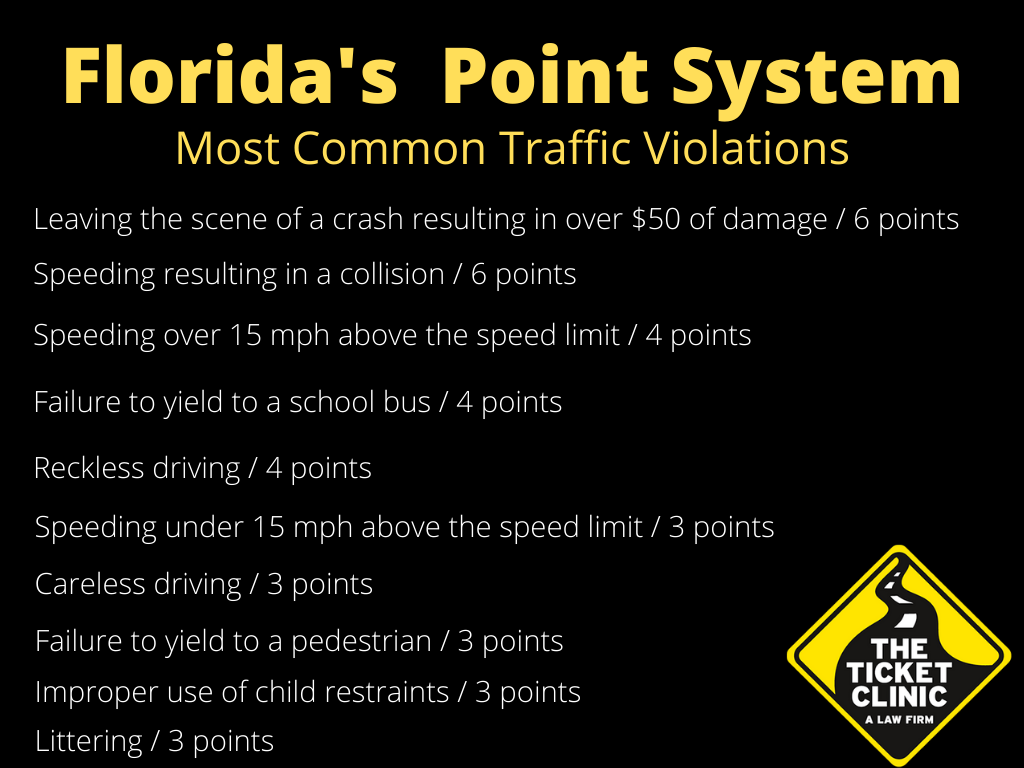
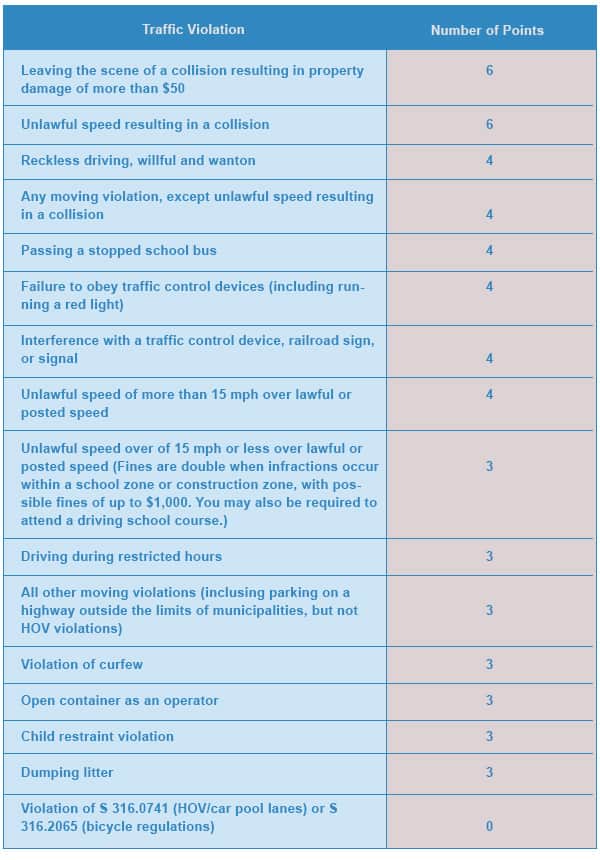
The number of points assessed for a violation depends on the nature and severity of the offense. While this is not an exhaustive list, here are some common traffic violations and their typical point values in Florida:
- 3 Points:
- Speeding (less than 15 mph over the posted speed limit).
- Moving violation (not resulting in a crash).
- Child restraint violation.
- Open container violation (alcoholic beverage).
- Failure to show proof of insurance.
- 4 Points:
- Speeding (15 mph or more over the posted speed limit).
- Moving violation resulting in a crash.
- Reckless driving.
- Running a red light or stop sign.
- Passing a stopped school bus.
- Driving during restricted hours (for minor drivers).
- Improper lane change.
- 6 Points:
- Leaving the scene of an accident with property damage of more than $50.
- Speeding that results in a crash.
It’s important to note that certain severe offenses, such as Driving Under the Influence (DUI), often result in immediate license suspension or revocation and carry their own distinct penalties, which supersede the standard point system, often leading to much longer-lasting impacts on your driving record.
The Immediate and Long-Term Consequences of Accumulating Points
Accumulating points on your Florida driver’s license carries a range of consequences, both immediate and long-term, which can significantly impact your ability to travel and enjoy life in the state.
The most severe immediate consequence is license suspension. The FDHSMV has specific thresholds for point-based suspensions:
- 12 points within 12 months: Results in a 30-day license suspension.
- 18 points within 18 months: Results in a 3-month license suspension.
- 24 points within 36 months: Results in a 1-year license suspension.
These suspensions directly impact your ability to drive legally, potentially disrupting travel plans, work commutes, and overall independence. Imagine being unable to drive to South Beach for a relaxing day or reach your accommodation in Fort Lauderdale without a valid license.
Beyond suspensions, perhaps the most common and persistent consequence is a significant increase in auto insurance premiums. Insurance companies regularly check your driving record, and an accumulation of points signals a higher risk driver, leading to higher rates. This financial burden can last for several years, even after the points are no longer actively counted towards suspension thresholds. Furthermore, a history of points can make it more difficult to rent a car from certain agencies, as they often review driving records, especially for long-term rentals, posing a challenge for travelers or new residents who rely on rental vehicles.
The Lifespan of Points on Your Florida Driving Record
Understanding how long points remain active on your driving record is crucial for managing your driving privileges and financial liabilities in Florida. The good news is that points do not stay on your record indefinitely.
The Standard Point Retention Period
In Florida, driver’s license points generally remain on your driving record for three years (36 months) from the date of the violation. This means that if you received a speeding ticket on January 1, 2023, the points associated with that violation would typically expire on January 1, 2026. After this period, those specific points will no longer be counted towards any potential license suspension thresholds.
However, it’s vital to clarify that while the points may expire from counting towards suspension, the record of the conviction itself (the traffic ticket) often remains on your driver history for a longer duration, sometimes up to seven to ten years, and for very serious offenses, permanently. Insurance companies, for instance, may still consider these historical violations when calculating your premiums, even if the “points” are no longer active in the FDHSMV system. This distinction is particularly important for anyone considering their long-term lifestyle and financial planning in Florida.
Exceptions and Aggravating Factors
While the three-year rule is standard, certain circumstances can lead to points having a much longer or more severe impact.
One significant exception is being designated a Habitual Traffic Offender (HTO). If you accumulate a certain number of serious offenses within a five-year period, regardless of the individual point values, you could be classified as an HTO. This designation carries a mandatory five-year license revocation. For example, three convictions for serious offenses like DUI, driving while license suspended or revoked, or reckless driving within a five-year period would classify you as an HTO. In such cases, the impact on your driving privileges extends far beyond the typical three-year point retention period, severely restricting your mobility and lifestyle in Florida.
Furthermore, violations related to DUI convictions have a distinct and much longer-lasting impact. A DUI conviction can lead to significant license suspension or revocation, mandatory substance abuse education, community service, and higher penalties, the effects of which can linger on your record for many years, sometimes even permanently for certain purposes. While these aren’t “points” in the traditional sense, they are severe demerits that overshadow the point system. For individuals holding a Commercial Driver’s License (CDL), the rules are even stricter. Violations can lead to CDL disqualification for extended periods, impacting their livelihood and ability to conduct business in Florida.
How Points Impact Your Insurance Rates

The relationship between points on your license and your auto insurance rates is arguably one of the most immediate and impactful financial consequences. Insurance companies utilize your driving record, including accumulated points, as a primary factor in assessing your risk profile. A driver with multiple points is statistically more likely to be involved in future accidents or file claims, thus presenting a higher risk to the insurer.
Consequently, following a traffic violation that results in points, you can almost always expect your insurance premiums to increase. This hike can be substantial, often ranging from 10% to 50% or even more, depending on the severity and number of violations. The crucial aspect here is that insurance companies often look back further than the FDHSMV’s three-year point period. Many insurers consider violations for up to five to seven years when determining rates. This means that even after the points are no longer counted towards a license suspension, the previous conviction can continue to affect your insurance costs for several years, adding a significant long-term financial strain to your budget, which could otherwise be spent on experiencing Florida’s vibrant attractions and culinary delights.
Strategies to Mitigate Points and Maintain a Clean Record
While avoiding traffic violations is the best approach, mistakes can happen. Fortunately, Florida offers mechanisms to mitigate the impact of points on your license, helping drivers maintain a cleaner record and navigate the state’s roads with greater ease.
The Power of Traffic School
One of the most effective ways to manage points on your license is by electing to attend a Basic Driver Improvement course (BDI), commonly known as traffic school. When you receive a traffic ticket for a minor moving violation, in most cases, you have the option to:
- Pay the fine and accept the points on your record.
- Challenge the ticket in court.
- Elect to attend a Basic Driver Improvement course.
If you choose traffic school, upon successful completion of the course, the points for that specific violation will typically not be assessed against your driving record. This is a significant advantage, as it prevents the points from accumulating towards a license suspension and, in most cases, helps avoid an increase in your insurance premiums for that particular incident.
Eligibility and Limitations:
- You can typically elect traffic school for one violation every 12 months, and a maximum of five times in your lifetime.
- The violation must not be a serious one (e.g., DUI, leaving the scene of an accident with injury).
- You must inform the court of your election to attend traffic school, pay the fine, and complete the course within the specified timeframe (usually 60-90 days).
- It’s crucial to confirm your eligibility with the clerk of court in the county where you received the citation.
Utilizing this option wisely can be a game-changer for drivers, offering a second chance and protecting their driving record from unnecessary demerits. It’s a proactive step that aligns with responsible travel and lifestyle management in Florida.
Defensive Driving for a Stress-Free Florida Experience
Beyond reactive measures, practicing defensive driving is the most proactive strategy to avoid accumulating points in the first place. Florida’s roads can be diverse, from the multi-lane highways like Interstate 4 and the Florida Turnpike traversing central Florida, to congested urban streets in Miami or Tampa, and scenic coastal routes.
- Adhere to Speed Limits: Always respect posted speed limits, especially in tourist areas like Orlando or Daytona Beach, where law enforcement is often vigilant.
- Maintain Safe Following Distances: Heavy traffic, especially during peak tourist seasons or rush hour in major cities, demands ample space between vehicles.
- Be Aware of Your Surroundings: Watch for aggressive drivers, unexpected maneuvers from other tourists, and pedestrians, especially in areas like South Beach or downtown districts.
- Avoid Distracted Driving: Put away your phone. Distracted driving is a major cause of accidents and can lead to severe penalties.
- Plan Your Routes: Use GPS and plan your travel times to avoid rushing. Knowing your route can prevent last-minute lane changes or missed exits, which often lead to violations.
A little extra caution goes a long way in ensuring your driving experience in Florida is stress-free, allowing you to focus on the destination rather than potential penalties.
When to Seek Legal Counsel
For more serious traffic violations, or when facing the risk of license suspension, seeking legal counsel becomes highly advisable. An experienced traffic attorney in Florida can:
- Challenge Citations: They can represent you in court, potentially getting the ticket dismissed, reduced, or modified to a non-moving violation that doesn’t carry points.
- Navigate Complex Cases: For violations like reckless driving, DUI, or hit-and-run incidents, an attorney can provide crucial guidance, explain your rights, and work towards the best possible outcome.
- Prevent License Suspension: If you’re nearing point thresholds or facing a potential HTO designation, a lawyer can intervene to protect your driving privileges.
While the cost of legal representation might seem daunting, it can often be a worthwhile investment when compared to the long-term financial burden of increased insurance rates or the significant inconvenience and loss of freedom resulting from a suspended license. For those enjoying the Florida lifestyle, maintaining the ability to drive is paramount.
Driving in Florida: Specific Considerations for Visitors and New Residents
Florida’s dynamic population includes a constant influx of visitors and new residents. Understanding how the point system applies to these groups is essential for a seamless transition or vacation experience.
Renting a Car in Florida and Driving Records
For many travelers, renting a car is indispensable for exploring Florida’s diverse offerings. Reputable car rental companies, especially those catering to the massive tourism industry in Orlando or Miami, often have policies regarding a driver’s record. While a single minor violation might not prevent you from renting, a history of serious offenses or multiple points could lead to denial of service, particularly from higher-end rental agencies or for certain vehicle types.
Furthermore, if you receive a traffic violation in a rental car, the citation will be issued to you, not the rental company. The points will be assessed against your license, whether it’s a Florida license or an out-of-state one. The rental company might also charge you administrative fees for processing the ticket or disclosing your information to authorities. It’s another strong incentive to drive cautiously and responsibly while navigating the Sunshine State in a rented vehicle.
Out-of-State Licenses and Florida Violations
If you are visiting Florida with an out-of-state driver’s license and receive a traffic ticket, the points will generally still be reported. Florida is part of the Interstate Driver’s License Compact, an agreement among most U.S. states to share information about traffic violations and license suspensions. This means that a traffic ticket received in Florida will typically be reported to your home state’s Department of Motor Vehicles (DMV) or equivalent agency.
Your home state will then decide how to handle the out-of-state violation, usually by applying its own point system or other penalties to your license. While the specifics vary by state, you can expect consequences similar to if the violation occurred in your home state. This interstate cooperation emphasizes the universal importance of safe driving practices, regardless of where you are licensed. A violation in Florida could still affect your driving privileges and insurance rates back home.
Relocating to Florida: Transferring Your License and Point History
For those making the exciting lifestyle change of relocating to Florida, transferring your driver’s license is one of the essential steps. When you apply for a Florida driver’s license, the FDHSMV will check your driving record in your previous state(s) through the Interstate Driver’s License Compact.
While points from out-of-state violations generally do not directly transfer to your new Florida license as active points that count towards suspension thresholds, your overall driving history will be considered. Serious past violations, suspensions, or revocations from other states can impact your eligibility for a Florida license or result in a probationary period. It’s crucial for new residents to be upfront about their driving history and to address any outstanding issues (e.g., unpaid fines, pending suspensions) before attempting to obtain a Florida license to ensure a smooth transition into your new Florida life.
Drive Smart, Live Free in Florida
In conclusion, understanding “How long do points stay on your license in Florida?” is more than just a technical detail; it’s a vital piece of information for anyone looking to fully embrace the travel, tourism, and lifestyle opportunities that the Sunshine State offers. While points generally remain on your record for three years, their indirect impacts, especially on insurance rates, can persist for longer. More severe violations can lead to extended suspensions or the dreaded Habitual Traffic Offender designation, significantly curtailing your freedom and mobility.
Whether you’re visiting the magical theme parks of Orlando, exploring the vibrant culture of Miami, or enjoying the serene beaches of Tampa, safe and responsible driving is your passport to an uninterrupted and enjoyable Florida experience. By adhering to traffic laws, utilizing options like traffic school when eligible, and considering legal counsel for serious issues, you can protect your driving record and ensure that your time in Florida is spent creating cherished memories, not dealing with traffic court headaches or inflated insurance bills. Drive smart, explore freely, and make the most of everything the Sunshine State has waiting for you.
LifeOutOfTheBox is a participant in the Amazon Services LLC Associates Program, an affiliate advertising program designed to provide a means for sites to earn advertising fees by advertising and linking to Amazon.com. Amazon, the Amazon logo, AmazonSupply, and the AmazonSupply logo are trademarks of Amazon.com, Inc. or its affiliates. As an Amazon Associate we earn affiliate commissions from qualifying purchases.