
The 2024 election cycle is a pivotal moment for political engagement across the United States, and understanding the delegate count for each state is crucial for comprehending the nomination process. For Texas, a state with a significant population and a deeply entrenched political landscape, its delegate allocation plays a substantial role in shaping the outcomes of both the Republican and Democratic presidential nomination races. This article delves into the specifics of how many delegates Texas will send to the national conventions in 2024, examining the allocation methods and the implications for aspiring candidates.
Understanding Delegate Allocation in 2024
The process by which delegates are awarded to presidential candidates is complex and varies significantly between the two major parties. While both the Republican Party and the Democratic Party aim to select their respective nominees through a series of state-level primaries and caucuses, their methodologies for assigning delegates differ. These differences are rooted in party rules, historical practices, and strategic considerations that aim to balance representation and reward party loyalty.
Republican Party Delegate Allocation
The Republican Party typically employs a system that is more varied from state to state, often leading to a delegate count that is not directly proportional to the popular vote in the primary. For the 2024 cycle, the Republican National Committee sets the broad guidelines, but individual state Republican parties have some discretion in how they implement the rules. Generally, the Republican delegate allocation can be based on a combination of factors, including:
- Winner-Take-All: In some states, the candidate who wins the popular vote receives all of that state’s delegates. This method can lead to rapid shifts in delegate totals and often rewards candidates who can consolidate support within a state.
- Proportional Allocation: Other states award delegates proportionally based on the percentage of votes each candidate receives. This system tends to spread delegates more evenly among candidates, particularly in states where the vote is closely divided.
- District Delegates: Many states allocate delegates based on the results within each congressional district, with some delegates awarded at the state level.
- Bonus Delegates: Some states offer bonus delegates to candidates who meet certain criteria, such as winning the statewide popular vote or carrying a majority of the congressional districts.
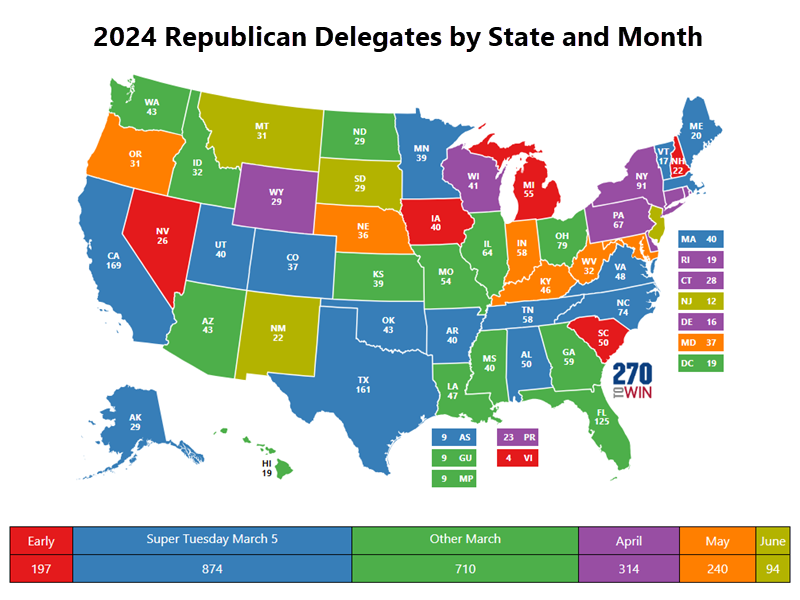
The exact number of delegates for Texas within the Republican party is a strategic calculation by the Texas Republican Party. It is influenced by the state’s overall representation in Congress, with additional delegates often awarded based on the state’s past support for the Republican nominee. For the 2024 cycle, the Texas Republican Party has been allocated a significant number of delegates, reflecting its status as a large and influential state within the party. This number is typically around 155-160 delegates, with a portion of these being district-level delegates and the remainder being at-large delegates. The Republican National Committee’s rules for 2024 emphasize a proportional allocation of some delegates, particularly at the congressional district level, while others might be awarded on a winner-take-all basis at the state level. The final confirmation of these numbers is usually released closer to the primary season by the state party.
Democratic Party Delegate Allocation
The Democratic Party, in contrast, generally adheres to a more uniform system of delegate allocation across states, emphasizing proportional representation. For 2024, the Democratic National Committee mandates that delegates be awarded proportionally based on the popular vote results in primaries and caucuses. This means that candidates receive a share of delegates that directly corresponds to their percentage of the vote, provided they meet a certain threshold (often 15% of the vote). The Democratic delegate system also includes different types of delegates:

- Pledged Delegates: These are the majority of delegates and are awarded based on the results of state primaries and caucuses. They are “pledged” to vote for a particular candidate at the convention.
- Unpledged Delegates (Superdelegates): These delegates include members of the Democratic National Committee, elected officials (such as members of Congress and governors), and distinguished party leaders. Superdelegates are free to support any candidate at the convention, though in recent cycles, their role in the initial balloting has been limited to ensure that pledged delegates reflect the will of the voters.
For Texas in 2024, the Democratic Party has a substantial number of delegates, reflecting the state’s large population. This count is typically in the range of 200-210 delegates, with a significant portion being pledged delegates determined by the primary results. The Texas Democratic Party follows the Democratic National Committee‘s rules for proportional allocation, ensuring that candidates who perform well receive a commensurate share of Texas‘s delegates. The exact number of pledged delegates is determined by the state party based on the total number of voters participating in the primary, and the distribution is strictly proportional. The inclusion of superdelegates, while fewer in number compared to pledged delegates, adds another layer to the delegate count, though their impact on the initial nomination is typically minimal.
The Texas Primary and Its Delegate Significance
Texas holds one of the largest and most influential primaries in the nation. Its early position in the primary calendar (though not as early as Iowa or New Hampshire) means that candidates are vying for its significant delegate haul. The sheer number of voters in Texas makes its primary a crucial test of a candidate’s ability to build and mobilize a broad coalition.
The Impact on Candidate Strategy
The delegate count for Texas directly influences campaign strategies. Candidates must invest considerable resources in campaigning within the state, understanding that winning a large share of Texas delegates can provide a significant boost in the overall delegate count. This often leads to extensive advertising, large rallies, and targeted outreach efforts across the diverse regions of Texas, from the major metropolitan areas like Houston and Dallas to the more rural communities. The state’s demographic diversity also means that candidates need to appeal to a wide range of voter groups, including Hispanic, African American, and white voters, as well as urban, suburban, and rural populations.

Factors Influencing Delegate Numbers
The exact number of delegates a state sends to the national conventions is not static. It can be influenced by several factors, including:
- Population Growth: States with significant population growth may see an increase in their representation, which in turn affects their delegate count.
- Party Rules and Revisions: Both parties periodically review and revise their delegate allocation rules. These changes can impact how delegates are distributed among the states.
- Past Electoral Performance: While less of a direct factor for delegate numbers in 2024, a state’s historical support for a party can sometimes play a role in bonus delegate allocations or other party-specific considerations.
For 2024, Texas is expected to maintain its position as one of the top states in terms of delegate allocation for both parties. The official numbers, confirmed by the respective state parties and national committees, are crucial for anyone following the nomination process. While precise figures are released closer to the election year, the general understanding of proportional versus winner-take-all systems, combined with the substantial population of Texas, allows for an accurate estimation of its significant role in selecting the next presidential nominees.
In conclusion, Texas‘s delegate count for 2024 is a critical element in the presidential nomination process. With its large population and diverse electorate, the state’s delegates carry substantial weight. Understanding the distinct allocation methods of the Republican and Democratic parties, as well as the strategic importance of the Texas primary, provides essential insight into the dynamics of the 2024 election. The approximately 155-160 Republican delegates and 200-210 Democratic delegates underscore Texas‘s enduring influence on the path to the White House.
LifeOutOfTheBox is a participant in the Amazon Services LLC Associates Program, an affiliate advertising program designed to provide a means for sites to earn advertising fees by advertising and linking to Amazon.com. Amazon, the Amazon logo, AmazonSupply, and the AmazonSupply logo are trademarks of Amazon.com, Inc. or its affiliates. As an Amazon Associate we earn affiliate commissions from qualifying purchases.