
The allure of Hawaii has remained a constant in the global imagination for decades. Known for its emerald-green volcanic peaks, crystalline waters, and the profound spirit of Aloha, the archipelago serves as a primary pillar of the United States tourism industry. Understanding how many tourists visit these islands each year requires a deep dive into shifting global trends, economic recoveries, and the evolving philosophy of travel that prioritizes sustainability over sheer volume.
Statistical Overview: Tracking the Flow of Visitors to the Archipelago
The trajectory of tourism in Hawaii has historically been one of consistent growth, peaking in 2019 when the state welcomed a record-breaking 10.4 million visitors. Following the global disruption of the pandemic, the numbers saw a sharp decline, but the recovery has been remarkably robust. According to data from the Department of Business, Economic Development and Tourism (DBEDT), the islands now see an annual visitor count hovering between 9.2 million and 9.8 million people.
Regional Market Breakdowns
The majority of these travelers arrive from the United States mainland, particularly from the West Coast and East Coast. These domestic markets account for nearly 75% of the total visitor volume. International travel, while recovering more slowly, remains vital. Japan has traditionally been the largest international source market, with hundreds of thousands of Japanese travelers visiting Honolulu annually to experience its unique blend of urban sophistication and tropical relaxation. Other significant contributors include Canada, Australia, and South Korea, each bringing a distinct demographic and spending pattern to the islands.
Spending and Economic Impact
While the number of visitors is a key metric, the Hawaii Tourism Authority (HTA) has shifted its focus toward visitor expenditures. Modern tourism strategies are designed to attract “high-value” travelers—those who stay longer and spend more locally. On average, tourists spend billions of dollars annually in the state, supporting over 200,000 jobs. This economic engine funds essential public services, but it also places a significant burden on the infrastructure of islands like Oahu and Maui.
The Cultural Fabric: How Tourism Intersects with Native Hawaiian Traditions
The massive influx of millions of people annually creates a complex relationship between the tourism industry and Native Hawaiian culture. Tourism is no longer just about sightseeing; it is about cultural exchange and the preservation of the indigenous identity.
The Concept of Malama Hawaii
In recent years, the state has launched the Malama Hawaii initiative. This program encourages visitors to “give back” to the land and the community during their stay. Rather than being passive observers, tourists are invited to participate in reforestation projects, fishpond restoration, or beach cleanups. This shift in the tourism model aims to ensure that the millions of people visiting the islands contribute to their preservation rather than their depletion.
Authentic Cultural Experiences
The Polynesian Cultural Center on Oahu remains one of the most visited attractions, offering an immersive look into the traditions of Samoa, Tahiti, and Tonga, alongside Hawaii. However, beyond structured attractions, visitors are increasingly seeking authentic experiences. This includes attending the Merrie Monarch Festival in Hilo, which celebrates the art of Hula, or visiting the Iolani Palace to learn about the Hawaiian Kingdom and its monarchy.
Island by Island: Where the Crowds Converge
Each island offers a different experience, and the tourist numbers reflect these distinctions. Understanding where tourists go helps paint a clearer picture of the state’s tourism landscape.
Oahu: The Gathering Place
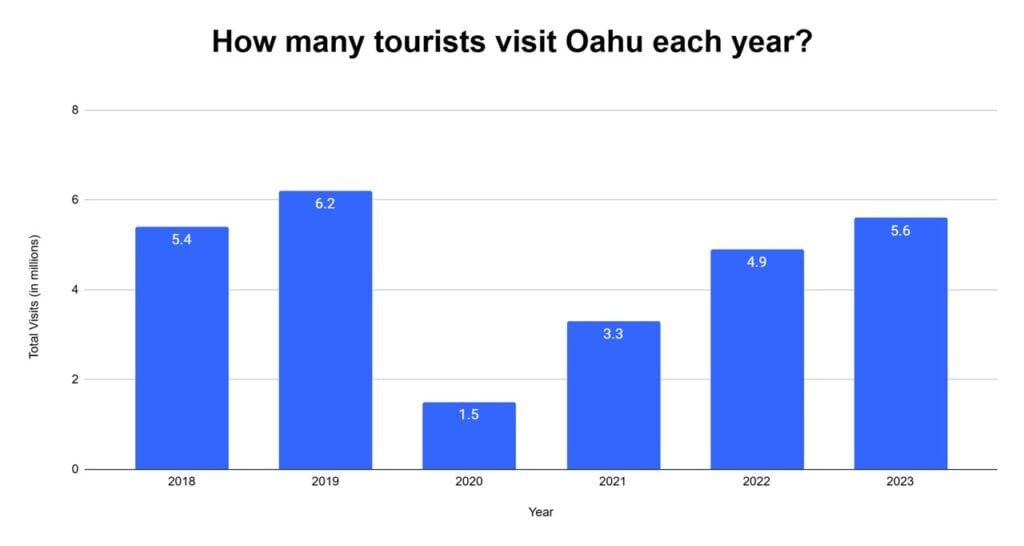
Oahu receives the highest volume of tourists, often exceeding 5 million visitors per year. Honolulu serves as the primary gateway, with Waikiki Beach acting as the epicenter of activity. Famous landmarks like Pearl Harbor and the Diamond Head State Monument are major draws that see thousands of daily visitors. The North Shore of the island attracts surf enthusiasts from around the world, especially during the winter months.

Maui and the Impact of Recent Events
Maui, often voted the best island in the world by travel magazines, typically sees around 2.5 to 3 million visitors annually. However, the tragic wildfires in Lahaina significantly impacted these numbers. The tourism industry on Maui is currently in a state of sensitive recovery, with officials balancing the need for economic revenue with the respect and space required for the community to heal. Destinations like Haleakala National Park and the Road to Hana remain iconic bucket-list items for those visiting the Valley Isle.
Kauai and the Big Island
Kauai, known as the Garden Isle, attracts roughly 1.3 million visitors who are primarily interested in nature and outdoor adventure. The Na Pali Coast and Waimea Canyon State Park offer some of the most dramatic landscapes in the Pacific Ocean.
The Big Island (officially named Hawaii Island) sees around 1.7 million visitors. It is unique for its active volcanic activity at Hawaii Volcanoes National Park. Travelers flock here to see Kilauea and to explore the diverse climate zones, ranging from the black sands of Punaluu to the snow-capped heights of Mauna Kea.
The Gastronomic and Experiential Landscape of Hawaiian Tourism
A significant portion of the tourism experience is defined by the unique culinary offerings and activities available across the islands. Food tourism has become a major driver for the millions of people who visit annually.
Culinary Tourism and Local Flavors
Hawaii has pioneered a unique culinary identity known as Hawaii Pacific Cuisine. Visitors often seek out traditional staples such as Poke, Kalua Pig, and Lau Lau. The proliferation of food trucks on the North Shore and high-end dining in Waikiki showcases the breadth of the food scene. Coffee tourism is also prevalent, with thousands of tourists visiting Kona to tour coffee farms and taste the world-renowned Kona Coffee.
Water Sports and Eco-Tourism
Activities are the heartbeat of the visitor experience. Snorkeling at Hanauma Bay Nature Preserve is one of the most popular activities on Oahu, though it now requires reservations to manage the high volume of tourists. Surfing, originally a sport of Hawaiian royalty, is a major draw in Makaha and the Banzai Pipeline. Whale watching in the Auau Channel between Maui and Lanai during the winter months provides an ecological spectacle that draws huge crowds.
Strategic Travel: Tips for Navigating Hawaii Responsibly
With millions of people descending upon the islands, the state has implemented various measures to manage the flow and ensure a positive experience for both locals and visitors.
When to Visit and Avoiding the Crowds
To avoid the peak crowds, savvy travelers often visit during the “shoulder seasons” of late spring (April to June) and fall (September to November). During these times, the visitor count drops slightly, leading to less crowded beaches and more availability at popular sites. December and July remain the busiest months, coinciding with winter holidays and summer vacations in the United States.
Respecting the Land and Culture
Tourism tips for Hawaii emphasize the concept of “Pono,” which means doing what is right. This includes:
- Using Reef-Safe Sunscreen: To protect the delicate coral reefs at places like Molokini Crater.
- Observing Wildlife from a Distance: Federal laws protect the Hawaiian Monk Seal and the Green Sea Turtle.
- Hiking Responsibly: Staying on marked trails in the Ko’olau Range to prevent erosion and protect native plant species.

The Impact of Short-Term Rentals
The rise of platforms like Airbnb and VRBO has significantly altered how tourists are distributed across the islands. This has led to increased tourist presence in residential neighborhoods on islands like Kauai and Oahu. Local governments are constantly adjusting regulations to balance the availability of housing for residents with the demand for tourist accommodations, highlighting the ongoing challenge of managing such a high-volume tourism destination.
In summary, while approximately 9 to 10 million tourists visit Hawaii each year, the focus of the industry is shifting. The emphasis is no longer merely on the quantity of arrivals, but on the quality of the interaction between the visitor, the local culture, and the natural environment. As the state moves forward, the goal is to create a sustainable tourism model that allows the world to experience the beauty of the Pacific without compromising the integrity of the islands for future generations.
LifeOutOfTheBox is a participant in the Amazon Services LLC Associates Program, an affiliate advertising program designed to provide a means for sites to earn advertising fees by advertising and linking to Amazon.com. Amazon, the Amazon logo, AmazonSupply, and the AmazonSupply logo are trademarks of Amazon.com, Inc. or its affiliates. As an Amazon Associate we earn affiliate commissions from qualifying purchases.