
The hospitality industry is a cornerstone of global commerce, and for developers, investors, and hotel brands, the fundamental unit of measurement is the individual guest room. Understanding the financial requirements of hotel development requires looking beyond the grand facades of the United States skyline or the coastal retreats of the Mediterranean. Instead, professionals focus on the “cost per key.” This metric encompasses the total development cost of a hotel divided by the number of rooms it contains. Building a hotel room is a multi-layered financial undertaking that involves everything from land acquisition and architectural fees to the price of high-thread-count linens and integrated smart-room technology.

The cost to build a hotel room varies dramatically based on the target market, the brand tier, and the geographic location. Whether constructing a streamlined Holiday Inn Express or a sprawling Ritz-Carlton, the allocation of capital follows a structured but complex path.
Decoding the Cost Per Key Metric across Different Hotel Tiers
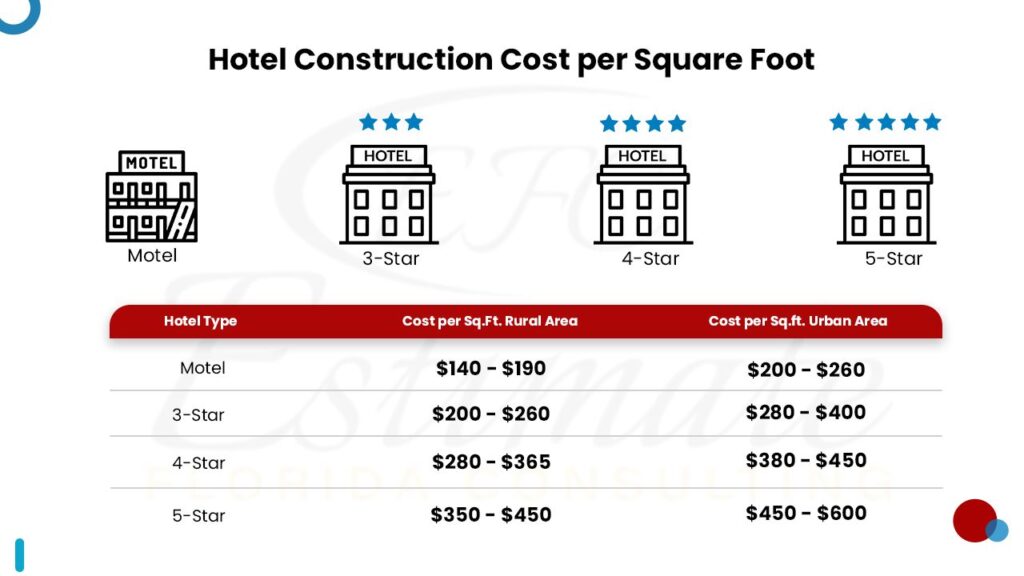
Hotel development is categorized by “chain scales,” a ranking system that determines the level of service, amenities, and luxury provided. As the service level increases, the cost per key escalates significantly.
Economy and Midscale Segments
At the entry-level of the market, economy and midscale hotels prioritize efficiency and functionality. In countries like India or parts of the United States, the cost to build an economy room can range from $150,000 to $250,000 per key. These properties often utilize standardized designs and prefabricated components to keep costs low. Brands under the Wyndham Hotels and Resorts umbrella often follow these models to ensure rapid deployment and consistent quality across diverse regions.
Upscale and Upper Upscale Segments
Moving into the upscale territory, such as properties managed by Marriott International or Hilton, the costs rise to reflect better materials, larger room footprints, and expanded public spaces like gyms and conference rooms. The cost per key in this segment typically falls between $350,000 and $600,000. In competitive markets like Chicago or Berlin, high labor costs and strict building codes can push these figures toward the higher end of the spectrum.
The Luxury Tier
Luxury hotel development is an entirely different financial animal. When building a Four Seasons or an Aman Resorts property, the cost per key can easily exceed $1 million, and in some cases, reach $2 million or more. These costs are driven by bespoke furniture, rare materials like Carrara marble, and the inclusion of extensive back-of-house infrastructure required to provide five-star service. For example, the construction of the Rosewood Hong Kong represented a massive investment per room due to its prime location in Kowloon and its uncompromising level of opulence.
A Comprehensive Breakdown of Construction and Development Expenses
To understand where the money goes, one must break down the total investment into four primary buckets: land, hard costs, soft costs, and FF&E (Furniture, Fixtures, and Equipment).
Land Acquisition and Site Preparation
The foundation of any hotel project is the land it sits on. In high-demand urban centers like London or New York City, land can account for 15% to 25% of the total project cost. Site preparation also includes clearing existing structures, environmental remediation, and ensuring the site is connected to essential utilities. In coastal areas such as Miami or the Maldives, specialized foundations may be required to protect against rising sea levels, adding millions to the initial budget.
Hard Costs: The Physical Structure
Hard costs refer to the physical construction of the building—the “bricks and mortar.” This includes the structural frame, roofing, plumbing, electrical systems, and the facade.
- Labor: Skilled labor shortages in Europe and North America have driven up hard costs significantly in recent years.
- Materials: The price of steel, concrete, and glass fluctuates based on global trade and supply chain stability.
- The Guest Room Shell: Inside the room, hard costs cover the walls, flooring, and the highly expensive “wet stack” or bathroom area, which is often the most costly square footage in the entire building.
Soft Costs: Architecture and Administration
Soft costs are the intangible expenses necessary to bring a project to life. These include architectural fees, interior design services, legal fees, permits, and insurance. Developing a brand-new Hyatt property requires extensive coordination with brand consultants to ensure the building meets specific brand standards. These standards dictate everything from the thickness of the soundproofing in the walls to the speed of the elevators.
FF&E and OS&E
Furniture, Fixtures, and Equipment (FF&E) cover everything that isn’t permanently attached to the building. This includes beds, desks, lighting fixtures, and window treatments. Operating Supplies and Equipment (OS&E) refers to smaller items like linens, towels, glassware, and the technology inside the room. In a luxury setting like the Burj Al Arab in Dubai, the FF&E budget alone can be higher than the total construction cost of an economy hotel room.
Geographic Influence on Development Budgets
Location is perhaps the most significant variable in determining construction costs. The price of building a 200-room hotel in Singapore is drastically different from building the same property in Bangkok.
High-Cost Urban Hubs
In “tier-one” global cities, developers face a “perfect storm” of high costs. In Paris or Tokyo, strict historical preservation laws may require developers to maintain original facades while gutting the interior, a process far more expensive than ground-up construction. Furthermore, the logistical challenge of moving materials into a congested city center like Manhattan adds a “congestion premium” to every delivery.
Emerging Markets and Resort Destinations
Conversely, in emerging markets like Vietnam or parts of Mexico, lower labor costs can reduce the hard cost component. However, these savings are often offset by the need to import specialized materials or technology that aren’t available locally. Building a luxury resort on a remote island in the Seychelles requires transporting every piece of timber and every bathtub by sea, which can inflate the cost per key beyond that of a city-center hotel.
Design, Technology, and the Modern Hotel Room
Modern guest expectations are driving up the cost of hotel rooms as brands race to integrate the latest technology and sustainability features.
The Integration of Smart Technology
Today’s hotel room is no longer just a place to sleep; it is a tech-enabled sanctuary. Developers must now budget for high-speed fiber-optic cabling, integrated room controls (lighting, climate, and entertainment), and keyless entry systems. In properties like the W Hotels chain, technology is a core part of the guest experience, requiring significant upfront investment in hardware and software integration.
Sustainability and Green Building Standards
Environmental, Social, and Governance (ESG) criteria are increasingly influencing hotel construction. Achieving certifications like LEED or BREEAM can add 5% to 10% to the initial construction cost. However, these investments in high-efficiency HVAC systems, solar panels, and water recycling systems are often seen as necessary for long-term operational savings and to appeal to the eco-conscious traveler visiting destinations like Costa Rica or Scandinavia.
The Rise of Modular Construction
To combat rising costs, some developers are turning to modular construction. In this process, entire hotel rooms—complete with bathrooms, wiring, and even furniture—are built in a factory in China or Poland and then shipped to the construction site. The rooms are then stacked together like Lego blocks. This method, utilized by brands like CitizenM, can reduce construction timelines by up to 30% and significantly lower labor costs, though it requires high precision during the design phase.
Navigating the Financial Lifecycle of Hotel Development
Building the room is only the first step. Developers must also account for pre-opening costs and the “ramp-up” period.
Pre-Opening Costs
Before a single guest checks in, the hotel must hire and train staff, launch marketing campaigns, and set up the property management systems. For a large-scale resort in Las Vegas like the Bellagio, pre-opening costs can run into the tens of millions of dollars. These costs are often capitalized and folded into the total “cost per key” calculation.
Financing and Interest
Hotel development projects typically take two to five years to complete. During this time, the developer is paying interest on construction loans without generating any revenue. In a high-interest-rate environment, the “cost of carry” can become a major component of the total budget. This is why speed of construction is so vital in the hospitality sector.

Capital Expenditure (CapEx) Planning
Experienced owners know that the cost of building a hotel room is followed by the ongoing cost of maintaining it. Most franchise agreements with major groups like Accor or InterContinental Hotels Group require a “Property Improvement Plan” (PIP) every few years. This ensures the room remains up to modern standards, which might mean a full renovation of the FF&E every seven to ten years.
In summary, the question of how much it costs to build a hotel room does not have a single answer. It is a spectrum that reflects the diversity of the hospitality industry itself. From a $150,000 budget-friendly room in a secondary market to a $2 million suite overlooking the Eiffel Tower in Paris, every dollar spent is a calculated move to capture a specific segment of the global traveling public. For the developer, success lies in balancing the high cost of construction with the projected Average Daily Rate (ADR) and occupancy, ensuring that the finished room is not just a place for rest, but a profitable asset in a competitive global market.
LifeOutOfTheBox is a participant in the Amazon Services LLC Associates Program, an affiliate advertising program designed to provide a means for sites to earn advertising fees by advertising and linking to Amazon.com. Amazon, the Amazon logo, AmazonSupply, and the AmazonSupply logo are trademarks of Amazon.com, Inc. or its affiliates. As an Amazon Associate we earn affiliate commissions from qualifying purchases.