
Understanding the complexities of alimony in Florida can be a daunting task for many navigating a divorce. Unlike child support, which often follows strict statutory guidelines, alimony calculations in the Sunshine State are more nuanced, relying heavily on the specific circumstances of each case. This article aims to demystify the factors that influence alimony awards, the different types of alimony available, and how a judge determines the duration and amount.
Factors Influencing Alimony Awards in Florida
Florida Statute 61.08 outlines the primary considerations a court will take into account when deciding whether to award alimony and, if so, in what amount and for how long. The overarching principle is to ensure fairness and to help the receiving spouse achieve economic self-sufficiency. Judges are granted significant discretion in these matters, meaning that no two alimony cases are precisely alike.

Marital Misconduct and Its Impact
While once a dominant factor, marital misconduct is now considered alongside other relevant factors in Florida alimony determinations. If one spouse engaged in adultery or other behavior that significantly contributed to the breakdown of the marriage, and this is proven to the court, it can influence the judge’s decision. However, it is not an automatic disqualifier or guarantee of alimony. The court will assess its relevance in the context of the overall financial picture and the needs of the parties.
Standard of Living During the Marriage
One of the key objectives of alimony is to allow the spouse with the lower or no income to maintain a lifestyle reasonably comparable to the one they enjoyed during the marriage. This means a judge will scrutinize the couple’s spending habits, assets, and overall financial well-being during their union. For instance, a couple accustomed to frequenting upscale restaurants, traveling extensively, or owning multiple luxury vehicles may see this reflected in the alimony calculation, especially if one spouse’s earning capacity is significantly higher than the other’s.
Age and Physical/Emotional Condition of Each Spouse
The age and health of each party are crucial considerations. An older spouse who has been out of the workforce for many years may face greater challenges in re-entering it and achieving financial independence. Similarly, a spouse with a chronic illness or disability that limits their earning potential will likely receive more favorable consideration for alimony. The court aims to provide support that compensates for these disadvantages.
Contribution to the Marriage
The court will assess the contributions of each spouse to the marriage, both tangible and intangible. This includes not only the income-earning spouse’s financial contributions but also the non-income-earning spouse’s role as a homemaker, caregiver, or supporter of the other’s career. Sacrifices made by one spouse to further the other’s education or career advancement will also be weighed heavily.
Duration of the Marriage
The length of the marriage is a significant determinant, particularly for rehabilitative and durational alimony. Generally, longer marriages are more likely to result in awards of alimony, and the duration of the alimony payments may also be extended. For very short marriages, alimony might be minimal or non-existent, while for marriages exceeding 17 years, permanent alimony might be considered, although it is not automatic.
Financial Resources of Each Spouse
This is perhaps the most critical factor. The court will meticulously examine the income, assets, and liabilities of both parties. This includes:
- Income: Wages, salaries, bonuses, commissions, self-employment income, investment income, retirement benefits, and any other sources of revenue.
- Assets: Real estate (including the marital home), bank accounts, stocks, bonds, retirement accounts (401(k)s, IRAs), vehicles, and personal property.
- Liabilities: Mortgages, car loans, credit card debt, and other financial obligations.
The court will aim to ensure that neither spouse is left destitute while the other enjoys a disproportionately high standard of living post-divorce.
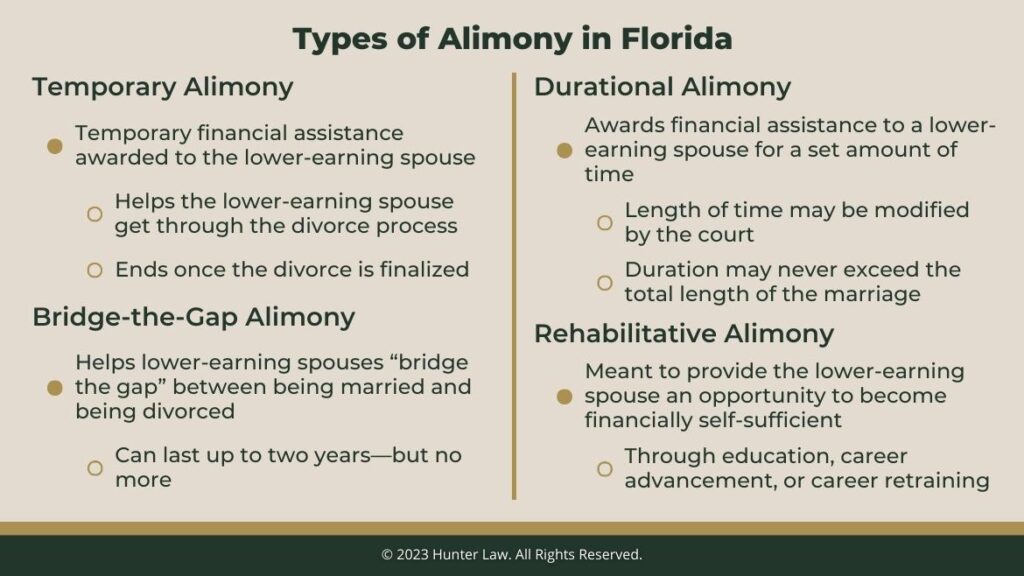
Types of Alimony in Florida
Florida law recognizes several distinct types of alimony, each designed to serve a specific purpose and address different marital circumstances. Understanding these categories is vital for comprehending how alimony is awarded.
Bridge-the-Gap Alimony
This form of alimony is intended to help a spouse transition from married life to being single. It’s typically awarded for a short, specific period to help the recipient meet immediate needs while they establish self-sufficiency. This might include covering living expenses while securing employment or undergoing necessary retraining. Bridge-the-gap alimony cannot exceed two years and is not dischargeable in bankruptcy.
Rehabilitative Alimony
Rehabilitative alimony is designed to help a spouse who lacks sufficient income to meet their reasonable needs and who is financially dependent on the other spouse. The purpose is to provide financial support for a defined period while the recipient pursues education, training, or a business venture that will enhance their earning capacity. A detailed rehabilitative plan is usually required, outlining the steps the recipient will take to become self-supporting. This type of alimony can be modified or terminated if the recipient fails to comply with the plan or achieves self-sufficiency sooner than anticipated.
Durational Alimony
Durational alimony is awarded following marriages of short or moderate duration, typically when the court does not find justification for permanent alimony but deems that some ongoing support is necessary. The purpose is to provide financial assistance for a specified period, allowing the recipient to adjust to their new economic circumstances. The length of the award is generally based on the length of the marriage. For example, marriages between 3 and 10 years might result in durational alimony for up to 5 years.
Permanent Alimony
Permanent alimony is typically reserved for long-term marriages where one spouse is demonstrably unable to become self-supporting, even with rehabilitative efforts. This type of alimony is intended to provide long-term financial security and is awarded when the marriage was of a significant duration (often 17 years or more) and the receiving spouse’s need and the paying spouse’s ability to pay are established. While it is called “permanent,” it can be terminated under certain circumstances, such as the death of either party, remarriage of the recipient, or cohabitation of the recipient with another person in a romantic relationship for a specified period.
Calculating the Amount and Duration of Alimony
The actual monetary amount and the length of time alimony will be paid are not fixed formulas. Instead, they are the result of a judicial balancing act, weighing the aforementioned factors.
Determining the Amount
The court will consider the needs of the recipient spouse and the ability of the paying spouse to pay. This involves a thorough review of financial documentation, including pay stubs, tax returns, bank statements, and property appraisals. The goal is to strike a balance that is fair and equitable for both parties. For example, if a spouse earned $200,000 annually during the marriage and the other spouse earned $30,000, the court might aim to provide the lower-earning spouse with enough support to maintain a lifestyle closer to what they experienced during the marriage, without unduly burdening the higher-earning spouse to the point of financial hardship.
Determining the Duration
The duration of alimony is as critical as the amount. As mentioned, it is heavily influenced by the length of the marriage. However, even in long-term marriages, permanent alimony is not guaranteed. The court will assess the rehabilitative potential of the recipient spouse. If there is a reasonable expectation that the recipient can become self-supporting through education or employment, even after a long marriage, the court might opt for durational or rehabilitative alimony instead of permanent support.
The Role of Legal Counsel
Given the subjective nature of alimony awards, it is highly advisable for individuals going through a divorce in Florida to seek legal counsel from an experienced family law attorney. An attorney can help you understand your rights and obligations, gather necessary documentation, negotiate with the other party, and represent your interests effectively in court. They can also explain how recent changes in Florida alimony law might impact your specific situation.
Navigating alimony in Florida requires a comprehensive understanding of the legal framework and the specific facts of your case. By considering all the relevant factors, types of alimony, and the guidance of legal professionals, individuals can better prepare for and understand the potential outcomes of alimony determinations.
LifeOutOfTheBox is a participant in the Amazon Services LLC Associates Program, an affiliate advertising program designed to provide a means for sites to earn advertising fees by advertising and linking to Amazon.com. Amazon, the Amazon logo, AmazonSupply, and the AmazonSupply logo are trademarks of Amazon.com, Inc. or its affiliates. As an Amazon Associate we earn affiliate commissions from qualifying purchases.