
The franchise tax in Texas is a complex topic, often leading to confusion for businesses operating within the state. Unlike typical income taxes, the Texas franchise tax is levied on the “privilege” of doing business in Texas. It’s not a tax on profit but rather on either revenue or the cost of compensation, depending on a business’s specific circumstances. Understanding the intricacies of this tax is crucial for compliance and financial planning for any entity that meets the state’s thresholds.
Understanding the Texas Franchise Tax
The Texas franchise tax is assessed annually by the Texas Comptroller of Public Accounts. It applies to all corporations, limited liability companies (LLCs), partnerships, and professional associations formed or doing business in Texas. Sole proprietorships and general partnerships where all partners are natural persons are generally exempt. The tax is designed to be revenue-neutral, meaning it aims to collect the same amount of revenue as the old corporate franchise tax it replaced.
Key Concepts and Definitions
To navigate the franchise tax, several key terms must be understood:
- Taxable Entity: This refers to any entity subject to the franchise tax. It includes corporations, LLCs, partnerships, and professional associations.
- Apportionment: For businesses operating both inside and outside of Texas, a portion of their total revenue is allocated to Texas based on a specific apportionment factor. This ensures that only revenue generated within the state is subject to the tax.
- Gross Receipts: This is the total revenue of a business before any deductions. In the context of the franchise tax, gross receipts can be a primary basis for calculating the tax liability.
- Total Revenue: This is a broader term that encompasses gross receipts and other forms of income. The specific definition used by the Comptroller is critical for accurate reporting.
- Cost of Goods Sold (COGS): For certain businesses, COGS may be deductible from gross receipts. This typically applies to businesses that manufacture or sell tangible personal property.
- Compensation: For some entities, the franchise tax is calculated based on the total compensation paid by the business to its employees and officers.
The Threshold for Taxation
A significant aspect of the Texas franchise tax is that not all businesses are required to pay. An entity is generally not subject to the franchise tax if its total revenue in Texas is $1.23 million or less. This threshold is adjusted periodically for inflation. Businesses whose total revenue in Texas exceeds this amount must file a franchise tax report, even if no tax is due.
Calculating the Franchise Tax
The calculation of the Texas franchise tax depends on a business’s total revenue and its chosen accounting method. There are two primary methods for calculating the tax liability for entities exceeding the $1.23 million threshold:
Method 1: Margin Tax Calculation (Based on Revenue)
This is the most common method and is based on a business’s “taxable margin.” The taxable margin is determined by subtracting certain deductions from total revenue.
Determining Total Revenue
The first step is to accurately calculate the entity’s total revenue. This includes all income generated from the sale of goods or services, as well as any other income derived from the entity’s business activities. For businesses with operations outside of Texas, only the portion of revenue apportioned to Texas is considered.
Deductions for Margin Tax
Several deductions are allowed to arrive at the taxable margin:
- Cost of Goods Sold (COGS): For businesses that sell tangible personal property, the direct costs of acquiring or producing those goods can be deducted. This typically includes the cost of raw materials, direct labor, and manufacturing overhead.
- Compensation: A significant deduction is available for compensation paid to employees and officers. This deduction is capped at a certain percentage of total revenue.
- Wages: Specific deductions related to wages paid to employees may also be applicable.
- Other Authorized Deductions: Texas law permits other deductions, such as the cost of purchased services, advertising, and energy costs, depending on the business’s industry and activities.
Tax Rates
Once the taxable margin is determined, it is taxed at one of the following rates:
- 0.75%: This rate applies to businesses primarily engaged in wholesale, retail, or professional services.
- 0.375%: This rate applies to businesses primarily engaged in retail trade or certain specific industries.
- 0.5%: This rate applies to businesses primarily engaged in agriculture, fishing, forestry, and mining.
A minimum tax may apply if the calculated tax is less than a certain amount.
Method 2: Total Revenue Calculation
For businesses whose total revenue (before deductions) is $10 million or less, they have the option to pay the franchise tax based solely on their total revenue, without calculating a taxable margin.
- Tax Rate: This method uses a flat rate of 0.575% applied to total Texas revenue.
This option can be advantageous for businesses with high COGS or significant compensation expenses that would substantially reduce their taxable margin under Method 1. However, it’s essential to perform calculations under both methods to determine which is more financially beneficial.
Filing and Reporting Requirements
Regardless of whether a tax is due, entities that meet the $1.23 million revenue threshold must file an annual franchise tax report.
Filing Deadlines
The franchise tax report is typically due on May 15th of each year. Extensions may be available under certain circumstances.
Filing Methods

Reports are filed electronically through the Texas Comptroller of Public Accounts website.
Required Information
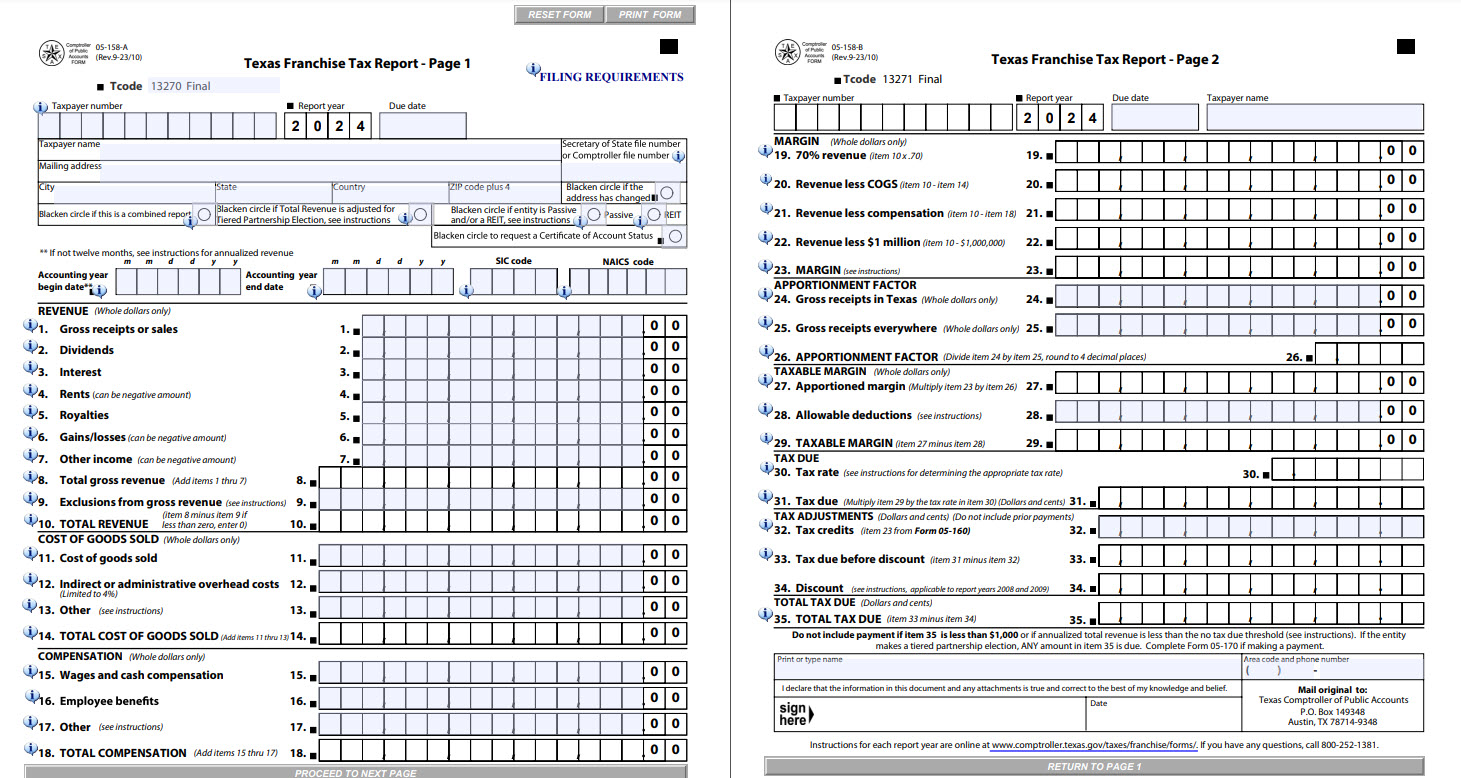
The franchise tax report requires detailed financial information, including:
- Entity identification and ownership details.
- Total revenue and its apportionment to Texas.
- Deductions claimed, such as COGS and compensation.
- Information on public filings and any changes in entity structure.
Special Considerations for Different Business Structures
The franchise tax rules can have nuanced applications depending on the business structure.
Limited Liability Companies (LLCs)
LLCs in Texas are generally subject to the franchise tax. Their liability is calculated based on the margin tax or the total revenue method, similar to corporations. The $1.23 million threshold applies to their total Texas revenue.
Partnerships
General partnerships where all partners are natural persons are typically exempt. However, if a general partnership includes any entity as a partner (e.g., a corporation or another LLC), or if it’s a limited partnership or limited liability partnership, it will likely be subject to the franchise tax.
S Corporations and C Corporations
C Corporations are directly liable for the franchise tax. S Corporations also pay the franchise tax, but their shareholders do not pay it on their individual tax returns, as the tax is levied at the entity level.
Professional Service Corporations
These entities have specific rules and may have different apportionment factors or allowable deductions.
Tips for Compliance and Minimizing Tax Liability
Navigating the Texas franchise tax can be challenging, but proactive planning can help businesses remain compliant and potentially reduce their tax burden.
1. Accurately Determine Your Threshold
The first and most crucial step is to accurately calculate your total Texas revenue. If it consistently remains below the $1.23 million threshold, you will be exempt from paying the tax, although you will still need to file a “No Tax Due” report.
2. Meticulous Record-Keeping
Maintain detailed and organized financial records. This is essential for accurately calculating total revenue, COGS, compensation, and other eligible deductions. Proper documentation will be vital if the Texas Comptroller of Public Accounts audits your business.
3. Understand Your Apportionment Factor
If your business operates in multiple states, understanding how to accurately apportion your revenue to Texas is critical. The state provides specific formulas and guidelines for this calculation.
4. Maximize Eligible Deductions
Thoroughly review the allowable deductions for both the margin tax and total revenue methods. Ensure you are claiming all deductions for which your business qualifies. This may include:
- Compensation: Carefully track all compensation paid to employees and officers.
- Cost of Goods Sold: If applicable, ensure all direct costs associated with producing or acquiring goods are included.
- Purchased Services: Understand which purchased services can be deducted.
5. Compare Calculation Methods
For businesses with revenue exceeding $10 million, always perform calculations using both the margin tax method and the total revenue method (if applicable based on specific criteria) to identify the most tax-efficient approach. For those with revenue below $10 million, comparing the margin tax calculation against the flat 0.575% total revenue tax is also prudent.
6. Seek Professional Advice
The Texas franchise tax is intricate, with evolving regulations. Consulting with a qualified tax professional or CPA experienced in Texas tax law is highly recommended. They can provide personalized guidance, ensure accurate filings, and help identify potential tax savings strategies.
7. Stay Updated on Legislative Changes
Tax laws can change. Regularly monitor updates from the Texas Comptroller of Public Accounts and legislative bodies to stay informed about any modifications to franchise tax rules, thresholds, or rates.
In conclusion, the Texas franchise tax is a significant consideration for businesses operating in the state. By understanding its mechanics, maintaining robust financial records, and leveraging available deductions, businesses can navigate this complex tax system effectively and ensure compliance.
LifeOutOfTheBox is a participant in the Amazon Services LLC Associates Program, an affiliate advertising program designed to provide a means for sites to earn advertising fees by advertising and linking to Amazon.com. Amazon, the Amazon logo, AmazonSupply, and the AmazonSupply logo are trademarks of Amazon.com, Inc. or its affiliates. As an Amazon Associate we earn affiliate commissions from qualifying purchases.