
Navigating daily life, especially in a state as expansive and amenity-rich as Florida, often hinges on the freedom of personal transportation. From commuting to work in bustling cities like Miami or Orlando, to embarking on leisurely road trips to the serene beaches of Naples or the historic charm of St. Augustine, a valid driver’s license is indispensable. However, unforeseen circumstances can lead to the suspension of driving privileges, throwing a significant wrench into one’s routine, lifestyle, and even travel plans. This is where the concept of a hardship license, also known as a “business purpose only” or “employment purpose only” license, becomes a lifeline for many residents of the Sunshine State.
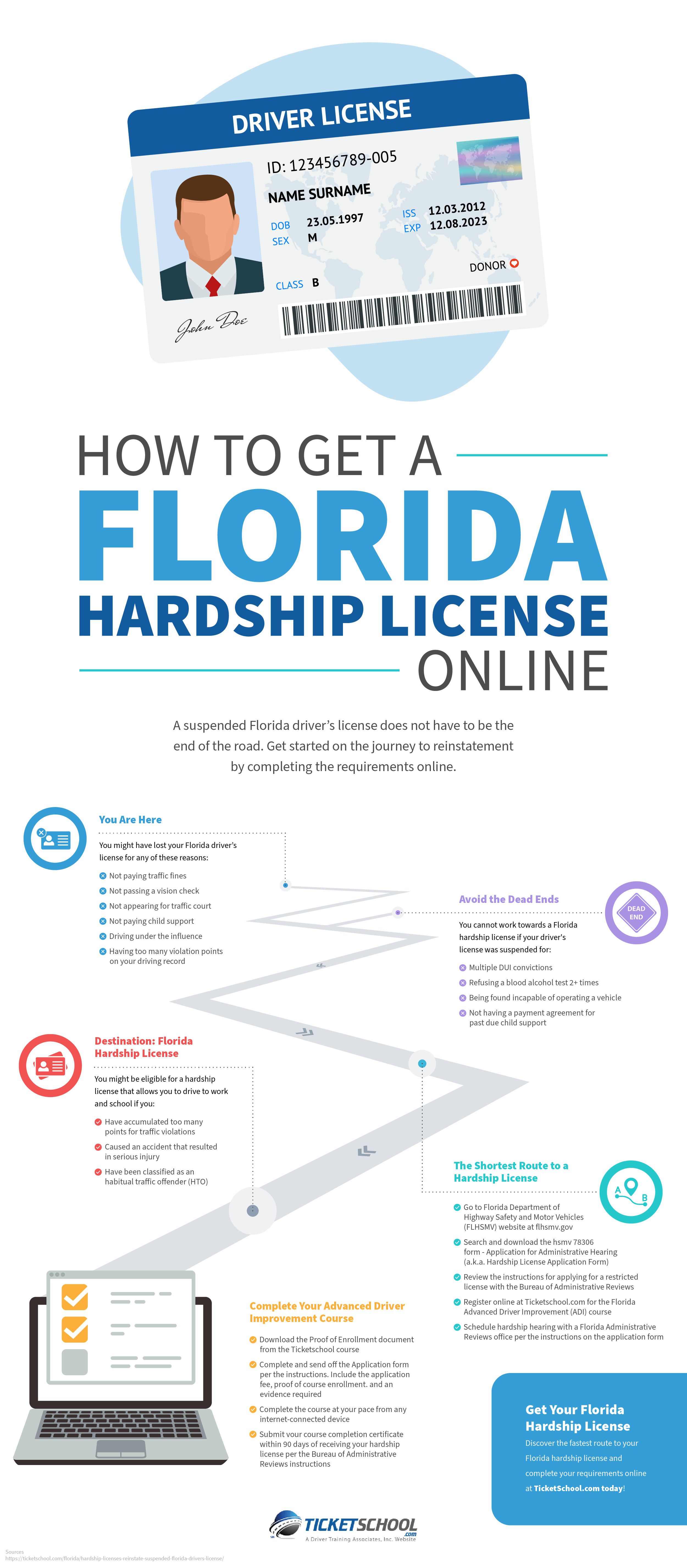
For those accustomed to the flexibility of exploring Florida’s diverse attractions, from the thrilling rides at Walt Disney World Resort to the natural wonders of Everglades National Park, a license suspension can feel like an insurmountable barrier. It can impact everything from your ability to reach your job at a popular resort in Kissimmee to attending essential medical appointments, picking up groceries, or dropping off children at school. Understanding how to apply for a hardship license in Florida is therefore crucial for mitigating the disruption and maintaining a semblance of normalcy and independence. This comprehensive guide will walk you through the intricate process, ensuring you have all the necessary information to pursue this vital driving privilege.
Understanding the Florida Hardship License
A hardship license is not a reinstatement of your full driving privileges; rather, it’s a restricted permit designed to allow individuals with suspended licenses to drive for essential activities. It’s a temporary measure, offering a pathway to managing daily responsibilities while working towards full license reinstatement. The specific rules and eligibility criteria are meticulously enforced by the Florida Department of Highway Safety and Motor Vehicles (FLHSMV), particularly through its Bureau of Administrative Reviews (BAR) offices.
What is a Hardship License?
At its core, a hardship license in Florida is a limited driving privilege. Unlike a standard driver’s license that grants you the freedom to drive anywhere, anytime, a hardship license comes with strict constraints. The primary distinction is whether it’s issued for “Business Purpose Only” or “Employment Purpose Only.”
- Business Purpose Only (BPO): This type of license permits driving for purposes essential to maintaining your livelihood. This broadly includes driving to and from work, driving for work-related tasks, attending school, going to church, medical appointments, and tasks directly related to sustaining your household, such as grocery shopping. For many working in Florida’s vibrant tourism and hospitality sectors, from hotel staff in South Beach to attraction operators in Tampa, this is the most common and vital form of hardship license. It allows them to continue their commute and professional duties, ensuring continuity in their lifestyle and financial stability.
- Employment Purpose Only (EPO): This is a more restrictive version, allowing driving strictly for work-related activities. This means driving to and from your place of employment and for duties directly required by your job. It does not extend to personal errands or other “business purposes” like medical appointments or grocery shopping. This distinction is crucial, as violating these restrictions can lead to further penalties, including an extended suspension period.
The essence of a hardship license lies in demonstrating genuine need. The state understands that removing someone’s ability to drive entirely can have cascading negative effects on their employment, family life, and overall ability to function within society. Therefore, these licenses are granted as a pragmatic solution to alleviate extreme difficulties caused by a license suspension.
Eligibility Requirements and Common Scenarios
The path to obtaining a hardship license is largely determined by the nature of your original license suspension. Florida law outlines specific conditions under which a hardship license might be considered.
Common reasons for license suspension that may allow for a hardship license include:
- Driving Under the Influence (DUI): For a first-time DUI offense, after serving an initial “hard suspension” period (usually 30 or 90 days, depending on refusal to test or blood alcohol content), individuals may be eligible for a hardship license, provided they enroll in or complete a DUI school program. Subsequent DUI offenses make it significantly harder, if not impossible, to obtain a hardship license.
- Too Many Points on Your Driving Record: Accumulating excessive points for traffic violations can lead to suspension. After a certain period, often six months into a twelve-month suspension, you might become eligible for a hardship license.
- Failure to Pay Traffic Fines or Court Obligations: Unpaid tickets or court-ordered fees can result in suspension. Once these financial obligations are met, a hardship license may be an option.
- Failure to Maintain Required Auto Insurance (FR Suspension): If your license was suspended due to not having adequate insurance, you might need to provide proof of current coverage and meet other financial responsibility requirements before applying for a hardship license.
- Driving with a Suspended License (DWLS): While driving while suspended is a serious offense, in some instances, particularly for a first offense, a hardship license might be considered after serving a portion of the suspension.
- Habitual Traffic Offender (HTO) Designation: This is one of the most challenging scenarios. Being designated an HTO (three serious moving violations or fifteen total moving violations within a five-year period) typically results in a five-year license suspension. Eligibility for a hardship license under HTO rules is extremely limited, often requiring one year of the five-year suspension to have passed, and the driver must not have been convicted of specific serious offenses during the past year.
It’s important to note that not all suspensions qualify for a hardship license. Suspensions related to certain felony convictions, serious drug offenses, or certain types of traffic offenses deemed exceptionally dangerous may preclude you from obtaining this limited privilege. For instance, those who rely on driving for their livelihood, such as delivery drivers servicing Miami’s vibrant restaurant scene or tour guides operating in Key West, find a hardship license crucial to maintaining their jobs and contributing to Florida’s economy.
The Application Process: A Step-by-Step Guide
Applying for a hardship license in Florida is a formal process that requires diligence, patience, and meticulous attention to detail. It involves several distinct stages, primarily interacting with the FLHSMV’s Bureau of Administrative Reviews (BAR).
Initial Steps and Documentation
Before you can even request a hearing, you must address the underlying issues that led to your suspension. This often involves completing specific requirements or gathering critical documentation.
- Satisfy DUI School Requirements: If your suspension is DUI-related, you absolutely must enroll in or complete an approved DUI program. This is a non-negotiable prerequisite. You’ll need proof of enrollment or completion. Florida has certified DUI schools across the state, from Jacksonville to Fort Lauderdale.
- Serve Your “Hard Suspension” Period: For many DUI suspensions, there’s an initial period where absolutely no driving is allowed, regardless of hardship. This period must be completed before you can apply for a hardship license.
- Address Other Underlying Issues: If your suspension is due to unpaid fines, outstanding court orders, or lack of insurance, these must be resolved. Obtain official documentation proving payment or compliance. For example, if you failed to pay a toll on the Florida’s Turnpike or accumulated fines in Tallahassee, resolve them and get a receipt.
- Gather Necessary Documents: Be prepared with identification (driver’s license number, social security number), proof of insurance, court documents related to your suspension, and any certificates of completion (DUI school, traffic school). A detailed log of your employment (employer’s name, address, contact) is also vital, especially for an Employment Purpose Only license.
Scheduling Your Hearing with the BAR Office
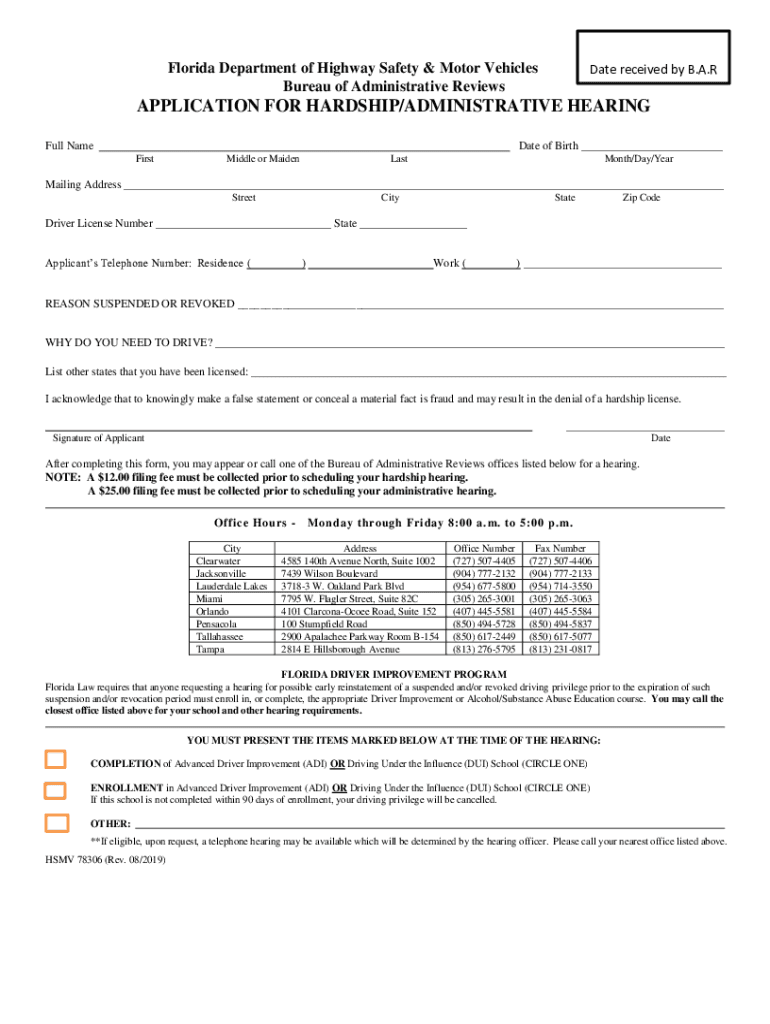
Once you’ve addressed the initial requirements, the next step is to request an administrative hearing with a BAR hearing officer. These offices are located in several major Florida cities, making it accessible for residents throughout the state.
- Locate Your Nearest BAR Office: FLHSMV maintains BAR offices in key locations such as Orlando, Tampa, Miami, Jacksonville, and Tallahassee. You will need to contact the office responsible for your county of residence or the county where your suspension originated.
- Submit Your Request for Hearing: This can often be done online through the FLHSMV website or by mail/fax. Be sure to clearly state your driver’s license number and contact information. You will also need to pay a small application fee at this stage.
- Wait for Scheduling: The BAR office will process your request and schedule a hearing. This may take some time, so patience is key. You will receive notification, often by mail, with the date, time, and location of your hearing. During this waiting period, it’s critical to ensure all your documentation is in order and you have a clear understanding of your case.
The Administrative Hearing
This is your opportunity to present your case to a BAR hearing officer. While less formal than a court proceeding, it’s still a serious administrative review.
- Prepare Your Case: Clearly articulate why you need a hardship license. Outline your travel needs for work, school, medical appointments, or family obligations. For instance, if you work at a popular attraction like Busch Gardens Tampa Bay or a hotel in Clearwater Beach, explain how commuting without a license is impossible or severely detrimental.
- Bring All Documentation: This includes your proof of DUI school enrollment/completion, current proof of insurance, court documents, identification, and any other relevant papers (e.g., doctor’s notes for medical appointments, employment verification letters, school schedules).
- Be Punctual and Professional: Arrive on time, dress appropriately, and be respectful to the hearing officer. Your demeanor can influence the outcome.
- Answer Truthfully and Concisely: The hearing officer will ask questions to determine your eligibility and the extent of your hardship. Be honest and straightforward in your responses. They want to ascertain that you understand the seriousness of your prior offense and are committed to complying with the terms of a restricted license.
- Understanding the Decision: The hearing officer will either approve your request, deny it, or request additional information. If approved, you will typically receive a temporary permit on the spot.
Receiving Your Temporary Permit
If your hardship license request is approved, the BAR hearing officer will issue you a temporary restricted license, often effective immediately. This permit will clearly state the restrictions (e.g., “Business Purpose Only”). You will then need to visit a local Florida Department of Motor Vehicles (DMV) office to have your new physical hardship license issued. This physical card will be your official documentation of your restricted driving privilege. Remember, this is not a full license, and you must adhere strictly to its terms to avoid further penalties.
Navigating Life with a Hardship License
Obtaining a hardship license is a significant step, but it’s equally important to understand and comply with its limitations. This phase requires careful adherence to the stipulated restrictions and a proactive approach toward full license reinstatement.
Restrictions and Responsibilities
The most critical aspect of holding a hardship license is strict adherence to its terms. Whether you have a “Business Purpose Only” or “Employment Purpose Only” license, violating these restrictions can lead to severe consequences, including another suspension, additional fines, or even criminal charges.
- Understand Your Specific Terms: Review your hardship license carefully. It will explicitly state what you are permitted to do. For example, a “Business Purpose Only” license allows driving for work, school, medical needs, and essential household tasks. An “Employment Purpose Only” license is far more restrictive, generally limited to commuting to and from your job. If you typically drive for leisure, such as visiting Universal Orlando Resort or taking a scenic drive along A1A to St. Augustine, those activities are strictly prohibited.
- Carry Supporting Documentation: It’s wise to carry proof of your destinations (e.g., work schedule, appointment cards, school enrollment) when driving with a hardship license. If pulled over, this documentation can help explain your presence on the road.
- Consequences of Violation: Driving outside the scope of your hardship license is considered driving while suspended. This can result in further suspension, heavier fines, impoundment of your vehicle, and even jail time, especially if it’s a repeated offense. This means your journey back to full driving privileges will be significantly lengthened and complicated. Imagine being caught driving to South Beach for a pleasure trip when your license is “Employment Purpose Only” – the repercussions would be immediate and severe.
Maintaining meticulous records of your allowed travel and strictly avoiding any unauthorized detours is paramount. This discipline is not just about avoiding legal trouble; it’s about demonstrating responsibility and commitment to regaining your full driving privileges.
The Path to Full Reinstatement
A hardship license is a temporary solution, not a permanent one. Your ultimate goal should be to satisfy all conditions for full license reinstatement.
- Complete All Requirements: This includes fulfilling any remaining DUI school requirements, completing probation, paying all outstanding fines and fees, and serving the entirety of your original suspension period. For many, this also includes maintaining an ignition interlock device for a specified duration if ordered by the court or FLHSMV.
- Monitor Your Suspension Status: The FLHSMV website offers tools to check the status of your driver’s license. Regularly monitor this to understand when you are eligible for full reinstatement.
- Financial Obligations: Be prepared to pay reinstatement fees. These fees can vary depending on the nature of your suspension and any accumulated penalties. It’s essential to budget for these costs as they are a prerequisite for getting your full license back.
- Visit a DMV Office: Once all conditions are met and your suspension period has ended, you’ll need to visit a DMV office in person. You will need to provide identification, proof of having met all requirements, and pay the final reinstatement fees to receive your unrestricted driver’s license. This final step restores your ability to drive without the “Business Purpose Only” or “Employment Purpose Only” limitations, opening up opportunities for unrestricted travel and lifestyle choices across Florida.
Common Challenges and Expert Tips
While the process for obtaining a hardship license is structured, individuals often encounter various challenges. Being prepared and knowing when to seek additional help can significantly smooth the journey.
Seeking Legal Counsel
Navigating the intricacies of Florida traffic law and FLHSMV procedures can be daunting. For many, especially those with complex cases, consulting with an attorney specializing in traffic or DUI law is highly beneficial.
- When an Attorney is Beneficial:
- Complex Suspension Reasons: If your suspension involves multiple offenses, habitual traffic offender status, or unusual circumstances, an attorney can help decipher the legal jargon and identify the best path forward.
- DUI Cases: DUI laws are notoriously complex, and an attorney can guide you through the specific requirements, potential defenses, and steps needed to secure a hardship license while also addressing any criminal charges.
- Appeals: If your initial request for a hardship license is denied, an attorney can help you understand the reasons for the denial and assist with the appeals process.
- Understanding Your Rights: A lawyer can ensure you understand all your rights and responsibilities, preventing costly mistakes.
- Time Savings: An attorney is familiar with the process and can often expedite the application, reducing stress and confusion.
For those whose livelihood in Florida’s tourism industry – whether as a shuttle driver for a resort in Lake Buena Vista or a mobile concierge for luxury villas in Palm Beach – depends on driving, legal expertise can be an invaluable investment.
Staying Informed and Planning Ahead
The rules and regulations surrounding driver’s licenses can change. It’s vital to stay updated and consider the broader implications of your license status.
- Monitor FLHSMV Updates: Regularly check the FLHSMV website for any changes to laws, forms, or procedures related to license suspensions and hardship licenses. Ignorance of a new rule is not an excuse.
- Keep Excellent Records: Maintain a file with all correspondence, receipts, court documents, and hearing decisions. This can be invaluable if questions or discrepancies arise.
- Plan for Alternative Transportation: Even with a hardship license, your driving is restricted. Plan for alternative transportation for activities outside your permitted scope. Florida’s major metropolitan areas like Miami, Orlando, and Tampa offer public transportation, ride-sharing services, and taxis. However, for exploring Florida’s more remote landmarks or nature parks, planning ahead becomes even more critical. Consider how a suspended license might affect your ability to visit attractions like the Kennedy Space Center Visitor Complex or participate in ecotourism activities far from urban centers.
- Budget for Costs: Factor in all potential costs: DUI school, court fines, reinstatement fees, and potentially legal fees. Financial preparedness is key to a smooth process.
- Focus on Compliance: The entire purpose of a hardship license is to demonstrate that you can be a responsible driver, even under restricted conditions. Embrace the discipline required, and view it as a stepping stone to regaining your full driving privileges and the freedom to fully experience all that Florida has to offer, from its vibrant cities to its tranquil natural retreats.
In conclusion, applying for a hardship license in Florida is a structured but navigable process. By understanding the requirements, preparing meticulously, and adhering strictly to the terms of your restricted license, you can minimize disruption to your daily life and work steadily toward the full reinstatement of your driving privileges. This proactive approach ensures that you can continue to meet essential obligations, maintain your lifestyle, and eventually, once again freely explore the myriad attractions and beautiful destinations across the Sunshine State.
LifeOutOfTheBox is a participant in the Amazon Services LLC Associates Program, an affiliate advertising program designed to provide a means for sites to earn advertising fees by advertising and linking to Amazon.com. Amazon, the Amazon logo, AmazonSupply, and the AmazonSupply logo are trademarks of Amazon.com, Inc. or its affiliates. As an Amazon Associate we earn affiliate commissions from qualifying purchases.