
Navigating the intricacies of academic citation can often feel like deciphering an ancient map, especially when dealing with specific source types like book chapters. For travelers and researchers alike, accurately attributing sources is paramount to upholding academic integrity and acknowledging the intellectual contributions of others. The Chicago Manual of Style (CMOS), a widely respected and comprehensive citation style, offers clear guidelines for citing various works, including those found within edited collections or anthologies. Understanding these rules ensures your research, whether it’s a deep dive into the history of Machu Picchu or an analysis of local culinary traditions in Kyoto, is meticulously sourced. This guide will demystify the process of citing a chapter in a book using Chicago style, covering both its footnote/endnote and author-date systems.

Understanding the Chicago Style: Footnotes/Endnotes vs. Author-Date
The Chicago Manual of Style provides two distinct systems for referencing sources: the Notes and Bibliography system (often referred to as footnote/endnote style) and the Author-Date system. Both systems have their merits and are chosen based on the discipline and specific publication requirements. For those documenting travel experiences, historical analyses of landmarks like the Colosseum, or cultural explorations, the Notes and Bibliography system is frequently preferred for its ability to embed detailed source information directly within the text, without disrupting the narrative flow. The Author-Date system, conversely, is more common in the social and natural sciences, relying on parenthetical in-text citations that correspond to a reference list at the end of the work. Regardless of the chosen system, the core components of a citation for a book chapter remain consistent.
The Notes and Bibliography System
This system uses numbered notes (footnotes at the bottom of the page or endnotes at the end of the document) to cite sources. The first full citation for a source in a note is comprehensive, while subsequent citations for the same source are typically shortened. A bibliography at the end of the work lists all consulted sources alphabetically by author’s last name.
Citing a Chapter in a Book (Notes and Bibliography)
When citing a chapter within an edited book or anthology, the Chicago style requires specific elements to uniquely identify the source and the specific contribution within it. This allows readers to locate the precise information you have referenced.
First Note/Endnote Citation:
The structure for the first citation of a chapter in a book using the Notes and Bibliography system is as follows:
For a Chapter in an Edited Book (with an editor):
Author of Chapter Last Name, First Name. “Title of Chapter.” In Title of Book, edited by Editor First Name Last Name, Chapter or Page Numbers. Place of Publication: Publisher, Year.
- Author of Chapter Last Name, First Name: This is the individual who wrote the specific chapter you are referencing.
- “Title of Chapter”: The title of the chapter should be enclosed in quotation marks.
- In Title of Book: The overall title of the book should be italicized.
- edited by Editor First Name Last Name: If the book has an editor (or editors), their name(s) are included here, preceded by “edited by.” If there are multiple editors, the first editor is listed as “First Name Last Name,” and subsequent editors are listed as “and First Name Last Name.”
- Chapter or Page Numbers: Specify the exact pages or chapter number where the chapter appears. This is crucial for locating the information. For example, “pp. 45-67” for page numbers or “chap. 3” for a chapter.
- Place of Publication: The city where the publisher is located.
- Publisher: The name of the publishing company.
- Year: The year the book was published.
Example:
For a chapter titled “The Ancient Art of Roman Engineering” by Dr. Eleanor Vance, found in a book edited by Professor David Chen titled Engineering Marvels Through the Ages, you would cite it as:
- Vance, Eleanor. “The Ancient Art of Roman Engineering.” In Engineering Marvels Through the Ages, edited by David Chen, 112-135. Rome: Academic Press, 2021.
For a Chapter in a Book with only an Author (no editor):
If the book is not edited and you are citing a chapter within a work by a single author, the structure is slightly different, as there is no editor to acknowledge.
Author of Chapter Last Name, First Name. “Title of Chapter.” In Title of Book, Chapter or Page Numbers. Place of Publication: Publisher, Year.
Example:
If you are citing a chapter titled “The Silk Road’s Golden Age” by Marco Polo from his own book Journeys, you would cite it as:
- Polo, Marco. “The Silk Road’s Golden Age.” In Journeys, 78-95. Venice: Voyager Publishing, 1450.
Subsequent Note/Endnote Citation:
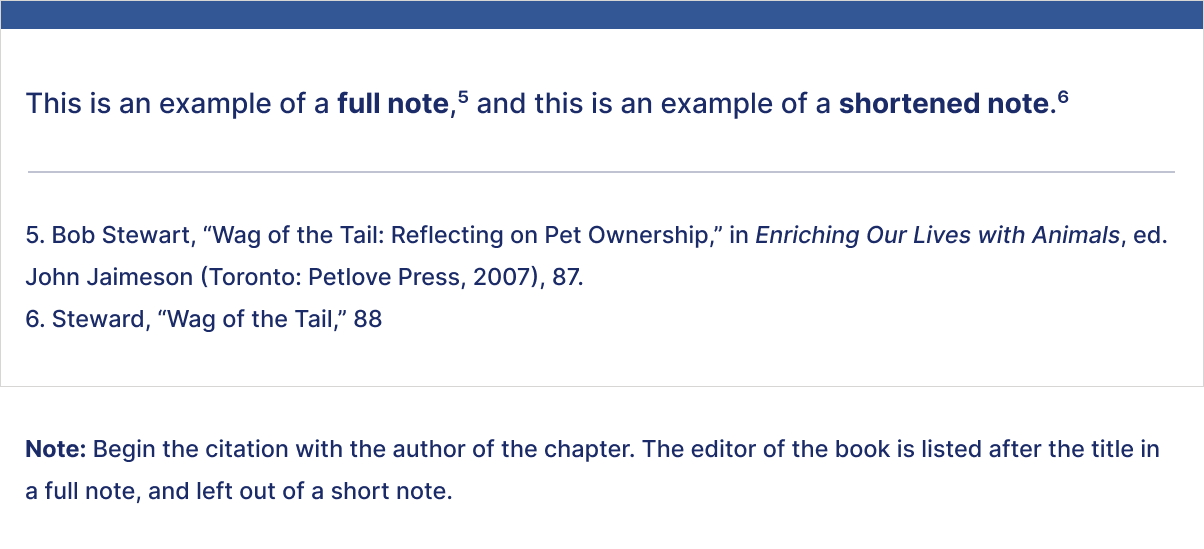
After the first full citation, subsequent references to the same chapter can be shortened to save space and streamline the notes.
Author of Chapter Last Name, “Shortened Chapter Title.” In Shortened Book Title, Page Numbers.
Example (Continuing from Vance example):
- Vance, “Ancient Art.” In Engineering Marvels, 120.
Bibliography Entry:
The bibliography entry for a chapter in an edited book mirrors the first note citation but uses a slightly different format, with the author’s last name appearing first for alphabetical sorting.
Author of Chapter Last Name, First Name. “Title of Chapter.” In Title of Book, edited by Editor First Name Last Name, Chapter or Page Numbers. Place of Publication: Publisher, Year.
Example (Continuing from Vance example):
Vance, Eleanor. “The Ancient Art of Roman Engineering.” In Engineering Marvels Through the Ages, edited by David Chen, 112-135. Rome: Academic Press, 2021.
The Author-Date System
The Author-Date system uses in-text citations consisting of the author’s last name and the year of publication, often accompanied by page numbers, enclosed in parentheses. These in-text citations correspond to a reference list at the end of the document, which provides full bibliographic details for each source.
Citing a Chapter in a Book (Author-Date)
In the Author-Date system, the in-text citation for a chapter typically includes the author of the chapter, the year of publication, and the page number. The full details are then provided in the reference list.
In-Text Citation:
(Author of Chapter Last Name Year, Page Numbers)
Example:
If you are referencing material from Dr. Eleanor Vance’s chapter “The Ancient Art of Roman Engineering” from the 2021 book Engineering Marvels Through the Ages, edited by David Chen, your in-text citation would look like this:
The architectural innovations of the Romans were remarkable (Vance 2021, 115).
Reference List Entry:
The reference list entry for a chapter in an edited book provides all necessary bibliographic information for retrieval.
Author of Chapter Last Name, First Name. Year. “Title of Chapter.” In Title of Book, edited by Editor First Name Last Name, Chapter or Page Numbers. Place of Publication: Publisher.
Example (Continuing from Vance example):
Vance, Eleanor. 2021. “The Ancient Art of Roman Engineering.” In Engineering Marvels Through the Ages, edited by David Chen, 112-135. Rome: Academic Press.
For a Chapter in a Book with only an Author (no editor):
If the book has a single author and you are citing a chapter within it, the structure remains consistent.
In-Text Citation:
(Author Last Name Year, Page Numbers)
Example:
For a chapter from Marco Polo’s Journeys:
Polo documented his travels extensively (Polo 1450, 82).
Reference List Entry:
Author Last Name, First Name. Year. “Title of Chapter.” In Title of Book, Chapter or Page Numbers. Place of Publication: Publisher.
Example:
Polo, Marco. 1450. “The Silk Road’s Golden Age.” In Journeys, 78-95. Venice: Voyager Publishing.
Essential Elements for Accurate Chapter Citations
Regardless of whether you employ the Notes and Bibliography system or the Author-Date system, several key pieces of information are vital for correctly citing a chapter in a book. Meticulous attention to detail in gathering these elements will prevent ambiguity and ensure your readers can easily access the original sources. This is particularly important when researching diverse topics, from the historical significance of the Great Wall of China to the culinary landscape of Paris.
Identifying the Author(s) and Chapter Title
The most crucial element is identifying the author of the specific chapter. This is distinct from the editor of the entire book. Ensure you have the full name as it appears on the title page of the chapter. Similarly, the chapter’s title must be accurately transcribed and formatted according to Chicago style—enclosed in quotation marks.
Verifying the Book’s Information
You will need the complete title of the book in which the chapter appears. This title should be italicized. If the book has an editor or multiple editors, their names must be recorded accurately. The place of publication, the publisher’s name, and the year of publication are also indispensable for contextualizing the source. For travel guides or historical analyses, understanding the publication date can be crucial for assessing the currency of information or historical context.
Pinpointing Page or Chapter Numbers
To enable precise referencing, always include the specific page numbers or the chapter number where the cited material can be found. This allows your audience to go directly to the relevant section, saving them time and effort. For instance, if you are citing a passage about the architecture of Hagia Sophia, providing the exact page number is far more helpful than just listing the chapter.
Common Pitfalls and How to Avoid Them
Even with clear guidelines, citation errors can occur. Awareness of common mistakes can help you produce more accurate and professional academic work, whether you are detailing a luxurious stay at the Burj Al Arab Jumeirah or researching ancient trade routes.
Incorrectly Differentiating Author and Editor
A frequent error is confusing the author of a chapter with the editor of the entire book. Remember, the chapter author is the individual whose ideas and words are being directly cited. The editor’s role is to compile and organize the contributions of multiple authors into a cohesive whole.
Inconsistent Formatting
Adhering strictly to Chicago style’s formatting rules, including the use of quotation marks for chapter titles and italics for book titles, is essential. Minor inconsistencies can detract from the professionalism of your work.
Omitting Crucial Information
Ensuring all necessary components—author, chapter title, book title, editor (if applicable), publication details, and page numbers—are present in your citations is non-negotiable. Missing even one element can render a citation incomplete and unhelpful.
Not Differentiating Between First and Subsequent Citations
In the Notes and Bibliography system, failing to shorten subsequent citations can lead to unnecessarily lengthy notes. Conversely, using shortened citations for the first mention is incorrect.

Conclusion
Mastering the art of citing a chapter in a book using Chicago style is an invaluable skill for anyone engaged in scholarly research or detailed writing, particularly within fields that draw heavily on diverse textual sources, such as travel history, cultural studies, or architectural analysis. By meticulously following the established formats for either the Notes and Bibliography system or the Author-Date system, you not only demonstrate respect for intellectual property but also enhance the credibility and clarity of your own work. Accurate citations are the backbone of sound research, allowing your readers to trace your intellectual journey and engage directly with the sources that have informed your insights, whether you are exploring the vibrant markets of Marrakech or the historical depths of Athens.
LifeOutOfTheBox is a participant in the Amazon Services LLC Associates Program, an affiliate advertising program designed to provide a means for sites to earn advertising fees by advertising and linking to Amazon.com. Amazon, the Amazon logo, AmazonSupply, and the AmazonSupply logo are trademarks of Amazon.com, Inc. or its affiliates. As an Amazon Associate we earn affiliate commissions from qualifying purchases.