
Understanding the Supplemental Nutrition Assistance Program in Kansas
Navigating food assistance programs can often feel overwhelming, but securing nutritional support is a vital step for individuals and families facing financial hardship. In Kansas, the Supplemental Nutrition Assistance Program—commonly known as SNAP—serves as a crucial resource to help households buy the food they need for a nutritionally adequate diet. Administered federally by the United States Department of Agriculture and locally by the Kansas Department for Children and Families, this initiative bridges the gap between limited financial resources and wholesome, nourishing meals.

What is Kansas SNAP and Who Does it Help?
SNAP is designed to supplement a household’s food budget rather than cover the entirety of its grocery needs. The program provides eligible residents with an Electronic Benefit Transfer card, which functions similarly to a debit card. This card can be used to purchase eligible food items at authorized retail stores, local farmers’ markets, and even select online grocers across Kansas.
The target demographic for this support is diverse. It includes low-income working adults, seniors living on fixed incomes, individuals with disabilities, and families experiencing temporary unemployment or underemployment. By easing the financial strain of grocery shopping, SNAP allows households to redirect their limited funds toward other essential living expenses, such as housing, utilities, and healthcare.
Economic Impact and Local Resources
Beyond helping individual households, food assistance programs stimulate local economies throughout Kansas. Every dollar of SNAP benefits redeemed at grocery stores and markets generates a multiplier effect within the community, supporting agricultural producers, local retailers, and supply chain workers.
For those navigating the initial stages of claiming benefits, numerous community organizations and food banks—such as those operating in major hubs like Wichita, Kansas City, and Topeka—offer guidance, application assistance, and temporary emergency food supplies while official claims are being processed.
Eligibility Criteria and Financial Guidelines
Before starting the application process, prospective applicants must understand the specific eligibility rules established for Kansas. These guidelines ensure that federal and state resources are directed to households with the greatest need. Eligibility is generally determined by a combination of household composition, gross and net income limits, and resource thresholds.
Income Limits and Household Rules
A household is defined as a group of individuals who live together and customarily purchase and prepare meals together. When evaluating an application, the Kansas Department for Children and Families looks at two primary income categories:
- Gross Income Eligibility: For most households, total monthly cash income must be at or below 130 percent of the federal poverty guidelines. Gross income includes earnings, self-employment income, child support, social security benefits, and unemployment compensation before any deductions are made.
- Net Income Eligibility: After allowable deductions are applied—such as standard deductions, earned income deductions, dependent care costs, medical expenses for elderly or disabled members, and excess shelter costs—the resulting net income must generally fall at or below 100 percent of the federal poverty guidelines.
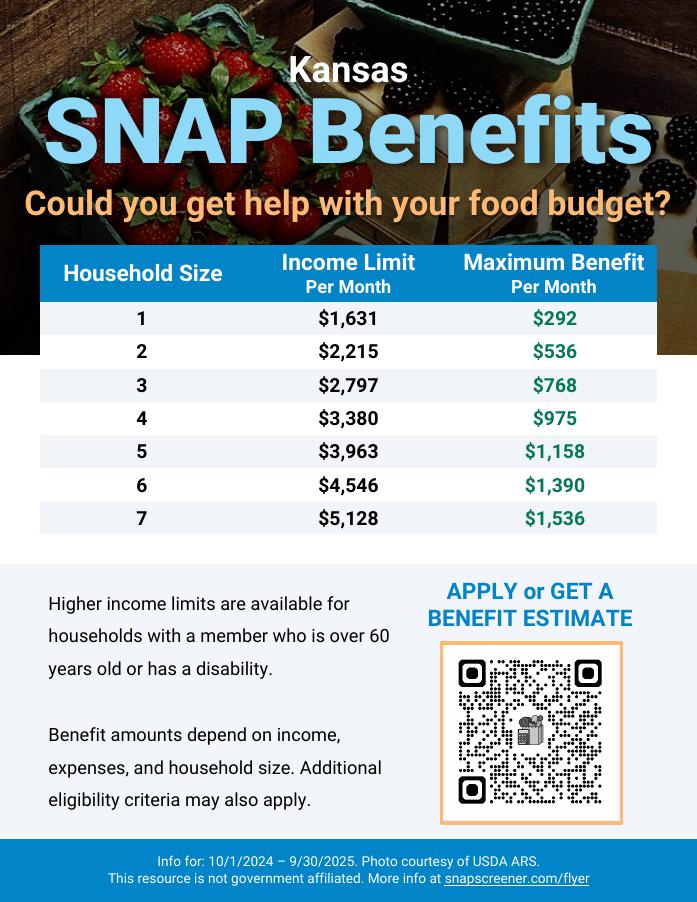
Households that include an elderly member (age 60 or older) or a person with a documented disability face slightly modified rules, often exempting them from the gross income test, though they must still meet net income requirements.
Resource and Asset Limits
In addition to income, the state evaluates household resources, such as liquid assets, savings accounts, and certain vehicles. Fortunately, Kansas has streamlined these rules to make it easier for low-income residents to qualify. Most households have a broad asset limit, and many types of retirement accounts, pensions, and primary homes are entirely excluded from the calculation. Reviewing these criteria beforehand ensures you have a clear picture of your household’s standing before submitting formal paperwork.
Step-by-Step Guide to Filing Your Claim
Once you have reviewed the financial guidelines and determined that your household likely meets the criteria, the next phase involves gathering your documentation and submitting your claim. A systematic approach ensures your application moves smoothly through the review pipeline without unnecessary delays.
Step 1: Gather Required Documentation
To substantiate the information provided on your application, the Kansas Department for Children and Families requires specific verification documents. Having these ready in advance will save significant time:
- Proof of Identity: A government-issued photo ID, driver’s license, or passport for the primary applicant.
- Proof of Income: Recent pay stubs spanning the last 30 days, tax returns for self-employment, or award letters for social security, pension, or child support payments.
- Proof of Expenses: Documentation of housing costs (rent receipts, mortgage statements), utility bills, child care expenses, and out-of-pocket medical costs for elderly or disabled household members.
- Immigration Status: Documentation verifying citizenship or legal residency for non-citizen household members applying for benefits.
Step 2: Submit Your Application
There are multiple convenient ways to submit a claim in Kansas:
- Online: The fastest and most efficient method is utilizing the online self-service portal provided by the state. This digital platform allows you to complete the application, upload verification documents securely, and track the status of your claim in real-time.
- By Mail or Fax: If you prefer a paper format, you can download and print an application from the official state website, complete it by hand, and mail or fax it to your local Kansas Department for Children and Families service center.
- In-Person: You may visit a local office directly to pick up an application, drop off documents, or receive assistance from a caseworker.
Step 3: Complete the Interview
Following the submission of your claim, a caseworker will review your file and schedule an interview. In most cases, this interview is conducted over the telephone for your convenience. During the interview, the caseworker will verify the information on your application, ask clarifying questions regarding your household expenses and income, and explain your rights and responsibilities as a SNAP recipient.
Maintaining Benefits and Maximizing Your Assistance
Successfully claiming nutritional assistance is only the beginning. To ensure uninterrupted support and make the most of your benefits, recipients must adhere to ongoing state reporting requirements and take advantage of additional local food security programs.
Reporting Changes and Periodic Reviews
Once your claim is approved, you have a legal obligation to report certain changes in your household circumstances. Significant alterations—such as a change in household size, an increase in gross income exceeding specific thresholds, or a move to a new address—must be reported to the Kansas Department for Children and Families within a designated timeframe. Failure to report these changes accurately can result in overpayments that must be repaid or the temporary suspension of benefits. Additionally, most households undergo a periodic review or recertification process every 6 to 12 months to re-establish ongoing eligibility.
Leveraging Supplemental Local Programs
To further stretch your food budget, consider combining your SNAP benefits with other community-based initiatives. Many farmers’ markets throughout Kansas participate in matching programs—such as Double Up Food Bucks—which match SNAP dollars spent on fresh, locally grown fruits and vegetables. Utilizing these complementary resources ensures that your household enjoys optimal nutrition, improved health outcomes, and long-term financial stability.
LifeOutOfTheBox is a participant in the Amazon Services LLC Associates Program, an affiliate advertising program designed to provide a means for sites to earn advertising fees by advertising and linking to Amazon.com. Amazon, the Amazon logo, AmazonSupply, and the AmazonSupply logo are trademarks of Amazon.com, Inc. or its affiliates. As an Amazon Associate we earn affiliate commissions from qualifying purchases.