
Navigating the complexities of marriage dissolution can be one of life’s most challenging journeys. For those considering this path in the Sunshine State, understanding “How To File For Dissolution Of Marriage In Florida?” is the crucial first step. While the process may seem daunting, Florida law provides a clear framework designed to guide individuals through this significant life transition. This comprehensive guide aims to demystify the legal requirements, procedures, and considerations involved, offering clarity for anyone embarking on this new chapter.
Dissolution of marriage, commonly known as divorce, involves more than just ending a legal bond; it encompasses a complete restructuring of two individuals’ lives, their finances, and potentially their family dynamics. From understanding the initial filing requirements to finalizing a judgment that addresses property division, parental responsibilities, and support, each stage demands careful attention and often, professional guidance. This article will walk you through the essential components of a Florida divorce, providing a roadmap for a smoother, albeit often emotional, journey towards a new beginning.

Understanding Florida’s Dissolution Process
Florida operates under a specific legal framework for dissolving marriages, emphasizing principles that aim to make the process as equitable and straightforward as possible, given the circumstances. Familiarity with these foundational aspects is essential before taking any formal steps.
Florida’s “No-Fault” State Status
One of the most defining characteristics of marriage dissolution in Florida is its “no-fault” designation. This means that a person seeking a divorce does not need to prove marital misconduct, such as adultery or abandonment, to legally end their marriage. Instead, the primary legal ground for dissolution is simply that the marriage is “irretrievably broken.”
To satisfy this requirement, the court only needs to be convinced that there is no reasonable prospect of reconciliation between the parties. While proof of marital fault is not required to obtain a divorce, it can, in rare cases, become relevant when determining issues like alimony or the equitable distribution of assets, particularly if one party’s actions significantly depleted marital resources. However, the initial hurdle for obtaining the dissolution itself remains the “irretrievably broken” standard, simplifying the initial filing process compared to fault-based jurisdictions.
Residency Requirements for Filing
Before you can file for dissolution in Florida, strict residency requirements must be met. At least one of the parties must have resided in the state for a continuous period of six months immediately preceding the date the Petition for Dissolution of Marriage is filed. This is a jurisdictional prerequisite; if it’s not met, a Florida court cannot legally grant the divorce.
Proof of residency can be established through various means, such as a Florida driver’s license, voter registration, utility bills, or witness testimony. For example, if one spouse has been living in Miami for the past seven months, they meet the residency requirement, even if the other spouse lives out of state or has only recently moved to a different Florida city like Orlando. The court where the petition is filed will typically be in the county where one of the parties resides, such as the Circuit Court in Tampa or Jacksonville.
Types of Dissolution Proceedings
Florida law recognizes different pathways for marriage dissolution, primarily categorized based on the level of agreement between the spouses and the complexity of their marital estate and family situation.
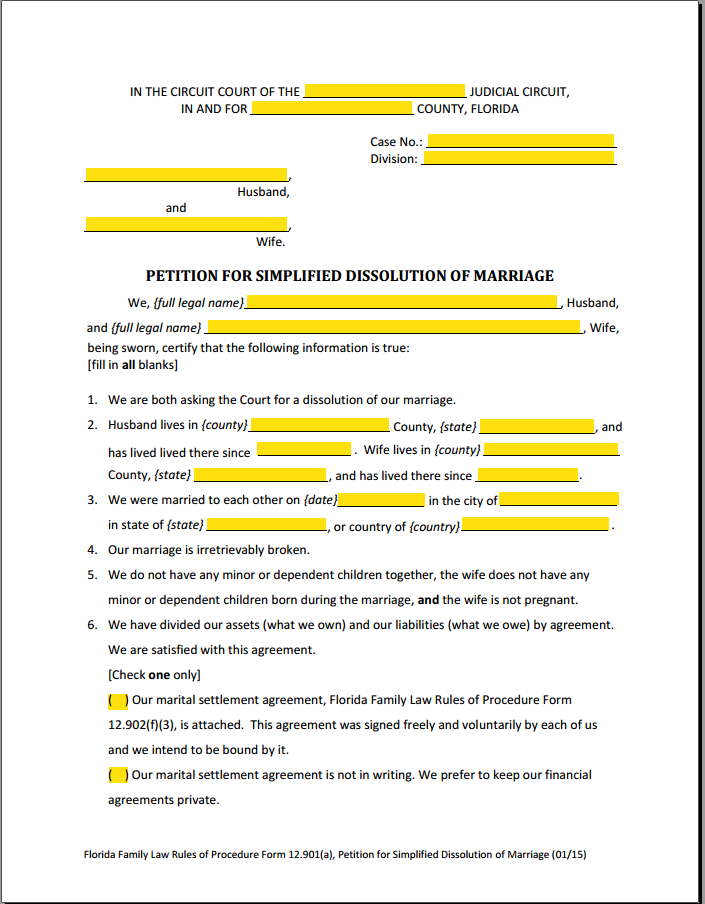
Simplified Dissolution of Marriage
This streamlined process is available for couples who meet specific criteria and are in full agreement on all aspects of their divorce. To qualify for a Simplified Dissolution, both parties must:
- Agree that the marriage is irretrievably broken.
- Have no minor children from the marriage and the wife is not pregnant.
- Agree on how to divide all marital assets and liabilities.
- Agree that neither party will seek alimony.
- Both appear before a judge to finalize the divorce.
The Simplified Dissolution is quicker and generally less expensive, requiring fewer court appearances and less paperwork. It’s often suitable for couples who have been married for a shorter duration and have minimal assets or debts.
Regular Dissolution of Marriage (Contested or Uncontested)
The Regular Dissolution process is far more common and encompasses all cases that do not qualify for a Simplified Dissolution. This includes marriages involving minor children, disputes over property division, requests for alimony, or situations where one spouse does not agree to the divorce terms.
- Uncontested Regular Dissolution: Occurs when the parties eventually reach a complete agreement on all issues, even if they initially had disagreements. They typically sign a Marital Settlement Agreement (and a Parenting Plan, if children are involved) outlining their resolutions, which is then submitted to the court for approval. This path, while more involved than a Simplified Dissolution, still avoids the need for a protracted and costly trial.
- Contested Regular Dissolution: Arises when the parties cannot agree on one or more key issues (e.g., child custody, property division, alimony). These cases often involve extensive discovery, negotiations, mediation, and potentially a trial, where a judge makes the final decisions on the unresolved matters. Legal representation is highly recommended in contested cases due to their complexity.
Key Steps in Filing for Dissolution
Once you understand the fundamental principles, the next stage involves the practical steps of initiating the legal process. Filing for dissolution in Florida requires specific documentation and adherence to procedural rules to ensure the case moves forward effectively.
Initial Documentation and Petition Filing
The first formal step is to prepare and file a “Petition for Dissolution of Marriage.” This document officially informs the court that you are seeking a divorce and outlines your requests regarding child custody, support, property division, and alimony. The petitioner (the spouse initiating the divorce) must sign this document under oath.
Along with the Petition, several other forms are typically required, especially if minor children are involved. These may include a Uniform Child Custody Jurisdiction and Enforcement Act (UCCJEA) Affidavit, a Family Law Financial Affidavit, and a Notice of Social Security Number. The Financial Affidavit is particularly critical, as it provides a detailed snapshot of each party’s income, expenses, assets, and liabilities. This information is foundational for determining child support, alimony, and equitable distribution. You can often find standardized forms on the Florida Supreme Court website or through legal counsel.
The Petition and accompanying documents are filed with the Clerk of Courts in the appropriate county’s Circuit Civil Division. This is usually the county where one of the parties resides, such as Fort Lauderdale or St. Petersburg. A filing fee is required, though mechanisms exist for individuals who cannot afford the fee to request a waiver.
Service of Process
After the Petition is filed, the other spouse, known as the respondent, must be legally notified that the divorce action has begun. This is called “service of process.” In Florida, service must be performed by a sheriff or a certified private process server, who will personally deliver the Petition and Summons to the respondent. The Summons is a formal notice from the court informing the respondent of the lawsuit and the deadline to respond.
Proper service is crucial for the court to establish jurisdiction over the respondent. If the respondent cannot be located, alternative methods of service, such as constructive service (e.g., publishing notice in a newspaper), may be permitted by the court, but these are generally more complex and less effective. In an uncontested case, the respondent can sign a “Waiver of Service,” acknowledging receipt of the documents and agreeing to waive formal service.
Respondent’s Response
Once served, the respondent has a limited timeframe, typically 20 days in Florida, to file a formal “Answer” with the court. In their Answer, the respondent can admit or deny the allegations in the Petition and present any counter-arguments or additional requests.
The respondent may also file a “Counter-Petition for Dissolution of Marriage,” which is essentially their own petition for divorce, outlining their desired outcomes. This is common even in cases that eventually become uncontested, as it ensures both parties’ claims are formally before the court. Failure to file an Answer within the allotted time can result in a “default,” potentially allowing the petitioner to obtain a divorce judgment without the respondent’s participation, though this is less common when significant assets or children are involved.
Addressing Core Issues in Dissolution
Beyond the procedural steps, the heart of any dissolution of marriage lies in resolving the substantive issues that impact the future lives of the spouses and their children. Florida law provides detailed guidance on how to address these critical areas.
Equitable Distribution of Assets and Liabilities
Florida is an “equitable distribution” state, meaning that marital assets and liabilities are divided fairly, though not necessarily equally. The process involves identifying, valuing, and then distributing all assets and debts acquired during the marriage.
- Marital vs. Non-Marital Property: First, the court distinguishes between marital property (acquired during the marriage by either spouse) and non-marital property (acquired before marriage, by inheritance, or as a gift to one spouse). Only marital property is subject to equitable distribution. Examples of marital assets can range from a family home in Naples, retirement accounts, vehicles, and bank accounts to more complex assets like businesses or investments. Liabilities include mortgages, credit card debts, and loans incurred during the marriage.
- Factors for Distribution: While the starting point is a 50/50 split, courts consider various factors that might justify an unequal distribution, such as the duration of the marriage, each spouse’s economic circumstances, contributions to the marriage (including homemaking and child-rearing), and any deliberate dissipation of marital assets by one spouse. The goal is to ensure both parties leave the marriage with a fair share of the marital estate, allowing them to rebuild their financial lives.

Parental Responsibility and Timesharing (Child Custody)
When minor children are involved, their well-being becomes the paramount concern for Florida courts. The terms “custody” and “visitation” have been replaced with “parental responsibility” and “timesharing” to emphasize both parents’ continuing roles in their children’s lives.
- Parental Responsibility: This refers to the ability to make decisions concerning the children’s welfare, including education, healthcare, and religious upbringing. Florida law presumes that shared parental responsibility is in the best interest of the minor child, encouraging both parents to confer and jointly make decisions. In rare cases where it’s determined that shared responsibility would be detrimental to the child, sole parental responsibility may be awarded.
- Timesharing: This involves the actual schedule outlining when each parent will have the children. A “Parenting Plan” is a mandatory document that details not only the timesharing schedule but also specifies how the parents will communicate, share information, make decisions, and address other issues related to the children’s upbringing. The court must approve a Parenting Plan based on the “best interests of the child” standard, considering factors like the child’s developmental needs, the parents’ ability to foster a relationship with the other parent, and the child’s preference (if mature enough). A detailed plan can help prevent future disputes and provide stability for children amidst parental separation.
Child Support
Both parents have a legal obligation to support their minor children financially. Florida uses specific Child Support Guidelines outlined in state statutes to calculate the amount of support. These guidelines primarily consider:
- Net Income of Both Parents: This includes gross income minus allowable deductions (e.g., taxes, health insurance premiums, mandatory retirement contributions).
- Number of Overnights with Each Parent: The more overnights a child spends with one parent, the more that parent is considered to be contributing directly to the child’s daily needs, which can affect the support calculation.
- Childcare Costs: Expenses for daycare or after-school care.
- Health Insurance Premiums: Costs for the children’s health and dental insurance.
- Uninsured Medical Expenses: A plan for sharing costs not covered by insurance.
The court may deviate from the guideline amount by up to 5% if specific factors warrant it, and greater deviations require written justification. Child support payments are typically made until the child turns 18, graduates from high school (if still enrolled and making progress towards graduation, up to age 19), or becomes emancipated. Enforcement of child support orders can involve the Department of Revenue or contempt of court proceedings.
Alimony (Spousal Support)
Alimony is financial support paid by one spouse to the other after a divorce. Unlike child support, alimony is not automatic and is awarded based on the specific circumstances of each case. The court determines whether alimony is appropriate and, if so, the type and amount, primarily considering:
- Need and Ability to Pay: Whether one spouse has a need for financial assistance and the other spouse has the ability to pay it.
- Length of the Marriage:
- Short-term: Less than 7 years.
- Moderate-term: 7 to 17 years.
- Long-term: 17 years or more (creating a presumption of permanent alimony).
- Standard of Living During the Marriage: The lifestyle established by the couple.
- Age and Physical/Emotional Condition of Each Spouse:
- Financial Resources of Each Spouse: Including non-marital and marital assets.
- Time Needed for Education or Training: To allow a spouse to become self-supporting.
- Contributions to the Marriage: Including services as a homemaker or contributions to the other spouse’s career.
Florida law recognizes several types of alimony, each designed for different situations:
- Bridge-the-Gap Alimony: Short-term support to assist a spouse in transitioning from married to single life, typically for two years or less.
- Rehabilitative Alimony: For a limited period to allow a spouse to acquire education or training to become self-supporting. A plan outlining the rehabilitation is usually required.
- Durational Alimony: Provides economic assistance for a set period, often after short or moderate-term marriages, or when permanent alimony is inappropriate. It cannot exceed the length of the marriage.
- Permanent Alimony: Awarded to provide for the needs and necessities of a spouse who lacks the financial ability to be self-sustaining at the marital standard of living. This is generally reserved for long-term marriages or in cases of exceptional need.
- Temporary Alimony: Awarded during the divorce proceedings to help a spouse maintain their standard of living until the final judgment.
In 2023, Florida made significant changes to its alimony laws, largely eliminating permanent alimony and placing stricter limits on other types, reflecting a societal shift towards promoting self-sufficiency post-divorce. Consulting with a Florida Bar licensed attorney is crucial to understand how these changes might impact your specific case.
Navigating the Legal Journey and Finalizing Dissolution
The journey through dissolution can involve several stages after the initial filing, designed to facilitate resolution and, if necessary, prepare for a judicial decision.
Discovery Phase
After the initial pleadings are exchanged, both parties enter the “discovery” phase. This is the information-gathering stage, where each spouse obtains relevant financial and other personal information from the other. Common discovery tools include:
- Interrogatories: Written questions sent to the other party, who must answer under oath.
- Requests for Production: Demands for documents such as bank statements, tax returns, pay stubs, retirement account statements, and property deeds (e.g., for a home in Sarasota or Palm Beach).
- Requests for Admissions: Written statements that the other party is asked to admit or deny, narrowing the issues in dispute.
- Depositions: Oral testimony taken under oath outside of court, transcribed by a court reporter.
This phase is critical for ensuring full financial disclosure, which is a cornerstone of Florida dissolution law. Each party has a fiduciary duty to disclose all assets and liabilities.
Mediation
Florida courts often mandate mediation in dissolution cases, particularly when there are contested issues. Mediation is a confidential process where a neutral third party, the mediator, helps the spouses communicate and negotiate to reach a mutually agreeable settlement. The mediator does not make decisions but facilitates discussion and explores common ground.
Mediation is highly effective, often leading to full or partial settlement, thus avoiding the need for a costly and emotionally draining trial. If a settlement is reached, a Marital Settlement Agreement (and Parenting Plan, if applicable) is drafted, signed by both parties, and submitted to the court for approval. This agreement becomes part of the final judgment.
Trial (If Necessary)
If mediation fails to resolve all outstanding issues, the case proceeds to trial. A trial is a formal court proceeding where both parties present their evidence, call witnesses, and make legal arguments before a judge (jury trials are not typically available in Florida family law cases). The judge then makes final decisions on all contested matters, including property division, parental responsibilities, child support, and alimony.
Trials are generally expensive, time-consuming, and emotionally taxing. They are often viewed as a last resort, highlighting the importance of diligent negotiation and mediation efforts.
Final Judgment of Dissolution
The culmination of the dissolution process is the entry of a “Final Judgment of Dissolution of Marriage.” This is the official court order that legally terminates the marriage and makes all the terms of the divorce binding. It incorporates any Marital Settlement Agreement and Parenting Plan reached by the parties, or it details the judge’s rulings after a trial.
The Final Judgment is a comprehensive document that addresses:
- The termination of the marriage.
- The equitable distribution of assets and liabilities.
- The terms of parental responsibility and timesharing.
- Child support obligations.
- Alimony provisions.
- Any other agreed-upon or court-ordered conditions.
Once the Final Judgment is entered, the parties are legally divorced and are free to remarry.
Post-Judgment Considerations
Even after the Final Judgment is entered, certain aspects of a dissolution case may require future attention.
- Modifications: Circumstances can change significantly after a divorce. If there’s a substantial, unanticipated change in circumstances, either party may petition the court to modify certain aspects of the Final Judgment, such as child support, timesharing schedules, or alimony. For example, a job loss or a significant increase in income for one party might warrant a modification of child support.
- Enforcement: If one party fails to comply with the terms of the Final Judgment (e.g., not paying child support or alimony, or violating timesharing provisions), the other party can seek court intervention to enforce the order. This can involve mechanisms like wage garnishment for support, or holding the non-compliant party in contempt of court.
Conclusion
Filing for dissolution of marriage in Florida is a journey that, while complex and often emotionally charged, is designed to lead to a fair and legally sound resolution. From understanding Florida’s no-fault status and residency rules to navigating the intricacies of equitable distribution, parental responsibility, child support, and alimony, each step requires careful consideration. Whether your path involves a simplified, uncontested, or contested dissolution, thorough preparation and understanding of the process are paramount.
While this guide provides a comprehensive overview, it is crucial to remember that every divorce is unique. The specifics of your financial situation, family dynamics, and personal circumstances will dictate the exact trajectory of your case. For this reason, seeking counsel from a qualified Florida family law attorney is highly recommended. An attorney can provide personalized advice, help you understand your rights and obligations, navigate the legal procedures, and advocate for your best interests.
Embracing this new phase of life involves not only legal finality but also a personal restructuring. With proper guidance and a clear understanding of the process, individuals can move forward with confidence, ready to explore new horizons and build a fulfilling future.
LifeOutOfTheBox is a participant in the Amazon Services LLC Associates Program, an affiliate advertising program designed to provide a means for sites to earn advertising fees by advertising and linking to Amazon.com. Amazon, the Amazon logo, AmazonSupply, and the AmazonSupply logo are trademarks of Amazon.com, Inc. or its affiliates. As an Amazon Associate we earn affiliate commissions from qualifying purchases.