
Navigating the legal complexities of divorce can feel daunting, but understanding the process in Nebraska can provide a clear path forward. This guide outlines the essential steps and considerations for filing for divorce in the Cornhusker State, ensuring you are well-informed and prepared.
Understanding Divorce in Nebraska
Nebraska operates under a no-fault divorce system, meaning you do not need to prove that your spouse did something wrong to obtain a divorce. The primary ground for divorce is the irretrievable breakdown of the marriage. This simply means that the marriage is beyond repair, and there is no reasonable prospect of reconciliation.
Residency Requirements
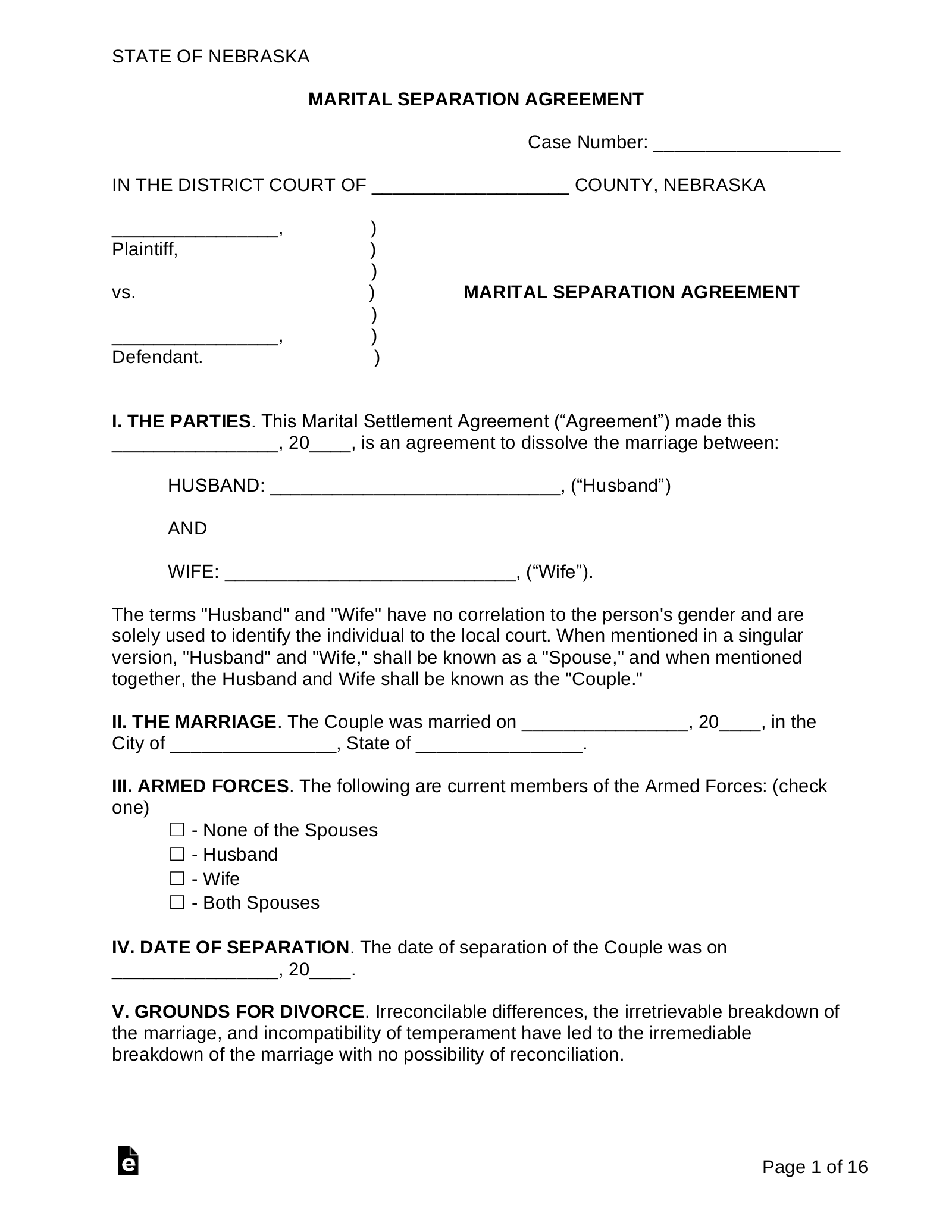
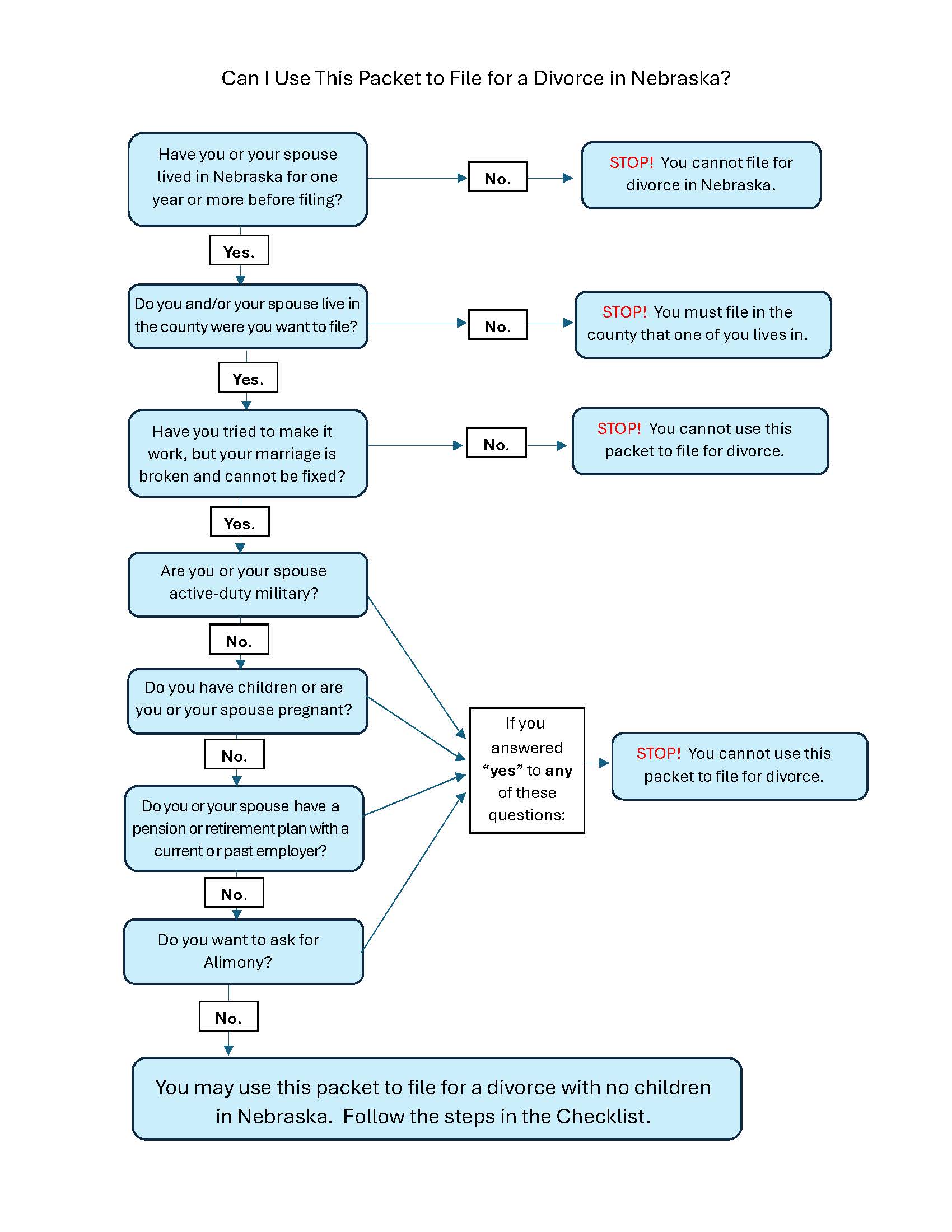
Before filing for divorce in Nebraska, you must meet specific residency requirements. One of the parties must have resided in the state for at least one year immediately preceding the filing of the petition. Additionally, either the petitioner or the respondent must have been a resident of the county where the action is filed for at least 90 days.
Types of Divorce
In Nebraska, there are generally two main types of divorce proceedings:
- Uncontested Divorce: This occurs when both spouses agree on all major issues, including property division, child custody, child support, and alimony. An uncontested divorce is typically faster, less expensive, and less emotionally draining than a contested divorce.
- Contested Divorce: This arises when spouses cannot agree on one or more of the significant issues related to the divorce. In such cases, the court will intervene and make decisions on behalf of the divorcing parties after a trial.
Legal Separation vs. Divorce
Nebraska also offers legal separation as an alternative to divorce. A legal separation allows a married couple to live apart while remaining legally married. This option is often chosen for religious reasons or if the couple wishes to maintain certain benefits, such as health insurance, that would be lost upon divorce. However, a legal separation still involves resolving many of the same issues as a divorce, such as property division and child custody.
The Divorce Filing Process
The divorce process in Nebraska involves several key stages, from initiating the case to finalizing the decree.
Filing the Petition
The first formal step in a divorce is filing a “Petition for Dissolution of Marriage” with the appropriate district court in the county where the residency requirements are met. The party filing the petition is known as the Petitioner, and the other spouse is the Respondent. The petition must include essential information such as the names of both parties, the date and place of marriage, the grounds for divorce, and specific requests regarding property division, child custody, support, and alimony.
Service of Process
Once the petition is filed, the Respondent must be formally notified of the lawsuit. This is known as “service of process.” Typically, a sheriff’s deputy or a private process server will deliver a copy of the filed petition and a summons to the Respondent. There are specific rules for how service must be completed, and failure to properly serve the Respondent can delay or even invalidate the divorce proceedings. If the Respondent cannot be located, the court may allow for service by publication, which involves publishing a notice in a local newspaper.
Response to the Petition
After being served, the Respondent has a limited time to file a formal “Answer” to the Petition. In the Answer, the Respondent can agree with or dispute the claims made by the Petitioner and can also file a “Counterclaim” outlining their own requests and grounds for divorce. If the Respondent fails to file an Answer within the specified timeframe, the Petitioner may be able to seek a “default judgment,” meaning the court may grant the divorce and make decisions based solely on the Petitioner’s requests.
Temporary Orders
While the divorce is pending, either party can request “temporary orders” from the court. These orders address immediate issues that need resolution during the divorce proceedings. Common temporary orders include:
- Temporary Custody and Visitation: Establishing who the children will live with and the visitation schedule for the other parent.
- Temporary Child Support and Alimony: Setting interim payments for child support and spousal support.
- Temporary Use of Marital Property: Deciding who will live in the marital home or use specific vehicles.
- Restraining Orders: Preventing one party from dissipating marital assets or harassing the other.
These orders are temporary and remain in effect until a final divorce decree is issued or modified by the court.
Discovery
In contested divorces, the “discovery” phase is crucial for gathering information and evidence. Both parties exchange relevant financial documents, such as bank statements, tax returns, and pay stubs, and may also depose witnesses. This process helps to ensure that all assets and debts are identified and that decisions regarding custody and support are based on accurate information.
Negotiation and Settlement
Many divorce cases are resolved through negotiation and settlement, even after the initial filing and discovery. Attorneys for both parties may engage in discussions to reach an agreement on all outstanding issues. Mediation, a process where a neutral third party helps facilitate discussions between the spouses, can also be a highly effective way to reach a settlement outside of court.
Trial
If negotiations and mediation fail to produce an agreement, the case will proceed to trial. During the trial, both sides will present evidence and arguments to the judge, who will then make final decisions on all disputed matters. This is the most formal and often the most expensive part of the divorce process.
Key Issues in Divorce Proceedings
Several critical issues must be addressed during any divorce case in Nebraska.
Child Custody and Visitation
When minor children are involved, child custody and visitation are paramount. Nebraska courts prioritize the best interests of the child when making custody decisions. This can include:
- Legal Custody: The right to make major decisions about the child’s upbringing, such as education, healthcare, and religious instruction. This can be awarded jointly to both parents or solely to one parent.
- Physical Custody: Where the child primarily resides. This can be sole physical custody (the child lives with one parent) or joint physical custody (the child spends significant time with both parents).
- Visitation Schedule: A detailed schedule outlining when each parent will have the child. This is often referred to as a parenting plan.
The court will consider various factors when determining custody, including the wishes of the child (if they are of sufficient age and maturity), the relationship of the child with each parent, each parent’s ability to provide care, and the child’s adjustment to their home, school, and community.
Child Support
Child support is financial assistance paid by one parent to the other for the support of their minor child. Nebraska utilizes a child support guidelines formula to determine the amount of support, which primarily considers the income of both parents and the number of overnights each child spends with each parent. The goal is to ensure that the child receives adequate financial support from both parents.
Division of Marital Property and Debts
Marital property refers to all assets and debts acquired by either spouse during the marriage, regardless of whose name is on the title. In Nebraska, marital property is divided in an “equitable” manner, meaning fairly, though not necessarily equally. The court will consider various factors when dividing property, including the length of the marriage, the contributions of each spouse, and their economic circumstances. This division can include real estate, bank accounts, investments, vehicles, and retirement funds. Marital debts are also subject to equitable division.
Alimony (Spousal Support)
Alimony, or spousal support, is financial maintenance paid by one spouse to the other following a divorce. Nebraska courts may award alimony if one spouse is financially dependent on the other or if there is a significant disparity in earning capacity. Factors considered by the court include the length of the marriage, the financial needs of the receiving spouse, the ability of the paying spouse to pay, the age and health of the parties, and the contributions of each spouse to the marriage. Alimony can be temporary, rehabilitative, or permanent, depending on the circumstances.
Finalizing the Divorce
Once all issues are resolved, either through settlement or court order, the final step is to obtain a “Decree of Dissolution of Marriage.”
Finalizing the Decree
The Decree of Dissolution of Marriage is the legal document that officially ends the marriage. It will outline all the terms of the divorce, including child custody, support, property division, and alimony. Both parties will sign the decree, and it must be approved and signed by the judge.

Post-Divorce Modifications
Life circumstances can change after a divorce is finalized. If there is a substantial change in circumstances, either party may petition the court to modify certain aspects of the divorce decree, such as child custody, child support, or alimony. Property division, however, is typically a final decision and cannot be modified after the divorce is granted.
Filing for divorce in Nebraska requires careful attention to detail and adherence to legal procedures. Understanding these steps can empower you to navigate this complex process with greater confidence and achieve a fair resolution. Consulting with a qualified family law attorney in Nebraska is highly recommended to ensure your rights are protected throughout the proceedings.
LifeOutOfTheBox is a participant in the Amazon Services LLC Associates Program, an affiliate advertising program designed to provide a means for sites to earn advertising fees by advertising and linking to Amazon.com. Amazon, the Amazon logo, AmazonSupply, and the AmazonSupply logo are trademarks of Amazon.com, Inc. or its affiliates. As an Amazon Associate we earn affiliate commissions from qualifying purchases.