
Legal separation in California offers a pathway for couples who wish to live apart and resolve issues related to their marriage without formally dissolving it through divorce. This process shares many similarities with divorce proceedings, encompassing the division of assets and debts, spousal support, child custody, and child support. However, it allows individuals to remain legally married, which can be a crucial distinction for various personal, religious, or financial reasons.
Understanding Legal Separation Versus Divorce
The fundamental difference between legal separation and divorce lies in the marital status of the parties involved. In a divorce, the marriage is terminated, and both parties are legally single. In contrast, a legal separation allows a couple to live separately, but they remain legally married. This distinction has significant implications, particularly regarding:
Marital Status and Remarriage
- Divorce: Once a divorce is finalized, both parties are free to remarry.
- Legal Separation: Parties in a legal separation remain married. They cannot legally remarry until the legal separation is converted to a divorce or they pursue a divorce action separately. This can be important for individuals who wish to maintain health insurance benefits tied to their spouse’s employment, for instance, or for those whose religious beliefs prohibit divorce.
Financial and Benefit Considerations
- Health Insurance: In some cases, a spouse may be able to remain on the other’s health insurance plan during a legal separation. This is often not possible after a divorce, unless specific provisions are made or COBRA is utilized.
- Social Security Benefits: Legal separation can affect eligibility for certain Social Security benefits derived from a spouse’s work record. Unlike divorce, where eligibility can be based on a marriage of 10 years or more, legal separation does not automatically grant these rights.
- Tax Status: While legally separated, couples may be able to file taxes as married filing separately. The specific tax implications should always be discussed with a tax professional.
Residency Requirements
Similar to divorce, California has residency requirements for filing for legal separation. One party must have lived in California for at least six months and in the specific county where the action is filed for at least three months immediately preceding the filing.
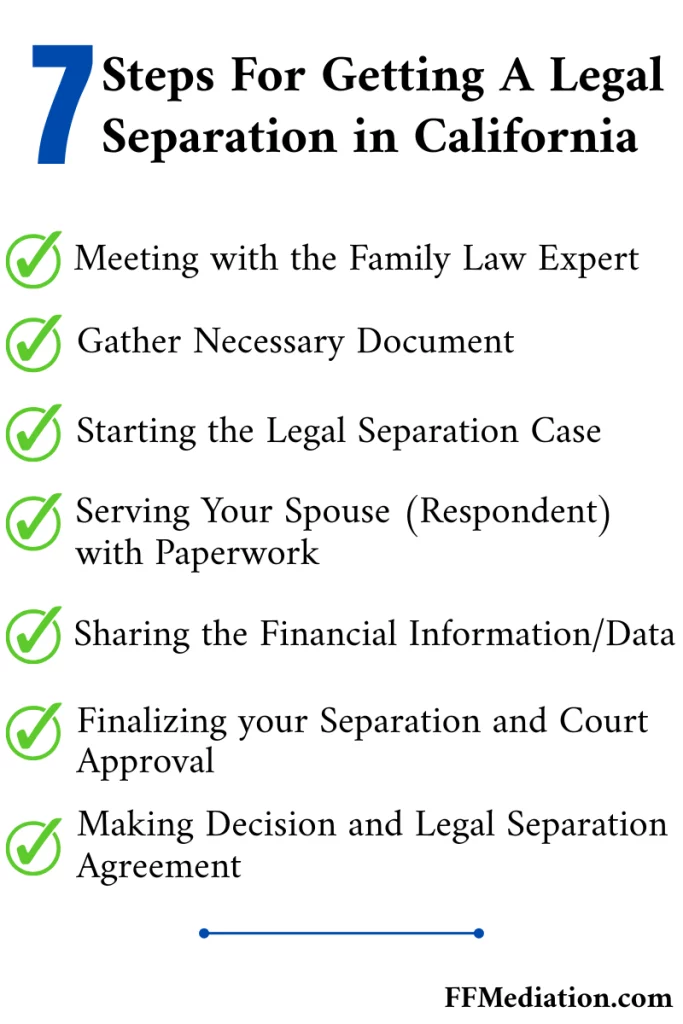
Steps to Filing for Legal Separation in California
The process of filing for legal separation in California involves several key steps, which are largely identical to those in a divorce. It is highly recommended to consult with an attorney throughout this process.
Initiating the Case: Filing the Petition
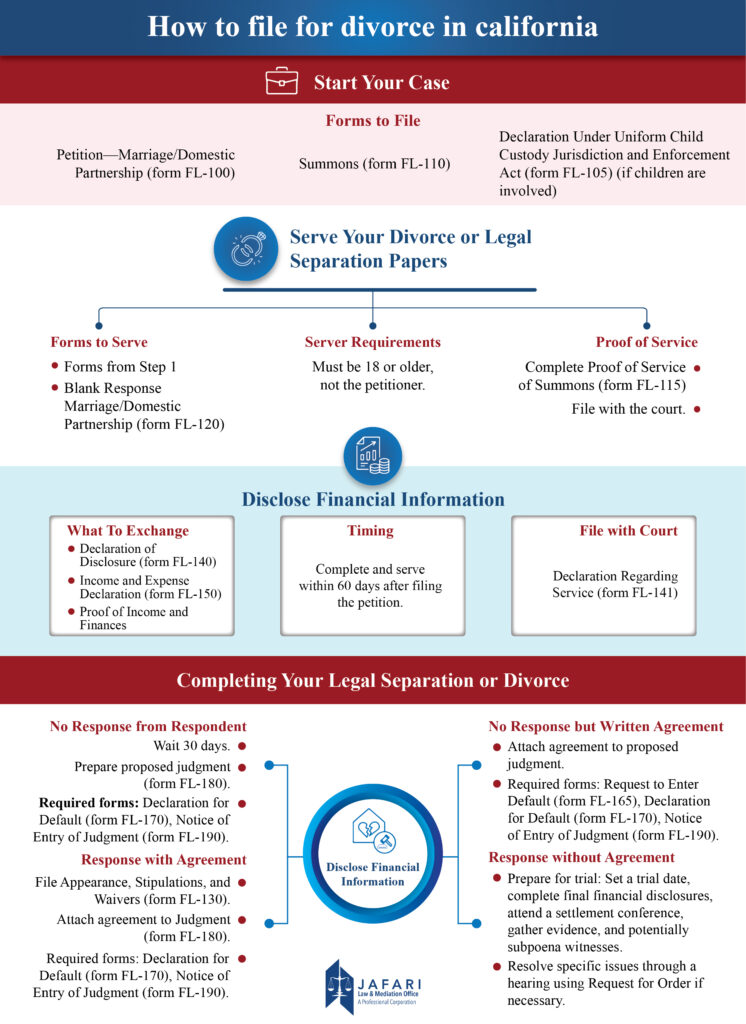
- Petition for Legal Separation: The process begins with one spouse, the petitioner, filing a Petition for Legal Separation (Form FL-100) with the Superior Court in the appropriate county. This document outlines basic information about the marriage, including the names and birthdates of the parties and any children, the date of marriage, and the legal grounds for separation.
- Summons: Along with the petition, a Summons (Form FL-110) must be filed. This document formally notifies the other spouse, the respondent, that a legal action has been initiated and that they have a limited time to respond.
- Filing Fees: There are filing fees associated with initiating a court case. If you cannot afford these fees, you may be eligible for a fee waiver.
Serving the Respondent
Once the petition and summons are filed, the respondent must be formally served with these documents. This is a critical legal step to ensure the respondent is aware of the proceedings and has an opportunity to participate.
- Methods of Service: Service can be accomplished by:
- A sheriff or professional process server.
- Any adult who is not a party to the case.
- By mail with a Notice and Acknowledgment of Receipt (Form FL-117), if the respondent agrees to accept service this way.
- Proof of Service: After service is completed, the person who served the documents must complete and file a Proof of Service of Summons (Form FL-115) with the court.
The Respondent’s Response
The respondent typically has 30 days from the date of service to file a response with the court.
- Response to Petition: If the respondent agrees with the petitioner’s requests, they may file a simple response. If they disagree or have their own requests, they will file a Response—Family Law (Form FL-120).
- Default: If the respondent fails to file a response within the 30-day timeframe, the petitioner can request a “default,” which means the court can proceed with the case without the respondent’s participation, likely granting the petitioner’s requests.
Financial Disclosures
Both parties are required to exchange detailed financial information. This is a crucial step for the fair division of assets and debts and the determination of support.
- Preliminary Declaration of Disclosure: Within 60 days of filing the petition, each party must serve the other with a Preliminary Declaration of Disclosure (Form FL-140). This involves completing and exchanging detailed financial statements, including:
- Income and Expense Declaration (Form FL-150)
- Schedule of Assets and Debts (Form FL-142)
- Supporting documents such as tax returns, pay stubs, bank statements, and property deeds.
- Final Declaration of Disclosure: Before a judgment can be entered, both parties must also serve a Final Declaration of Disclosure. This updates the information provided in the preliminary declaration.
Reaching an Agreement or Going to Court
Once financial disclosures are exchanged, the parties can attempt to reach an agreement on all issues or proceed to court.
Negotiating a Settlement Agreement
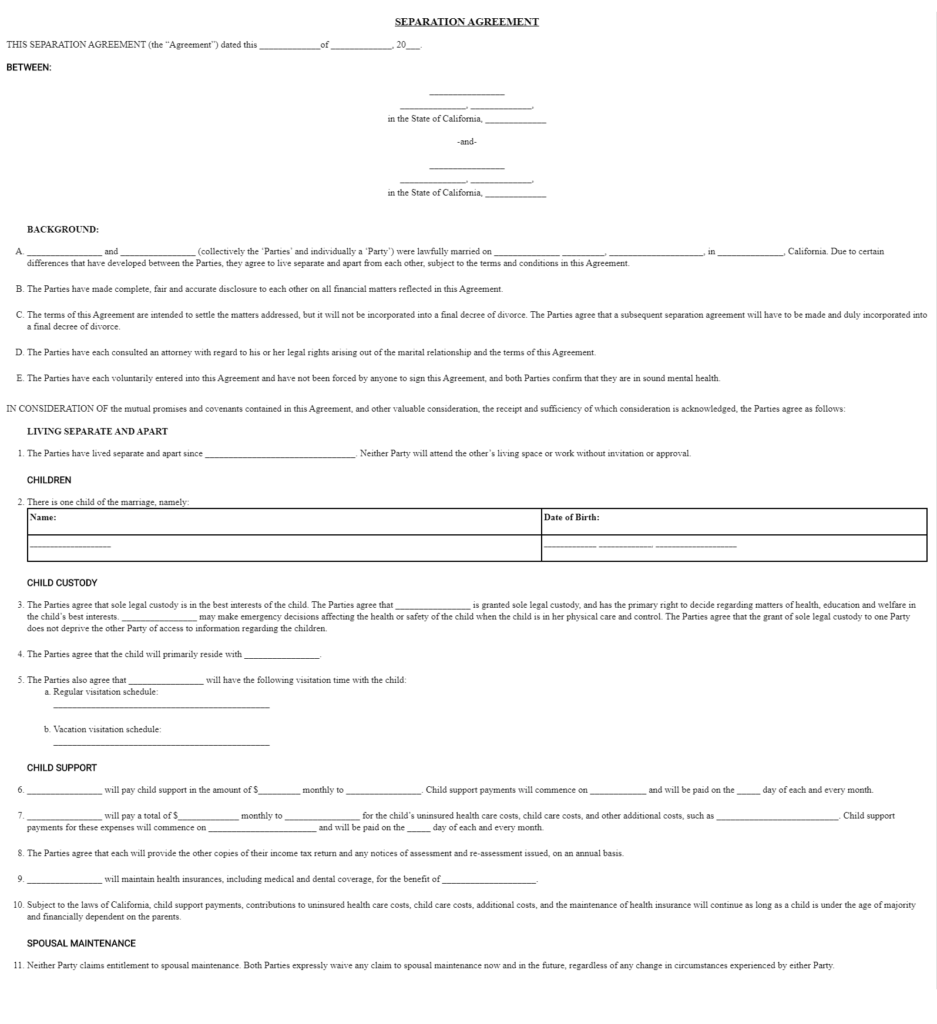
- Marital Settlement Agreement (MSA): The most common and often the most amicable way to resolve a legal separation is through a Marital Settlement Agreement (MSA). This is a legally binding contract that outlines how all issues will be handled, including:
- Child Custody and Visitation: Legal and physical custody arrangements, parenting schedules.
- Child Support: Financial support for minor children.
- Spousal Support (Alimony): Financial support for one spouse from the other.
- Division of Property: How community property (assets and debts acquired during the marriage) will be divided.
- Division of Debts: How community debts will be allocated.
- Mediation: If direct negotiation is difficult, couples may utilize a mediator to help facilitate discussions and reach an agreement.
Court Intervention
If an agreement cannot be reached, the case will proceed to court. This may involve:
- Hearings: The court may schedule various hearings to address specific issues or to resolve the case.
- Discovery: This involves formal requests for information from the other party, such as interrogatories (written questions), requests for production of documents, and depositions (out-of-court sworn testimony).
- Trial: If all attempts at settlement fail, the case will go to trial, where a judge will hear evidence from both sides and make a decision on all outstanding issues.
Finalizing the Legal Separation
Once all issues are resolved, either by agreement or court order, the final judgment must be entered by the court.
- Judgment: The Judgment (Form FL-180) is the court order that finalizes the legal separation. It incorporates the terms of the Marital Settlement Agreement or the judge’s decisions from a trial.
- Decree of Legal Separation: This document officially recognizes the parties as legally separated.
Key Issues in Legal Separation
Regardless of whether a legal separation is amicable or contested, several critical issues must be addressed.
Child Custody and Visitation
California courts prioritize the best interests of the child when making custody decisions. This involves determining legal custody (the right to make major decisions about the child’s upbringing, such as education, healthcare, and religious training) and physical custody (where the child lives). Visitation schedules are also established to ensure both parents have meaningful contact with the child.
Child Support
Child support is calculated based on guidelines established by the state of California. These guidelines take into account factors such as the income of both parents, the amount of time each parent spends with the children, and the number of children. The goal is to ensure children receive adequate financial support from both parents.
Spousal Support (Alimony)
Spousal support is financial assistance paid by one spouse to the other. The court considers various factors when determining spousal support, including:
- The length of the marriage
- The standard of living established during the marriage
- The ability of each spouse to pay
- The needs of each spouse
- The age and health of each spouse
- The marketable skills and earning capacity of each spouse
Division of Property and Debts
California is a community property state. This means that most assets and debts acquired during the marriage are considered jointly owned and must be divided equally between the spouses.
- Community Property: This includes real estate, bank accounts, vehicles, investments, and retirement funds acquired from the date of marriage to the date of separation.
- Separate Property: This is property owned by one spouse before the marriage, or received during the marriage as a gift or inheritance.
- Debts: Community debts, such as mortgages, car loans, and credit card balances incurred during the marriage, are also subject to division.
When to Consider Legal Separation
Legal separation can be a suitable option in several scenarios:
- Maintaining Health Insurance: When one spouse relies on the other’s employer-provided health insurance.
- Religious or Personal Beliefs: For individuals who oppose divorce on religious or personal grounds but wish to live separately.
- Financial Stability and Time: When couples need time to adjust financially or plan for their futures without the immediate pressure of divorce.
- Testing the Waters: For couples unsure about divorce and wanting a period of separation before making a final decision.
- Avoiding Long-Term Separation: If a couple has been separated for a long period and wishes to formalize their arrangements without the finality of divorce.
Seeking Legal Counsel
Navigating the legal separation process in California can be complex. It involves understanding legal terminology, adhering to court procedures, and making significant financial and personal decisions. Therefore, engaging with an experienced family law attorney is highly recommended. An attorney can provide invaluable guidance, ensure your rights are protected, and help you achieve a fair and equitable resolution. While resources like the California Courts website offer forms and basic information, personalized legal advice is crucial for a successful outcome.
LifeOutOfTheBox is a participant in the Amazon Services LLC Associates Program, an affiliate advertising program designed to provide a means for sites to earn advertising fees by advertising and linking to Amazon.com. Amazon, the Amazon logo, AmazonSupply, and the AmazonSupply logo are trademarks of Amazon.com, Inc. or its affiliates. As an Amazon Associate we earn affiliate commissions from qualifying purchases.