
While the title of this article might initially spark visions of a completely cost-free legal dissolution of marriage in the Golden State, the reality is more nuanced. A “free divorce” in California typically refers to navigating the divorce process with minimal to no legal fees, primarily by utilizing resources designed for those with limited financial means. This doesn’t mean the court system itself becomes free; rather, it’s about leveraging available avenues to reduce or eliminate the need for expensive attorneys. The underlying principle is access to justice, ensuring that financial hardship doesn’t become an insurmountable barrier to ending a marriage legally. This guide will explore the various pathways and resources available to achieve this goal, focusing on the practical steps and support systems that can make a divorce in California more accessible financially.
The core concept revolves around understanding the different types of divorce and identifying which might be more budget-friendly. A summary dissolution is the simplest and least expensive option, but it comes with strict eligibility requirements. For those who don’t qualify for a summary dissolution, the path to a low-cost divorce involves exploring fee waivers, self-help resources, and potentially pro bono legal services. Understanding the procedural steps and being prepared to handle much of the paperwork yourself are crucial components of a cost-effective divorce.
Understanding the Pathways to a Low-Cost Divorce in California
The journey to a divorce in California can be daunting, especially when financial constraints are a significant concern. The idea of a “free divorce” is aspirational, representing the ability to complete the legal process without incurring substantial attorney fees. This is achievable through a combination of specific legal procedures and readily available support services.
The Nuance of “Free” in Legal Proceedings
It’s essential to clarify what “free” means in the context of a divorce. Courts do have filing fees, and while these can sometimes be waived, the process itself is not inherently free of all costs. The term “free divorce” predominantly refers to the absence of attorney fees. This can be achieved if:
- Both parties are in complete agreement on all terms of the divorce, and the process is straightforward.
- One or both parties qualify for a waiver of court fees due to low income.
- One or both parties can access pro bono (free) legal assistance.
- Individuals can successfully navigate the process themselves using court-provided resources and forms.
Eligibility for Summary Dissolution
The most straightforward and cost-effective path to divorce in California is the summary dissolution. This is a streamlined process designed for couples who meet specific criteria. If you qualify, you can often complete the process with minimal court interaction and no need for extensive legal representation. The eligibility requirements for a summary dissolution are stringent and include:
- Marriage Length: You and your spouse must have been married for less than five years.
- Children: You must not have any children together, whether born or adopted, from the current marriage. This also includes any children born before the marriage to whom you have not become parents by adoption.
- Property: You and your spouse must not own any community property or community debt accumulated during the marriage, with limited exceptions for minor amounts. This includes real estate, vehicles, and significant financial assets.
- Separate Property: You must not have any separate property exceeding a certain value (as set by law, which can change).
- Spousal Support: Neither spouse can be seeking or receiving spousal support.
- Agreement: Both spouses must agree that they want a summary dissolution and must have attended a counseling session if requested by one spouse.
If you meet all these criteria, you can file a joint petition for summary dissolution. The process involves filling out specific forms, serving your spouse, and waiting for the mandatory waiting period before the divorce is finalized. This option significantly reduces the need for attorney involvement, making it the closest to a “free” divorce available.
Navigating Dissolution Without Children or Significant Assets
For couples who do not qualify for summary dissolution due to having children or owning assets, but still wish to minimize costs, the focus shifts to managing a standard divorce with as little expense as possible. This involves a high degree of cooperation and self-education.
Understanding Legal Separation vs. Divorce
Before embarking on a divorce, some couples may consider legal separation. While it’s not a divorce, it allows couples to live apart and resolve issues like child custody, support, and property division without formally ending the marriage. In California, the process and forms for legal separation are very similar to divorce. This might be a temporary solution or a preferred outcome for individuals who wish to maintain certain benefits, such as health insurance, tied to their spouse’s employment. However, for those aiming to end the marriage, the focus remains on divorce.
The Importance of Uncontested Divorce
The most significant factor in reducing divorce costs is whether the divorce is uncontested. An uncontested divorce occurs when both parties agree on all terms, including child custody and visitation, child support, spousal support, and the division of property and debts. In such cases, you can often proceed without attorneys, or with attorneys only providing limited assistance (e.g., reviewing documents).
- Full Agreement: If you and your spouse can communicate effectively and reach agreements on all aspects of your divorce, you can file joint paperwork with the court. This significantly reduces legal fees because there are no disputes to litigate.
- Mediation: For couples who struggle to agree but are willing to compromise, mediation can be a highly effective and cost-saving alternative to contentious court battles. A neutral mediator helps facilitate discussions and guide couples toward mutually acceptable solutions. While mediators do charge fees, they are generally much lower than attorney fees for contested divorce proceedings.
Essential Resources for a Low-Cost Divorce
Even in an uncontested divorce, there are legal procedures and forms that must be completed accurately. Fortunately, California provides a wealth of resources to assist individuals in navigating these complexities without professional legal representation.
Utilizing Court Self-Help Centers and Forms
Every superior court in California has a Self-Help Center (also known as a Family Law Facilitator’s office). These centers offer free assistance to individuals who are representing themselves in family law cases, including divorce.
- Assistance with Forms: Staff at the Self-Help Centers can explain court procedures, help you understand and fill out the necessary legal forms, and provide information on your rights and responsibilities. They cannot provide legal advice or represent you in court, but they are invaluable in demystifying the legal process.
- Free Legal Forms: The California Courts website (jud.ca.gov) provides free access to all the required divorce forms. These forms are standardized and designed to be filled out by individuals without legal training. Downloading and meticulously completing these forms is a critical step in a DIY divorce. Common forms include the Petition (FL-100), Summons (FL-110), and various other documents related to financial disclosures, child custody, and property division.
Fee Waivers: Eliminating Court Filing Costs
Court filing fees can be a significant expense. However, if your income is below a certain level, you may qualify for a fee waiver.
- Application Process: To apply for a fee waiver, you will need to complete a Request to Waive Court Fees form (FW-001) and a court’s order on the request to waive court fees form (FW-002). These forms require you to provide information about your income, expenses, and assets.
- Eligibility: Eligibility is generally based on your ability to pay the fees without depriving yourself or your family of necessities of life. The court will review your application, and if approved, you will be exempt from paying most court fees associated with your divorce case. This can save you hundreds of dollars in filing and service fees.
Exploring Pro Bono Legal Services and Low-Cost Clinics
While the goal is a “free divorce,” sometimes even with careful planning, legal nuances might arise that make some level of legal guidance beneficial. For those who cannot afford an attorney, several options exist:
- Pro Bono Programs: Many local bar associations and legal aid organizations offer pro bono services. Pro bono attorneys volunteer their time to provide legal assistance to low-income individuals who cannot afford to hire an attorney. You can contact your local county bar association to inquire about pro bono divorce programs in your area.
- Legal Aid Societies: These non-profit organizations provide free or low-cost legal services to eligible individuals with limited incomes. They often have specific programs for family law matters, including divorce.
- Law School Clinics: Many law schools operate clinics where students, supervised by experienced faculty, provide free legal services to the public. These clinics can be an excellent resource for individuals seeking assistance with divorce proceedings.
Steps to Managing Your Divorce Pro Se (Without an Attorney)
Successfully navigating a divorce without an attorney requires diligence, organization, and a commitment to understanding the process. Here’s a breakdown of the general steps involved:
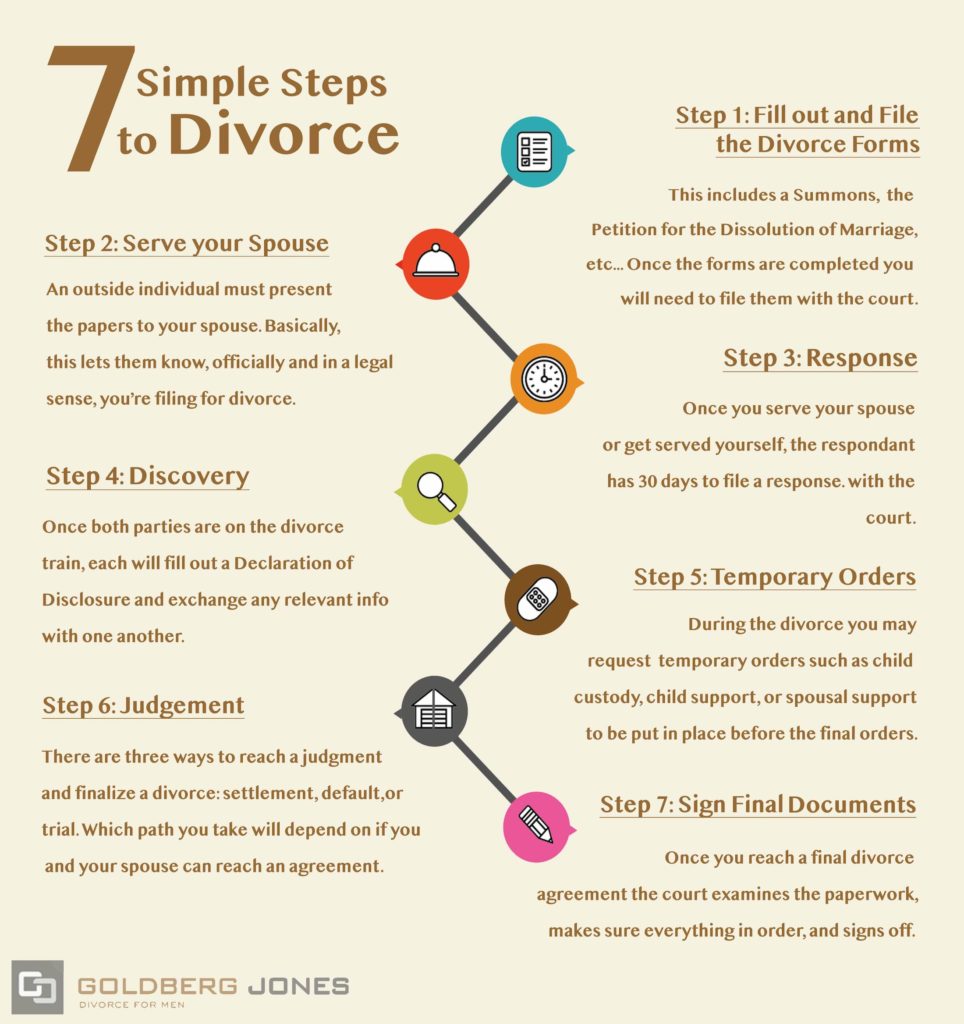
Filing the Initial Petition and Summons
The divorce process begins when one spouse (the petitioner) files a Petition for Dissolution of Marriage (Form FL-100) with the court. This document outlines the basic information about the marriage, the parties involved, and the relief sought. Along with the petition, the petitioner must file a Summons (Form FL-110), which officially notifies the other spouse (the respondent) that a divorce action has been filed.
- Service of Documents: Once filed, the petition and summons must be formally served on the respondent. This typically cannot be done by the petitioner themselves. Service must be carried out by a sheriff, a professional process server, or another adult who is not a party to the case. The completed Proof of Service form must then be filed with the court. This step is crucial for the court to have jurisdiction over the case.
Financial Disclosures and Reaching an Agreement
A critical phase in any divorce is the mandatory exchange of financial information. Both parties must disclose all income, expenses, assets, and debts.
- Declaration of Disclosure: This involves completing and exchanging financial disclosure forms, such as the Declaration of Disclosure (Form FL-140), Income and Expense Declaration (Form FL-150), and Schedule of Assets and Debts (Form FL-142). Accurate and complete disclosure is legally required and vital for reaching a fair settlement.
- Negotiation and Stipulation: If the divorce is uncontested, the parties will work together to divide their community property and debts and determine child custody and support arrangements. Once an agreement is reached, it is formalized in a written document called a Stipulated Judgment. This document details all the terms of the divorce settlement.

Finalizing the Divorce
After the waiting period and once all necessary paperwork is filed and approved by the court, the divorce will be finalized.
- Mandatory Waiting Period: California has a mandatory six-month waiting period from the date the respondent is served with the divorce papers or the date of the respondent’s appearance in court, whichever is earlier. The divorce cannot be finalized before this period has passed.
- Judgment: The Stipulated Judgment is submitted to the court for review and approval. Once signed by the judge, it becomes the final judgment of divorce, legally dissolving the marriage.
While the term “free divorce” in California is a simplification, it represents a tangible goal for many individuals. By understanding the eligibility for summary dissolution, leveraging court self-help resources, applying for fee waivers, and diligently managing the process, it is possible to achieve a legal divorce without incurring significant financial burdens. It requires patience, attention to detail, and a willingness to educate oneself on the legal procedures, but the outcome—a cost-effective and amicable resolution—is well within reach for many.