
The General Educational Development (GED) credential is a valuable stepping stone for individuals in Texas seeking to advance their education, career prospects, or personal development. Earning a GED signifies that you have achieved a level of academic knowledge and skills equivalent to a high school graduate. This article provides a comprehensive guide to navigating the process of obtaining your GED in Texas, from understanding eligibility requirements to preparing for and passing the official exams.
Understanding the GED in Texas
The GED test is a battery of four exams that assess your proficiency in:

- Mathematical Reasoning: This section covers basic math concepts, algebra, geometry, and data analysis.
- Reasoning Through Language Arts: This exam tests your reading comprehension, critical thinking, and writing skills.
- Science: This portion evaluates your understanding of life science, physical science, and earth and space science.
- Social Studies: This section focuses on U.S. history, civics and government, geography, and economics.
Successful completion of these four tests results in a Texas High School Equivalency Certificate, a widely recognized credential that opens doors to post-secondary education, vocational training, and many employment opportunities.
Eligibility Requirements
To be eligible to take the GED test in Texas, you must meet the following criteria:
- Age: You must be at least 16 years old. Individuals aged 16 and 17 must have official parental consent and meet specific educational requirements, such as being withdrawn from school.
- Residency: You must be a resident of Texas or a U.S. resident attending a GED program administered by a Texas GED provider.
- No High School Diploma: You must not have graduated from high school or completed a previous high school equivalency exam.
The GED Testing Program Administrator in Texas
The official GED testing program in Texas is administered by the Texas Education Agency (TEA). The TEA partners with approved testing centers across the state to provide a secure and standardized testing environment.
Preparing for the GED Exam
Effective preparation is key to successfully passing the GED test. Texas offers a variety of resources to help you study, from formal classes to self-paced online programs.
Study Options in Texas
- Adult Education Programs: Many community colleges and local school districts in Texas offer free or low-cost adult education and GED preparation classes. These programs provide structured learning, experienced instructors, and study materials designed to cover all GED content areas. You can find a list of these programs through the Texas Workforce Commission (TWC) or by contacting your local Texas education service center.
- Online GED Courses: Numerous online platforms offer comprehensive GED preparation courses. These can be an excellent option for individuals who need flexibility or prefer to study at their own pace. Look for courses that are specifically designed for the current GED test version and offer practice tests.
- GED Study Guides and Practice Tests: Official GED study guides and practice tests are invaluable resources. They provide detailed explanations of the test content, sample questions, and full-length practice exams that simulate the real testing experience. These materials can be purchased online or at local bookstores.
- Tutor Support: For personalized assistance, consider hiring a private tutor specializing in GED preparation. A tutor can identify your specific weaknesses and tailor a study plan to your needs.
Key Areas of Focus for Each Subject
- Mathematical Reasoning: Brush up on arithmetic operations, fractions, decimals, percentages, basic algebra (solving equations, graphing), geometry (shapes, areas, volumes), and data interpretation (charts, graphs).
- Reasoning Through Language Arts: Practice reading various types of texts, analyzing author’s purpose and tone, understanding literary devices, and developing strong argumentative and informative essays. Focus on grammar, punctuation, and sentence structure.
- Science: Review fundamental concepts in biology (cells, genetics, ecology), chemistry (matter, reactions), physics (motion, energy), and earth science (weather, geology). Understanding scientific inquiry and data analysis is also crucial.
- Social Studies: Strengthen your knowledge of U.S. history from early settlement to modern times, understand the structure and functions of the U.S. government, learn about key geographical concepts and map reading, and grasp basic economic principles.
Taking the GED Exam in Texas
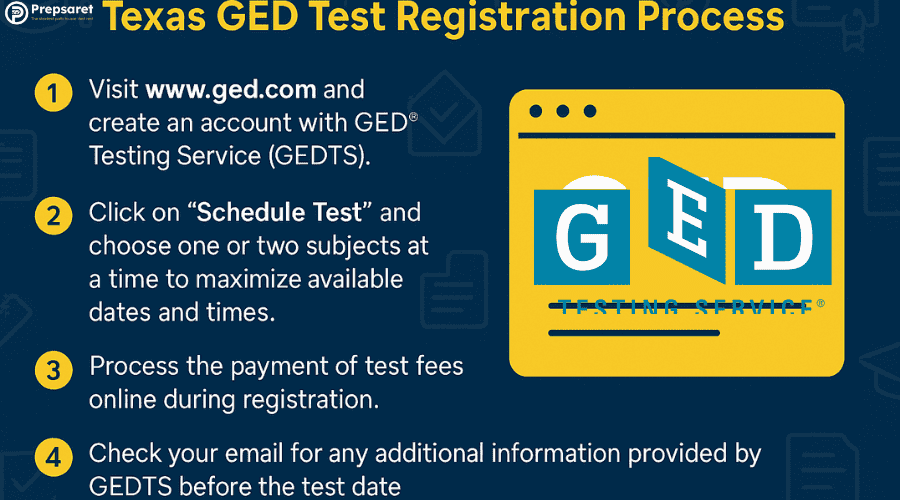
Once you feel adequately prepared, you can schedule your GED test. The process involves registering, paying fees, and selecting a testing location and time.
Registration and Scheduling
- GED.com: The official registration and scheduling platform for the GED test in Texas is GED.com. You will need to create an account, which will allow you to schedule your exams, view your scores, and access study resources.
- Testing Centers: Texas has numerous official GED testing centers located throughout the state. These centers are equipped with computers and provide a secure environment for taking the exam. You can find a list of authorized testing centers on GED.com or by contacting the Texas GED Program.
- Fees: There are fees associated with the GED test. These fees vary slightly and cover the cost of the exams and the administration of the program. Fee waivers or financial assistance may be available through some adult education programs; inquire with your local provider.
The Testing Experience
The GED test is computer-based. Here’s what to expect on test day:
- Identification: You will need to present a valid, government-issued photo ID (such as a driver’s license or state ID) on test day.
- Test Format: Each section of the GED test has a time limit, including breaks. The Mathematical Reasoning test includes a calculator section, and a basic on-screen calculator is provided.
- Passing Score: To earn your GED credential, you must achieve a minimum score of 145 on each of the four GED subject tests. You also need a minimum total score of 580 across all four tests.
- Retakes: If you do not pass a particular section, you can retake it. The Texas GED Program may have specific policies regarding the number of retakes allowed and any associated fees. It is advisable to review the current policies on GED.com.
After Earning Your GED
Congratulations on achieving your GED in Texas! This accomplishment opens up a world of possibilities.
Utilizing Your GED Credential
- Higher Education: Your GED certificate is equivalent to a high school diploma and will be accepted by most colleges and universities in Texas and across the nation. You can now pursue associate’s degrees, bachelor’s degrees, and other post-secondary educational programs.
- Career Advancement: Many employers require a high school diploma or equivalent for employment. Your GED credential can qualify you for a wider range of jobs and career advancement opportunities.
- Vocational Training: For those interested in skilled trades, your GED is a prerequisite for enrollment in many vocational and technical training programs.
- Personal Fulfillment: Earning your GED is a significant personal achievement that can boost your confidence and open new avenues for lifelong learning and personal growth.
Accessing Your GED Records
After you have successfully passed all four GED tests, you will receive your Texas High School Equivalency Certificate. Official transcripts and duplicate certificates can be requested through the Texas Education Agency (TEA) if needed for future applications or verification.

Frequently Asked Questions About the GED in Texas
- How long does it take to prepare for the GED? The time needed varies greatly depending on an individual’s prior knowledge and study habits. Some individuals may be ready in a few months, while others might require a year or more of dedicated study.
- Can I take the GED test online? The official GED test must be taken in a proctored testing center. While preparation can be done online, the actual exam requires in-person supervision.
- What is the cost of the GED test in Texas? The cost varies and is subject to change, but generally involves fees for each of the four tests. It is best to check the most current fee schedule on GED.com.
- Are there resources available for individuals with learning disabilities? The GED program offers accommodations for individuals with documented learning disabilities. You will need to apply for these accommodations through GED.com and provide supporting documentation.
Obtaining your GED in Texas is a challenging yet achievable goal. By understanding the requirements, dedicating time to preparation, and utilizing the available resources, you can successfully earn your GED and unlock a brighter future.
LifeOutOfTheBox is a participant in the Amazon Services LLC Associates Program, an affiliate advertising program designed to provide a means for sites to earn advertising fees by advertising and linking to Amazon.com. Amazon, the Amazon logo, AmazonSupply, and the AmazonSupply logo are trademarks of Amazon.com, Inc. or its affiliates. As an Amazon Associate we earn affiliate commissions from qualifying purchases.