
Navigating the path to a General Educational Development (GED) credential in Texas can be a transformative journey for adults seeking to advance their education and career prospects. The GED test is a comprehensive assessment of high school-level academic skills, offering a valuable alternative for those who did not complete traditional high school. This guide provides an in-depth look at the requirements, preparation strategies, and testing process for obtaining your GED in the Lone Star State.
Understanding the GED in Texas
The GED program in Texas is administered by the Texas Department of Licensing and Regulation (TDLR) through its GED Testing Program. It serves as a standardized measure of high school equivalency, recognized by most colleges, universities, and employers across the nation. The credential signifies that the holder has academic skills equivalent to those of a high school graduate.

Eligibility Requirements
To be eligible to take the GED test in Texas, candidates must meet the following criteria:
- Age: Applicants must be at least 16 years old. Those aged 16 and 17 must have official parental consent and may also need to provide evidence of withdrawal from high school. Individuals under 16 are generally not eligible.
- Residency: Candidates must be a resident of Texas or a resident of another state or country who is physically present in Texas at the time of testing.
- High School Completion: Applicants must not have graduated from a public or private high school or received a high school equivalency certificate in another state. If a candidate has previously earned a high school diploma or equivalency certificate, they are not eligible to retake the GED test.
The GED Test Structure
The GED test is comprised of four subject areas, each designed to assess different skills and knowledge domains:
- Mathematical Reasoning: This section covers algebraic reasoning, numerical operations, geometry, and data analysis. It includes both multiple-choice and constructed-response questions. A calculator is provided on-screen for some parts of the test.
- Reasoning Through Language Arts: This section assesses reading comprehension, writing skills, and the ability to analyze and synthesize information from various texts. It includes multiple-choice questions and a 45-minute essay component, which evaluates argumentative writing.
- Science: This part of the test covers life science, physical science, and earth and space science. It includes multiple-choice questions that require the interpretation of data, scientific principles, and experimental design.
- Social Studies: This section focuses on U.S. history, civics and government, geography, and economics. It features multiple-choice questions that test the understanding of historical events, governmental structures, and economic concepts.
Each test subject is scored on a scale of 100 to 200. A score of 145 or higher in each of the four subject areas is required to pass and earn the GED credential. A score between 100 and 134 indicates a “Banded” score, suggesting the test-taker is developing their skills but has not yet met the standard. A score below 100 indicates a “Low” score, suggesting minimal knowledge in that area.
Preparing for the GED Test
Effective preparation is crucial for success on the GED test. Texas offers a variety of resources to help individuals prepare, ranging from free adult education programs to paid study materials.
Adult Education Programs
The Texas Workforce Commission (TWC) funds adult education and literacy programs across the state. These programs provide free instruction in GED preparation, foundational literacy, and English as a Second Language (ESL). They are an invaluable resource for individuals who need structured learning environments and direct guidance from instructors.
Many community colleges and local school districts host these programs. They often offer flexible scheduling, including day, evening, and weekend classes, to accommodate working adults and families. The curriculum is designed to cover all the content areas of the GED test, with a focus on developing the specific skills required for each section.
Finding a Program Near You
To locate an adult education program, individuals can visit the Texas Workforce Commission website or contact their local Workforce Solutions office. These offices can provide information on program availability, enrollment procedures, and eligibility for specific services.
Self-Study Options
For those who prefer a more independent approach, various self-study materials are available. These include:
- Official GED Study Guides: The GED Testing Service offers official study guides that provide comprehensive content reviews, practice questions, and test-taking strategies. These guides are aligned with the current GED test format and content.
- Online Learning Platforms: Numerous online platforms offer GED preparation courses, practice tests, and video lessons. Some popular options include Kaplan, Princeton Review, and Khan Academy, which often has free resources. These platforms can offer flexibility and personalized learning experiences.
- GED Practice Tests: Taking practice tests is an excellent way to gauge your readiness and identify areas where you need further study. Many online resources and study guides provide full-length practice tests that simulate the actual GED exam experience. The TDLR also offers official GED Ready™ practice tests, which can provide an estimate of your score on the official GED test.
Key Preparation Strategies
Regardless of the chosen preparation method, certain strategies can enhance learning and improve the likelihood of success:
- Diagnostic Assessment: Begin by taking a diagnostic test or completing a practice test to assess your current skill level in each subject area. This will help you identify strengths and weaknesses, allowing you to focus your study efforts effectively.
- Structured Study Plan: Create a realistic study schedule that allocates sufficient time to each subject area. Break down the material into manageable chunks and set achievable goals.
- Active Learning: Engage actively with the material by taking notes, summarizing information, working through practice problems, and discussing concepts with others.
- Focus on Weak Areas: Dedicate more time and effort to the subject areas where you scored lower on diagnostic or practice tests.
- Develop Test-Taking Strategies: Learn effective strategies for approaching different question types, managing your time during the exam, and performing well on the essay portion of the Reasoning Through Language Arts test.
- Simulate Test Conditions: When taking practice tests, try to replicate the actual testing environment as much as possible. This includes timing yourself and avoiding distractions.
The GED Testing Process in Texas
Once you feel adequately prepared, the next step is to register for and take the GED test. The process is streamlined to be accessible and efficient.
Registration and Scheduling
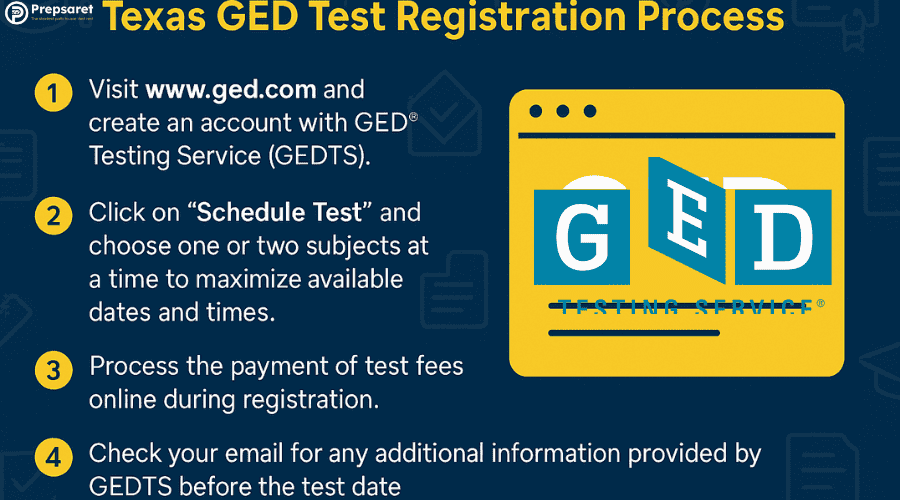
GED testing in Texas is administered through authorized Pearson VUE test centers. Registration is done online through the official GED.com website.
- Create an Account: Visit GED.com and create a personal account. This account will be used for registration, scheduling, and accessing your test scores.
- Find a Test Center: Use the website’s locator tool to find a Pearson VUE GED testing center near you. Texas has numerous authorized centers located in various cities and towns.
- Schedule Your Tests: Once you have selected a test center, you can schedule your GED tests. You have the option to schedule all four tests at once or schedule them individually, depending on your preference and readiness. Each test subject requires a separate appointment.
- Payment: Payment is typically made at the time of scheduling. The fee for the GED test can vary, so it is advisable to check the current pricing on GED.com. Some adult education programs may offer vouchers or financial assistance for test fees.
Taking the Test
On your scheduled test day, arrive at the Pearson VUE testing center with a valid, government-issued photo identification (e.g., driver’s license, state ID, passport). Check the specific identification requirements on GED.com to ensure you have the correct documentation.
- Arrival: Arrive at the testing center at least 30 minutes prior to your scheduled appointment time.
- Check-in: You will be asked to check in and may have your photograph taken.
- Testing Environment: The GED test is administered on computers in a secure testing room. You will be provided with scratch paper and pencils. Lockers are usually available for personal belongings, as electronic devices are not permitted in the testing room.
- During the Test: Read the instructions carefully for each section. Manage your time effectively. If you encounter a question you are unsure about, make your best guess and move on. You may be able to return to unanswered questions within a section before submitting it.
Understanding Your Scores
After completing your GED tests, your scores will be available on your GED.com account, typically within a few business days.
- Passing Scores: As mentioned earlier, a score of 145 or higher in each of the four subject areas is required to pass.
- Retaking Tests: If you do not pass a particular subject area, you can retake it. Texas offers free retakes for the first two attempts of each subject after the initial paid attempt. Subsequent retakes may have associated fees. It is recommended to review your study materials and focus on the areas where you struggled before retaking the test.
- Receiving Your Diploma: Once you have successfully passed all four GED subject tests, you will be issued a GED diploma by the Texas Department of Licensing and Regulation. This diploma is your official high school equivalency credential.
Leveraging Your GED Credential
Earning a GED credential opens doors to a wide range of opportunities. It is a recognized qualification that allows individuals to pursue further education, enter new career paths, and enhance their earning potential.
Further Education
With a GED, you are eligible to apply to colleges and universities in Texas and across the country. Many institutions view the GED as equivalent to a high school diploma, allowing access to associate’s, bachelor’s, and graduate degree programs. It can also be a stepping stone to vocational training programs and certifications.
Career Advancement
Many employers require a high school diploma or its equivalent for entry-level positions. A GED credential can help you qualify for a broader range of jobs, secure promotions, and increase your earning capacity. It demonstrates a commitment to learning and a foundational level of academic competence that employers value.

Personal Growth and Empowerment
Beyond the practical benefits, earning a GED is a significant personal achievement. It signifies dedication, perseverance, and a commitment to self-improvement. This accomplishment can boost confidence, open up new personal interests, and empower individuals to achieve their broader life goals.
Obtaining your GED in Texas is an attainable goal with the right preparation and resources. By understanding the requirements, utilizing available study programs, and following the established testing procedures, you can successfully earn your high school equivalency and embark on a future filled with new possibilities.
LifeOutOfTheBox is a participant in the Amazon Services LLC Associates Program, an affiliate advertising program designed to provide a means for sites to earn advertising fees by advertising and linking to Amazon.com. Amazon, the Amazon logo, AmazonSupply, and the AmazonSupply logo are trademarks of Amazon.com, Inc. or its affiliates. As an Amazon Associate we earn affiliate commissions from qualifying purchases.