
Starting a limited liability company (LLC) in Florida can be an empowering step for entrepreneurs looking to establish their business presence. While navigating legal and administrative processes might seem daunting, understanding the steps involved can make the endeavor manageable, even when undertaking it independently. This guide aims to demystify the process of forming an LLC in the Sunshine State, providing a clear, step-by-step roadmap for solo founders.
Understanding the Basics of an LLC
Before diving into the formation process, it’s crucial to grasp what an LLC is and why it’s a popular choice for businesses of all sizes. An LLC is a hybrid business structure that combines the pass-through taxation of a partnership or sole proprietorship with the limited liability of a corporation. This means that the personal assets of the owners (members) are protected from business debts and lawsuits.
Key Benefits of an LLC
- Limited Liability Protection: This is the most significant advantage. If your business incurs debt or faces legal action, your personal assets, such as your home, car, or savings, are generally shielded from creditors and litigants. This separation is fundamental to the LLC structure.
- Pass-Through Taxation: Unlike C-corporations, LLCs typically don’t pay corporate income tax. Instead, profits and losses are “passed through” to the individual members’ personal income tax returns. This avoids the “double taxation” that can occur with C-corporations, where profits are taxed at the corporate level and then again when distributed to shareholders.
- Flexibility in Management: LLCs offer considerable flexibility in how they are managed. They can be member-managed, where all members participate in daily operations, or manager-managed, where members appoint one or more managers (who may or may not be members) to run the business. This adaptability allows the structure to suit various business needs.
- Fewer Formalities: Compared to corporations, LLCs generally have fewer ongoing compliance requirements. They don’t typically need to hold annual board or shareholder meetings or maintain extensive corporate minutes, although keeping good records is always advisable.
- Credibility: Forming an LLC can lend a sense of legitimacy and professionalism to your business, which can be beneficial when dealing with clients, suppliers, and financial institutions.
LLC vs. Other Business Structures
It’s helpful to compare an LLC with other common business structures to understand its unique advantages:
- Sole Proprietorship: The simplest structure, where the business is owned and run by one individual. There is no legal distinction between the owner and the business, meaning the owner is personally liable for all business debts and obligations.
- Partnership: Similar to a sole proprietorship but with two or more owners. Partners share profits and losses, and each partner is typically personally liable for the business’s debts, including those incurred by other partners.
- Corporation (S-Corp and C-Corp): A more complex structure that creates a separate legal entity from its owners (shareholders). Corporations offer strong liability protection but come with more stringent reporting and tax requirements. S-corps offer pass-through taxation, similar to LLCs, but have specific eligibility criteria and operational rules. C-corps are subject to double taxation.
For many small to medium-sized businesses and solo entrepreneurs, the LLC strikes an ideal balance between liability protection, tax flexibility, and operational simplicity.
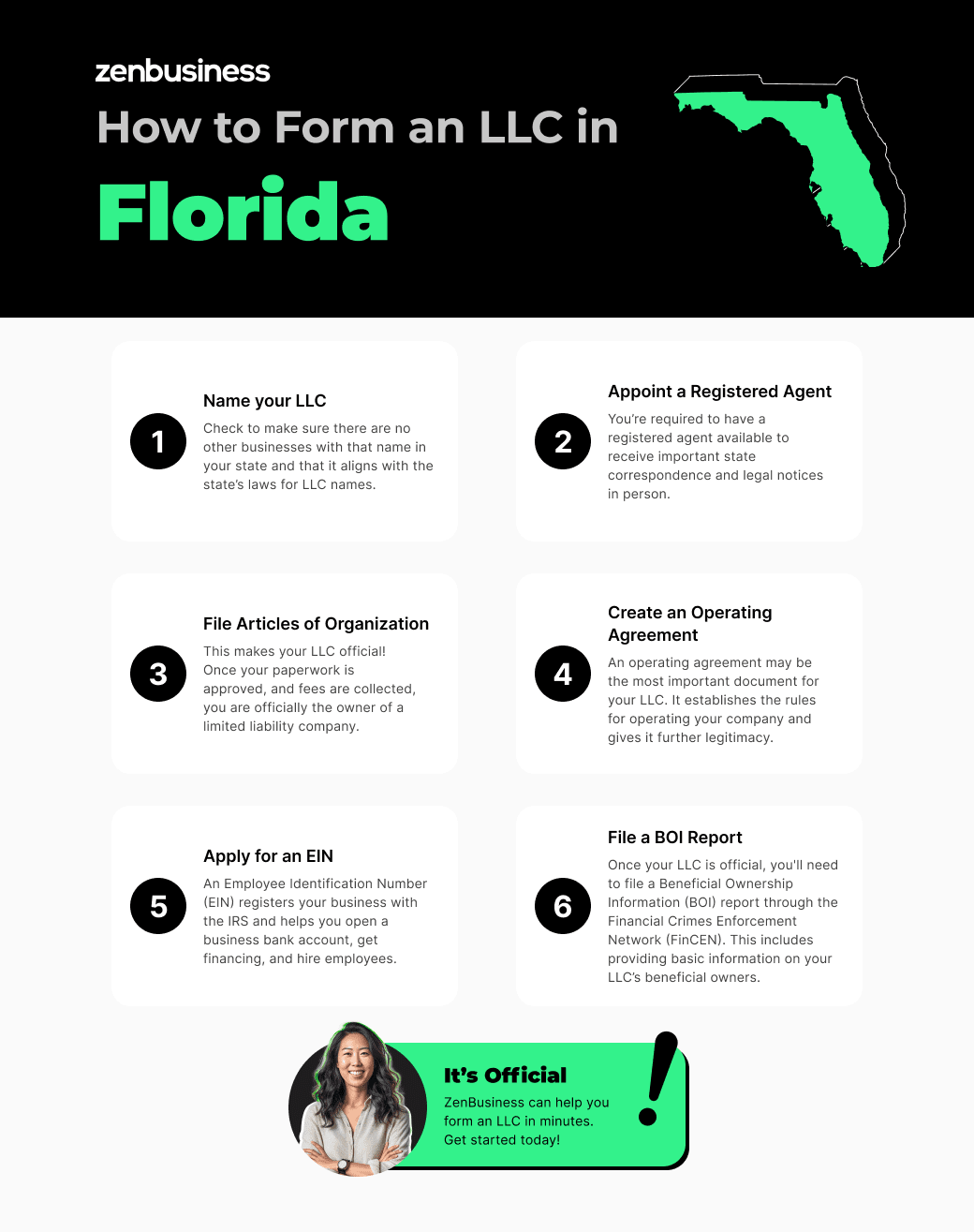
Step-by-Step Guide to Forming Your Florida LLC
Forming an LLC in Florida involves several distinct steps, primarily managed through the Florida Department of State, Division of Corporations.
Step 1: Choose a Business Name
Your LLC’s name is a critical element. It needs to be unique, memorable, and compliant with Florida state laws.
Naming Requirements
- Uniqueness: The name you choose must not be identical or confusingly similar to the names of existing businesses registered in Florida. You can check name availability on the Florida Department of State’s website.
- Designator: The name must include a designator that signifies it’s an LLC. Acceptable designators include “Limited Liability Company,” “LLC,” or “L.L.C.”
- Prohibited Words: Certain words are restricted or prohibited, such as “Bank,” “Credit Union,” “Trust,” or “Insurance,” unless you obtain specific approval or are licensed to use them.
- Considerations: While not legally required, choose a name that reflects your business, is easy to spell and pronounce, and is available as a domain name for your website.
Checking Name Availability
Before proceeding, you must verify that your desired name is available.
- Navigate to the Florida Department of State’s Sunbiz website.
- Use their “Name Availability” search tool.
- Enter your proposed business name to see if it’s already in use.
If your preferred name is unavailable, brainstorm alternatives. You can also reserve a name for up to 30 days by filing an application and paying a fee, although this is often unnecessary if you’re ready to file your formation documents promptly.
Step 2: Designate a Registered Agent
A registered agent is an individual or a business entity that agrees to accept legal documents on behalf of your LLC. This is a mandatory requirement for all businesses registered in Florida.
Who Can Be a Registered Agent?
- An Individual Resident of Florida: If you are a Florida resident and plan to serve as your own registered agent, you must have a physical street address within the state (P.O. boxes are not allowed).
- A Business Entity: A Florida domestic or foreign business entity that has a business presence in Florida.
- A Commercial Registered Agent Service: These professional services specialize in being registered agents and offer services for a fee, providing a reliable and professional point of contact.
Responsibilities of a Registered Agent
The registered agent’s primary duty is to be available during normal business hours to accept service of process (like lawsuit notifications), official government correspondence, and other important legal documents. Failure to maintain a registered agent can lead to the dissolution of your LLC.
If you choose to be your own registered agent, ensure your physical address is consistently accessible and that you will promptly forward any received documents to yourself. For many, especially those who travel frequently or wish to maintain a clear separation, hiring a registered agent service is a practical solution.
Step 3: File Articles of Organization
The core document for establishing your LLC in Florida is the Articles of Organization. This document is filed with the Florida Department of State.
Information Required for Articles of Organization
- LLC Name: The full, approved name of your limited liability company.
- Principal Office Address: The street address of your LLC’s principal place of business in Florida. A P.O. Box is not sufficient.
- Mailing Address: If different from the principal office address, provide a mailing address.
- Registered Agent Name and Address: The full name and physical street address of your designated registered agent in Florida.
- Management Structure: Indicate whether the LLC will be “member-managed” or “manager-managed.”
- Effective Date: You can specify an effective date for your LLC, which can be up to 90 days after filing. If no date is specified, it becomes effective upon filing.
- Signature: The document must be signed by an authorized person, typically one of the organizers.
Filing Methods
You can file your Articles of Organization electronically through the Florida Department of State’s Sunbiz website, by mail, or in person. Online filing is generally the fastest and most efficient method.
- Online Filing: Visit the Sunbiz website and follow the prompts to create an account or log in and complete the online form for Articles of Organization.
- Mail or In-Person Filing: Download the Articles of Organization form from the Sunbiz website, complete it, and mail or deliver it to the Division of Corporations address listed on their site.
There is a filing fee associated with this process, which is subject to change. Always check the latest fee schedule on the Department of State’s website. Once filed and approved, your LLC legally exists.

Step 4: Create an Operating Agreement
While not a mandatory filing requirement with the state of Florida, an Operating Agreement is a crucial internal document that governs the operations and ownership of your LLC. It’s highly recommended, especially for solo entrepreneurs, to clearly define the business’s internal workings.
Purpose of an Operating Agreement
- Defines Ownership and Management: It outlines the ownership percentages of members, their rights and responsibilities, and how the LLC will be managed.
- Profit and Loss Distribution: It specifies how profits and losses will be allocated among members.
- Membership Changes: It details procedures for admitting new members, members withdrawing or transferring their interests, and what happens upon the death or disability of a member.
- Operational Procedures: It can include rules for voting, decision-making processes, and dispute resolution.
- Reinforces Limited Liability: By detailing operational procedures and separation, it helps reinforce the legal separation between the members and the LLC, bolstering liability protection.
Key Components of an Operating Agreement
- Company Name and Purpose: State the official name of the LLC and its business purpose.
- Member Information: List all members, their contribution to the LLC, and their ownership percentages.
- Management Structure: Clearly state whether the LLC is member-managed or manager-managed and define the roles and powers of managers if applicable.
- Capital Contributions: Detail how members contribute to the LLC (e.g., cash, property, services) and the process for additional contributions.
- Distributions: Outline how and when profits and capital will be distributed to members.
- Membership Changes: Address procedures for adding, removing, or transferring membership interests.
- Dissolution: Specify the conditions under which the LLC can be dissolved and how assets will be distributed.
- Amendments: Define the process for amending the operating agreement.
An Operating Agreement is a flexible document that can be tailored to your specific business needs. Even for a single-member LLC, it’s wise to have one to formalize your business structure and intent.
Step 5: Obtain an Employer Identification Number (EIN)
An EIN, also known as a Federal Tax Identification Number, is like a Social Security number for your business. It’s issued by the Internal Revenue Service (IRS) and is required for most businesses.
When You Need an EIN
You will generally need an EIN if your LLC:
- Has more than one member.
- Plans to hire employees.
- Operates as a corporation or partnership for tax purposes.
- Files excise taxes.
- Uses certain types of trusts.
- Is involved with a Keogh plan.
- Is involved with a non-profit organization.
Even if not strictly required, obtaining an EIN is often beneficial. It allows you to open a business bank account, which is crucial for maintaining the separation between personal and business finances.
How to Obtain an EIN
You can apply for an EIN online directly from the IRS website. The application is free, and you can receive your EIN immediately after successful submission.
- Visit the IRS website.
- Navigate to the “Apply for an Employer Identification Number (EIN) Online” section.
- Complete the online application form.
Ensure you have accurate information ready regarding your LLC’s formation and structure.
Step 6: Open a Business Bank Account
Maintaining separate finances for your LLC is paramount to preserving your limited liability protection and for accurate bookkeeping.
Why a Separate Bank Account is Essential
- Liability Protection: Commingling personal and business funds can “pierce the corporate veil,” making your personal assets vulnerable to business debts and lawsuits.
- Financial Clarity: A dedicated business account simplifies tracking income and expenses, making tax preparation easier and providing a clearer picture of your business’s financial health.
- Professionalism: Using a business account adds a layer of professionalism when dealing with clients, vendors, and lenders.
What You’ll Need
To open a business bank account, you’ll typically need:
- Your LLC’s Articles of Organization (filed with the state).
- Your LLC’s Operating Agreement.
- Your EIN from the IRS.
- Personal identification for all signatories on the account.
Shop around for business bank accounts that offer the features and low fees that best suit your business needs.
Ongoing Compliance and Considerations
Forming your LLC is just the first step. Ongoing compliance ensures your business remains in good standing with the state and maintains its legal protections.
Annual Reports
Florida requires LLCs to file an annual report with the Department of State. This report updates information about your LLC, such as the principal address and registered agent details. There is a fee associated with filing the annual report. Failure to file can result in administrative dissolution of your LLC.
Taxes
As mentioned, LLCs generally enjoy pass-through taxation. However, you will still need to file federal and state tax returns. The specific tax obligations will depend on your LLC’s structure and activities. Consult with a tax professional to ensure you are meeting all your tax requirements.
Business Licenses and Permits
Depending on your industry and location within Florida, you may need to obtain specific business licenses and permits at the federal, state, or local level. Research the requirements for your specific business operations.

Business Insurance
While not legally mandated for all LLCs, business insurance is a vital component of risk management. Consider general liability insurance, professional liability insurance (if applicable), and workers’ compensation insurance if you have employees.
Opening an LLC in Florida by yourself is an achievable goal with careful planning and adherence to these steps. By understanding the requirements and diligently completing each phase, you can successfully establish your business entity and lay a strong foundation for future growth.
LifeOutOfTheBox is a participant in the Amazon Services LLC Associates Program, an affiliate advertising program designed to provide a means for sites to earn advertising fees by advertising and linking to Amazon.com. Amazon, the Amazon logo, AmazonSupply, and the AmazonSupply logo are trademarks of Amazon.com, Inc. or its affiliates. As an Amazon Associate we earn affiliate commissions from qualifying purchases.