
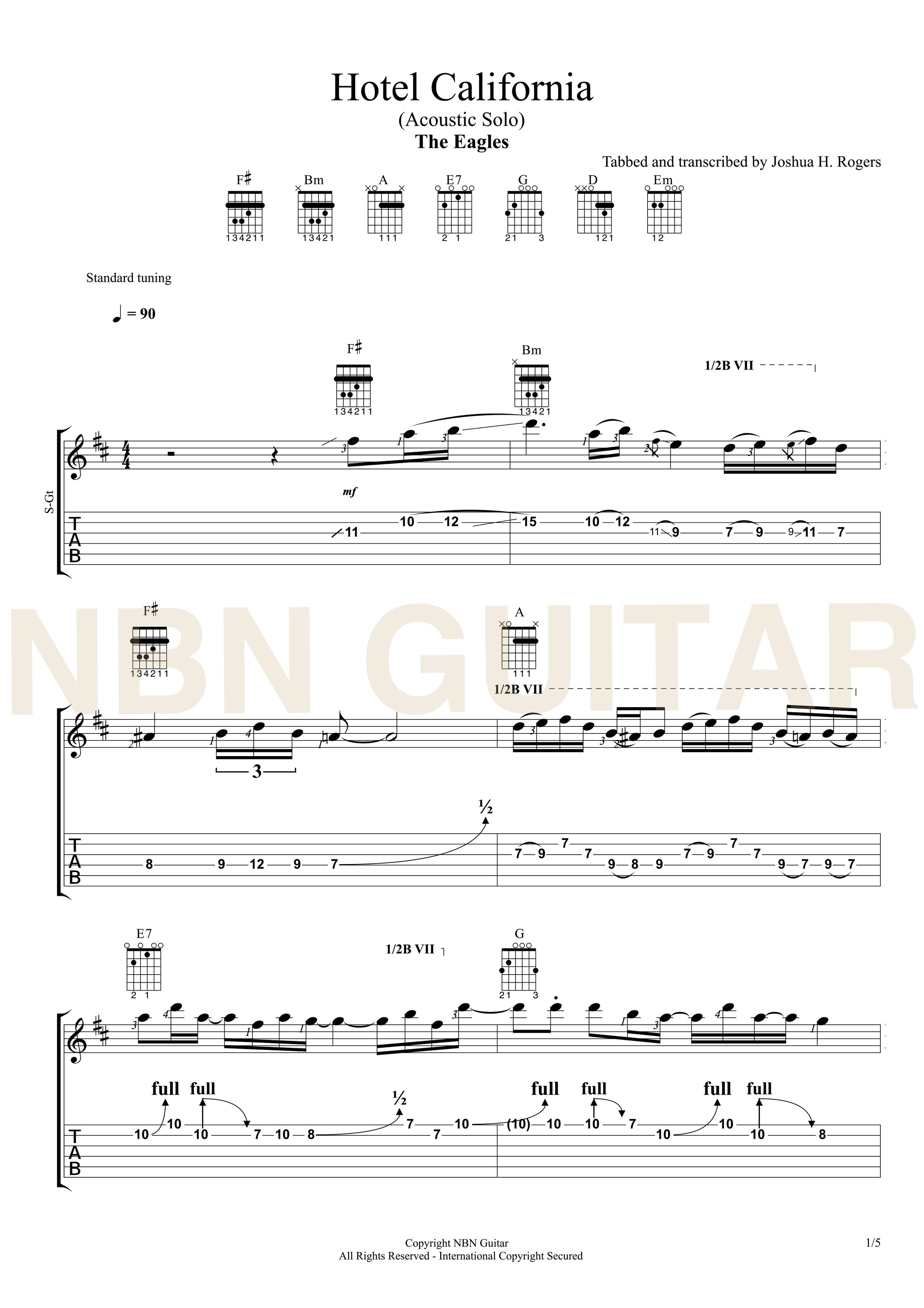
The iconic guitar solo from The Eagles’ “Hotel California” is a masterclass in melodic storytelling, weaving a narrative of technical prowess and emotional depth. For aspiring guitarists, learning this solo represents a significant milestone, offering a deep dive into the techniques and compositional brilliance of Don Felder and Joe Walsh. This guide will break down the solo into digestible sections, exploring the key licks, harmonic considerations, and stylistic nuances that make it so captivating.
The Foundation: Understanding the Solo’s Structure and Harmony
Before diving into the fingerwork, it’s crucial to grasp the harmonic landscape over which the solo unfolds. “Hotel California” is famously in the key of B minor. The solo primarily navigates through the B minor pentatonic and B natural minor scales, with excursions into modes that add color and tension. The underlying chord progression during the solo section is a descending sequence that creates a sense of unease and eventual resolution.

The Chordal Underpinning
The solo typically begins over a progression that includes chords like Bm, F#7, A, E, G, D, Em, and F#. This cyclical pattern creates a rich harmonic palette for the guitarists to improvise over. Understanding how the solo lines interact with these chords is key to capturing the authentic feel. For instance, phrases played over the F#7 chord will often emphasize the A (the third of F#7) or the C# (the fifth), providing a strong harmonic anchor. Similarly, the A major chord opens up possibilities for melodies utilizing the A major pentatonic or even the C# minor pentatonic (which is the relative minor of A major).
Scale Choices and Modal Flavors
While the B minor pentatonic scale (B, D, E, F#, A) is the bedrock, Felder and Walsh judiciously employ notes from the B natural minor scale (B, C#, D, E, F#, G, A) and even incorporate elements of the Phrygian dominant scale for specific dramatic effects, particularly over the dominant seventh chords like F#7. The Phrygian dominant scale, in this context (B Phrygian dominant: B, C, D#, E, F#, G, A), offers a distinctive Spanish or Middle Eastern flavor due to its lowered second degree (C natural) and raised third (D#). The masterful use of these scales, transitioning seamlessly between them, is what elevates the solo beyond mere technicality.
Deconstructing the Solo: Key Licks and Techniques
The “Hotel California” solo is renowned for its interlocking guitar parts, often referred to as the “trading fours” between Felder and Walsh. While learning both parts is the ultimate goal, dissecting them individually first is a more manageable approach.
Part 1: Don Felder’s Melodic Introduction
Felder’s opening lines are characterized by their lyrical phrasing and memorable melodic contours. He often starts with bends that are perfectly intonated, conveying a sense of yearning.
The Iconic Opening Bend
The solo typically begins with a powerful bend on the B string, often around the 15th fret, resolving to the root note. This initial phrase establishes the emotional tone and immediately grabs the listener’s attention. Precise bending technique is paramount here – the bend needs to reach the target note accurately and sustain with vibrato.
Ascending and Descending Phrases
Felder’s phrases often feature a combination of arpeggios and scalar runs. He skillfully uses hammer-ons and pull-offs to create fluid transitions between notes, making the solo sound more like a vocal melody than a series of discrete notes. Pay close attention to his use of the B minor pentatonic scale, particularly the higher register, where he executes rapid runs that cascade down the fretboard.
Part 2: Joe Walsh’s Grittier Counterpoint
Walsh’s contributions tend to be more aggressive, utilizing a rawer tone and more angular phrasing. His licks often add a driving rhythmic element and a touch of bluesy grit.
The Bluesy Inflection
Walsh frequently incorporates the blues note (F natural in B minor) and bends that have a slightly more raw, less refined character than Felder’s. His vibrato is often wider and more aggressive, adding a distinct personality to his lines.
Rhythmic Interplay and Call-and-Response

Walsh’s phrases often act as a response to Felder’s, creating a compelling dialogue. He employs rhythmic staccato notes and quicker, more percussive stabs, contrasting with Felder’s smoother delivery. Understanding the rhythmic placement of his notes is as important as the pitch itself.
Mastering the Techniques: Bends, Vibrato, and Phrasing
Beyond the specific notes and scales, the expressiveness of the “Hotel California” solo lies in its sophisticated use of guitar techniques.
Bending with Precision
Accurate bending is perhaps the most critical technique to master. The solo features numerous bends, from full-step bends to one-and-a-half step bends. It’s essential to develop your ear to ensure that each bend lands precisely on the intended target note. Practicing with a tuner or a reference pitch is highly recommended. Holding the bend with consistent pressure and then applying controlled vibrato is key to achieving that signature sustained, vocal-like quality.
The Art of Vibrato
Vibrato is the subtle wavering of a note, adding warmth and life. Both guitarists in the “Hotel California” solo employ distinct vibrato styles. Felder’s vibrato is often more controlled and even, while Walsh’s can be wider and more agitated. Experiment with different speeds and widths of vibrato to find what best suits the phrase you’re playing. The goal is to add expressiveness without making the note sound unstable.
Phrasing and Dynamics
The solo is not just a collection of notes; it’s a narrative. Pay attention to how Felder and Walsh group notes into musical phrases. Think of them as sentences or musical ideas. Where do they breathe? Where do they accelerate or decelerate? Dynamic control – playing softer or louder – is also crucial for conveying emotion. A crescendo can build tension, while a sudden drop in volume can create a moment of introspection.
Practicing the Solo: A Step-by-Step Approach
Learning a complex solo like this requires patience and a structured practice routine.
Slow Down and Isolate
Start by learning the solo at a significantly reduced tempo. Use a metronome religiously. This allows your fingers to build muscle memory for the correct notes and movements without the pressure of speed. Break the solo down into small, manageable phrases, perhaps just one or two bars at a time. Master each phrase before moving on to the next.
Listen Intently and Transcribe
While transcriptions are helpful, developing your ear by listening to the original recording is invaluable. Try to hum the phrases yourself before attempting to play them. If possible, attempt to transcribe sections by ear. This process will deepen your understanding of the melody and its nuances.
Gradually Increase Tempo
Once you can play a phrase accurately at a slow tempo, gradually increase the metronome speed in small increments. Don’t rush this process. It’s better to play it perfectly at a slower tempo than sloppily at a faster one.
Integrate the Two Parts
After you’ve become proficient with each individual guitar part, begin working on playing them together. This is where the true magic of the “Hotel California” solo emerges – the interplay between the two distinct voices. Experiment with playing along with a backing track, either the original recording with the guitars isolated or a good quality instrumental version.
Add Your Own Expression
As you become more comfortable with the notes and techniques, start infusing your own personality into the solo. Experiment with slightly different vibrato, subtle variations in bending, and your own dynamic interpretations. The goal is not just to replicate but to understand and embody the spirit of the original performance. Learning the “Hotel California” solo is a rewarding journey that will undoubtedly elevate your guitar playing skills.
LifeOutOfTheBox is a participant in the Amazon Services LLC Associates Program, an affiliate advertising program designed to provide a means for sites to earn advertising fees by advertising and linking to Amazon.com. Amazon, the Amazon logo, AmazonSupply, and the AmazonSupply logo are trademarks of Amazon.com, Inc. or its affiliates. As an Amazon Associate we earn affiliate commissions from qualifying purchases.