
While the allure of exploring exotic locales and experiencing diverse cultures often takes center stage in travel planning, sometimes the perfect complement to an adventure is found in a different kind of skill – the strategic art of poker. Specifically, Texas Hold’em, the most popular poker variant, offers a captivating blend of luck, skill, and psychology that can be enjoyed in various settings, from a casual game in your resort suite in Las Vegas to a more intimate gathering in a rented villa in the Tuscan countryside. This guide will equip you with the fundamental knowledge to play Texas Hold’em, enhancing your travel experiences by adding a new dimension of entertainment and social interaction.

Imagine yourself after a day of exploring the vibrant markets of Marrakech or admiring the ancient architecture of Rome. Instead of winding down with just a book, you could be engaging in a thrilling game of Texas Hold’em with newfound friends at your hotel, sharing stories of your adventures while strategizing your next move. Understanding the basics of this game can transform a quiet evening into an exciting and memorable experience, making your lifestyle travel even richer.
This article will walk you through the essentials of Texas Hold’em, from the objective of the game to the ranking of hands and the flow of play. We’ll cover everything you need to know to sit down at a table with confidence, whether you’re in a dedicated card room in Macau or simply playing with friends during a family trip to the Grand Canyon.
The Core Objective and Basic Setup
At its heart, Texas Hold’em is a game of skill where players compete to win a “pot” of chips. The pot is formed by players placing bets during rounds of play. The ultimate goal is to have the best five-card poker hand at the showdown, or to bluff your opponents into folding their hands before the showdown.
Each player is dealt two private cards, known as “hole cards.” Then, five community cards are dealt face-up in the center of the table, accessible to all players. These five community cards are revealed in stages: the “flop” (the first three cards), the “turn” (the fourth card), and the “river” (the fifth and final card). Players then combine their two hole cards with the five community cards to make the best possible five-card poker hand.
The game involves several players, typically between two and ten, gathered around a poker table. A dealer is designated, who shuffles and deals the cards. In many games, especially those played in casinos or dedicated card rooms, a professional dealer handles the shuffling and dealing. However, in casual games, players often take turns acting as the dealer, rotating clockwise after each hand.
The “button” is a marker that indicates the nominal dealer for the current hand. It moves one position clockwise after each hand. The players to the left of the button are the first to act in betting rounds, ensuring a structured and fair progression of play. Understanding the position of the button is crucial as it influences betting strategy. For instance, players in later positions have the advantage of seeing how their opponents act before they have to make their own decision.
Understanding the Betting Structure
Before the hole cards are dealt, two mandatory bets are placed to start the pot. These are called the “blinds.” The player immediately to the left of the button posts the “small blind,” and the player to their left posts the “big blind,” which is typically twice the size of the small blind. This ensures there’s always something to play for, even if no one decides to raise their bets.
Following the dealing of the hole cards, the first betting round commences with the player to the left of the big blind. This player has several options:
- Fold: Discard their hand and forfeit any chance of winning the current pot. They lose any chips they’ve already bet.
- Call: Match the amount of the current bet (in this initial round, the big blind).
- Raise: Increase the current bet amount. Any subsequent player must then call the new, higher bet, re-raise, or fold.
After the first betting round, the “flop” is dealt – three community cards are placed face-up. Another betting round ensues, starting with the player closest to the left of the button who is still in the hand. The options remain the same: fold, call, or raise.
The “turn” is then dealt – the fourth community card. This is followed by a third betting round, again starting with the first active player to the left of the button.
Finally, the “river” is dealt – the fifth and final community card. A last betting round takes place.
The Showdown
If two or more players remain in the hand after the final betting round, a “showdown” occurs. The player who made the last aggressive action (bet or raise) typically shows their hand first. If all players have checked, the player to the left of the button shows their hand first. Players then reveal their hole cards, and the player with the best five-card poker hand, formed by combining their two hole cards with the five community cards, wins the pot. If two or more players have the exact same best hand, the pot is split equally among them.
The Hierarchy of Poker Hands
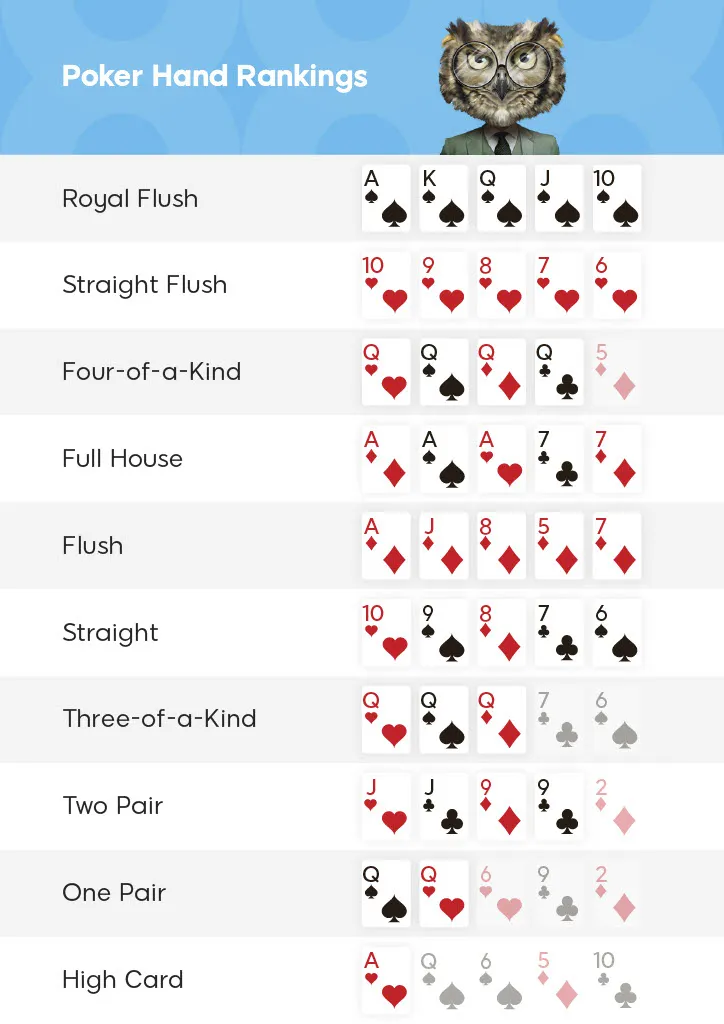
Mastering the ranking of poker hands is fundamental to Texas Hold’em. Knowing which hand beats another allows you to make informed decisions about betting and bluffing. Here are the hands in descending order of strength:
The Top Hands
- Royal Flush: The highest possible hand. It consists of an Ace, King, Queen, Jack, and 10, all of the same suit. For example, A♠ K♠ Q♠ J♠ 10♠.
- Straight Flush: Five cards in sequence, all of the same suit. For example, 9♥ 8♥ 7♥ 6♥ 5♥. A Royal Flush is a specific type of Straight Flush.
- Four of a Kind: Four cards of the same rank and one other card (the “kicker”). For example, K♦ K♥ K♣ K♠ 7♠.
- Full House: Three cards of one rank and two cards of another rank. For example, Q♠ Q♥ Q♣ 8♦ 8♠.
- Flush: Five cards of the same suit, but not in sequence. For example, K♣ 9♣ 7♣ 4♣ 2♣.
- Straight: Five cards in sequence, but not all of the same suit. For example, 7♦ 6♣ 5♥ 4♠ 3♦. An Ace can be used as either a high card (A-K-Q-J-10) or a low card (A-2-3-4-5).
The Mid to Lower Hands
- Three of a Kind: Three cards of the same rank and two other unrelated cards. For example, 10♥ 10♠ 10♣ 8♦ 3♠.
- Two Pair: Two cards of one rank, two cards of another rank, and one other card. For example, J♠ J♥ 5♦ 5♣ 9♠.
- One Pair: Two cards of the same rank and three other unrelated cards. For example, A♦ A♥ 7♣ 4♠ 2♦.
- High Card: If no player has any of the above hands, the player with the highest-ranking card wins. For example, K♠ Q♦ 9♥ 7♣ 3♠ (King high).
In case of ties, the highest card outside of the matching set determines the winner. For instance, if two players have a pair of Kings, the player with the higher kicker card wins. If the kickers are also tied, the pot is split.
Strategic Considerations for the Traveling Poker Player
While understanding the rules is the first step, developing a winning strategy is what elevates your game. For travelers, this can be particularly rewarding, as it allows you to engage more deeply with social settings.
Positional Awareness
As mentioned earlier, your position at the table relative to the dealer button is a significant strategic advantage. Being in a late position allows you to observe the actions of players before you. This information is invaluable for making more informed decisions about whether to bet, call, or fold. For example, if several players before you have folded, you might be more inclined to play a weaker hand from a later position, knowing that the pot is less contested. Conversely, playing from early positions requires stronger starting hands, as you have less information about your opponents’ intentions.
When you’re in a new city, perhaps staying at a boutique hotel in Paris or a charming bed and breakfast in the Scottish Highlands, and you find yourself with a group of people interested in a game, understanding position will immediately give you an edge, making your exploration of the local tourism scene even more engaging.
Reading Your Opponents (The Psychological Game)
Poker is as much a game of psychology as it is of cards. Observing your opponents for “tells” – involuntary physical cues that might reveal the strength of their hand – can be a powerful tool. These can range from nervous fidgeting when they have a strong hand to overly confident betting when they’re bluffing.
However, be cautious. Skilled players can also employ “reverse tells” to mislead you. The best approach is to focus on consistent patterns of behavior rather than isolated incidents. This is where a relaxed, social atmosphere, perhaps during a luxury travel experience in the Maldives or a budget travel adventure through Southeast Asia, can be beneficial. You have the opportunity to observe people over a longer period, noticing subtle changes in their demeanor.
Bankroll Management
A crucial aspect of any poker game, especially when traveling, is bankroll management. This refers to the practice of only playing with money you can afford to lose. When you are far from home, it’s essential to set a strict budget for your poker games. This prevents you from overspending and ensures that your gambling does not negatively impact your ability to enjoy your travel plans, such as visiting landmarks like the Great Wall of China or the Machu Picchu.
Decide on a specific amount you are willing to spend before you even start playing. If you lose that amount, you stop playing for the trip. This discipline will protect your finances and allow you to continue enjoying your vacation.
Practice and Patience
Like any skill, becoming proficient at Texas Hold’em requires practice and patience. Don’t be discouraged if you don’t win every hand or every game. Focus on learning from each hand, understanding why you won or lost, and how you could have played differently.
The beauty of Texas Hold’em is its adaptability. You can play online, at dedicated card rooms, or in casual home games. For the traveler, this means you can often find opportunities to play wherever your journey takes you. Whether you’re in a bustling casino in Atlantic City or a quiet lodge in the Canadian Rockies, the game remains the same, offering a consistent and enjoyable form of entertainment.
By learning how to play Texas Hold’em, you’re not just acquiring a new skill; you’re unlocking a new way to connect with people, experience different cultures, and add an exciting layer to your travel lifestyle. So, the next time you pack your bags for a new destination, consider packing your poker face too!
LifeOutOfTheBox is a participant in the Amazon Services LLC Associates Program, an affiliate advertising program designed to provide a means for sites to earn advertising fees by advertising and linking to Amazon.com. Amazon, the Amazon logo, AmazonSupply, and the AmazonSupply logo are trademarks of Amazon.com, Inc. or its affiliates. As an Amazon Associate we earn affiliate commissions from qualifying purchases.