
Texas Hold’em, a game of skill, strategy, and a little bit of luck, has transcended its origins to become a global phenomenon. Whether you’re planning a trip to the glittering casinos of Las Vegas, the opulent resorts of Macau, or simply looking for an engaging activity during a leisurely cruise, understanding the nuances of Texas Hold’em can significantly enhance your travel and lifestyle experiences. It’s more than just a card game; it’s a cultural staple found in poker rooms from bustling urban centers to serene resort islands, offering an exciting dimension to local culture and entertainment. This comprehensive guide will walk you through the fundamentals of Texas Hold’em, from the initial deal to mastering advanced strategies, ensuring you’re well-prepared for your next game, wherever your adventures may take you.

The Allure of Texas Hold’em: A Traveler’s Guide to the Ultimate Card Game
The appeal of Texas Hold’em lies in its captivating blend of simplicity and depth. Easy to learn but challenging to master, it offers endless hours of strategic engagement. For travelers, poker rooms often serve as social hubs, places to meet fellow enthusiasts, and an integral part of the vibrant nightlife in many world-class destinations. Imagine a sophisticated evening at the Casino de Monte-Carlo in Monaco, a high-stakes tournament in Atlantic City, or a casual cash game at a luxurious resort in the Caribbean. Texas Hold’em connects you to these locales in a unique way, transforming a simple card game into a memorable travel experience.
Why Texas Hold’em Captivates Global Travelers
Texas Hold’em offers a unique form of entertainment that aligns perfectly with the spirit of travel. It’s an activity that can be enjoyed solo or with companions, providing a thrilling intellectual challenge that transcends language barriers. Many travelers seek out local experiences, and engaging in a poker game in a foreign land offers an authentic glimpse into local entertainment and social customs. From the bustling poker scene in London to the serene, yet competitive, environments found aboard luxury cruise lines navigating the Mediterranean, the game provides an exhilarating backdrop to your journey. It’s a game of psychology, observation, and calculated risk, skills that resonate with the adventurous spirit of explorers and global citizens.
Furthermore, the game’s universal rules mean that once you learn how to play, you can participate almost anywhere in the world. This accessibility makes it a fantastic addition to any travel itinerary, whether you’re staying in a five-star hotel with a dedicated poker room, or simply enjoying a friendly game with new acquaintances at an apartment rental during a long-term stay. The thrill of competition, the chance to test your wits against others, and the potential for a substantial win, all contribute to why Texas Hold’em remains a beloved pastime for countless adventurers.
Finding the Game: From Cruise Ships to Grand Casinos
The accessibility of Texas Hold’em means you can find a game in an astonishing array of locations, catering to various travel styles and budgets. For those seeking a glamorous experience, iconic casinos like the Bellagio or Caesars Palace in Las Vegas offer world-class poker rooms, often hosting high-stakes games and major tournaments like the World Series of Poker qualifiers. These establishments are more than just casinos; they are sprawling resorts providing luxurious accommodation, gourmet dining, and spectacular entertainment, making them destinations in themselves.
In Macau, known as the “Gambling Capital of the World,” you’ll find colossal venues such as The Venetian Macau and MGM Grand with extensive poker facilities that attract players from across Asia and beyond. Similarly, Singapore boasts architectural marvels like the Marina Bay Sands and Resorts World Sentosa, which combine luxury hotels with vibrant casino floors, offering a refined poker experience.
Beyond these major hubs, poker is also a popular feature on many cruise ships, offering entertainment as you sail between exotic destinations. Smaller, boutique casinos in cities like Prague or Dublin cater to a more intimate crowd, reflecting the local culture. Even destinations known for natural beauty, like the Bahamas, often feature resorts like Atlantis Paradise Island that house impressive poker rooms, blending relaxation with exhilarating gameplay. Whether your travel leans towards luxury, adventure, or cultural immersion, there’s likely a Texas Hold’em table waiting for you.
Understanding the Fundamentals: Getting Started with Texas Hold’em
Before diving into complex strategies, it’s essential to grasp the core mechanics of Texas Hold’em. The game is played with a standard 52-card deck and can involve anywhere from two to ten players at a single table. The objective is to form the best five-card poker hand using a combination of two “hole cards” dealt to you and five “community cards” shared by all players.
The Deck and the Deal: Setting Up Your Game
Every game of Texas Hold’em begins with a standard 52-card deck. The player designated as the “dealer” (or a dedicated casino dealer) shuffles and deals the cards. To ensure fair play and stimulate action, two players to the left of the dealer button are required to place forced bets called “blinds.” The player immediately to the left of the dealer posts the “small blind,” and the player to their left posts the “big blind,” which is typically twice the size of the small blind. These blinds ensure there’s always money in the pot for players to compete for, setting the stage for the first betting round. The dealer button rotates clockwise after each hand, ensuring everyone takes a turn posting blinds and dealing (in home games).
The Hole Cards: Your Starting Hand
Once the blinds are posted, each player is dealt two cards face down. These are your “hole cards,” unique to you, and form the foundation of your potential hand. It’s crucial to keep your hole cards private, as their value is a significant part of your strategic advantage. Based on these two cards, and your position at the table relative to the dealer and the blinds, you’ll decide whether to continue in the hand or fold. This initial decision is one of the most critical in Texas Hold’em, influencing all subsequent actions.
The Betting Rounds: A Dance of Strategy
Texas Hold’em unfolds over four distinct betting rounds, each presenting new information and strategic opportunities.
-
Pre-Flop: This is the first betting round, occurring immediately after the hole cards are dealt. The action begins with the player to the left of the big blind. Players have three options:
- Call: Match the amount of the big blind to stay in the hand.
- Raise: Increase the bet beyond the big blind, forcing other players to call the new, higher amount or fold.
- Fold: Give up your hand and forfeit any money you’ve already contributed to the pot (like the blinds), waiting for the next hand.
This round continues clockwise until all active players have contributed an equal amount to the pot or folded.
-
The Flop: After the pre-flop betting concludes, three community cards are dealt face up in the center of the table. This is known as “the flop.” These cards are shared by all active players, meaning anyone can use them to form their best five-card hand. A new betting round begins, starting with the first active player to the left of the dealer button. The options remain call, raise, or fold, but now players also have the option to “check” if no one has made a bet yet in the current round. Checking means passing the action to the next player without betting, but you retain the option to bet or raise later if someone else bets.
-
The Turn: Following the flop betting round, a fourth community card, known as “the turn,” is dealt face up. This card further alters the possibilities for players’ hands and can drastically change the dynamics of the game. Another betting round ensues, again starting with the first active player to the left of the dealer button.
-
The River: The final community card, “the river,” is dealt face up after the turn betting round. With all five community cards now revealed, players have all the information available to form their best possible five-card hand. This final card often determines the ultimate winner. The last betting round takes place, concluding with players either folding or seeing the hand through to the showdown.
Showdown: Revealing Your Hand
If two or more players remain in the hand after the final betting round on the river, a “showdown” occurs. Players reveal their hole cards, and the player with the best five-card poker hand wins the entire pot. If two or more players have identical best hands, the pot is split evenly among them. The showdown is the moment of truth, where all the strategic maneuvers and bluffs come to a head, and the strength of your hand is finally tested.
Mastering the Hand Rankings: Knowing What Beats What
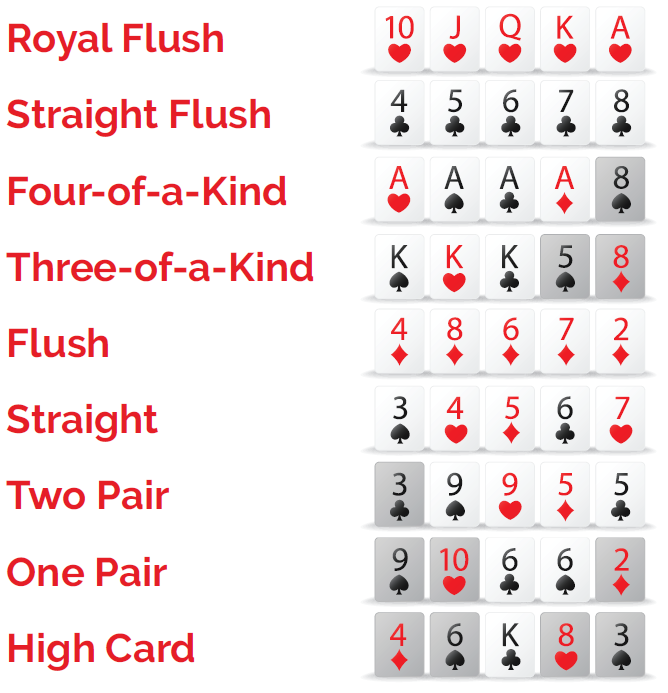
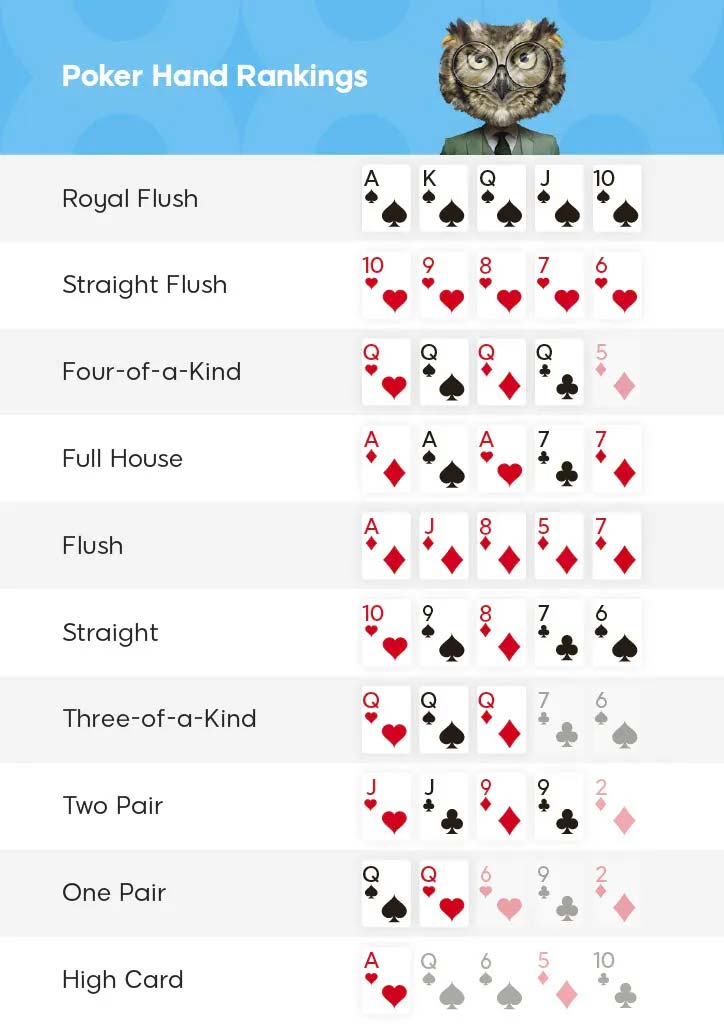
To succeed in Texas Hold’em, a thorough understanding of hand rankings is absolutely crucial. You must know exactly what beats what, from the lowest possible hand to the elusive royal flush. Here’s a breakdown of hand rankings, from weakest to strongest:
From High Card to Royal Flush: The Hierarchy of Power
-
High Card: The weakest possible hand. If no player can form any other hand, the player with the highest single card wins. For example, Ace high beats King high.
-
One Pair: Two cards of the same rank. For example, two Queens. If multiple players have a pair, the highest-ranking pair wins. If pairs are tied, the highest “kicker” (the next highest unsuited card) decides the winner.
-
Two Pair: Two different pairs in the same hand. For example, two Kings and two sevens. The hand with the highest-ranking pair wins. If the highest pair is tied, the second highest pair is compared. If both pairs are tied, the kicker card decides.
-
Three of a Kind: Three cards of the same rank. For example, three Jacks. Also known as “trips” or a “set” (if you have a pair in your hole cards and one community card matches).
-
Straight: Five consecutive cards of different suits. For example, 5-6-7-8-9 of mixed suits. An Ace can be used as either a high card (A-K-Q-J-10) or a low card (5-4-3-2-A).
-
Flush: Five cards of the same suit, but not in consecutive order. For example, five hearts (e.g., A-K-8-4-2 of hearts). If multiple players have a flush, the player with the highest card in their flush wins.
-
Full House: A combination of three of a kind and a pair. For example, three Queens and two Kings. The hand with the highest-ranking three of a kind wins. If those are tied, the highest-ranking pair wins.
-
Four of a Kind: Four cards of the same rank. For example, four sevens. This is a very strong and rare hand.
-
Straight Flush: Five consecutive cards of the same suit. For example, 7-8-9-10-J of spades.
-
Royal Flush: The absolute strongest hand in poker. It is a specific type of straight flush, consisting of A-K-Q-J-10 all of the same suit. This hand is incredibly rare and virtually unbeatable.
Memorizing these rankings is fundamental. Without this knowledge, you won’t be able to accurately assess the strength of your hand or your opponents’, making strategic decisions nearly impossible.
Strategic Play and Etiquette: Elevating Your Game
Once you’ve grasped the rules and hand rankings, the journey to becoming a proficient Texas Hold’em player involves understanding strategic concepts and adhering to proper poker room etiquette. This not only improves your chances of winning but also enhances the overall experience for everyone at the table, whether you’re in a high-stakes game in Paris or a casual game in a remote villa.
Key Concepts for Aspiring Players
-
Position: Your position at the table relative to the dealer button is one of the most crucial strategic factors. Players acting later in a betting round (closer to the dealer button) have the advantage of seeing what their opponents do before making their own decisions. This information allows for more informed betting, checking, or folding. Playing “in position” generally means you have more control over the pot and more opportunities to bluff or extract value.
-
Pot Odds: This concept involves calculating the ratio of the current size of the pot to the cost of your next call. Understanding pot odds helps you determine if calling a bet is mathematically profitable in the long run, especially when you’re drawing to a stronger hand. It’s a critical tool for making rational decisions rather than emotional ones.
-
Bluffing: Bluffing is an integral part of poker, involving betting with a weak hand to convince opponents that you have a strong one, thereby forcing them to fold. Effective bluffing requires careful timing, reading your opponents, and understanding the table dynamics. Over-bluffing can be costly, while never bluffing makes you predictable.
-
Bankroll Management: For serious players, especially those engaging in longer trips or seeking to make poker a consistent part of their lifestyle, proper bankroll management is paramount. This involves having sufficient funds set aside specifically for poker, ensuring you can withstand losing streaks without impacting your personal finances or cutting short your travel plans. It also dictates which stakes you should play, recommending you play at levels where a single bad session won’t deplete a significant portion of your bankroll. This financial discipline is key to longevity in the game.
Casino Etiquette and Responsible Gaming
Playing in a live casino, whether it’s a grand establishment like the Casino de Monte-Carlo or a more relaxed venue in Dubai, comes with its own set of unwritten rules and etiquette. Being a considerate player contributes to a pleasant atmosphere for all.
- Act in Turn: Always wait for your turn to act. Acting out of turn can confuse other players and disrupt the flow of the game.
- Keep Cards Visible: Keep your hole cards on the table, visible to the dealer, and protect them with a chip or card protector.
- Don’t “Angle Shoot”: Avoid deceptive actions that are technically within the rules but considered unethical or misleading, like feigning a fold or misrepresenting your hand strength.
- Be Mindful of Others: Don’t slow down the game excessively, comment on hands you’re not in, or criticize other players’ decisions.
- Tipping: It is customary to tip the dealer, especially in cash games, for good service.
- Responsible Gaming: Always remember that poker is a game of chance and skill, and it’s vital to play responsibly. Set limits for yourself in terms of time and money, and stick to them. Gambling should always be for entertainment, never a way to solve financial problems. If you find yourself struggling with control, many casinos and organizations offer resources and support for responsible gaming. Prioritizing your well-being and enjoying the game as a leisure activity is the ultimate win, aligning with a balanced and sustainable lifestyle, especially when you are away from home.
By understanding these fundamentals, embracing strategic thinking, and respecting the social contract of the game, you’ll be well on your way to enjoying Texas Hold’em, making it a rewarding and engaging part of your travel adventures around the globe.
LifeOutOfTheBox is a participant in the Amazon Services LLC Associates Program, an affiliate advertising program designed to provide a means for sites to earn advertising fees by advertising and linking to Amazon.com. Amazon, the Amazon logo, AmazonSupply, and the AmazonSupply logo are trademarks of Amazon.com, Inc. or its affiliates. As an Amazon Associate we earn affiliate commissions from qualifying purchases.