
The story of California’s acquisition is a complex tapestry woven from threads of exploration, imperial ambition, geopolitical shifts, and the relentless drive of expansion. Far from a simple transaction, it represents a pivotal chapter in the history of North America, transforming a remote Spanish outpost into a Mexican province, and ultimately, a jewel in the crown of the United States. Understanding this acquisition is not merely an academic exercise; it offers profound insights into the foundational narratives that shaped one of the world’s most vibrant and influential regions, a region whose historical landmarks still bear the marks of this tumultuous past.
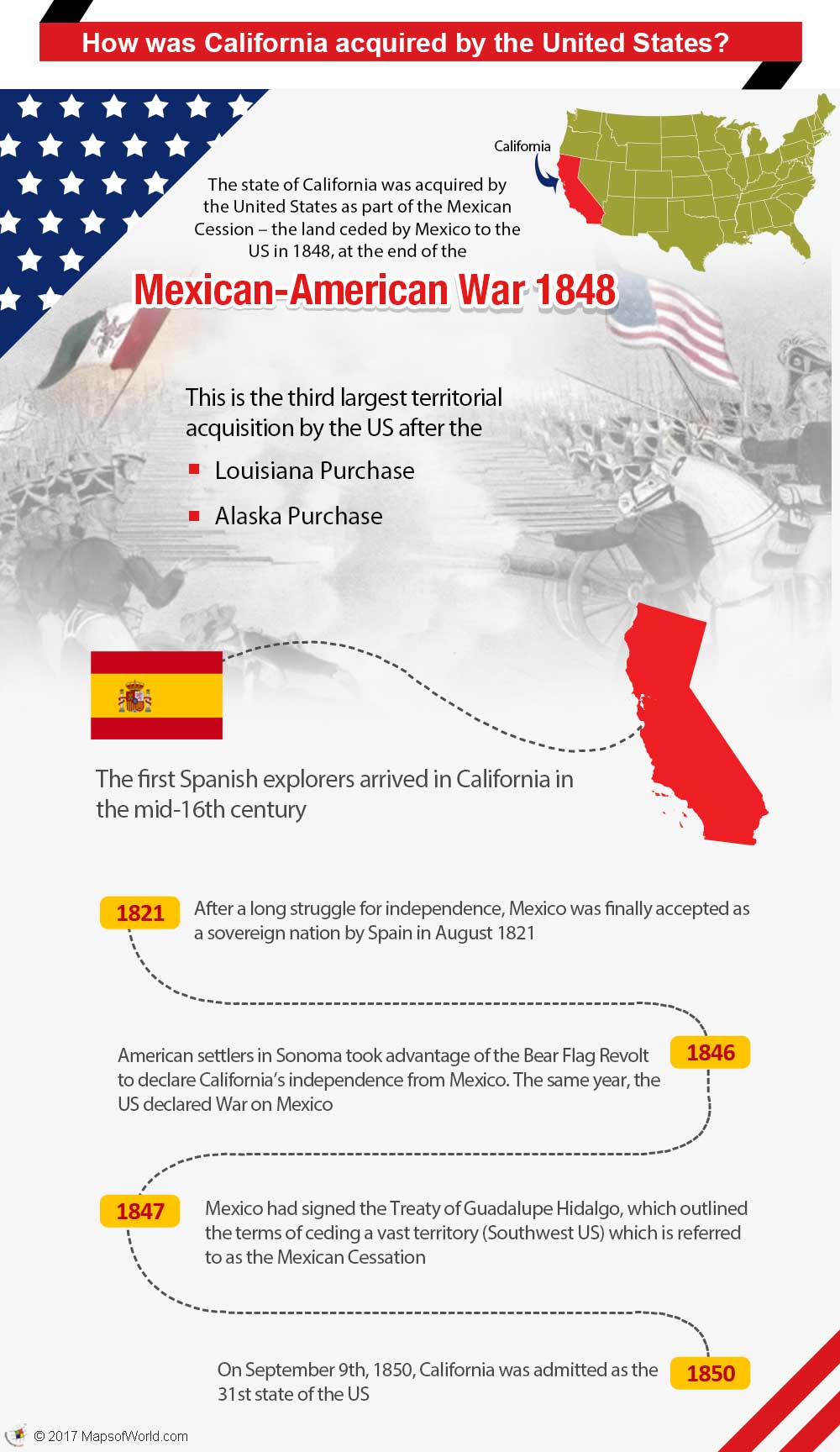
The Spanish Legacy: Early Exploration and Colonization
The European presence in California began with the Spanish, driven by the same motives that fueled their conquests across the Americas: evangelism, resource exploitation, and strategic territorial claims. While the allure of gold and silver was initially focused elsewhere, the strategic importance of the Pacific coastline eventually drew their attention northward.
First European Contact: Juan Rodríguez Cabrillo and the Coastline
The first documented European to explore what is now California was the Portuguese explorer Juan Rodríguez Cabrillo, sailing under the Spanish flag. In 1542, Cabrillo navigated the Pacific coast, claiming the territory for Spain. His expedition explored as far north as the Russian River area, charting bays and naming significant geographical features. However, permanent settlement remained elusive for over two centuries. Subsequent expeditions, notably by Sebastián Vizcaíno in 1602, further detailed the coast, including the magnificent Monterey Bay, solidifying Spanish knowledge of the region but not immediate colonization. The remote nature of California and the greater focus on richer lands to the south meant that it remained largely undeveloped by the Spanish for generations.
Mission System and Spanish Rule: From San Diego to Sonoma
It wasn’t until the late 18th century, spurred by fears of Russian and British encroachment from the north, that Spain finally committed to colonizing Alta California (Upper California). This effort was spearheaded by two key figures: José de Gálvez, the Visitador General of New Spain, and Father Junípero Serra, a Franciscan missionary. Beginning in 1769 with the establishment of the first mission in San Diego, a chain of 21 missions, along with presidios (military forts) and pueblos (civilian towns), stretched northward to Sonoma. These institutions served as the primary instruments of Spanish control, aiming to convert indigenous populations to Christianity, Hispanicize them, and establish a permanent colonial presence. The missions, often self-sufficient agricultural centers, became the backbone of Spanish colonial society in California, dramatically reshaping the landscape and the lives of its native inhabitants.
Limited Settlement and Growing Tensions
Despite the mission system, Spanish settlement in Alta California remained sparse. The vast majority of the population consisted of indigenous peoples, followed by a relatively small number of Spanish soldiers, missionaries, and a handful of civilian settlers (pobladores). The distance from Mexico City, the capital of New Spain, made administration difficult and the region often felt neglected. This isolation, coupled with economic restrictions imposed by the Spanish crown, fostered a unique culture among the Californios – the Spanish-speaking inhabitants of Alta California – who often felt a stronger allegiance to their land than to the distant European metropolis. These internal dynamics would become crucial as geopolitical winds began to shift.
Mexican Independence and the Era of Alta California
The early 19th century brought significant change to New Spain, culminating in its independence from Spain. This seismic shift dramatically altered the status of Alta California, ushering in a new era marked by both opportunity and instability.
The Break from Spain: Mexico Assumes Control
The Mexican War of Independence, which raged from 1810 to 1821, ultimately led to the establishment of the First Mexican Empire and later the Republic of Mexico. With independence, Alta California transitioned from a Spanish colony to a frontier province of the new Mexican nation. This change was largely uneventful locally, as news traveled slowly, and the Californios had little direct involvement in the revolutionary struggles. However, the shift in sovereignty meant that California’s destiny was now tied to a fledgling nation struggling to establish its own identity and maintain control over vast, disparate territories. The new Mexican government, often plagued by internal conflicts and a lack of resources, found it challenging to exert strong authority over its distant northern provinces.
Secularization of the Missions and Ranchos
One of the most profound impacts of Mexican rule was the secularization of the missions. The mission system, originally conceived as a temporary means to civilize and Christianize indigenous populations, had by the 1830s accumulated vast lands and wealth, often at the expense of native inhabitants. The Mexican government, fueled by liberal ideals, saw the missions as an anachronistic holdover from colonial rule and a source of potential revenue. Between 1833 and 1836, the missions were largely dismantled, their lands redistributed into private ownership through large land grants known as “ranchos.” These ranchos became the dominant economic and social units of Mexican California, controlled by a relatively small number of Californio families who formed a powerful elite. This era, often romanticized as the “Rancho Period,” saw the flourishing of a unique pastoral society centered on cattle raising and a distinctive Californio culture.
American Influx and Manifest Destiny
Despite the vibrant ranchero culture, Mexican California was increasingly vulnerable. The vast, lightly populated territory attracted the attention of American traders, trappers, and settlers. Pioneers like Jedediah Smith and Mariano Vallejo opened overland routes, and American ships frequented California ports, engaging in trade that often bypassed Mexican economic regulations. The concept of “Manifest Destiny,” the belief in the divinely ordained expansion of the United States across the North American continent, gained significant traction in the 1840s. California, with its rich agricultural potential and strategic Pacific coastline, became a prime target for American expansionists, who viewed the weak Mexican hold over the territory as an invitation for annexation.
The Seeds of Conflict: American Interest and Expansion
The increasing American presence and the geopolitical ambitions of the United States set the stage for a dramatic confrontation over California. The mid-1840s saw a rapid escalation of tensions, driven by both official and unofficial American actions.
Early American Expeditions: John C. Frémont and “Pathfinding”
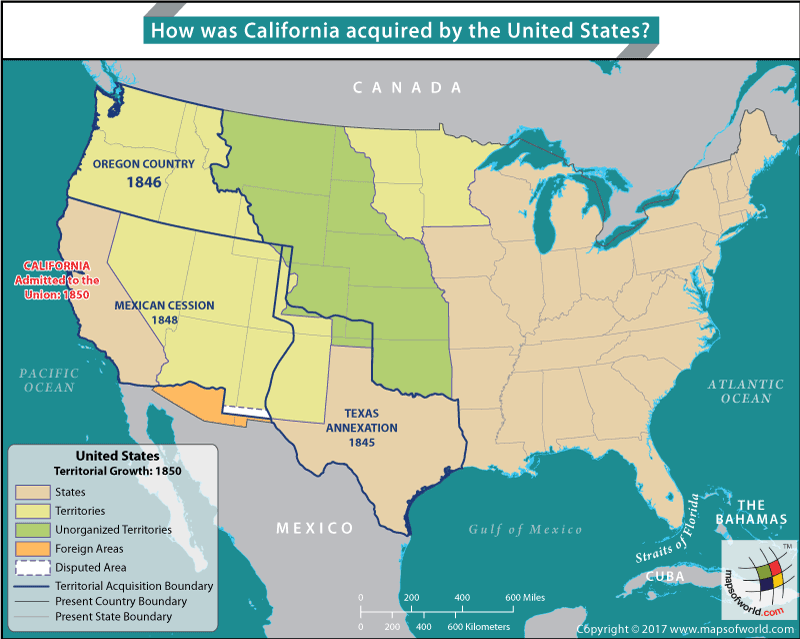
One of the most controversial figures in this period was John C. Frémont, an American explorer and military officer. Beginning in the early 1840s, Frémont led several “scientific” expeditions into Mexican territory, ostensibly to map and explore the West. However, these expeditions were widely seen by Mexican authorities, and later by historians, as thinly veiled military reconnaissance missions. Frémont’s presence in California with armed men, often in defiance of Mexican orders, fueled suspicions and contributed to the sense of an impending American takeover. His actions, particularly in early 1846, became a significant irritant and a direct challenge to Mexican sovereignty.
Political Instability in Mexico and Alta California
During this critical period, both the central Mexican government and the provincial government of Alta California were plagued by chronic political instability. Frequent changes in leadership, coups, and civil unrest in Mexico City made it difficult to formulate a coherent policy for its northern frontier. In Alta California itself, there were internal divisions among the Californio elite, with factions vying for power and control. This internal weakness severely hampered their ability to respond effectively to the growing external threat posed by American expansionism, leaving the province vulnerable and ill-prepared for conflict.
Bear Flag Revolt: A Precursor to War
In June 1846, a group of American settlers, encouraged by Frémont’s presence and American expansionist sentiment, launched the “Bear Flag Revolt” in Sonoma. They captured the Mexican military commandant, Mariano Vallejo, and declared California an independent republic, hoisting a makeshift flag featuring a grizzly bear. While the “republic” was short-lived, quickly absorbed by the official American military forces that arrived shortly thereafter, the Bear Flag Revolt served as a de facto declaration of war against Mexican authority in California. It was a clear signal that American settlers, with tacit US government support, intended to seize the territory.
The Mexican-American War and the Treaty of Guadalupe Hidalgo
The Bear Flag Revolt coincided with the outbreak of the Mexican-American War, a conflict that would ultimately redefine the geopolitical map of North America and definitively settle the question of California’s ownership.
Declaration of War and Military Campaigns
Tensions between the United States and Mexico had been mounting for years, primarily over the annexation of Texas and a disputed border. In May 1846, following a border skirmish, the United States formally declared war on Mexico. While military campaigns were fought on multiple fronts, including a major invasion of Mexico proper, the acquisition of California was a key strategic objective from the outset. American forces were dispatched to secure the territory, effectively turning the localized Bear Flag Revolt into a broader military occupation.
Conquest of California: Naval and Land Operations
The conquest of California was primarily a two-pronged effort. Commodore John D. Sloat of the US Pacific Squadron played a crucial role, landing forces and raising the American flag in Monterey in July 1846, effectively claiming the territory for the United States. Soon after, Commodore Robert F. Stockton took command, consolidating naval control over coastal cities like San Francisco and Los Angeles. Concurrently, Stephen W. Kearny’s “Army of the West” marched overland from New Mexico, eventually joining forces with Stockton and Frémont. Despite some spirited resistance from Californio forces, notably at the Battle of San Pasqual and the Battle of La Mesa, the superior organization and resources of the American military ultimately prevailed. By January 1847, with the signing of the Treaty of Cahuenga, hostilities in California officially ceased.
The Treaty of Guadalupe Hidalgo: A Defining Moment
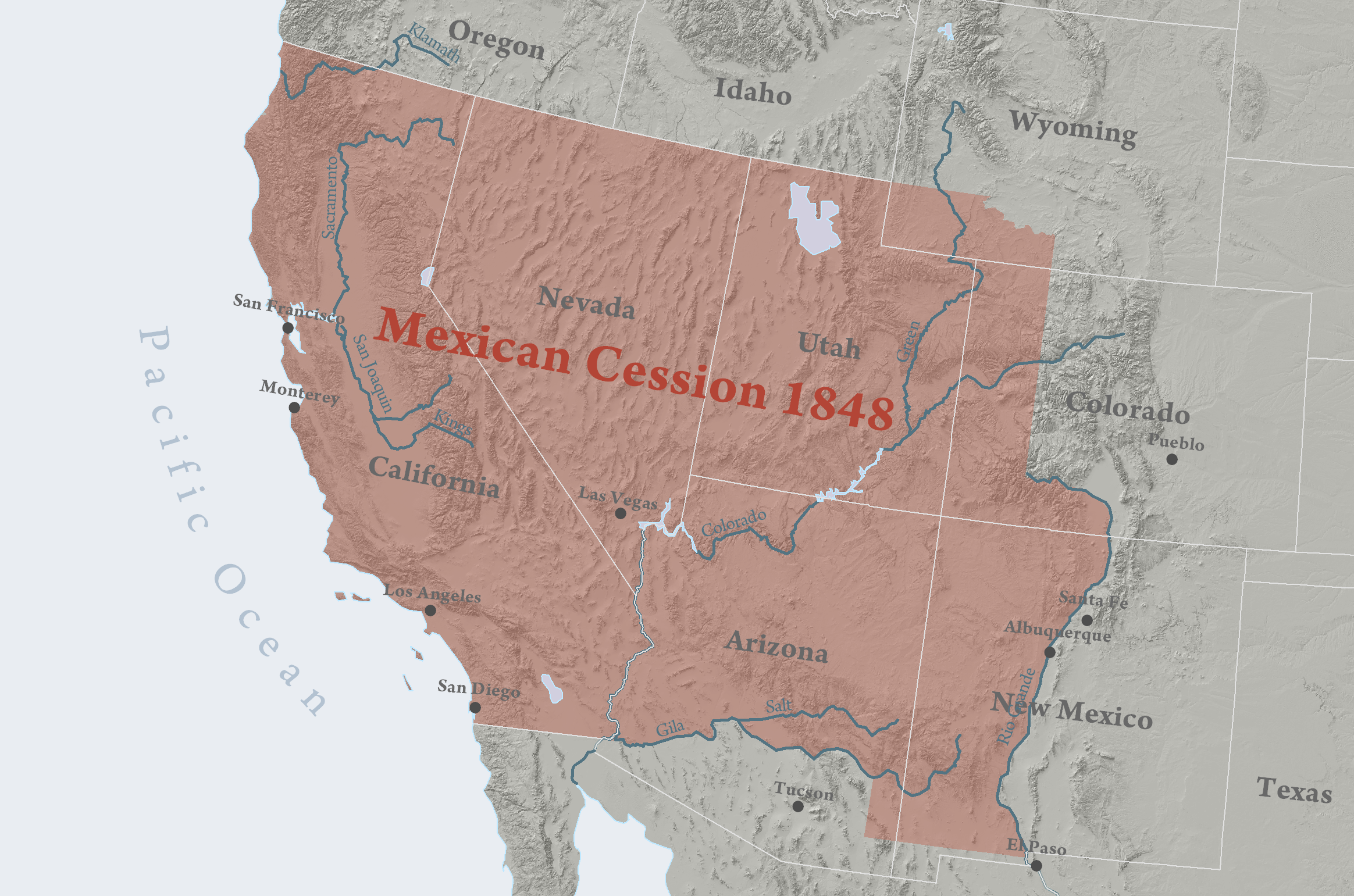
The formal acquisition of California by the United States was cemented by the Treaty of Guadalupe Hidalgo, signed on February 2, 1848, which ended the Mexican-American War. Under the terms of this treaty, Mexico ceded vast territories, including Alta California and New Mexico, to the United States in exchange for $15 million and the assumption of Mexican debts to American citizens. This massive land transfer, often referred to as the Mexican Cession, expanded the United States by approximately 525,000 square miles, forever altering the nation’s boundaries and paving the way for westward expansion. For the Californios, it meant a dramatic shift in allegiance, culture, and legal systems, often with significant and challenging consequences for their land ownership and civil rights.
The Gold Rush and Statehood: Solidifying American California
Barely a week before the signing of the Treaty of Guadalupe Hidalgo, an event occurred in California that would accelerate its integration into the United States with unprecedented speed and impact.
Discovery of Gold at Sutter’s Mill
On January 24, 1848, James W. Marshall, working for Swiss pioneer John Sutter, discovered flakes of gold at Sutter’s Mill on the American River near Coloma. Initially kept secret, news of the discovery soon spread like wildfire, first within California, and then across the United States and the world. This singular event ignited the California Gold Rush, an economic and demographic phenomenon that would irrevocably transform the newly acquired territory.
Rapid Population Growth and Economic Boom
The promise of instant wealth drew hundreds of thousands of “Forty-Niners” – prospectors, adventurers, and entrepreneurs – to California from all corners of the globe. The population exploded, overwhelming the fledgling American military administration and creating instant, booming cities like San Francisco. This massive influx of people brought with it immense challenges in terms of governance, law and order, and infrastructure, but also generated incredible economic growth. The Gold Rush established California as a vital economic hub, far surpassing its previous role as a remote agricultural outpost. It also diversified its population, attracting people from China, Europe, South America, and other parts of the United States, creating a rich, if sometimes contentious, multicultural society.
From Territory to State: The 31st State
The rapid population growth and the unique circumstances created by the Gold Rush made it imperative for California to transition quickly from a military territory to full statehood. Unlike other territories, California skipped the traditional territorial phase, drafting a state constitution in 1849 and applying for admission to the Union. Its admission, however, became entangled in the escalating national debate over slavery, as California’s proposed free-state status would upset the delicate balance between free and slave states in Congress. Ultimately, as part of the Compromise of 1850, California was admitted as the 31st state on September 9, 1850, solidifying its place within the United States and marking the official end of its tumultuous acquisition process.
The acquisition of California was not a singular event but a prolonged, multi-faceted process shaped by centuries of exploration, shifting imperial powers, and an ambitious young nation’s drive for continental expansion. From the initial Spanish claims and the establishment of its iconic missions, through the Mexican era of sprawling ranchos, to the dramatic American conquest and the transformative Gold Rush, California’s story is a compelling narrative of how a remote frontier became an integral part of the United States. Its acquisition laid the groundwork for its future as an economic powerhouse and cultural trendsetter, and the historical landmarks scattered across its diverse landscape serve as enduring reminders of this extraordinary journey.
LifeOutOfTheBox is a participant in the Amazon Services LLC Associates Program, an affiliate advertising program designed to provide a means for sites to earn advertising fees by advertising and linking to Amazon.com. Amazon, the Amazon logo, AmazonSupply, and the AmazonSupply logo are trademarks of Amazon.com, Inc. or its affiliates. As an Amazon Associate we earn affiliate commissions from qualifying purchases.