
Navigating the intricacies of vehicle window tint laws is a common concern for drivers across the United States. In the vibrant state of Texas, where sunshine is abundant and vehicle ownership is high, understanding these regulations is crucial for both safety and compliance. The question “Is 20% tint legal in Texas?” often arises, touching upon a specific level of tint that sits in a grey area for many. This article aims to provide a comprehensive and clear explanation of Texas tint laws, focusing specifically on the legality of 20% tint for passenger vehicles, and offering practical guidance for motorists.

Understanding Tint Percentages and Light Transmission
Before delving into the specifics of Texas law, it’s essential to grasp what tint percentages actually signify. The term “tint percentage” refers to the Visible Light Transmission (VLT) level of the window film. A lower VLT percentage means less light can pass through the window, resulting in a darker tint. Conversely, a higher VLT percentage allows more light to penetrate, leading to a lighter tint.
For instance, a 5% tint is considered very dark, allowing only 5% of visible light to enter the vehicle. A 70% tint, on the other hand, is very light, allowing 70% of visible light. The industry standard for automotive window film ranges typically from 5% to 80% VLT. When discussing 20% tint, we are referring to a film that allows 20% of visible light to pass through the window, blocking 80% of it. This level of tint is often sought after for its aesthetic appeal and its ability to reduce heat and glare.
The Role of Visible Light Transmission (VLT)
Visible Light Transmission is the metric used by state legislators and law enforcement to define and enforce window tint regulations. It’s a standardized measure, ensuring consistency in how tint levels are assessed. The goal of these laws is generally to strike a balance between a driver’s desire for privacy and comfort, and the need for law enforcement officers to clearly see into a vehicle for safety and identification purposes.
Common Tint Levels and Their Applications
- 5% Tint (Limo Tint): Extremely dark, offering maximum privacy and heat rejection. Often used for rear windows and sometimes for side windows in certain states where legal.
- 15% Tint: Still very dark, providing significant privacy. Commonly used for rear windows and sometimes legally permitted for front windows in some regions.
- 20% Tint: A popular choice that offers a noticeable reduction in glare and heat while still allowing a reasonable amount of light in. This is where the ambiguity often arises in various state laws.
- 35% Tint: A moderate tint, providing a good balance of privacy and visibility. This is often a legally permissible option for front windows in many states.
- 50% and 70% Tint: Lighter tints that offer minimal privacy but can still help reduce UV rays and some heat. These are generally legal for all windows in most jurisdictions.
Understanding these levels helps in appreciating why 20% tint is a point of discussion, as it falls into a range that can be permissible in some areas and restrictive in others.
Texas Window Tint Laws: The Official Regulations
In Texas, the laws governing vehicle window tint are primarily defined by the Texas Transportation Code. These statutes are designed to ensure driver visibility and officer safety without completely prohibiting the use of tint. The regulations differentiate between the tint allowed on the front windshield and the side and rear windows of passenger vehicles.
Front Windshield Restrictions
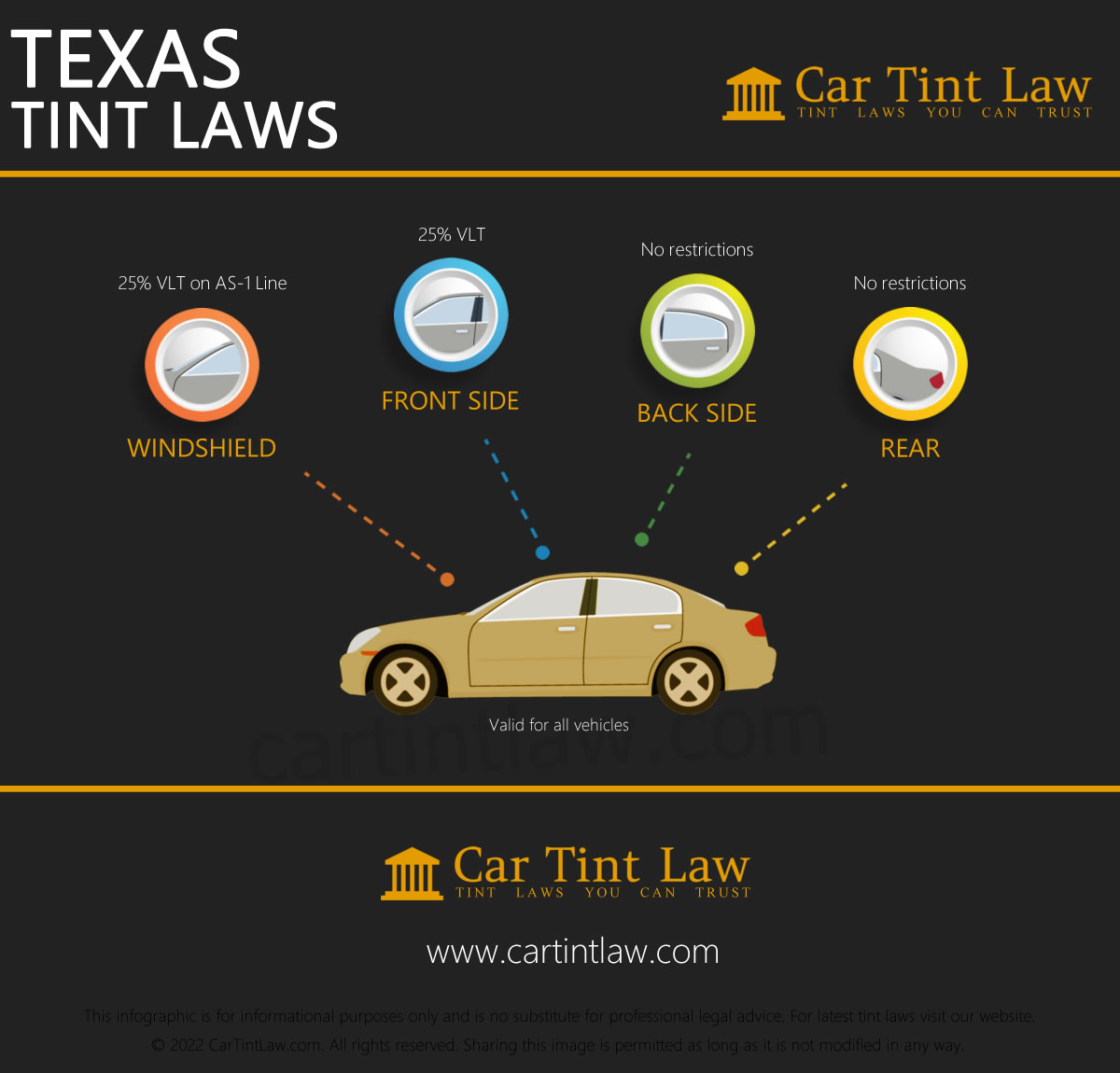
The law in Texas is quite clear regarding the front windshield. Non-reflective tint is permitted on the top five inches of the windshield, or the AS-1 line, whichever is less. This allows for some sun protection without impeding the driver’s forward vision. However, any tint beyond this limited strip is illegal. This is a standard safety measure seen in many states, prioritizing unimpeded forward visibility for the driver.
Side and Rear Window Tint Regulations
For the side and rear windows of passenger vehicles in Texas, the regulations are more nuanced and where the question of 20% tint legality is most relevant.
According to Texas law (specifically, Transportation Code § 547.322), vehicle windows may not be tinted to a degree that obstructs the driver’s clear view into or out of the vehicle. However, specific VLT percentages are provided for clarity:
- Rear and side windows: Tinting is permitted as long as the windows allow at least 25% of the light from the sun to pass through. This means a VLT of 25% or higher is legal.
The Legality of 20% Tint in Texas
Given the Texas law requiring at least 25% VLT for side and rear windows, 20% tint is technically illegal in Texas for these specific windows. A 20% tint allows only 20% of light to pass through, which is below the legal minimum of 25%.
This means that any vehicle with 20% tint on its side or rear windows is in violation of Texas state law. While enforcement can vary, and officers may exercise discretion, relying on leniency is not a sound strategy for long-term compliance.
Exceptions and Special Circumstances
While the general rules are clear, Texas law does provide for certain exceptions that allow for darker tinting under specific conditions. These exceptions are typically related to medical necessity or specific vehicle types.
Medical Exemptions
Drivers who have a medical condition that requires them to have darker window tint for protection from the sun’s harmful UV rays may be eligible for a medical exemption. To obtain this exemption, a physician licensed in Texas must certify the medical necessity.
Requirements for Medical Exemption

- Physician’s Certification: A written statement from a licensed medical doctor detailing the patient’s specific medical condition and the necessity for tinted windows.
- Application Process: The driver must typically apply for an exemption certificate through the Texas Department of Public Safety (DPS).
- Documentation: Keep the exemption certificate and the physician’s statement in the vehicle at all times.
It is crucial to follow the prescribed application process and carry all necessary documentation to avoid any issues with law enforcement. The exemption typically allows for darker tint than otherwise permitted, often up to 5% VLT.
Other Potential Exemptions
While less common for standard passenger vehicles, certain types of vehicles may have different tint allowances. For instance, some law enforcement vehicles or specialized commercial vehicles might operate under different guidelines, though these are generally not applicable to the average driver.
It is always advisable to consult official sources from the Texas Department of Public Safety or relevant legislative statutes for the most accurate and up-to-date information on exemptions.
Enforcement and Penalties for Tint Violations
Understanding that 20% tint is illegal in Texas for side and rear windows is only half the battle; knowing the potential consequences of non-compliance is equally important. Law enforcement officers in Texas are authorized to cite drivers for window tint violations.
How Tint is Measured
Law enforcement officers typically use a handheld light meter, known as a tint meter, to measure the VLT of a vehicle’s windows. These devices are calibrated to provide an accurate reading of how much light passes through the film. A reading that falls below the legal threshold (25% VLT for side and rear windows in Texas) will result in a citation.
Potential Penalties
The penalties for a window tint violation in Texas can vary depending on the jurisdiction and the specific circumstances. However, common penalties include:
- Traffic Citations: A driver may receive a ticket similar to a speeding ticket.
- Fines: Fines can range from a small amount to several hundred dollars, depending on the court and local ordinances.
- Corrective Action: In some cases, the citation may require the driver to have the illegal tint removed and provide proof of compliance to the court or law enforcement agency. Failure to do so can result in further penalties.
- Points on Driving Record: While not always the case for minor traffic violations, some tint citations could potentially be added to a driver’s record, impacting insurance rates.
Avoiding Violations
The simplest way to avoid penalties is to ensure your vehicle’s window tint complies with Texas state law. This means:
- Choosing Legal Tint: Opt for tint that meets or exceeds the 25% VLT requirement for side and rear windows. Common legal options in Texas include 30%, 35%, or 40% tint.
- Verifying with Installer: If you are getting your windows tinted, ensure the installer is knowledgeable about Texas tint laws and uses films that comply with state regulations. Ask for clarification and proof of compliance.
- Carrying Exemption Documentation: If you have a valid medical exemption, always carry the required paperwork in your vehicle.
Choosing Legal Tint in Texas: A Practical Guide
For drivers in Texas who wish to enjoy the benefits of window tinting – such as reduced heat, glare, and UV protection – while remaining fully compliant with the law, making informed choices is key. The legal limit of 25% VLT for side and rear windows means there are still plenty of aesthetically pleasing and functional tint options available.
Recommended Legal Tint Percentages
While 20% is illegal, several VLT percentages fall within the legal spectrum and offer significant benefits:
- 35% Tint: This is a very popular choice in Texas. It provides a noticeable darkening of the windows, offering a good balance of privacy and heat rejection without compromising visibility for drivers or attracting undue attention from law enforcement. It effectively reduces glare and heat while maintaining a clear view for those inside and outside the vehicle.
- 40% Tint: Slightly lighter than 35%, this option still offers good UV protection and heat reduction. It provides a subtle enhancement to the vehicle’s appearance and is well within legal limits.
- 50% Tint: This is a lighter tint that offers minimal visual alteration but still provides substantial protection against UV rays and some reduction in heat and glare. It’s an excellent choice for those who prefer a more factory-like appearance while still gaining some functional benefits.
The Importance of Professional Installation
When seeking to tint your vehicle’s windows, choosing a reputable and experienced professional installer is paramount. A good installer will:
- Understand Texas Laws: They will be fully aware of the VLT requirements and any specific nuances in Texas tint laws.
- Use Quality Materials: They will use high-quality window films that offer durability, UV protection, and heat rejection.
- Provide Documentation: They may be able to provide documentation regarding the VLT of the film used, which can be helpful if questioned by law enforcement.
- Offer Warranties: Reputable installers often offer warranties on their workmanship and the window film itself.
Considering the Benefits Beyond Appearance
While aesthetics often play a role in tint choices, the functional benefits of legal window tint in Texas are substantial. Reduced interior temperatures can make driving more comfortable, especially during the hot summer months. Lowering the amount of UV radiation entering the vehicle can protect your car’s interior from fading and cracking, and also safeguard passengers from harmful sun exposure. Furthermore, window tint can add a layer of safety by helping to hold shattered glass together in the event of an accident.
By adhering to the 25% VLT minimum for side and rear windows, drivers can enjoy these advantages without the risk of citations and fines, ensuring a safe and compliant driving experience across the Lone Star State.
LifeOutOfTheBox is a participant in the Amazon Services LLC Associates Program, an affiliate advertising program designed to provide a means for sites to earn advertising fees by advertising and linking to Amazon.com. Amazon, the Amazon logo, AmazonSupply, and the AmazonSupply logo are trademarks of Amazon.com, Inc. or its affiliates. As an Amazon Associate we earn affiliate commissions from qualifying purchases.