
Navigating the legal landscape of firearm ownership and carrying is a critical concern for many travelers and residents alike, especially when crossing state lines. For those planning a visit or relocation to the Silver State, understanding the intricacies of firearm laws is paramount. This article delves into the specifics of Nevada’s approach to firearm carry, focusing on whether it operates under a constitutional carry framework.
Understanding Constitutional Carry
Constitutional carry, also known as permitless carry or free carry, is a legal doctrine that allows an individual to carry a handgun in public, openly or concealed, without needing a government-issued permit or license. The legal basis for this doctrine is the interpretation of the Second Amendment of the United States Constitution, which protects the right of the people to keep and bear arms. Proponents argue that the right to bear arms, as enshrined in the Constitution, inherently includes the right to carry those arms for self-defense without requiring prior government authorization.

The implementation of constitutional carry varies significantly from state to state. Some states have adopted it broadly, allowing permitless carry for all individuals legally permitted to own a firearm. Others have implemented it with certain restrictions, such as age limits or specific carry locations. Conversely, many states still require a permit for concealed carry and may have different regulations for open carry. Understanding these distinctions is vital for responsible firearm ownership and adherence to state laws.
Historical Context and Legal Basis
The concept of constitutional carry has gained traction in recent decades, with an increasing number of states enacting laws to permit permitless firearm carry. This movement is often driven by advocacy groups and legislative efforts aimed at expanding gun rights. The legal arguments supporting constitutional carry typically hinge on the belief that requiring a permit infringes upon the fundamental right to self-defense. Critics, however, often raise concerns about public safety and the potential for increased firearm-related incidents in states without permit requirements. The debate often involves balancing individual rights with collective security, a common theme in firearm legislation discussions across the United States.
Variations Across States
It is crucial to recognize that the term “constitutional carry” is not a monolithic legal standard. While the core principle remains permitless carry, the specifics can differ dramatically. Some states may permit constitutional carry for both concealed and open carry, while others may only allow one or the other. Age restrictions are also common, with many states requiring individuals to be 21 years of age to carry without a permit, aligning with federal laws for handgun purchases. Furthermore, the geographical scope of permitless carry can be limited, with certain areas or types of locations being off-limits regardless of permit status. For instance, schools, federal buildings, and polling places often have strict prohibitions on firearm possession, even in constitutional carry states. This patchwork of regulations necessitates thorough research for anyone traveling with a firearm.
Nevada’s Firearm Carry Laws
Nevada has a complex and evolving legal framework regarding firearm possession and carry. While the state does not require a permit for open carry, its stance on concealed carry has seen significant shifts over the years. Understanding these nuances is key to lawful firearm carriage within the Silver State.
Open Carry in Nevada
Nevada is generally permissive when it comes to open carry of firearms. In most public places, individuals who are legally permitted to possess a firearm can carry it openly without a permit. This means a handgun can be carried in a holster, visible to the public. However, there are specific exceptions and prohibitions that apply even to open carry. For example, carrying a firearm within certain government buildings, courthouses, or while attending public gatherings might be restricted. The intent behind open carry also matters; if the firearm is displayed in a manner that causes alarm or is used in a threatening way, legal repercussions can follow, irrespective of permit status.
Concealed Carry in Nevada: A Shifting Landscape
The landscape of concealed carry in Nevada has been marked by significant legislative changes. Historically, Nevada required a permit for concealed carry. However, recent legislative action has moved the state towards a more permitless carry model. Understanding the current status requires examining the latest statutes and their effective dates.
The Path to Permitless Concealed Carry
Prior to recent changes, Nevada was a “shall-issue” state for concealed carry permits. This meant that if an applicant met the statutory requirements, the issuing authority was generally obligated to issue the permit. These requirements typically included background checks, age verification, and completion of a firearms safety course. Obtaining a permit allowed for both concealed and, in some cases, open carry under specific conditions, although open carry was already generally permissible without a permit.
The significant development in Nevada was the passage of legislation that moved the state towards permitless concealed carry. This means that individuals who are legally permitted to own a firearm can now carry it concealed without first obtaining a concealed firearm permit from the state. This change aligns Nevada with a growing number of states that have adopted similar permitless carry laws.
Key Provisions and Restrictions
While Nevada now allows permitless concealed carry, it is imperative to understand that this right is not absolute. Several restrictions and prohibitions remain in place to ensure public safety and to regulate the carrying of firearms in sensitive locations.
Age Requirements: As with most states, federal law and Nevada law impose age restrictions on firearm possession and carry. Generally, individuals must be at least 18 years old to possess a firearm and 21 years old to carry a concealed handgun without a permit, aligning with federal regulations for handgun purchases.
Prohibited Persons: Certain individuals are legally prohibited from possessing or carrying firearms, regardless of state permit laws. These typically include convicted felons, individuals with domestic violence convictions, those adjudicated as mentally defective, and others as defined by state and federal law. It is the responsibility of the individual to ensure they are not a prohibited person.
Locations Where Carry is Prohibited: Even with permitless carry, firearms are prohibited in numerous locations. These often include:
- Federal Buildings: Post offices, federal courthouses, and other federal facilities.
- Schools: The grounds and buildings of public and private K-12 schools and universities.
- Courthouses: State and local courthouses.
- Polling Places: During elections.
- Law Enforcement Facilities: Police stations and sheriff’s offices.
- Secure Areas of Airports: Beyond security checkpoints.
- Private Property with Notice: Businesses or private residences that have clearly posted signage prohibiting firearms.
It is crucial for individuals to be aware of and respect these prohibitions. Failure to do so can result in criminal charges, including misdemeanors or felonies, depending on the circumstances and location.
Reciprocity with Other States
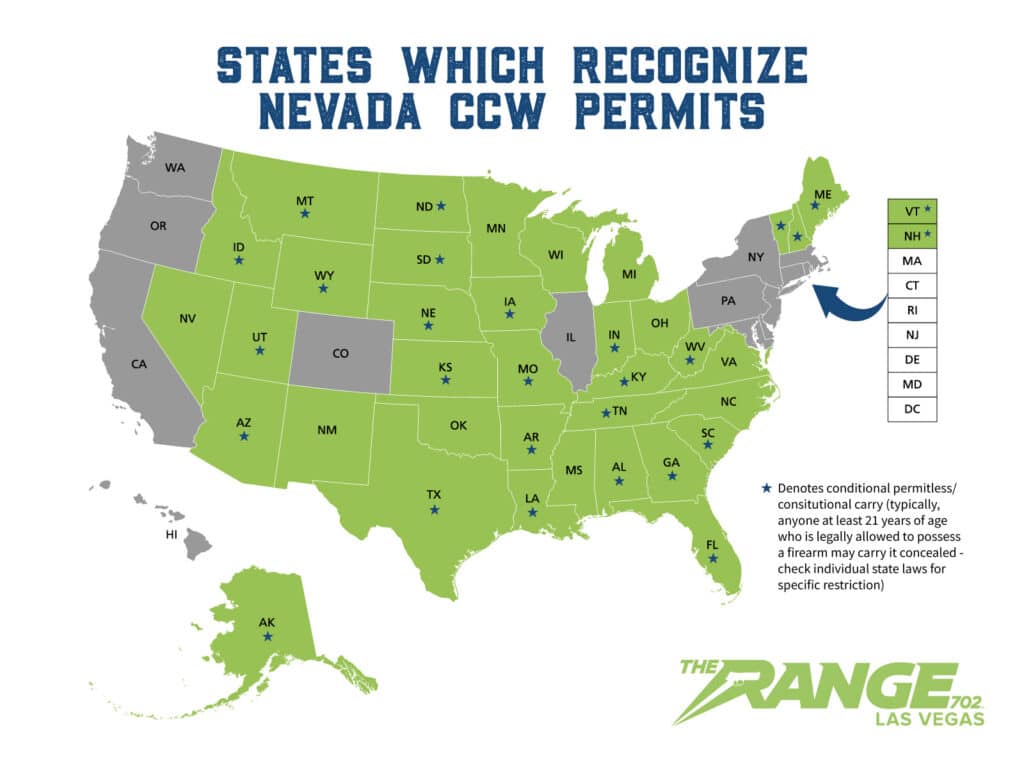
For individuals traveling to or from Nevada, understanding firearm reciprocity is crucial. Reciprocity refers to the extent to which states recognize the firearm permits or licenses issued by other states. Since Nevada has moved to permitless concealed carry, the concept of reciprocity primarily relates to whether other states will recognize an individual’s right to carry in Nevada, or if Nevada residents carrying firearms will have their right recognized in other states.
Nevada’s adoption of permitless concealed carry means that a Nevada resident who is legally allowed to carry a handgun does not need a permit to carry concealed within Nevada. However, when traveling to other states, it is essential to research the specific firearm laws of each destination. Some states may still require a permit, and Nevada residents may need to obtain a permit from their destination state or a recognized reciprocity state to carry concealed legally. Conversely, out-of-state visitors carrying firearms in Nevada must comply with Nevada’s laws, which, in essence, allow permitless carry for those legally permitted to own a firearm.
Traveling to Nevada with Firearms
For those planning a trip to the vibrant landscapes and bustling cities of Nevada, such as Las Vegas or Reno, understanding firearm transport laws is vital. Whether arriving by car or plane, adherence to regulations ensures a smooth and lawful journey.
Transporting Firearms by Vehicle
Transporting firearms by vehicle within Nevada is generally straightforward for legal gun owners. Under Nevada law, individuals legally permitted to possess firearms can transport them in their vehicles. It is generally recommended that firearms be unloaded and stored in a secure case, separate from ammunition, especially if not being carried on one’s person. While open carry is permitted, responsible transport often involves ensuring the firearm is not readily accessible to unauthorized individuals within the vehicle. Familiarity with the specific firearm laws of any other states you may be traveling through en route to Nevada is also critically important, as these laws can differ significantly.
Transporting Firearms by Air
Air travel with firearms falls under strict federal regulations enforced by the Transportation Security Administration (TSA) and individual airlines. To transport firearms by air, they must be declared to the airline at check-in. Firearms must be unloaded and packed in a hard-sided, locked container that prevents unauthorized access. Ammunition must also be transported in accordance with TSA guidelines, typically in its original packaging or a securely designed box, and may need to be separated from the firearm. It is crucial to contact the specific airline well in advance of travel to understand their unique policies and requirements, as well as to review the latest TSA regulations for firearm transport.
Responsible Firearm Ownership and Travel
Responsible firearm ownership extends beyond understanding laws; it encompasses a commitment to safety, training, and awareness. For anyone carrying a firearm, particularly when traveling, these principles are paramount.
Training and Education
Even in states with permitless carry, a thorough understanding of firearm safety, handling, and legal responsibilities is indispensable. Engaging in certified firearms training courses provides essential knowledge on marksmanship, safe storage, conflict de-escalation, and the legal implications of using a firearm. Such training not only enhances personal safety but also fosters responsible decision-making. Resources for training are widely available through local gun shops, shooting ranges, and certified instructors across Nevada and beyond.
Situational Awareness and De-escalation
The ability to recognize and avoid potentially dangerous situations is a cornerstone of personal safety. Situational awareness involves being attentive to one’s surroundings, identifying potential threats, and making informed decisions to minimize risk. In conjunction with firearm carry, the practice of de-escalation is equally important. Learning techniques to verbally defuse tense situations can often prevent the need to resort to the use of a firearm. Understanding when and how to disengage from a potentially volatile encounter is a critical skill for any responsible firearm carrier.

Legal Responsibilities and Best Practices
Carrying a firearm, whether openly or concealed, carries significant legal responsibilities. This includes understanding the laws of the jurisdiction you are in, knowing where firearms are prohibited, and acting within the bounds of self-defense laws. Best practices dictate that firearms should be carried responsibly and discreetly, avoiding any actions that could be perceived as threatening or provocative. For those who choose to carry concealed, maintaining the concealment of the firearm is crucial to avoid unnecessary alarm or legal issues. Always err on the side of caution and be informed about the specific legal landscape of the location you are visiting or residing in.
In conclusion, while Nevada has significantly advanced its firearm laws to permit constitutional carry for concealed handguns, responsible ownership, thorough knowledge of restrictions, and adherence to safety protocols remain the ultimate responsibility of every firearm carrier.
LifeOutOfTheBox is a participant in the Amazon Services LLC Associates Program, an affiliate advertising program designed to provide a means for sites to earn advertising fees by advertising and linking to Amazon.com. Amazon, the Amazon logo, AmazonSupply, and the AmazonSupply logo are trademarks of Amazon.com, Inc. or its affiliates. As an Amazon Associate we earn affiliate commissions from qualifying purchases.