
For travelers planning a trip to the vibrant island of Puerto Rico, understanding the local time is a fundamental aspect of seamless journey planning. While the Caribbean island boasts a rich tapestry of culture, stunning beaches, and historical landmarks, its temporal alignment with other parts of the world is a crucial detail for everything from booking flights to coordinating with local contacts. This guide delves into the time zone of Puerto Rico and explores the implications for international visitors.
Understanding Puerto Rico’s Time Zone
Puerto Rico observes a single time zone across the entire island, including its dependencies like Vieques and Culebra. The island operates on Atlantic Standard Time (AST). AST is UTC-4 year-round. This means Puerto Rico does not observe daylight saving time. This consistency is a significant advantage for travelers, eliminating the confusion that can arise from seasonal clock changes common in many other destinations.
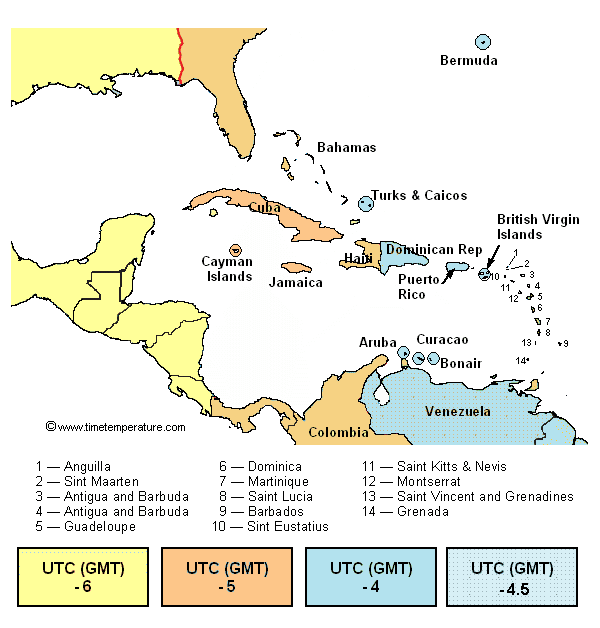
Atlantic Standard Time (AST) Explained
Atlantic Standard Time (AST) is a time zone that is four hours behind Coordinated Universal Time (UTC). This is the same time zone observed by countries and territories such as the Dominican Republic, Barbados, and parts of Canada (like Nova Scotia, New Brunswick, and Prince Edward Island). The absence of daylight saving time means that AST remains constant throughout the year, providing a predictable temporal anchor for those traveling to or from Puerto Rico.
No Daylight Saving Time: A Traveler’s Advantage
The fact that Puerto Rico does not participate in daylight saving time simplifies planning considerably. Many travelers from regions that do observe DST often find themselves adjusting to a “new” time difference upon arrival, only to have to readjust again upon departure. In Puerto Rico, once you’ve established the UTC-4 difference, that remains the standard. This consistency is a welcome relief, especially for those on shorter trips or with busy itineraries involving multiple time zone calculations.
Navigating Time Differences When Traveling
The primary implication of Puerto Rico’s time zone for travelers is how it relates to their departure and arrival locations. Understanding these differences allows for accurate scheduling of flights, transfers, and activities.
East Coast USA (e.g., New York, Miami)
For travelers originating from the Eastern United States, the time difference is straightforward. The US East Coast observes Eastern Standard Time (EST) which is UTC-5 during standard time and Eastern Daylight Time (EDT) which is UTC-4 during daylight saving time.
- During EST (roughly November to March): Puerto Rico (AST, UTC-4) is one hour ahead of EST (UTC-5). When it is 10:00 AM in New York, it is 11:00 AM in San Juan.
- During EDT (roughly March to November): When the US East Coast observes daylight saving time, EDT (UTC-4) is the same as AST (UTC-4). Therefore, during this period, there is no time difference between the US East Coast and Puerto Rico. This can be a point of confusion, so always check the current date against the daylight saving schedule of your departure location.
West Coast USA (e.g., Los Angeles, San Francisco)
Travelers from the US West Coast, which observes Pacific Standard Time (PST) (UTC-8) and Pacific Daylight Time (PDT) (UTC-7), will experience a larger time difference.
- During PST (roughly November to March): Puerto Rico (AST, UTC-4) is four hours ahead of PST (UTC-8). If it’s 10:00 AM in Los Angeles, it’s 2:00 PM in San Juan.
- During PDT (roughly March to November): Puerto Rico (AST, UTC-4) is three hours ahead of PDT (UTC-7). When it’s 10:00 AM in San Francisco, it’s 1:00 PM in San Juan.
Europe (e.g., London, Paris)
For visitors from Europe, the time difference will vary significantly depending on the time of year due to Europe’s extensive use of daylight saving time.
- When mainland Europe is on Greenwich Mean Time (GMT) / Western European Time (WET) (UTC+0) (roughly November to March): Puerto Rico (AST, UTC-4) is four hours behind. If it’s 10:00 AM in London, it’s 6:00 AM in San Juan.
- When mainland Europe is on Central European Summer Time (CEST) (UTC+2) (roughly March to October): Puerto Rico (AST, UTC-4) is six hours behind. If it’s 10:00 AM in Paris, it’s 4:00 AM in San Juan. It’s crucial to check the specific time zone and daylight saving status of European cities when planning.

Other Caribbean Destinations
Many other Caribbean islands also observe AST, meaning there might be no time difference if you are island-hopping. However, it is always prudent to confirm the specific time zone of your connecting or subsequent destination. For example, while many islands use AST, some may observe a different time zone or have their own daylight saving practices.
Practical Implications for Travelers
Understanding the time difference is more than just a matter of knowing the clock. It has practical implications for every stage of your travel.
Flight Bookings
When booking flights, always pay close attention to the departure and arrival times. Ensure you are looking at local times for both departure and arrival airports. A flight departing at 10:00 AM from a city on the US East Coast that observes EDT and arriving in San Juan at 1:00 PM local time means the flight duration is 3 hours, with no time difference that day. However, if the departure was from a city observing EST, a 10:00 AM departure might result in a 1:00 PM arrival in San Juan, indicating a 2-hour flight duration and a one-hour time jump. Flight booking engines usually handle these conversions automatically, but cross-referencing can prevent errors.
Accommodation and Activity Reservations
When booking hotels, tours, or other activities in Puerto Rico, all times will be listed in AST. If you are coordinating with tour operators or making dinner reservations from a different time zone, factor in the difference to avoid missed appointments. For instance, if a tour departs at 9:00 AM AST and you are calling from a time zone that is 5 hours behind, you’ll need to remember that 9:00 AM in Puerto Rico is 4:00 AM in your local time.
Communication
Staying connected with family, friends, or business associates back home requires an awareness of the time difference. Scheduling phone calls or video conferences will be much smoother if you are mindful of the time in Puerto Rico and the time in your correspondent’s location. A quick check of a world clock or time zone converter can save a lot of miscommunication.
Jet Lag and Arrival Planning
While Puerto Rico’s consistent time zone can help mitigate some jet lag effects, especially on shorter trips, understanding the temporal shift is still important. Arriving in San Juan in the afternoon local time from the West Coast of the US means you might still have a good portion of the day to explore Old San Juan or enjoy dinner. Conversely, arriving in the morning from Europe means you are effectively stepping into the late morning of Puerto Rico’s day. Planning your first day’s activities with the local time in mind can help you make the most of your arrival.

Ensuring a Smooth Transition
To ensure your transition to Puerto Rico is as smooth as possible, here are a few recommended practices:
- Utilize Online Time Zone Converters: Before and during your trip, these tools are invaluable. Simply input your current location and Puerto Rico (AST, UTC-4) to get an instant comparison.
- Set Your Devices: Most smartphones and computers will automatically update to the local time when you connect to Wi-Fi or cellular service. However, it’s wise to manually check and confirm your device’s time upon arrival.
- Communicate Clearly: When making arrangements, always specify the time zone (AST) if there’s any ambiguity, especially if communicating with people in time zones that observe daylight saving.
- Inform Contacts: Let your friends, family, or colleagues know about the time difference so they can reach you at appropriate hours.
By understanding and planning around Puerto Rico’s consistent Atlantic Standard Time, travelers can eliminate a potential source of stress and focus on what truly matters: enjoying the breathtaking beauty and vibrant culture of this captivating Caribbean gem. Whether you’re exploring the bioluminescent bays of Fajardo, hiking in the El Yunque National Forest, or simply relaxing on the shores of Flamenco Beach, knowing the local time ensures you’re always on schedule for adventure.
LifeOutOfTheBox is a participant in the Amazon Services LLC Associates Program, an affiliate advertising program designed to provide a means for sites to earn advertising fees by advertising and linking to Amazon.com. Amazon, the Amazon logo, AmazonSupply, and the AmazonSupply logo are trademarks of Amazon.com, Inc. or its affiliates. As an Amazon Associate we earn affiliate commissions from qualifying purchases.