
The dream of sun-drenched beaches, vibrant cities, and a relaxed lifestyle draws countless individuals to Florida annually, many with the intention of establishing a permanent or seasonal residence. Whether you’re considering a move for retirement, seeking a vacation home, or exploring investment opportunities in rental properties, a fundamental question often arises: “Is there real estate tax in Florida?” The unequivocal answer is yes. Like nearly every state in the United States, Florida levies property taxes. However, understanding the intricacies of Florida’s real estate tax system is paramount for anyone navigating the landscape of accommodation in the Sunshine State, as it significantly impacts the overall cost of homeownership and the financial viability of long-term stays.

Real estate taxes in Florida are not a fixed statewide charge; instead, they are locally assessed and collected, primarily by county and municipal governments. These funds are crucial for supporting essential local services such as public schools, law enforcement, fire protection, infrastructure maintenance, and various community programs. For prospective homeowners, seasoned residents, and real estate investors alike, comprehending how these taxes are calculated, the exemptions available, and the factors that influence the final bill is critical for effective budgeting and strategic accommodation planning. This guide will demystify Florida’s property tax structure, providing an insightful look into what you can expect as an accommodation seeker or provider in this popular state.
Understanding Florida’s Property Tax System
Navigating the financial aspects of property ownership in Florida requires a foundational understanding of how the state’s property tax system operates. Far from a simple flat fee, it’s a multi-layered process involving assessment, millage rates, and specific exemptions designed to balance local government funding with taxpayer considerations. For anyone planning a long-term stay or investment in accommodation, these fundamentals are indispensable.
The Basics: What is Property Tax?
At its core, real estate tax in Florida is an ad valorem tax, meaning it is levied “according to value.” This value is determined by the local property appraiser and represents the property’s market worth. Every property, whether it’s a single-family home, a condominium, commercial space, or undeveloped land, is subject to this annual assessment. The amount you pay is directly proportional to your property’s assessed value and the specific tax rates applied by various local taxing authorities. For individuals seeking long-term accommodation, this direct link between property value and tax bill makes the initial purchase price, and subsequent market fluctuations, a critical consideration beyond just the mortgage payment. It forms a substantial, recurring operational cost for any form of accommodation.
Who Assesses and Collects?
The process begins at the county level. Each of Florida’s 67 counties has an independently elected Property Appraiser. Their primary responsibility is to appraise all real and tangible personal property within the county fairly and equitably, ensuring that properties are valued at their “just value” (fair market value) as of January 1st each year. This valuation is the bedrock upon which your tax bill is built. They consider factors like recent sales of comparable properties, replacement cost, income-generating potential (for rental accommodations), and physical characteristics.
Once the value is established and any applicable exemptions are applied, the Property Appraiser certifies the tax roll. The next step falls to the Tax Collector, another independently elected county official. The Tax Collector is responsible for collecting the assessed property taxes, typically beginning in November for the current tax year, with discounts offered for early payment. These collected funds are then distributed to the various taxing authorities, including the county commission, school board, water management districts, and municipal governments, all of whom contribute to the quality of life and services within your chosen accommodation’s locality. Understanding these roles helps property owners know where to direct inquiries regarding their assessment or payment.
How Property Value is Determined
The determination of a property’s “just value” is a sophisticated process that aims to reflect what a willing buyer would pay a willing seller in an open market. Property Appraisers employ several valuation methods:
- Sales Comparison Approach: This is often the most common method for residential properties. It involves analyzing recent sales of similar properties in the same area, adjusting for differences in features, condition, and location.
- Cost Approach: This method estimates the cost to replace the structure new, subtracts depreciation, and adds the land value. It’s often used for new construction or properties where comparable sales are scarce.
- Income Approach: Primarily used for income-producing properties (like rental accommodations or commercial buildings), this method estimates value based on the property’s potential to generate income.
Property owners receive a “Notice of Proposed Property Taxes” (TRIM Notice) annually in August, which outlines the proposed assessed value, applicable exemptions, and estimated taxes. This notice is a crucial opportunity for property owners to review the assessment and, if they disagree, file an appeal to ensure their accommodation is taxed fairly.
Key Factors Influencing Your Florida Property Tax Bill
While the foundational principles of property tax are consistent across Florida, the actual amount you pay for your accommodation can vary dramatically based on several critical factors. These elements are vital to consider whether you’re planning a permanent move, investing in a second home, or managing rental properties.
Millage Rates Across Florida’s Counties
The “millage rate” is perhaps the most significant variable influencing your property tax bill after the assessed value. A mill is equal to one dollar per $1,000 of taxable value (or 0.001 of the assessed value). Various local taxing authorities—such as the county government, school board, water management districts, and specific municipal service districts—each set their own millage rates. These rates are added together to form a total millage rate for a specific property’s location.
Consequently, the total millage rate can differ significantly from one county to another, and even from one city to an unincorporated area within the same county. For instance, a property in Miami-Dade County might have a different total millage rate than a similar property in Orange County or Pinellas County. This regional variation means that two properties of equal market value could have vastly different tax bills simply by virtue of their geographical location. When considering accommodation, it’s not enough to know a property’s list price; understanding the specific local millage rates is crucial for an accurate long-term financial projection. This factor underscores the importance of researching specific locales when planning where to establish your accommodation.
The “Save Our Homes” Amendment (SOH)
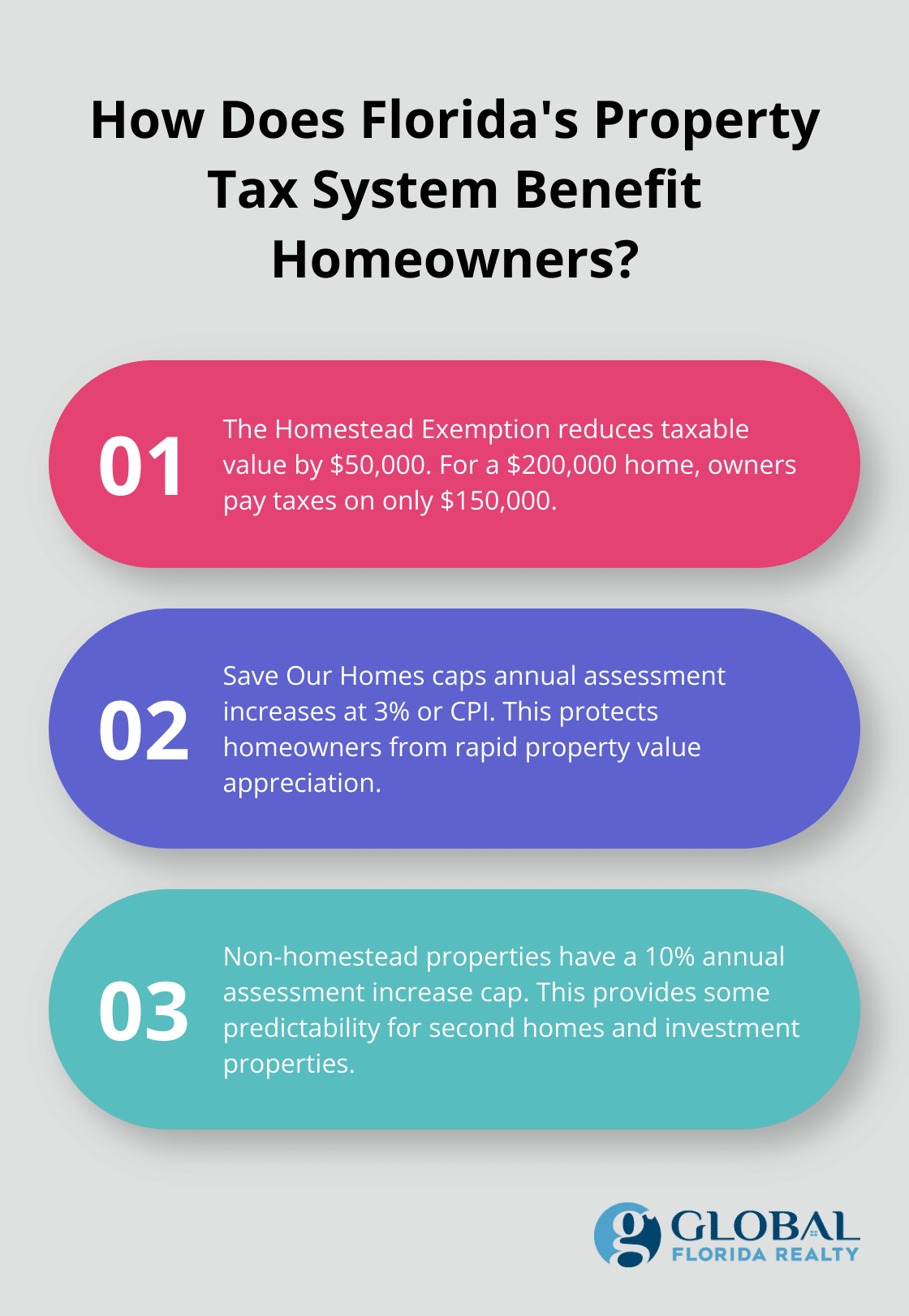
The Save Our Homes Amendment (SOH) is a cornerstone of Florida’s property tax system, offering substantial protection to primary residences (homesteaded properties). Enacted in 1992, SOH caps the annual increase in the assessed value of a homesteaded property at 3% or the percentage change in the Consumer Price Index (CPI), whichever is lower. This cap applies only to the assessed value, not the market value.
The impact of SOH on accommodation costs is profound, particularly during periods of rapid market appreciation. While market values might soar, the assessed value for a homesteaded property increases at a much slower, predictable rate, effectively insulating long-term residents from sudden, drastic jumps in their property tax bills. This amendment is a powerful incentive for establishing permanent residency in Florida, as it significantly enhances the financial stability of long-term accommodation. Without SOH, many long-time residents would face unaffordable tax increases that could jeopardize their ability to remain in their homes. For prospective residents, understanding SOH is key to projecting future accommodation expenses.
Non-Homesteaded Properties and Their Implications
In stark contrast to homesteaded properties, non-homesteaded properties—which include second homes, vacation properties, investment properties, and commercial buildings—do not benefit from the Save Our Homes Amendment cap. The assessed value of these properties can increase by up to 10% annually.
This distinction has significant implications for individuals or entities investing in Florida’s real estate market for rental accommodation or those purchasing a seasonal residence. Owners of non-homesteaded properties are more exposed to the volatility of the real estate market. If market values rise sharply, their assessed values (and consequently their tax bills) can increase at a much faster pace compared to an equivalent homesteaded property. This requires careful financial planning, as the annual property tax expense for a rental unit or a second home could fluctuate more widely. For those considering a property for purely seasonal accommodation or as an income-generating asset, the absence of SOH protection means property taxes become a more dynamic and potentially larger operating cost, influencing rental rates and overall profitability.
Homestead Exemptions and Other Reliefs for Florida Homeowners
Beyond the nuances of millage rates and the Save Our Homes Amendment, Florida offers various exemptions that can significantly reduce a homeowner’s taxable value, thereby lowering their property tax bill. These exemptions are particularly beneficial for individuals seeking to make Florida their permanent accommodation, providing financial relief that can make homeownership more accessible and sustainable.
The Standard Homestead Exemption
The cornerstone of property tax relief for primary residents in Florida is the Homestead Exemption. If you own a home in Florida and reside there as your permanent legal residence on January 1st of the tax year, you are generally eligible for this exemption. The standard homestead exemption reduces the assessed value of your property by up to $50,000.
Here’s how it typically works:
- The first $25,000 of the exemption applies to all taxing authorities, including the county, municipality, and school board.
- An additional $25,000 exemption applies to the assessed value between $50,000 and $75,000, but only for non-school levies. This means the school board tax portion of your bill only benefits from the initial $25,000 exemption.
This exemption directly translates into substantial annual savings for homeowners. For someone considering Florida for long-term accommodation, qualifying for the homestead exemption is a crucial financial benefit that should be factored into their budget. It’s not automatically applied; homeowners must file an application with their county Property Appraiser’s office by March 1st of the year they wish the exemption to take effect. This benefit underscores Florida’s commitment to making primary residency more affordable.
Additional Exemptions: Seniors, Veterans, and Disabilities
Florida extends its tax relief efforts to specific groups, further enhancing the affordability of accommodation for those who meet certain criteria. These additional exemptions stack on top of the standard Homestead Exemption and can provide significant financial relief:
- Senior Citizen Exemption: Many counties and cities in Florida offer additional exemptions for homeowners aged 65 and older who meet specific income limitations and have resided in their home for a certain number of years. The amount of this exemption can vary by local ordinance but typically ranges from $25,000 to $50,000. These exemptions make Florida an even more attractive state for retirees seeking stable, affordable long-term accommodation.
- Veteran Exemptions: Veterans with service-connected disabilities can qualify for substantial property tax exemptions. A 10% or more disability can lead to a $5,000 exemption, while a 100% permanent and total service-connected disability can result in a total exemption from property taxes. This is a profound benefit that significantly eases the financial burden of homeownership for eligible veterans and their families.
- Exemptions for Widows/Widowers, Blind Persons, and Other Disabilities: Florida also provides smaller exemptions (e.g., $500) for widows, widowers, and individuals who are legally blind. Furthermore, specific exemptions are available for individuals with other severe disabilities, often requiring medical certification.
These targeted exemptions reflect Florida’s policy to support various segments of its population, making the state a more welcoming and economically feasible option for a diverse range of long-term accommodation needs. Understanding eligibility for these exemptions is vital for maximizing tax savings.
Portability of Homestead Benefits
An often-overlooked but highly valuable feature of Florida’s property tax system, particularly for existing residents, is the portability of the Save Our Homes Amendment benefit. When a homeowner who has enjoyed the SOH cap on their primary residence sells that home and purchases another primary residence in Florida within a certain timeframe (typically two years), they may be able to “port” a portion of their accumulated SOH savings.
This portability allows homeowners to transfer up to $500,000 of their capped assessment difference from their old homestead to their new one. The exact amount that can be ported depends on the value of the old homestead relative to the new one and whether they are “upsizing” or “downsizing.”
- Upsizing: If the new home is more expensive than the old one, the homeowner can transfer up to the maximum $500,000 of their assessed value difference.
- Downsizing: If the new home is less expensive, a percentage of the SOH benefit is transferred.
The portability feature is a significant advantage for long-term residents of Florida who wish to move within the state. It provides continuity in tax savings, encouraging mobility without penalizing homeowners for changing their accommodation. This makes it easier for families to move for jobs, retirees to downsize, or individuals to upgrade their living situation, all while retaining some of the valuable tax protections they’ve earned.
The Impact of Property Taxes on Your Florida Accommodation Strategy
Integrating an understanding of Florida’s real estate tax system into your overall accommodation strategy is crucial, whether you’re seeking a forever home, a seasonal retreat, or a lucrative investment property. These taxes are more than just an annual bill; they fundamentally shape the financial landscape of property ownership and influence key decisions.
Budgeting for Ownership: Beyond the Mortgage
For prospective homeowners, the allure of Florida’s lifestyle often overshadows the full financial commitment involved. While the mortgage payment is typically the largest recurring expense, property taxes are an equally significant, and sometimes substantial, ongoing cost that must be meticulously factored into your budget. Failing to account for these taxes can lead to financial strain, making your dream accommodation less attainable than anticipated.
Property taxes are often escrowed by lenders, meaning a portion of your annual tax bill is collected monthly alongside your mortgage payment. However, it’s vital for homeowners to understand the components of this escrow payment and how changes in assessed value or millage rates can impact it. Beyond property taxes, homeowners must also budget for property insurance (which can be high in coastal areas due to hurricane risk), maintenance, utilities, and potential homeowner association (HOA) fees. A holistic financial plan that includes a realistic estimate of property taxes ensures that your long-term accommodation in Florida remains affordable and enjoyable.
Investing in Rental Accommodation
For those looking to leverage Florida’s robust tourism and relocation markets by investing in rental properties, property taxes represent a critical operating expense that directly affects profitability and return on investment (ROI). Unlike primary residences, rental accommodations generally do not qualify for the Homestead Exemption or the Save Our Homes Amendment cap, meaning their assessed values can increase by up to 10% annually.
This dynamic requires investors to:
- Conduct thorough due diligence: Research local millage rates and historical tax trends for specific rental markets (e.g., short-term vacation rentals in Orlando vs. long-term residential rentals in Tampa).
- Project future expenses: Anticipate potential tax increases when setting rental rates and calculating cash flow. Higher property taxes may necessitate higher rents, which could impact competitiveness.
- Understand market demand: Ensure that the local market can support rental rates that cover all operating costs, including property taxes, while still generating a desirable profit margin.
Property taxes, alongside maintenance, insurance, and vacancy rates, are a major determinant of a rental property’s financial performance, making their accurate estimation indispensable for any accommodation investment strategy.

Seasonal vs. Permanent Residency
The decision to establish seasonal versus permanent residency in Florida carries significant property tax implications. As highlighted, a primary residence (permanent residency) qualifies for the substantial Homestead Exemption and the protective Save Our Homes Amendment cap on assessed value increases. These benefits provide a robust financial advantage, significantly reducing the annual tax burden and offering long-term predictability for accommodation costs.
Conversely, a seasonal home or second residence, by definition, does not qualify for these homestead benefits. This means:
- Higher taxable value: The property’s assessed value does not receive the exemption reduction.
- Greater exposure to market fluctuations: The assessed value can increase by up to 10% annually, making the tax bill more susceptible to market appreciation.
This distinction creates a compelling financial incentive for individuals who spend a significant portion of their year in Florida to establish permanent residency, provided they meet the legal requirements. The difference in annual property tax bills between a homesteaded property and a non-homesteaded property of similar market value can be thousands of dollars, making it a critical consideration for anyone planning their accommodation lifestyle in the Sunshine State.
In conclusion, real estate tax is an undeniable and multifaceted aspect of owning property in Florida. While it adds a layer of complexity to the accommodation landscape, a thorough understanding of the assessment process, millage rates, the Save Our Homes Amendment, and various exemptions empowers individuals to make informed decisions. Whether you’re dreaming of a permanent home, a part-time retreat, or a strategic investment, factoring in these property tax nuances is key to successfully navigating Florida’s real estate market and ensuring your accommodation strategy aligns with your financial goals. Always consult with a local property appraiser’s office or a qualified real estate professional to get the most accurate and personalized information for your specific situation.
LifeOutOfTheBox is a participant in the Amazon Services LLC Associates Program, an affiliate advertising program designed to provide a means for sites to earn advertising fees by advertising and linking to Amazon.com. Amazon, the Amazon logo, AmazonSupply, and the AmazonSupply logo are trademarks of Amazon.com, Inc. or its affiliates. As an Amazon Associate we earn affiliate commissions from qualifying purchases.