
The “Fundamental Orders of Connecticut” stand as a monumental landmark in the annals of democratic governance, often heralded as the world’s first written constitution. Drafted and adopted by the colonial towns of Hartford, Windsor, and Wethersfield in January 1639, these orders established a framework for self-government that was remarkably progressive for its era. Far from being a mere administrative document, the Fundamental Orders articulated principles of popular sovereignty, limited government, and individual rights that would profoundly influence the development of democratic thought in the United States and beyond. To understand their true significance is to delve into a foundational moment in American history, exploring how a nascent colony forged a government based not on royal decree but on the consent of its citizens.
The Genesis of Self-Governance
The journey towards the Fundamental Orders began with the migration of Puritan settlers from the Massachusetts Bay Colony to the fertile Connecticut River Valley in the mid-1630s. Driven by a desire for more agricultural land and, crucially, a longing for greater religious and political autonomy, these communities established independent towns along the river.
Early Connecticut Settlements and Their Needs
The towns of Hartford, Windsor, and Wethersfield were founded by settlers who, while still considering themselves loyal subjects of the English Crown, sought to establish a civil government that reflected their specific needs and values. Unlike the Massachusetts Bay Colony, which was governed by a royal charter and heavily influenced by its powerful General Court, the Connecticut River towns found themselves geographically distant and politically distinct. They operated under informal agreements for a few years, but as their populations grew and the complexities of communal life increased, the need for a formal, unified governmental structure became paramount. This nascent independent spirit was a crucial catalyst, pushing these communities to create a government that directly served the populace rather than a distant monarch or a centralized colonial authority.
The Influence of Thomas Hooker’s Sermon
A pivotal moment leading to the adoption of the Fundamental Orders was a sermon delivered by the influential Puritan minister, Thomas Hooker, on May 31, 1638. Preaching in Hartford, Hooker famously articulated revolutionary ideas about the source of governmental authority. He declared that “the foundation of authority is laid in the free consent of the people,” and that “the choice of public magistrates belongs unto the people by God’s own allowance.” This powerful assertion, rooted in Calvinist theology but remarkably democratic in its implications, profoundly resonated with the settlers. Hooker’s sermon essentially provided the philosophical underpinning for the governmental structure that would soon be formalized. It argued that government’s legitimacy stemmed from the governed, not from divine right or inherited power, setting a direct precedent for the principles embedded within the Fundamental Orders.
Core Principles and Revolutionary Ideas
The Fundamental Orders, adopted in January 1639, were not merely a set of rules but a radical statement of political philosophy. They established a comprehensive framework for government, delineating powers, responsibilities, and, crucially, the rights of the citizens, marking a significant departure from contemporary European political models.
Government by Consent of the Governed
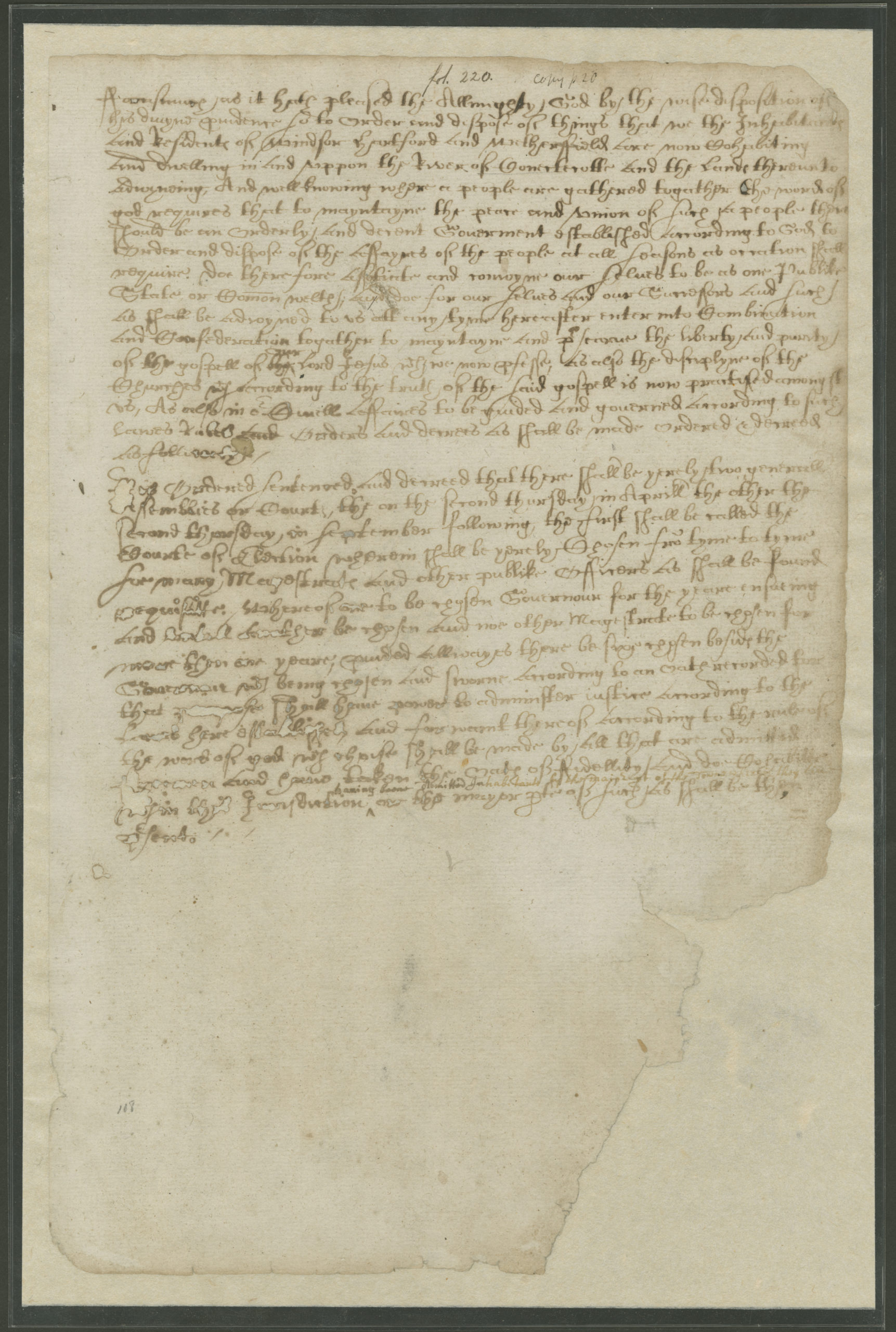
At the heart of the Fundamental Orders was the revolutionary principle that the authority of government derived from the consent of the governed. Unlike the charters granted by monarchs, which typically established colonies as extensions of royal power, the Fundamental Orders were an agreement among the people themselves. They explicitly stated the purpose of their government: “to maintain and preserve the liberty and purity of the Gospel of our Lord Jesus which we now profess, as also the said discipline of the Churches, which according to the truth of the said Gospel is now practiced amongst us; as also in our civil affairs to order and dispose ourselves and all our affairs to be guided and ordered according to such laws, rules, orders and decrees as shall be made, ordered & decreed, as hath been also agreed.” This preamble articulated a social contract, where individuals willingly entered into a political society for mutual benefit and shared principles. It meant that officials were elected by the people and accountable to them, a direct contrast to appointed rulers.
Limiting Executive Power (Governor’s Role)
Another groundbreaking aspect of the Fundamental Orders was its clear delineation and limitation of executive power. The document established the position of a Governor, elected annually, but intentionally restricted the scope of this office. The Governor was to be chosen “from amongst the Freemen,” and could only serve one term out of every two years, preventing any single individual from consolidating too much power. His role was primarily to preside over the General Court (the legislative body) and execute its laws, rather than to dictate policy. This early form of term limits and checks on executive authority was a prescient design feature, aimed at preventing tyranny and ensuring that the government remained truly representative of the people’s will. It provided a stark contrast to the absolute monarchies prevalent in Europe at the time, demonstrating a sophisticated understanding of balanced governance.
Defining Legislative Authority (General Court)
The Fundamental Orders placed significant power in the hands of the General Court, the legislative body of the colony. This court was composed of representatives (deputies) from each town, along with the Governor and magistrates. It had the authority to “make, alter, and repeal laws,” declare war, raise taxes, and appoint officials. Crucially, it was established that the General Court would meet twice a year, ensuring regular legislative oversight and responsiveness to the needs of the towns. The document also stipulated that a majority vote of the General Court was required for decision-making, emphasizing collective deliberation and representation. This strong legislative branch, directly accountable to the towns through elected deputies, reflected the settlers’ belief in the importance of a representative assembly that could articulate and enact the will of the people. It effectively served as the highest authority in the colony, rather than a single executive figure.
A Radical Departure from European Monarchies
What made the Fundamental Orders truly revolutionary was their complete omission of any reference to the English Crown or a royal charter as the source of governmental authority. Unlike other colonial documents of the period, it did not seek validation from a monarch or external power. Instead, it was an indigenous creation, a government “by the people, for the people.” This self-origination was unprecedented and marked a bold assertion of autonomy. It established a truly republican form of government, albeit within the broader context of a colonial possession, where the community itself was the ultimate sovereign. This radical departure laid down a philosophical marker that would resonate throughout the American colonies and eventually find full expression in the declaration of independence and the formation of the United States as a republic.
The Document’s Enduring Legacy
The Fundamental Orders of Connecticut did not merely govern a small colonial outpost; they cast a long shadow over the development of democratic principles in the United States, earning their place as a foundational historical landmark. Their influence extended far beyond the banks of the Connecticut River, shaping the very identity of the state and inspiring future generations of constitution-makers.
The “Father of American Democracy” Title
Due to its innovative provisions for self-governance and the bold assertion of popular sovereignty, the Fundamental Orders are often cited as the “first written constitution” in history that established a government by the people, for the people. This landmark status has led many to refer to Connecticut as the “Birthplace of American Democracy,” and Thomas Hooker, whose sermon provided the ideological backbone, is frequently called the “Father of American Democracy.” While historical debates exist regarding the precise definition of “constitution” and the influence of other early colonial documents, the spirit and comprehensive nature of the Fundamental Orders unequivocally set a precedent for future democratic experiments in North America. They embody the very essence of the American ideal of self-determination.
Influence on Later Constitutions
The principles enshrined in the Fundamental Orders profoundly influenced subsequent constitutional developments. Concepts like the consent of the governed, the separation of powers (with a strong legislature and limited executive), representative government, and the idea of a written document outlining the framework of government, all found echoes in later colonial charters and, most notably, the U.S. Constitution. The very act of codifying governmental structure and rights in a single, accessible document became a model. When the founding fathers gathered in Philadelphia in 1787, they built upon a tradition of constitutionalism that had roots in documents like the Fundamental Orders, learning from early successes and challenges in establishing stable, representative governments. The Fundamental Orders demonstrated the viability and effectiveness of a government derived from the people’s will, providing a practical blueprint for a nation that would later declare its independence from monarchical rule.
Connecticut’s “Constitution State” Identity
The enduring pride and significance of the Fundamental Orders are perhaps best encapsulated in Connecticut’s official nickname: “The Constitution State.” This moniker is a direct testament to the state’s historical role in pioneering written constitutional government. It serves as a constant reminder of Connecticut’s unique contribution to the development of democratic principles and its early commitment to the rule of law and popular sovereignty. The Fundamental Orders are not just a relic of the past but an integral part of Connecticut’s identity, celebrated in its schools, historical societies, and civic discourse. They are a source of profound state pride, highlighting a legacy of intellectual leadership and political innovation that helped shape the nation.
Preserving the Historical Record
Given their immense historical importance, the Fundamental Orders are not just abstract concepts but tangible artifacts that continue to be preserved and studied. Their physical existence serves as a direct link to the revolutionary ideas of 17th-century Connecticut.
The Original Document and Its Custody
The original handwritten copies of the Fundamental Orders of Connecticut are invaluable historical treasures. These documents, penned by Secretary Thomas Welles, are carefully preserved within the archives of the Connecticut State Library in Hartford. The Connecticut State Library acts as the guardian of these foundational texts, ensuring their protection from deterioration and making them available for scholarly research and public viewing in controlled environments. The physical presence of these documents allows historians, political scientists, and the general public to connect directly with the very words that laid the groundwork for a new form of government, offering a powerful testament to the origins of American democracy.

Educational Significance and Public Awareness
The Fundamental Orders hold immense educational significance. They are a cornerstone of Connecticut’s curriculum and are frequently discussed in the context of American history and civics education across the United States. Understanding the context, content, and legacy of these orders helps students grasp the evolutionary nature of democratic thought and the courage required to forge new political paths. Public awareness campaigns, historical markers, and exhibits dedicated to the Fundamental Orders further reinforce their importance, ensuring that this landmark document and the principles it espoused continue to be recognized and appreciated by current and future generations. They serve as a powerful reminder of the enduring power of ideas to shape societies and inspire calls for freedom and self-determination.
In conclusion, the Fundamental Orders of Connecticut represent a pivotal moment in the history of governance. As the first written constitution that established a government based on the consent of the governed, they laid down principles that would resonate throughout the American colonies and ultimately contribute to the foundational ideals of the United States. More than just a historical relic, these orders are a testament to the innovative spirit of early American settlers and an enduring landmark of democratic progress. They remind us that the pursuit of self-governance and the protection of popular sovereignty are deeply rooted in the earliest chapters of our national story, making Connecticut indeed “The Constitution State.”
LifeOutOfTheBox is a participant in the Amazon Services LLC Associates Program, an affiliate advertising program designed to provide a means for sites to earn advertising fees by advertising and linking to Amazon.com. Amazon, the Amazon logo, AmazonSupply, and the AmazonSupply logo are trademarks of Amazon.com, Inc. or its affiliates. As an Amazon Associate we earn affiliate commissions from qualifying purchases.