
A Banner of Resilience: The Iconic Chicago Flag
The Chicago flag is more than just a civic emblem; it is a meticulously crafted historical tapestry, each element woven with deep meaning reflecting the enduring spirit and pivotal moments of the Windy City. Adopted in 1917, its design immediately captivates with its bold stripes and prominent red stars, a visual shorthand recognized far beyond the city limits. Unlike many municipal flags that might feature complex seals or obscure heraldry, the Chicago flag is remarkably clean, modern, and profoundly symbolic. Its widespread popularity is a testament to how effectively it encapsulates the city’s identity—a beacon of resilience, innovation, and historical depth. For those exploring Chicago’s rich landscape, understanding the flag is akin to unlocking a key historical document, offering profound insights into the city’s journey from a humble trading post to a global metropolis. Each line, each star, is a landmark in its own right, narrating tales of triumph, tragedy, and rebirth that collectively form the bedrock of Chicago’s character.
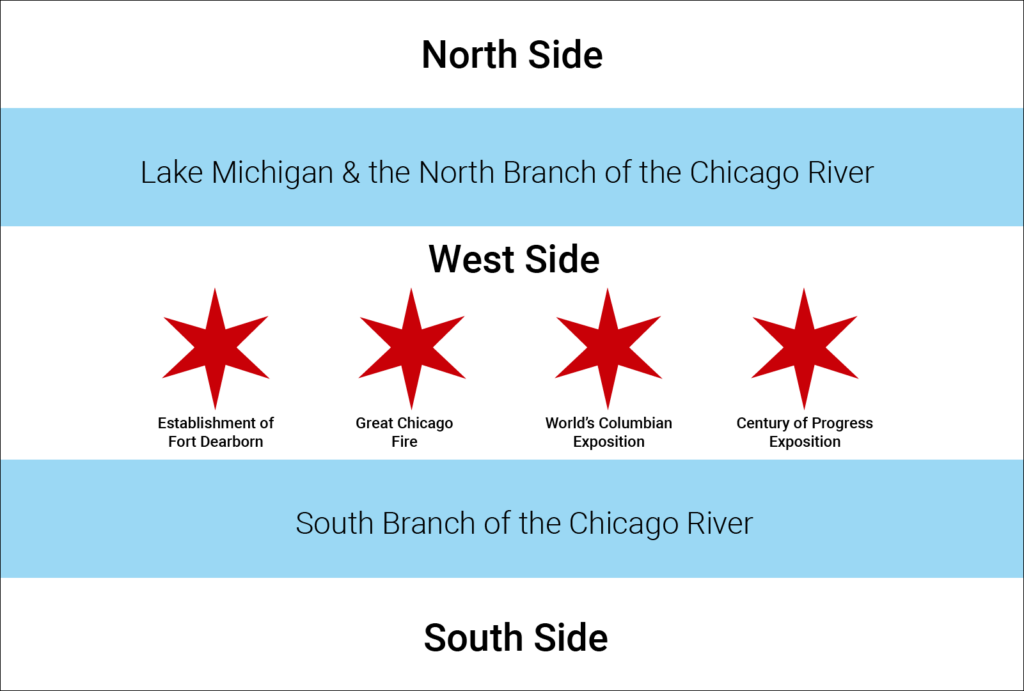
The flag’s design was the result of a competition launched by the city council in 1917, won by Wallace Rice, a lecturer at the Art Institute of Chicago. Rice, a heraldic expert, infused the design with precise historical and geographical references, ensuring that every component contributed to a cohesive narrative. Its enduring appeal lies not just in its aesthetic simplicity but in its ability to tell a compelling story about the city’s past and present. As a central fixture in the city’s identity, the flag adorns everything from official buildings to local businesses, and it is proudly displayed by Chicagoans worldwide. For visitors, recognizing and understanding its components adds an invaluable layer to their exploration of Chicago’s architectural marvels, vibrant neighborhoods, and historical sites. It’s a constant reminder of the city’s profound connection to its own history, a living landmark that flies high above its streets.
Deconstructing The Stripes: Blue And White Symbolism
The Chicago flag features two horizontal blue stripes and three white stripes. While seemingly simple, these bands carry significant geographical and historical weight, delineating the city’s physical characteristics and historical divisions.
The White Stripes: Representing Chicago’s Divisions
The three horizontal white stripes on the flag symbolize the distinct geographical sections of the city. These divisions are not arbitrary but reflect the historical and practical partitioning of the sprawling urban landscape.
- The Uppermost White Stripe: This band represents the North Side of Chicago. Historically characterized by its distinct neighborhoods, cultural institutions, and residential areas, the North Side has played a significant role in the city’s development, attracting diverse populations and contributing to its vibrant tapestry.
- The Middle White Stripe: Occupying the central position, this stripe stands for the West Side of Chicago. The West Side, with its industrial heritage, historic immigrant communities, and evolving commercial districts, has been a crucible of the city’s economic and social transformation, embodying the resilience and dynamism that define Chicago.
- The Lowermost White Stripe: This final white stripe signifies the South Side of Chicago. A vast and historically rich area, the South Side encompasses a wide array of communities, from the historic stockyards to beautiful parks and world-renowned universities. It has been central to Chicago’s industrial might and its profound cultural contributions, reflecting a complex and storied past.
Together, these white stripes represent the physical expanse of the city, highlighting its geographical diversity and the distinct identities of its primary regions. They serve as a constant reminder of the urban fabric that has grown around its natural waterways, a foundational aspect of Chicago’s unique development.
The Blue Stripes: Reflecting Historic Waterways
The two horizontal blue stripes on the flag are not merely decorative but deeply symbolic, representing the vital waterways that have shaped Chicago’s growth and prosperity. These bodies of water were critical for transportation, trade, and the very establishment of the city.
- The Uppermost Blue Stripe: This stripe signifies Lake Michigan and the North Branch of the Chicago River. Lake Michigan, one of the five Great Lakes, has been indispensable to Chicago’s identity, providing freshwater, a natural harbor, and a crucial link for shipping and commerce. The North Branch of the Chicago River further facilitated internal transportation and industry, linking the nascent settlement to the broader region.
- The Lowermost Blue Stripe: This stripe represents the South Branch of the Chicago River and the Illinois and Michigan Canal. The South Branch was instrumental in the city’s early development, particularly in connecting the burgeoning agricultural and industrial sectors. The Illinois and Michigan Canal, completed in 1848, was a monumental engineering feat that connected the Great Lakes to the Mississippi River system, transforming Chicago into a pivotal transportation hub and accelerating its growth into a major economic power.
These blue stripes not only pay homage to the natural and engineered waterways that defined Chicago’s early success but also underscore the city’s enduring relationship with its aquatic environment, a relationship that continues to influence its architecture, commerce, and recreational life.
The Stars of Chicago: A Chronicle of History
The four prominent red stars, arranged between the two blue stripes, are the focal points of the Chicago flag. Each star is a six-pointed “star of Chicago,” symbolizing a significant historical event that profoundly impacted the city’s formation and identity. Their six points themselves also hold symbolic meaning, representing virtues or significant attributes related to the event they commemorate.

The First Star: Fort Dearborn
The first star, closest to the flag’s hoist (left side), commemorates the establishment and subsequent massacre at Fort Dearborn. Built in 1803 at the mouth of the Chicago River, the fort was a crucial early outpost in the Northwest Territory. In 1812, during the War of 1812, its inhabitants were ordered to evacuate, leading to an ambush by Potawatomi warriors that resulted in significant loss of life. This event, known as the Fort Dearborn Massacre, marked a grim but formative chapter in the city’s nascent history, underscoring the frontier challenges and conflicts that preceded Chicago’s official incorporation.
The six points of this star represent the political entities that have flown their flags over the Chicago area: France, Great Britain, Virginia, the Northwest Territory, Indiana Territory, and Illinois (as a state). It’s a reminder of the shifting sovereignties and complex colonial history that laid the groundwork for the modern city.
The Second Star: The Great Chicago Fire
The second star on the flag symbolizes the Great Chicago Fire of 1871. This devastating inferno, which began on October 8, 1871, and raged for three days, destroyed a vast swath of the city, killed hundreds, and left over 100,000 homeless. While a monumental catastrophe, the fire also paved the way for Chicago’s rebirth and rapid reconstruction. The city emerged from the ashes stronger and more modern, adopting innovative architectural and urban planning techniques that cemented its place as a leader in urban development. This star embodies Chicago’s legendary resilience and its ability to innovate and rebuild in the face of immense adversity.
The six points of this star represent the virtues of Chicago: transportation, labor, commerce, finance, populousness, and salubrity (healthfulness). These attributes highlight the city’s economic engines and its commitment to public welfare even in its early, rapidly industrializing period.
The Third Star: The World’s Columbian Exposition
The third star commemorates the World’s Columbian Exposition of 1893. This spectacular world’s fair, held to celebrate the 400th anniversary of Christopher Columbus’s arrival in the Americas, showcased Chicago to the world as a city of innovation, culture, and progress. The fair profoundly influenced American architecture, urban planning, and art, demonstrating Chicago’s capacity for grand vision and execution. Often referred to as the “White City” due to its stunning neoclassical buildings, the exposition marked a coming-of-age for Chicago on the global stage, solidifying its reputation as a major cultural and economic center.
The six points of this star represent the different claims to fame of Chicago: “Urbs in Horto” (City in a Garden), “I Will” (the city motto), “Garden City,” “Great Central Market,” “Wonder City,” and “Convention City.” These titles underscore the city’s aspiration, growth, and reputation.
The Fourth Star: The Century of Progress Exposition
The fourth and most recently added star on the Chicago flag commemorates the Century of Progress Exposition, held in 1933 and 1934. This second major world’s fair was organized to celebrate Chicago’s centennial as a chartered city. Unlike the neoclassical grandeur of the Columbian Exposition, the Century of Progress focused on technological innovation and scientific advancement, reflecting a forward-looking vision amidst the challenging backdrop of the Great Depression. The fair demonstrated Chicago’s enduring spirit of progress and its commitment to shaping the future.
The six points of this star specifically symbolize the six largest universities in the Chicago area: the University of Chicago, Northwestern University, Loyola University Chicago, Illinois Institute of Technology, DePaul University, and the University of Illinois at Chicago. This emphasizes the city’s dedication to education and intellectual leadership.

The Enduring Legacy of the Chicago Flag
The Chicago flag stands as a powerful testament to the city’s rich history and its continuous journey of transformation. Far from being a mere static emblem, it is a dynamic narrative woven into the very fabric of Chicago, constantly evoking the struggles, triumphs, and aspirations of its people. Each stripe and star is a miniature landmark, encapsulating centuries of development, disaster, and innovation. For residents, it’s a source of immense civic pride, often seen adorning homes, businesses, and even personal items, indicating a deep, almost familial, connection to their city’s identity. For visitors, understanding the flag transforms a simple visual into a profound historical lesson, enhancing their appreciation for Chicago’s architectural marvels, vibrant cultural districts, and the indomitable spirit of its Chicagoans.
The flag’s design, crafted by Wallace Rice, was deliberately chosen to be enduring and meaningful, a professional and insightful approach to civic iconography. It serves as a constant reminder of the physical and historical forces that have shaped Chicago: the essential waterways that facilitated its growth, and the pivotal events that tested and ultimately strengthened its resolve. From the frontier outpost of Fort Dearborn to the global spectacle of two World’s Fairs, the flag chronicles a city that consistently rose to meet challenges, rebuilt from ashes, and presented itself as a beacon of progress to the world. It’s an engaging and ever-present symbol, guiding the gaze of observers to reflect upon the layered history contained within its simple, yet potent, design. The Chicago flag is, in essence, a compact historical guide and a powerful symbol of memory and hope, making it one of the most beloved and historically resonant municipal flags in the world.
LifeOutOfTheBox is a participant in the Amazon Services LLC Associates Program, an affiliate advertising program designed to provide a means for sites to earn advertising fees by advertising and linking to Amazon.com. Amazon, the Amazon logo, AmazonSupply, and the AmazonSupply logo are trademarks of Amazon.com, Inc. or its affiliates. As an Amazon Associate we earn affiliate commissions from qualifying purchases.