
The iconic song “Hotel California” by the Eagles has captivated listeners for decades with its haunting melody and cryptic lyrics. While the song is a staple of classic rock radio and a beloved anthem for many, its true meaning has remained a subject of intense speculation and debate. The title itself, “Hotel California,” evokes an image of a grand, perhaps even luxurious, establishment. However, the narrative that unfolds within the song paints a far more complex and disquieting picture. This article delves into the layers of meaning behind “Hotel California,” exploring its potential interpretations through the lens of travel, accommodation, tourism, lifestyle, and the very essence of a place that draws you in, only to hold you captive.

The song’s vivid imagery and enigmatic storytelling lend themselves to various interpretations, many of which align with the experiences one might encounter when traveling or seeking accommodation. Is “Hotel California” a literal place, a metaphorical state of mind, or a commentary on something entirely different? Let’s unpack the possibilities.
The Allure of the Destination: More Than Just a Stopover
The very concept of a “Hotel California” as a destination is central to its mystique. When we travel, we often seek out unique and memorable experiences, places that stand out from the ordinary. The lyrics paint “Hotel California” as such a place, initially appearing as a beacon of comfort and escape:
“On a dark desert highway, cool wind in my hair
Warm smell of colitas, rising up through the air”
This opening immediately sets a scene of a journey, a traveler seeking respite. The “cool wind” and “warm smell” suggest an inviting atmosphere, hinting at a place that promises relief from the rigors of the road. In the context of travel and tourism, such descriptions tap into the desire for sensory experiences and the romanticism of discovering new horizons.
The song describes arriving at this supposed haven:
“Up ahead in the distance, I saw a shimmering light
My head grew heavy and my sight grew dim
I had to stop for the night”
This Shimmering light could represent many things on a journey. It could be a literal hotel sign, a landmark promising sanctuary, or even a metaphorical representation of hope and guidance in an uncertain landscape. The traveler’s weariness, a common experience in long journeys, compels them to seek lodging.
First Impressions: The Facade of Paradise
Upon entering the “Hotel California,” the initial impression is one of opulence and a certain timeless quality. The lyrics describe:
“There she stood in the doorway;
I heard the mission bell
And I was thinking to myself
‘This could be Heaven or this could be Hell’”
This duality is crucial. The “mission bell” evokes a sense of history and perhaps a spiritual grounding, while the immediate contemplation of “Heaven or Hell” foreshadows the song’s darker undertones. In the world of hotels and accommodation, the initial impression is paramount. A well-appointed lobby, welcoming staff, and elegant decor can create an illusion of paradise, masking potential underlying issues.
The song continues to paint a picture of a place that is both beautiful and unsettling:
“Then she lit up a candle and she showed me the way
There were voices down the corridor,
I thought I heard them say…”
The “voices down the corridor” introduce an element of the uncanny, a subtle suggestion that things are not as they seem. This can be likened to the subtle nuances of a place that, while seemingly perfect, carries an undercurrent of unease. In travel guides and reviews, such descriptions often try to capture the intangible essence of a location – a place that has a “vibe” or a “feeling” that transcends its physical attributes.
The Tangible Elements of Accommodation: Rooms, Amenities, and the Unseen
The core of “Hotel California” revolves around the experience of staying in this enigmatic establishment. The lyrics detail the amenities and the pervasive atmosphere, blurring the lines between comfort and entrapment.
The Illusion of Comfort: Amenities and Their Double-Edged Nature
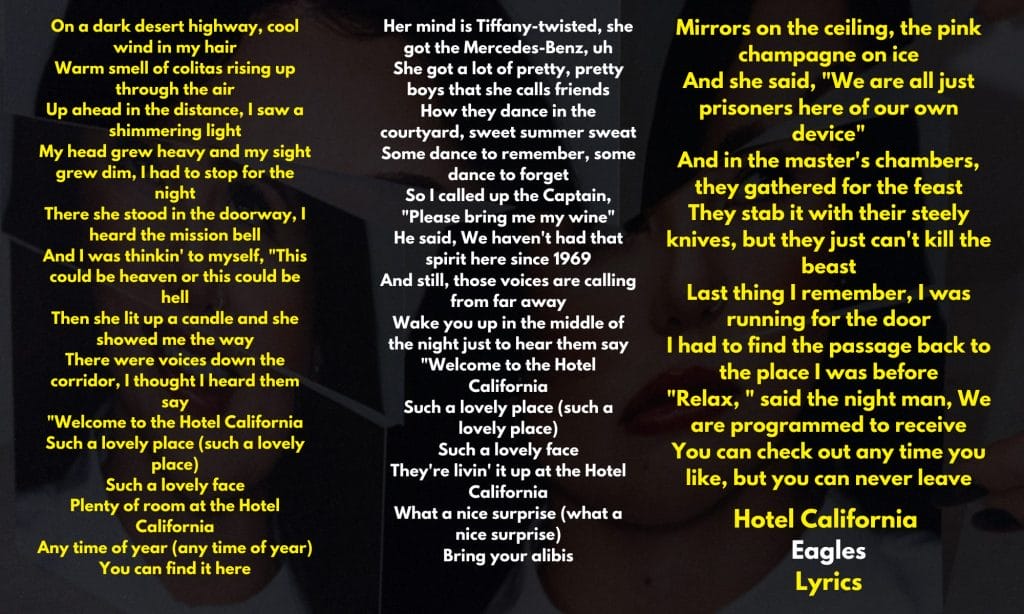
The song references familiar elements of hotel stays, yet imbues them with a sinister twist. The “pink champagne on ice” and the “pretty, pretty boys” suggest luxury and a certain social scene, elements often sought after in high-end resorts and boutique hotels. However, these very comforts become part of the trap.
“So I called up the Captain,
‘Please bring me my wine.’
He said, ‘We haven’t had that spirit here since nineteen sixty-nine.’”
This particular line is often cited as a key to the song’s meaning. The year 1969 is significant, a period of cultural upheaval and a turning point in the hippie movement and the perceived idealism of the era. The inability to procure a simple “spirit” suggests a loss of something fundamental, a stagnation or a decay beneath the surface of apparent luxury.
The song’s description of the rooms and the general ambiance highlights the deceptive nature of appearances:
“And in the master’s chambers
They gathered for the feast
They stab it with their steely knives,
But they just can’t kill the beast.”
This imagery is deeply symbolic. The “feast” and the “master’s chambers” suggest a place of indulgence and power, while the futility of trying to “kill the beast” implies an enduring, perhaps supernatural, evil or corruption. In terms of accommodation, this could translate to places that appear outwardly grand but are internally plagued by issues, or perhaps, places that have a history too dark to be fully overcome.
The feeling of being trapped is palpable:
“Last thing I remember, I was
Running for the door
I had to find the passage back
To the place I was before
‘Relax,’ said the night man,
‘We are programmed to receive.
You can check out any time you like,
But you can never leave!’”
This concluding stanza is the song’s most potent statement of entrapment. The “night man” represents the establishment itself, its systems and its staff, all designed to ensnare guests. The inability to truly “leave” is the ultimate paradox of “Hotel California.” It’s a place that offers temporary solace but permanent captivity, a chilling commentary on how certain experiences, places, or even lifestyles can become a gilded cage.
Deeper Interpretations: Lifestyle, Culture, and the American Dream
Beyond the literal aspects of travel and accommodation, “Hotel California” has been interpreted as a broader commentary on societal themes, particularly those related to the American lifestyle and the allure and eventual disillusionment with the Californian dream.
The Mirage of the Californian Dream
Many believe the song is a metaphor for the dark side of the California dream – the pursuit of fame, fortune, and hedonism that can lead to spiritual emptiness and moral decay. Los Angeles and California have long been symbols of opportunity and a place where dreams are made. However, the song suggests that the pursuit of this dream can come at a great cost, leading to a loss of self and an inability to escape the consequences of one’s choices.
This interpretation resonates with the idea of “luxury travel” or any lifestyle choice that prioritizes superficial pleasures over deeper fulfillment. The “Hotel California” becomes a symbol of this seductive but ultimately hollow pursuit. The endless cycle of indulgence without true satisfaction mirrors the experience of someone caught in a lifestyle they cannot escape.
Cultural Commentary and the Loss of Authenticity
The song can also be seen as a critique of the superficiality and commercialization of culture. The “voices” and the “feast” could represent the manufactured experiences and the loss of genuine connection that can occur in a society obsessed with image and consumption. This connects to the “local culture” aspect of tourism, suggesting that sometimes the authentic experience is overshadowed by a curated, commercialized version.
In this light, the “Hotel California” is not just a physical place but a state of being, a cultural phenomenon that promises fulfillment but delivers only an illusion. The inability to leave signifies a deep entrenchment in these superficialities, a loss of the ability to return to a more authentic self.

The Enduring Enigma: A Reflection of the Human Condition
Ultimately, the enduring power of “Hotel California” lies in its ambiguity. It invites listeners to project their own fears, desires, and experiences onto its lyrics. Whether it’s a commentary on the excesses of the music industry, a cautionary tale about hedonism, or a metaphor for the darker aspects of the human psyche, the song continues to resonate because it touches upon universal themes of desire, temptation, and the often-elusive search for true freedom.
The “Hotel California” remains a potent symbol in the landscape of popular culture, a place that, in our collective imagination, embodies both the alluring promises of a destination and the chilling reality of being forever bound by the choices we make. It serves as a reminder that sometimes, the most beautiful facades can hide the most profound and inescapable realities.
LifeOutOfTheBox is a participant in the Amazon Services LLC Associates Program, an affiliate advertising program designed to provide a means for sites to earn advertising fees by advertising and linking to Amazon.com. Amazon, the Amazon logo, AmazonSupply, and the AmazonSupply logo are trademarks of Amazon.com, Inc. or its affiliates. As an Amazon Associate we earn affiliate commissions from qualifying purchases.