
While the Eagles’ iconic 1976 hit “Hotel California” has captivated listeners for decades with its enigmatic lyrics and haunting melody, its true meaning remains a subject of fervent debate. Many interpret the song as a literal depiction of a luxurious yet sinister hotel, a place that lures unsuspecting travelers into a perpetual state of entrapment. However, delving deeper into the song’s context, the band’s statements, and the cultural landscape of the 1970s reveals a far more complex and profound allegory. “Hotel California” is not merely a narrative about a physical establishment; it is a powerful metaphor for excess, disillusionment, and the seductive but ultimately destructive nature of the American Dream as perceived in the latter half of the 20th century.

The Allure and Illusion of Paradise
The opening verses paint a vivid picture of a weary traveler, lost and seeking refuge from the harsh desert conditions. The “Hotel California” appears as a beacon of hope, a sanctuary promising comfort and respite. This initial allure is crucial to understanding the song’s central theme. It represents the siren call of indulgence, of a seemingly perfect escape from reality’s struggles. The descriptions are opulent: “a shimmering light,” “a lovely place,” “so much beauty.” This idealized portrayal immediately draws the listener in, mirroring how many were drawn to the superficial glamour of the California lifestyle.
The Symbolism of the Setting
The choice of a hotel as the central metaphor is particularly potent. Hotels, by their nature, are transient spaces, places where people temporarily shed their everyday lives. In “Hotel California,” however, this transience is subverted. The hotel becomes a trap, a place from which one cannot escape. The “dark desert highway” symbolizes the journey, the often-difficult path leading to aspirations. The discovery of the hotel represents finding what appears to be the culmination of those aspirations – success, wealth, fame, or a particular lifestyle.
The lyrics, “Up ahead in the distance I saw a shimmering light / My head grew heavy and my sight grew dim / I had to stop for the night,” suggest a moment of weakness or vulnerability, a point where the traveler succumbs to the temptation of ease and luxury. This can be interpreted as the point where ambition or desire overrides caution, leading one down a path of compromise. The hotel’s seemingly welcoming façade hides a deeper, more sinister reality, much like how the glittering promise of certain lifestyles can mask emptiness or moral decay.
Disillusionment and the Price of Excess
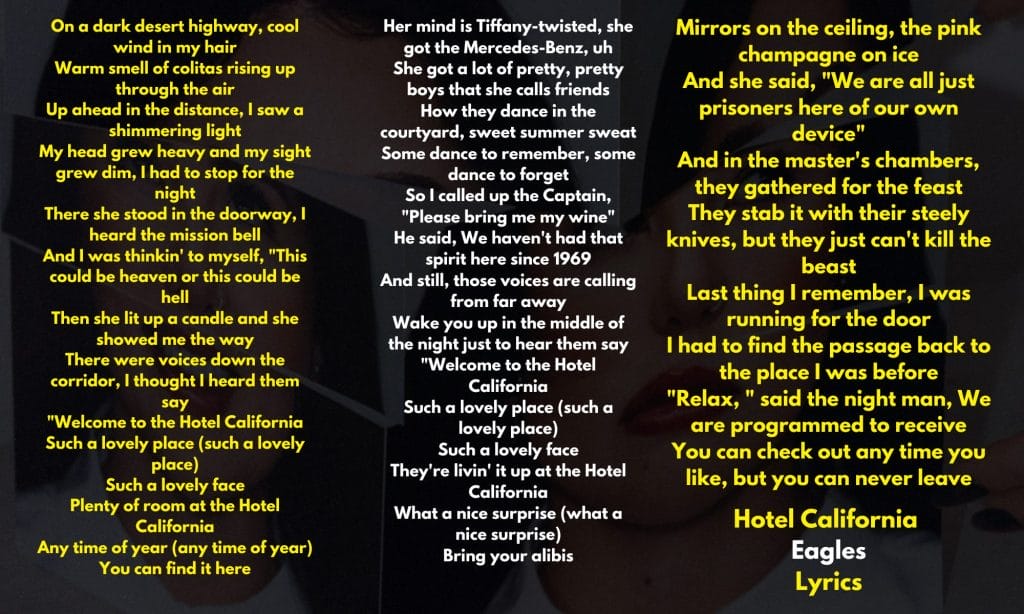
As the song progresses, the initial sense of wonder gives way to an unsettling realization. The traveler discovers that this paradise is not what it seems. The “pink champagne on ice” and “Heard the music fillin’ up the air” represent the superficial pleasures that define the hotel. Yet, beneath this veneer, there is a disturbing undercurrent. The lyrics “We haven’t had that spirit here since 1969” hint at a lost innocence or a fundamental change in the nature of the place. This could refer to the end of the optimistic idealism of the 1960s, giving way to the more cynical and materialistic 1970s.
The “Captives” of the Hotel
The most chilling lines are perhaps those that reveal the inhabitants of the hotel: “And in the master’s chambers / They gathered for the feast / They stab it with their steely knives / But they just can’t kill the beast.” These “guests” are not enjoying a vacation; they are prisoners, trapped in a cycle of self-destruction. The “beast” is the addiction, the obsession, the unattainable dream that consumes them. They are living a life of material comfort but spiritual poverty, forever seeking satisfaction they can never truly find.
Don Henley, a primary songwriter for the Eagles, has often explained that the song is an allegory for the excesses of the music industry and the American Dream in Southern California. It speaks to the way people can become trapped by their own desires and the superficiality of fame and fortune. The “Hotel California” can be seen as a metaphor for Los Angeles itself, a city that promises everything but can, for some, become a gilded cage.
The Inescapability of the Cycle
The final, haunting refrain, “You can check out any time you like / But you can never leave!” is the ultimate statement of the song’s meaning. It underscores the idea of being trapped by one’s choices, by the pursuit of material wealth or a particular lifestyle at the expense of genuine fulfillment. The “check-out” process is merely an illusion; the fundamental nature of the place, and the addiction it represents, is inescapable.

The Spirit of the Era
The song’s release in the mid-1970s coincided with a period of significant societal change and disillusionment. The optimism of the 1960s had waned, and the Vietnam War, economic recession, and the Watergate scandal had eroded public trust. “Hotel California” resonated deeply with audiences because it captured this prevailing sense of unease and the feeling that the promises of prosperity and happiness were proving hollow.
The song’s enduring popularity lies in its ambiguity. While the Eagles have offered interpretations, the lyrics remain open to individual meaning. It serves as a cautionary tale, a reminder that true contentment cannot be found in material possessions or superficial pleasures. The “Hotel California” is not a destination to be visited, but a state of being to be avoided – a seductive illusion that promises paradise but delivers eternal confinement. Its meaning transcends a simple narrative, offering a profound commentary on the human condition and the timeless struggle between desire and fulfillment.
LifeOutOfTheBox is a participant in the Amazon Services LLC Associates Program, an affiliate advertising program designed to provide a means for sites to earn advertising fees by advertising and linking to Amazon.com. Amazon, the Amazon logo, AmazonSupply, and the AmazonSupply logo are trademarks of Amazon.com, Inc. or its affiliates. As an Amazon Associate we earn affiliate commissions from qualifying purchases.