
Florida, a state synonymous with sunshine, pristine beaches, and vibrant theme parks, also presents a compelling landscape for real estate investment and homeownership. From the bustling metropolis of Miami to the charming historic streets of St. Augustine, the Sunshine State attracts millions of visitors and new residents annually. For those considering purchasing property, renting a vacation villa, or even staying in a luxurious resort, understanding the nuances of property taxation is a crucial aspect of financial planning. While Florida is often lauded for its lack of a state income tax, its real estate tax structure plays a significant role in the cost of homeownership and property investment. This article aims to demystify Florida’s real estate tax system, exploring its core components, exemptions, and how it impacts property owners and potential buyers.

Understanding Florida Property Taxes
In Florida, real estate taxes, more commonly referred to as property taxes, are levied by local government entities such as counties, cities, and school districts to fund essential public services. Unlike a state-level property tax, these taxes are administered and collected at the local level, meaning rates can vary significantly from one jurisdiction to another. The fundamental principle behind property taxation is that property owners contribute to the upkeep and funding of services that benefit their community, such as schools, law enforcement, fire departments, road maintenance, and parks.
How Property Taxes Are Assessed
The assessment process for property taxes in Florida is managed by the County Property Appraiser’s office. Each county has its own Property Appraiser who is responsible for identifying and valuing all taxable property within their jurisdiction.
The Assessment Roll
Annually, the Property Appraiser compiles an “Assessment Roll,” which is a comprehensive list of all properties and their assessed values as of January 1st of that year. The assessed value is an estimate of the property’s market value, which is generally defined as the price a willing buyer and seller would agree upon for the property under normal market conditions.
Reassessment Frequency
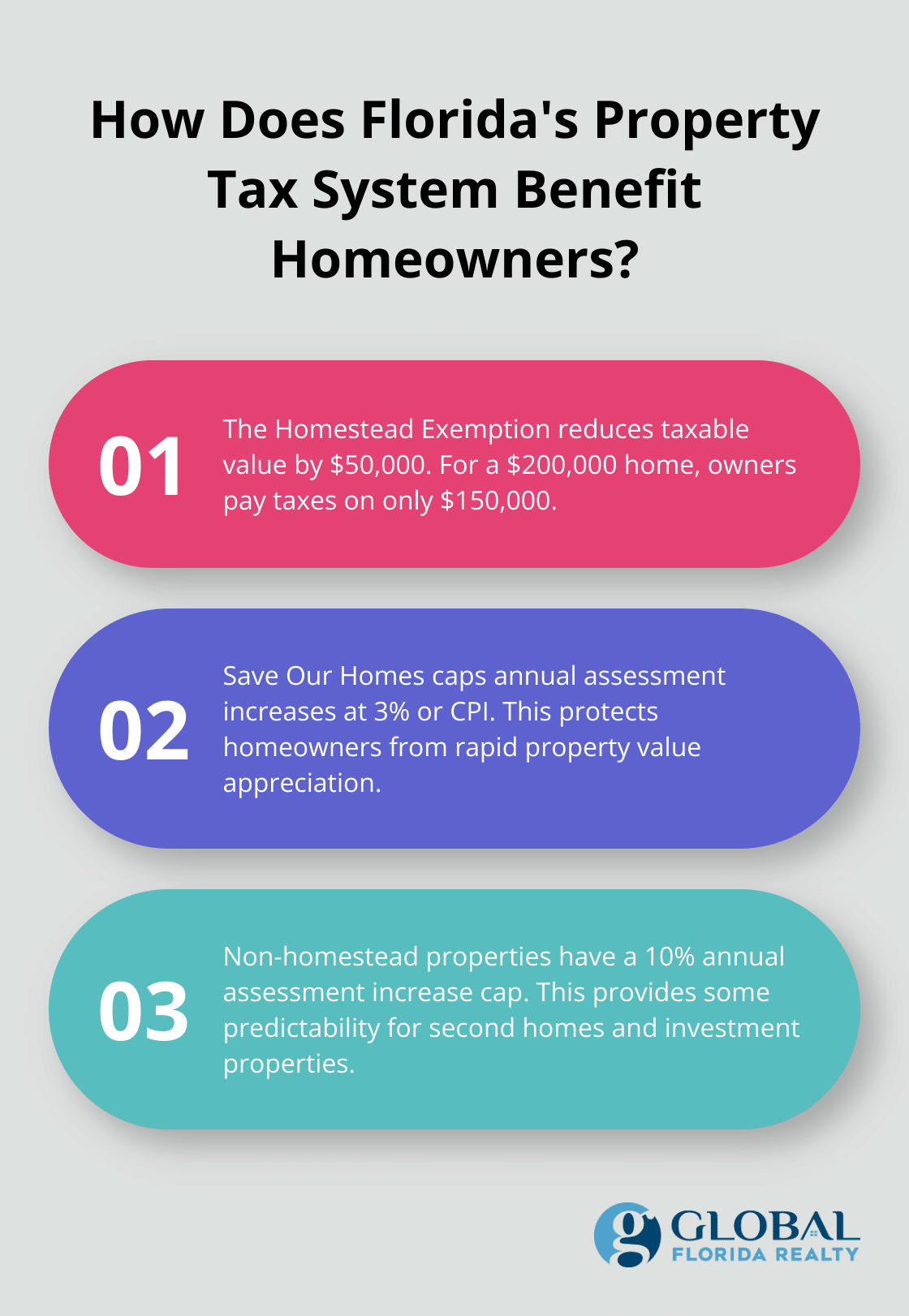
Florida law mandates that property be assessed at its fair market value. While this theoretically means properties should be reassessed annually, the market value of a property can fluctuate. However, due to the Save Our Homes amendment, the assessed value of homesteaded residential properties cannot increase by more than 3% per year or the percentage change in the Consumer Price Index (CPI), whichever is less. Non-homesteaded properties and new construction are subject to reassessment at market value each year.
The Millage Rate
Once the total value of taxable property within a taxing district is determined, the governing body of that district (e.g., the county commission, city council, or school board) sets its budget for the upcoming fiscal year. Based on this budget and the total assessed value of property, they then determine the “millage rate.” A mill is equivalent to $1 of tax for every $1,000 of taxable value. So, if a taxing district has a millage rate of 10 mills, it means for every $1,000 of taxable property value, the owner will pay $10 in taxes to that specific district. A property owner will pay taxes to multiple taxing districts, and the sum of their individual millage rates constitutes the total millage rate applied to their property.
Calculating Your Property Tax Bill
The calculation of your annual property tax bill is a straightforward process once you understand the key components:
- Assessed Value: This is the value of your property as determined by the County Property Appraiser.
- Exemptions: Various exemptions can reduce the taxable value of your property.
- Taxable Value: This is the assessed value minus any applicable exemptions.
- Total Millage Rate: This is the sum of the millage rates set by all the taxing districts that levy taxes on your property.
The formula is:
Taxable Value × (Total Millage Rate / 1000) = Annual Property Tax Bill
For example, if your property has an assessed value of $300,000, you have $50,000 in homestead exemptions, and the total millage rate for your area is 25 mills, your calculation would be:
- Taxable Value: $300,000 (Assessed Value) – $50,000 (Exemptions) = $250,000
- Annual Property Tax Bill: $250,000 × (25 mills / 1000) = $6,250
This $6,250 would be the total property tax levied for that year, distributed among the various taxing authorities.
Navigating Florida Property Tax Exemptions
Florida offers several property tax exemptions designed to reduce the tax burden for eligible property owners. These exemptions are crucial for making homeownership more affordable and are a significant factor in Florida’s appeal to homeowners and retirees.
Homestead Exemption
The most significant and widely utilized exemption is the Homestead Exemption. To qualify, you must own the property, reside in it as your primary residence as of January 1st of the tax year, and have a valid Florida driver’s license or ID card, and vehicle registrations.
- General Homestead Exemption: This exemption reduces the taxable value of your homestead by up to $50,000. The first $25,000 of value is fully exempt. For the portion of value between $25,000 and $50,000, the exemption applies only to the portion that is not used for non-homestead purposes (e.g., a separate rental unit). Crucially, this exemption does not apply to taxes levied for school districts.
- Additional Homestead Exemption for Seniors: In some counties, seniors aged 65 and older whose household income does not exceed a certain threshold (adjusted annually) may qualify for an additional homestead exemption, further reducing their tax liability.
Other Significant Exemptions
Beyond the homestead exemption, Florida provides a variety of other exemptions:
- Widow/Widower Exemption: Available to surviving spouses who have not remarried.
- Disability Exemption: For individuals who are totally and permanently disabled.
- Veteran Exemption: For disabled veterans, with varying levels of exemption based on the percentage of disability and service-connected status. Certain disabled veterans may also be eligible for an exemption on their home, regardless of whether it is their primary residence, if they are 100% disabled and considered permanently disabled by the U.S. Department of Veterans Affairs.
- Blind Person Exemption: For individuals who are legally blind.
- First Responder Exemption: For law enforcement officers, firefighters, and emergency medical technicians who are certified and employed full-time by a Florida governmental entity and have been diagnosed with PTSD, cancer, or heart disease as a result of their service.
- Tangible Personal Property Tax Exemption: While not directly related to real estate, it’s worth noting that Florida also provides an exemption for tangible personal property (e.g., furniture, equipment) valued up to $25,000. This often applies to businesses but can be relevant if renting out property as a furnished vacation rental.
It is essential for property owners to apply for these exemptions with their County Property Appraiser’s office. Deadlines typically apply, and it’s usually best to apply as soon as you purchase a property and establish residency.
The Impact of Property Taxes on Real Estate Investment and Tourism
Florida’s property tax system has a multifaceted impact on its real estate market, influencing both residential property owners and the broader tourism industry. For those looking to invest in rental properties, particularly vacation rentals, understanding these costs is paramount.
Property Taxes for Investment Properties
Investment properties, including vacation homes and rental units, generally do not qualify for the homestead exemption, meaning they are taxed at their full assessed market value. This can significantly increase the cost of ownership for investors.
Calculating Return on Investment
When evaluating a potential investment property, property taxes must be factored into the operating expenses. High property taxes can reduce the net rental income and, consequently, the overall return on investment (ROI). Investors often compare the property tax rates in different counties or cities within Florida to identify areas with more favorable tax structures for their investment strategies. For instance, areas with a high concentration of tourism, like parts of Orlando or the Florida Keys, may have higher millage rates to support local infrastructure and services that cater to tourists.
Short-Term vs. Long-Term Rentals
The distinction between short-term vacation rentals and long-term residential rentals can also influence tax considerations. While property taxes are a primary concern, short-term rentals may also be subject to local tourist development taxes or bed taxes, which are separate from property taxes but add to the overall cost of operating such a business.
The Role of Property Taxes in Florida Tourism
While property taxes are primarily paid by property owners, they indirectly affect tourists and visitors. The revenue generated from property taxes funds many of the amenities and services that attract tourists to Florida. Well-maintained roads, pristine public beaches, accessible parks, and vibrant cultural attractions are all supported by local government budgets, which are heavily reliant on property tax revenue.
Infrastructure and Destination Appeal
A robust property tax base allows local governments to invest in infrastructure that enhances the visitor experience. This includes everything from airport expansions to public transportation improvements and the preservation of natural attractions like the Everglades National Park. Consequently, the property tax system, by enabling these investments, plays a vital role in maintaining and growing Florida’s appeal as a premier tourist destination.
Property Values and Tax Rates
Conversely, very high property tax rates can, in some instances, deter potential property buyers, which could theoretically influence property values. However, Florida’s strong market demand, driven by its climate and lifestyle appeal, generally offsets this effect. The trade-off for property owners is contributing to the quality of life and infrastructure that makes Florida such an attractive place to live, visit, and invest.
Property Tax Appeals and Protests
Even with the assessment process, property owners may believe their property has been overvalued. Florida law provides avenues for appealing or protesting property tax assessments.
The Assessment Appeal Process
If a property owner believes their property’s assessed value is higher than its fair market value, they have the right to protest this assessment to the County Property Appraiser.
Filing a Notice of Appeal
The first step is typically to file a formal “Notice of Appeal” with the Property Appraiser within a specified timeframe, usually by a deadline in mid-summer. This notice must be filed with the Property Appraiser’s office, not the Value Adjustment Board.
Informal Conference with the Property Appraiser
Before proceeding to a formal hearing, many counties offer an informal conference with the Property Appraiser or their staff. This is an opportunity to present evidence and arguments for a lower valuation.
The Value Adjustment Board (VAB)
If an agreement cannot be reached with the Property Appraiser, the appeal can be taken to the Value Adjustment Board (VAB). The VAB is a quasi-judicial board composed of local officials and citizens. At the VAB hearing, the property owner presents their case, supported by evidence of comparable sales, professional appraisals, or documentation of the property’s condition, to argue for a reduced assessment. The Property Appraiser also presents their justification for the current assessment. The VAB then makes a determination on the property’s fair market value.
Appealing Special Assessments
It is important to note that appeals generally concern the assessed value of the property itself. Special assessments, such as those for specific infrastructure projects (e.g., a new sewer system or street paving), are typically levied based on benefit and have a different appeal process.
Understanding these processes empowers property owners to ensure their tax assessments are fair and accurate, contributing to a more equitable tax system across the state.

Conclusion: The Financial Landscape of Florida Property
Florida’s real estate tax system is a critical component of its financial and economic landscape. While the absence of a state income tax is a significant draw for residents and businesses, property taxes serve as the primary revenue source for local governments, funding essential public services that enhance the quality of life and support the thriving tourism industry.
For potential homebuyers, investors, and visitors contemplating longer stays in vacation rentals, a thorough understanding of property assessment, millage rates, and available exemptions is not merely beneficial but essential for accurate financial forecasting. The homestead exemption, in particular, provides substantial relief to primary homeowners, making Florida more accessible. However, for investment properties and second homes, the full impact of property taxes must be carefully considered within the context of rental income, operating expenses, and overall return on investment.
The ability to appeal or protest tax assessments further empowers property owners, ensuring a fair and transparent system. By staying informed about the intricacies of Florida’s property tax laws, individuals can make more informed decisions, whether they are seeking a permanent residence, a vacation getaway, or a lucrative real estate investment in the Sunshine State. The property tax, while a significant financial consideration, ultimately contributes to the vibrant communities and desirable lifestyle that continues to attract people to Florida.
LifeOutOfTheBox is a participant in the Amazon Services LLC Associates Program, an affiliate advertising program designed to provide a means for sites to earn advertising fees by advertising and linking to Amazon.com. Amazon, the Amazon logo, AmazonSupply, and the AmazonSupply logo are trademarks of Amazon.com, Inc. or its affiliates. As an Amazon Associate we earn affiliate commissions from qualifying purchases.