
Understanding the statute of limitations in California is crucial, not just for legal professionals, but for every resident and visitor who might find themselves in a situation where legal action could become necessary. While the main focus of lifeoutofthebox.com is on enriching your travel experiences, exploring destinations, discovering amazing attractions, delving into local culture, and finding the perfect accommodation, knowing the basic legal frameworks of the places you visit or live in adds another layer of preparedness and peace of mind. This article aims to demystify the concept of the statute of limitations in California, breaking down what it means, why it matters, and how it generally applies, all within the broader context of informed living and responsible exploration.

The Foundation of Time Limits in Legal Proceedings
At its core, the statute of limitations is a law that sets the maximum amount of time after an event within which legal proceedings may be initiated. Think of it as a legal deadline. If a lawsuit is not filed within the specified timeframe, the claim is forever barred, meaning the injured party loses their right to sue. This concept is not unique to California; it’s a fundamental principle in legal systems worldwide.
Why Do Statutes of Limitations Exist?
The rationale behind these time limits is multi-faceted and serves several important purposes:
- Ensuring Fairness and Preventing Stale Claims: Over time, evidence can disappear, memories fade, and witnesses may become unavailable or pass away. Allowing lawsuits to be filed indefinitely could lead to unfair outcomes, where it becomes impossible for the defendant to mount a proper defense. Statutes of limitations promote the timely resolution of disputes when evidence is most likely to be fresh and readily available. Imagine trying to recall the precise details of a minor incident that happened five or ten years ago – it’s significantly harder than remembering something from a few months ago.
- Promoting Certainty and Finality: For individuals and businesses, there needs to be a point at which they can be reasonably sure that they will not be sued for past actions. This certainty allows for planning, investment, and the normal conduct of affairs without the lingering threat of ancient lawsuits. For example, after a certain period, a business that operated a hotel in Los Angeles can assume that potential claims related to its operations are no longer viable.
- Encouraging Diligence: The existence of statutes of limitations incentivizes individuals who believe they have been wronged to pursue their claims promptly. It discourages individuals from sitting on their rights, waiting to see if a situation resolves itself or if the other party experiences further hardship.
Different Types of Claims, Different Time Limits
It’s crucial to understand that there isn’t a single, universal statute of limitations that applies to all types of legal claims in California. The time limit varies significantly depending on the nature of the claim. For instance, the time limit for filing a lawsuit for a breach of contract will likely be different from the time limit for a personal injury claim, which will be different again from a claim for fraud or a defective product.
Common Statutes of Limitations in California
To provide a clearer picture, let’s explore some of the more common types of claims and their general statutes of limitations in California. It is important to reiterate that this information is for general guidance only and not a substitute for legal advice from a qualified attorney.
Personal Injury Claims
Accidents can happen anywhere, whether you’re exploring the beaches of Santa Monica or staying in a luxury resort in Napa Valley. If you suffer an injury due to the negligence or wrongful act of another party, you may have grounds for a personal injury lawsuit.
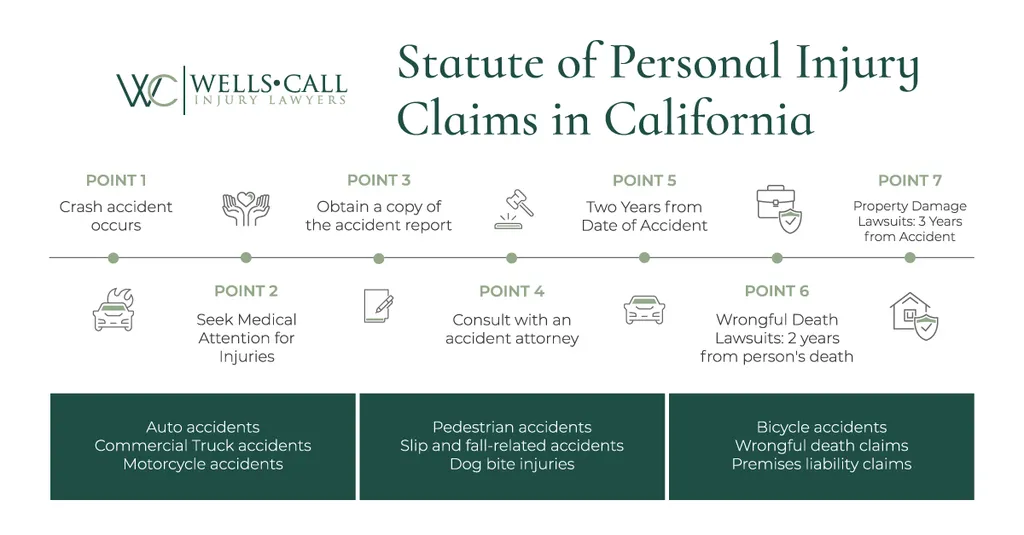
- General Rule: In California, the statute of limitations for most personal injury claims, including those arising from car accidents, slip and falls, or defective products, is two years from the date of the injury.
- Exceptions and Nuances:
- Discovery Rule: In some cases, the injury or its cause might not be immediately apparent. For example, a medical malpractice case where the patient doesn’t discover the harm until much later. In such situations, the statute of limitations may begin to run from the date the injury was discovered or reasonably should have been discovered.
- Claims Against Government Entities: If your injury was caused by a government entity (e.g., a pothole on a city street), you must file a formal administrative claim with the government agency within a much shorter period, typically six months from the date of injury. Failure to do so will bar any subsequent lawsuit.
- Minors: For claims involving injuries to minors, the statute of limitations is often “tolled” (paused) until the minor reaches the age of 18.
Property Damage Claims
Whether it’s damage to your rental apartment due to a neighbor’s actions or damage to your vehicle while parked near a popular attraction, property damage claims also have time limits.
- General Rule: The statute of limitations for claims seeking compensation for damage to real or personal property in California is generally three years from the date the damage occurred.
Breach of Contract Claims
When agreements are not honored, legal action might be necessary to recover losses. This applies to various situations, from a dispute over a tour booking to issues with a long-term accommodation rental.
- Written Contracts: For breaches of contracts that are in writing, the statute of limitations in California is generally four years from the date of the breach.
- Oral Contracts: If the contract was not in writing, the statute of limitations is shorter: two years from the date of the breach.
Fraud Claims
Discovering that you’ve been the victim of fraud can be a distressing experience, whether it involves a misrepresented travel package or a financial scam.
- General Rule: For fraud claims in California, the statute of limitations is three years. However, like with personal injury, the “discovery rule” often applies. The clock typically starts ticking from the date the fraud was discovered or reasonably should have been discovered.
Medical Malpractice Claims
Medical professionals, including those at renowned hospitals or clinics, are held to a certain standard of care. If that standard is breached and results in harm, a medical malpractice lawsuit may be filed.
- General Rule: In California, the statute of limitations for medical malpractice is generally three years from the date of the injury, or one year from the date the patient discovers, or reasonably should have discovered, the injury, whichever occurs first. However, there’s an absolute outer limit of three years from the date of the wrongful act, regardless of when the injury was discovered.
When Does the Clock Start Ticking?
Understanding when the statute of limitations “begins” is critical. As mentioned, it’s usually from the date the cause of action accrues, which typically means:
- For personal injury: The date of the injury.
- For property damage: The date the damage occurred.
- For breach of contract: The date of the breach.
- For fraud: The date of discovery (often).
However, there are situations where the statute of limitations can be “tolled” or paused.
Tolling the Statute of Limitations
Tolling refers to suspending the running of the statute of limitations for a period. Common reasons for tolling include:
- Minority: As mentioned, if the injured party is a minor, the statute is often tolled until they reach adulthood.
- Incapacity: If the injured party is legally incapacitated (e.g., due to severe mental illness or disability) and unable to manage their affairs, the statute may be tolled.
- Defendant Out of State: If the defendant leaves California after the cause of action arises and cannot be served with legal process, the statute of limitations may be tolled during the period of their absence.
- Ongoing Relationship: In certain continuous wrongful conduct situations, the statute might not begin until the relationship ends.
Seeking Legal Counsel
This overview provides a general understanding of the statute of limitations in California. However, the application of these laws can be incredibly complex, with numerous exceptions, nuances, and specific rules that depend heavily on the facts of each individual case.
If you believe you have a legal claim or are facing a potential lawsuit, it is imperative to consult with a qualified attorney in California as soon as possible. An experienced lawyer can assess your specific situation, determine the applicable statute of limitations, and advise you on the best course of action. Waiting too long can mean losing your right to seek justice, regardless of the merits of your case. While we encourage you to explore the world, discover new landmarks, and embrace different lifestyles, it’s equally important to be aware of the legal frameworks that govern your life and travels.