
When one imagines the majestic skyline of Chicago, a few iconic structures immediately spring to mind, each a testament to the city’s profound architectural heritage. However, there is one undisputed titan that has dominated the cityscape for decades, a towering symbol of American ingenuity and ambition: the Willis Tower. Formerly known as the Sears Tower, this architectural marvel stands as the tallest building in Chicago and a beacon for both residents and visitors alike.
The Unmistakable Monarch of the Chicago Skyline
The story of Chicago’s tallest tower is one rooted in a bold vision and an unwavering commitment to pushing the boundaries of what was thought possible. For over four decades, the structure has not only defined the city’s profile but has also played a significant role in the global narrative of supertall skyscrapers.
A Legacy of Grandeur and Innovation
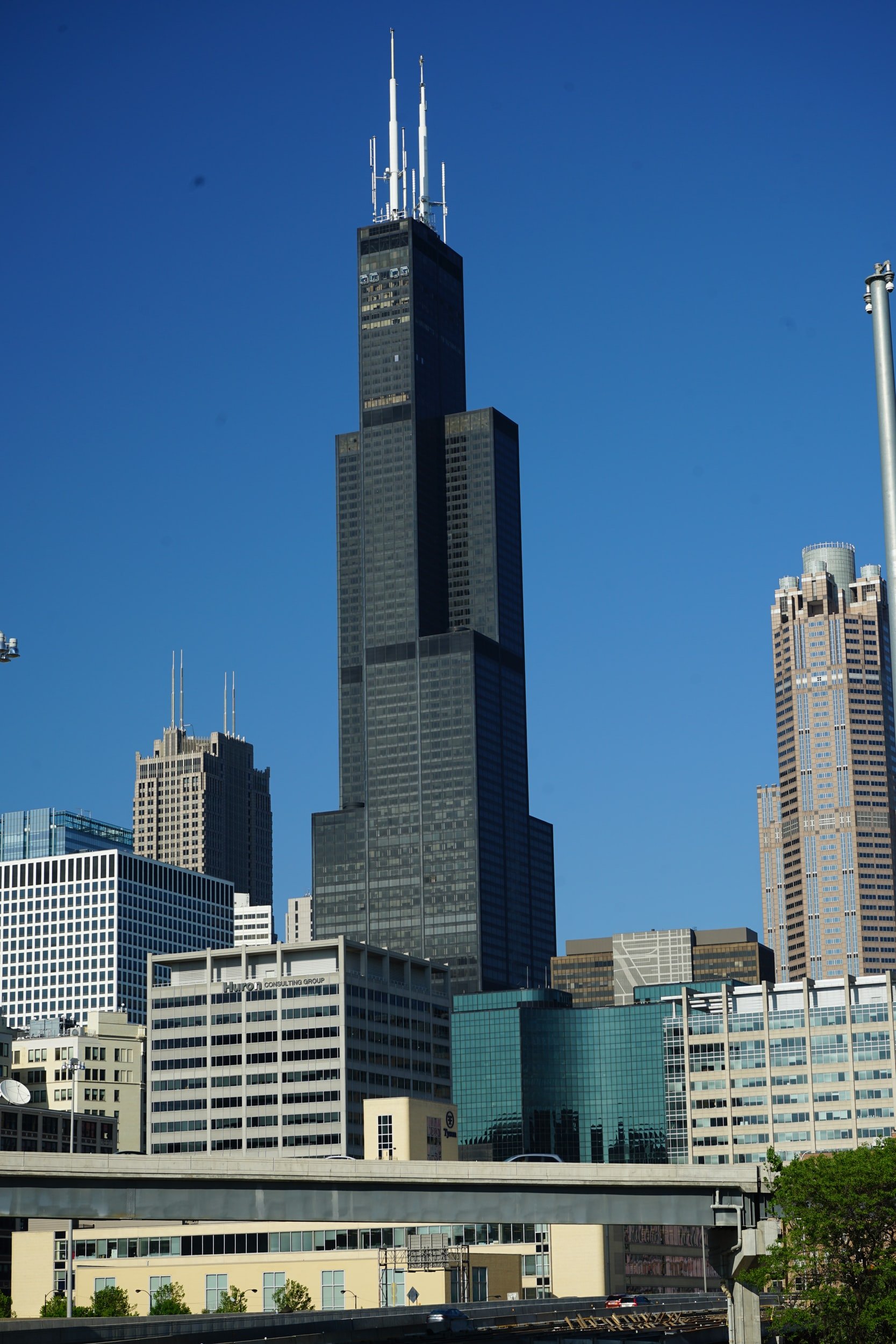
Conceived in the late 1960s by Sears, Roebuck and Company, then the world’s largest retailer, the goal was to consolidate its thousands of employees into a single office building. What emerged from this necessity was a structure of unprecedented scale. Designed by architect Bruce Graham and structural engineer Fazlur Rahman Khan of the firm Skidmore, Owings & Merrill (SOM), construction began in 1970 and was completed in 1973. Upon its inauguration, the Sears Tower claimed the title of the world’s tallest building, surpassing the World Trade Center towers in New York City, and held that prestigious distinction for nearly 25 years. Its imposing height of 1,450 feet (442 meters) to its roof, and 1,729 feet (527 meters) to the top of its antenna, solidified Chicago’s reputation as a cradle of architectural innovation.
The Name Change: Sears Tower to Willis Tower
In a significant, albeit initially controversial, rebranding, the iconic Sears Tower officially became the Willis Tower on July 16, 2009. This change came about when London-based insurance broker Willis Group Holdings leased a significant portion of the building’s office space and secured the naming rights. While the name change was met with some resistance from long-time Chicagoans who held a strong sentimental attachment to the original name, the building’s architectural grandeur and status as a landmark remained undiminished. Today, it is globally recognized as the Willis Tower, continuing its legacy as a symbol of the city’s enduring strength and forward-looking spirit.
Architectural Marvel and Engineering Feat
The Willis Tower isn’t just tall; it’s a masterpiece of engineering that redefined skyscraper construction. Its design principles have influenced countless subsequent supertall buildings around the world, making it a cornerstone in the history of modern architecture.
The Bundled-Tube Design: Revolutionizing Skyscraper Construction
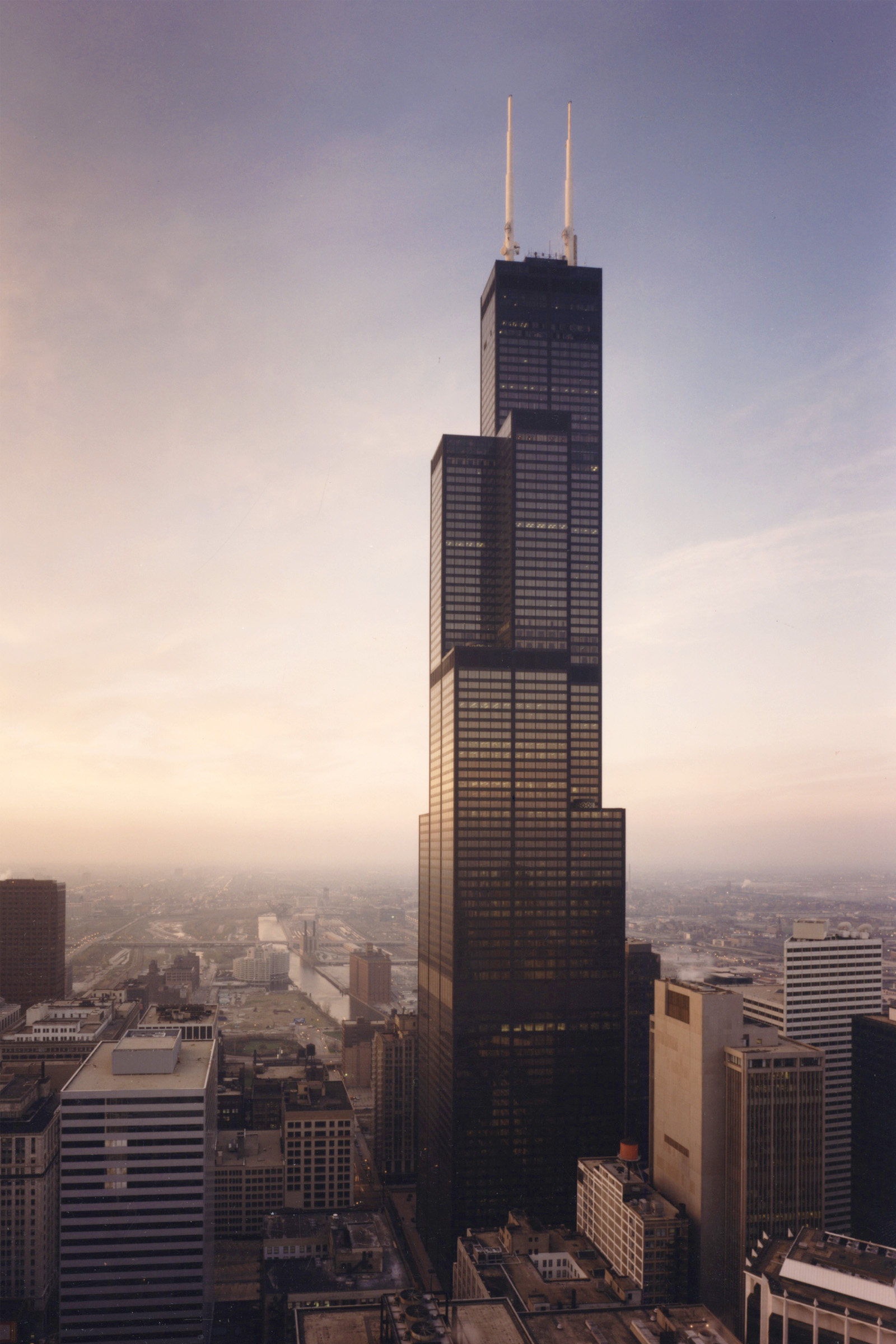
The innovative structural system employed in the Willis Tower is known as the “bundled-tube” design. Pioneered by Fazlur Rahman Khan, this concept fundamentally changed how architects and engineers approached constructing incredibly tall buildings. Instead of a single, central core supporting the entire structure, the bundled-tube system uses nine square tubes (each essentially a skyscraper in itself) arranged in a 3×3 matrix. All nine tubes rise 50 stories; then, two tubes drop off, leaving seven. At the 66th story, two more tubes drop off, leaving five. The final two tubes drop off at the 90th story, leaving only two that continue to the 108th floor. This tapering design not only gives the tower its distinctive stepped appearance but also provides exceptional resistance to the immense wind forces characteristic of Chicago and earthquakes. This structural efficiency dramatically reduced the amount of steel required, making the project both economically viable and architecturally ground-breaking.
A Visionary Collaboration: SOM and Bruce Graham
The success of the Willis Tower’s design can be largely attributed to the synergistic collaboration between architect Bruce Graham and engineer Fazlur Rahman Khan, both working for Skidmore, Owings & Merrill (SOM). Graham’s architectural vision for a tapering form was brilliantly brought to life by Khan’s structural innovations. Their partnership exemplified how engineering and aesthetics could be seamlessly integrated to create structures that were not only functional and safe but also breathtakingly beautiful and iconic. The building’s dark aluminum and bronze-tinted glass façade contribute to its imposing yet elegant presence, allowing it to reflect the ever-changing Chicago sky.
Beyond Height: Its Role as a Chicago Landmark
More than just an office building, the Willis Tower has cemented its place as a pivotal cultural and economic landmark, drawing millions to its heights annually.
The Skydeck Chicago and The Ledge: An Unforgettable Experience
A major draw for tourists and locals alike is the Skydeck Chicago, located on the 103rd floor. Offering unparalleled panoramic views extending up to 50 miles on a clear day, visitors can see across four states: Illinois, Indiana, Wisconsin, and Michigan. The true highlight for the adventurous is “The Ledge,” a series of four glass boxes that extend 4.3 feet out from the building. Standing within these transparent enclosures, 1,353 feet above the street, provides an exhilarating and unforgettable sensation of floating above the city. This experience transforms the tower from merely a structure into an interactive attraction, fostering a deeper connection between the city and its admirers.
Impact on the City’s Identity and Tourism
The Willis Tower is inextricably linked to Chicago’s identity. It symbolizes the city’s industrial prowess, architectural ambition, and resilience. For tourists, it’s a must-visit destination, often serving as the starting point for exploring Chicago’s rich architectural landscape. Its presence significantly boosts the local tourism economy, supporting countless related businesses and contributing to the city’s vibrant cultural tapestry. It appears in films, television shows, and postcards, making it a globally recognized icon that immediately conjures images of the Windy City.
Chicago’s Enduring Obsession with the Sky
While the Willis Tower remains the tallest, Chicago is a city perpetually reaching for the clouds, boasting a skyline punctuated by numerous other impressive skyscrapers. This competitive spirit has fostered an environment of continuous architectural innovation.
A City of Architectural Giants
Chicago’s skyline is a veritable museum of modern architecture, featuring a collection of buildings that have each, in their own right, made significant contributions to urban design. Other notable supertalls include the Trump International Hotel and Tower, which stands as the second-tallest building in Chicago at 1,388 feet to the top of its spire, offering luxury accommodations and breathtaking river views. The St. Regis Chicago, formerly known as the Vista Tower, is another elegant addition, notable for its distinctive stacked-box design and as one of the tallest residential buildings globally. The Aon Center, the city’s third-tallest, and the iconic John Hancock Center (now 875 North Michigan Avenue) with its famous X-braced exterior, further solidify Chicago’s reputation as a mecca for skyscraper enthusiasts. Each of these structures contributes to a dynamic urban fabric, telling a layered story of architectural evolution and ambition.
The Future of Verticality in the Windy City
The architectural narrative of Chicago is far from complete. The city continues to embrace vertical growth, with new projects consistently pushing design and engineering boundaries. Developers and architects are continually exploring innovative solutions for urban density, sustainable design, and mixed-use spaces. While the Willis Tower’s reign as the tallest has been long and celebrated, the city’s relentless pursuit of architectural excellence suggests that the skyline will continue to evolve, perhaps one day introducing a new contender for the ultimate height record, yet always respecting the foundational legacy left by its predecessors.
Preserving a Legacy
Maintaining a structure of the Willis Tower’s magnitude is an ongoing endeavor, ensuring its longevity and continued relevance in a rapidly changing world.
Modernization and Sustainability Efforts
In recent years, significant investments have been made to modernize the Willis Tower. These efforts include extensive renovations to its interior spaces, the expansion of its retail and dining options, and a strong focus on sustainability. Upgrades to its energy systems, waste management, and overall operational efficiency are aimed at reducing its environmental footprint, ensuring that this historic landmark meets contemporary ecological standards. These initiatives underscore a commitment not just to preserve its physical structure but also to enhance its functionality and appeal for future generations.

The Tower’s Place in History and Popular Culture
The Willis Tower remains a towering monument to human achievement. Its silhouette is instantly recognizable, a powerful symbol of Chicago’s pioneering spirit and architectural prowess. It has featured in countless films, books, and artworks, becoming an integral part of global popular culture. As an enduring landmark, it continues to inspire awe, representing not just a physical height but also the boundless potential of human imagination and engineering. Its legacy will forever be etched into the fabric of Chicago and the annals of architectural history.
LifeOutOfTheBox is a participant in the Amazon Services LLC Associates Program, an affiliate advertising program designed to provide a means for sites to earn advertising fees by advertising and linking to Amazon.com. Amazon, the Amazon logo, AmazonSupply, and the AmazonSupply logo are trademarks of Amazon.com, Inc. or its affiliates. As an Amazon Associate we earn affiliate commissions from qualifying purchases.