
The Boston Massacre stands as a pivotal and tragic event in the tapestry of American history, a moment where the simmering tensions between British soldiers and American colonists in Boston boiled over into a deadly confrontation. Far from an isolated incident, this event on March 5, 1770, was the culmination of years of growing resentment, economic grievances, and a profound clash of ideologies that would ultimately pave the way for the American Revolution. To understand what truly led to the Boston Massacre, one must delve into the complex web of political, economic, and social factors that defined the relationship between Great Britain and its North American colonies in the mid to late 18th century.

At its core, the conflict stemmed from Great Britain’s attempt to assert greater control over its colonies after the costly French and Indian War (also known as the Seven Years’ War). While the British emerged victorious, the war left the empire with a massive debt. In an effort to replenish its coffers, the British Parliament began to impose a series of taxes and regulations on the colonies, believing it was fair for the Americans to contribute to the defense and administration of the empire, particularly as much of the war had been fought on colonial soil. However, the colonists viewed these measures as an infringement on their rights as Englishmen, particularly the principle of “no taxation without representation.” They argued that since they had no elected representatives in Parliament, Parliament had no legitimate right to tax them. This fundamental disagreement formed the bedrock of the escalating crisis.
The Burdens of Taxation and Colonial Resistance
The period leading up to the Boston Massacre was characterized by a series of contentious acts passed by the British Parliament, each met with fierce resistance from the American colonists. These legislative measures were not just economic burdens; they were perceived as direct assaults on colonial autonomy and liberty.
The Stamp Act and its Unraveling
Perhaps the most significant precursor to the unrest was the Stamp Act of 1765. This act required colonists to pay a tax on virtually all printed materials, including newspapers, legal documents, playing cards, and even dice. The tax was indicated by a revenue stamp that had to be purchased from British agents. Unlike previous taxes, which were largely regulatory and applied to trade, the Stamp Act was an internal tax intended solely to raise revenue, making it particularly egregious in the eyes of the colonists.
The reaction was immediate and widespread. Colonial merchants organized boycotts of British goods, artisans refused to work for British officials, and lawyers refused to handle cases requiring stamps. Violent protests erupted, most notably by groups like the Sons of Liberty, who intimidated stamp distributors and destroyed stamp paper. In Boston, the home of Lieutenant Governor Thomas Hutchinson was ransacked. The colonial assemblies also played a crucial role, with the Stamp Act Congress forming in New York City to draft a unified protest against the tax. The widespread defiance and economic pressure eventually forced Parliament to repeal the Stamp Act in 1766. However, in repealing the act, Parliament simultaneously passed the Declaratory Act, which asserted its full authority to make laws binding the colonies “in all cases whatsoever.” This act, though less immediately provocative, laid the groundwork for future conflicts by unequivocally stating Britain’s claim to absolute sovereignty.
The Townshend Acts and Escalating Tensions
The reprieve from direct taxation was short-lived. In 1767, Charles Townshend, the Chancellor of the Exchequer, persuaded Parliament to pass a new series of revenue laws known as the Townshend Acts. These acts imposed duties on imports of glass, lead, paints, paper, and tea into the colonies. While presented as external taxes, their stated purpose was to raise revenue to pay the salaries of colonial governors and judges, thereby making them independent of colonial assemblies. This was seen by colonists as another attempt to undermine their self-governance.
The Townshend Acts reignited colonial protests. Samuel Adams of Massachusetts penned the “Massachusetts Circular Letter,” urging other colonial legislatures to resist the acts. This led to further boycotts of British goods, particularly among merchants and consumers in port cities like Boston. The British response was to dissolve the Massachusetts legislature and, critically, to send British troops to Boston in 1768 to enforce order and customs regulations.
A City Under Occupation: Military Presence and Mounting Friction
The arrival of several regiments of the British Army in Boston transformed the city into an occupied zone. For the residents of Boston, a thriving port city and a hotbed of revolutionary sentiment, this military presence was an unbearable affront.
Daily Life and Growing Resentment
Imagine the bustling streets of Boston in the late 1760s, a hub of commerce and intellectual discourse. Suddenly, thousands of red-coated soldiers, known colloquially as “redcoats,” were quartered in public buildings, private homes, and even in tents on the Boston Common. This influx of soldiers immediately created tension.
The soldiers were often poorly paid and sometimes resorted to taking part-time jobs, competing with colonial laborers for scarce employment. This economic competition fueled resentment, particularly among the working class. Furthermore, the presence of an army was a constant reminder of British authority and a symbol of oppression. Skirmishes between soldiers and civilians became increasingly common, ranging from verbal taunts and insults to full-blown brawls in taverns and on the streets. The colonists viewed the soldiers not as protectors, but as an occupying force whose presence was an ongoing provocation.
For a city that prided itself on its tradition of self-governance and economic independence, the sight of armed troops patrolling its streets was a daily indignity. The soldiers, for their part, often felt besieged and outnumbered in a hostile environment. They were tasked with enforcing unpopular laws among a population openly defiant of imperial authority. This created a volatile atmosphere, a powder keg waiting for a spark. The very “lifestyle” of Boston was altered by this military occupation, impacting daily interactions, economic opportunities, and the general sense of peace. The Old State House, a landmark central to colonial governance, stood as a constant witness to these escalating tensions, its very proximity to the fateful Custom House site symbolic of the clash between imperial rule and colonial aspirations.
The Fateful Night: March 5, 1770
The evening of March 5, 1770, began much like any other tense night in occupied Boston, but it quickly devolved into one of the most infamous events in American history. The culmination of years of political struggle, economic grievances, and daily friction between citizens and soldiers was about to unfold.
A Tense Confrontation at the Custom House
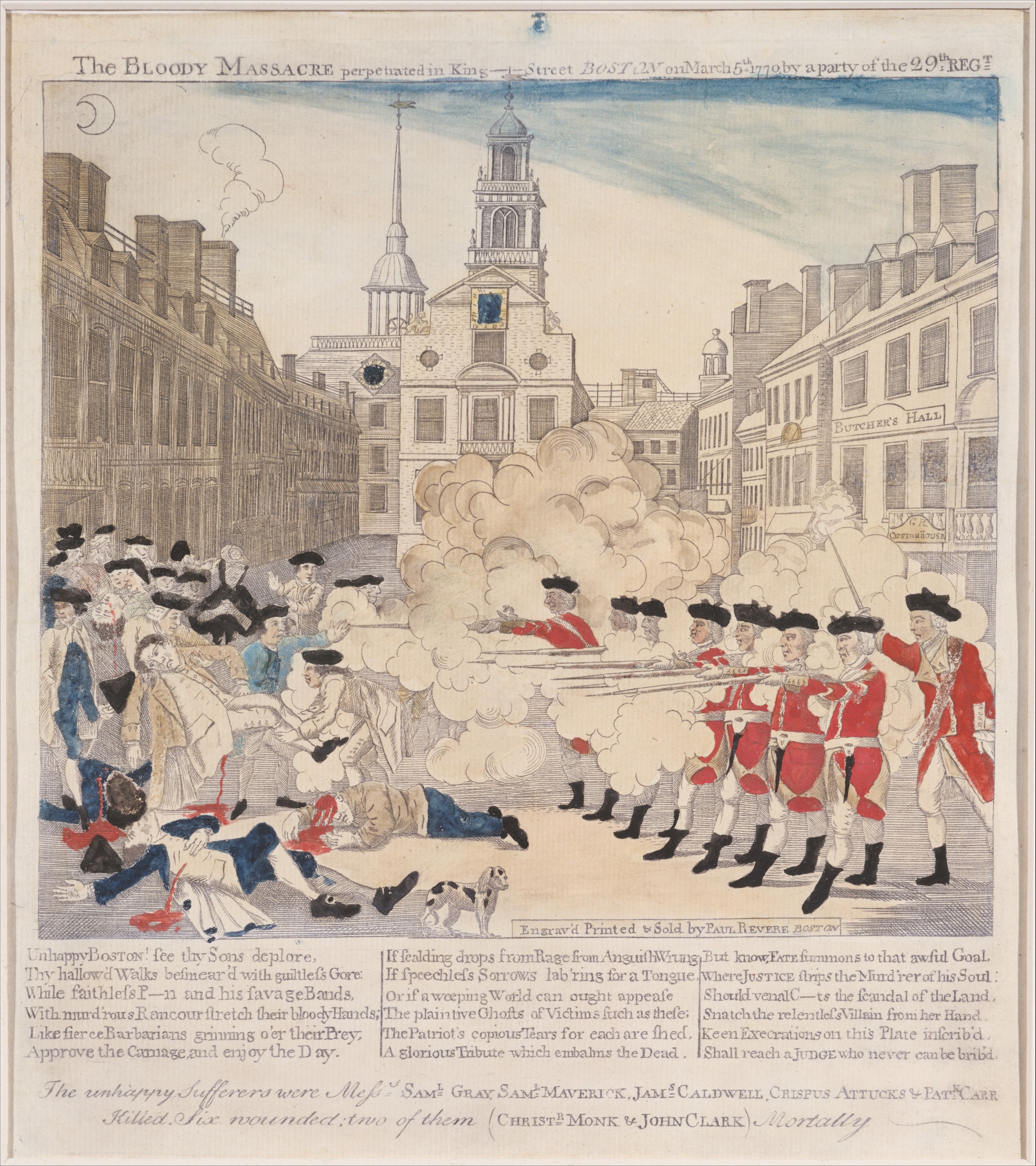
The initial incident began when a young wigmaker’s apprentice, Edward Garrick, called out to a British officer, Captain-Lieutenant John Goldfinch, accusing him of not paying his barber’s bill. A sentry, Private Hugh White, stationed outside the Custom House on King Street (now State Street), interjected and struck Garrick with his musket. This act quickly drew a crowd, which began to gather and grow, fueled by curiosity, anger, and the ever-present antagonism towards the British military.
As the crowd swelled, it became more unruly. Taunts, insults, and snowballs (some reportedly containing rocks) were hurled at Private White. Feeling threatened and isolated, White called for reinforcements. In response, a squad of seven British soldiers from the 29th Regiment of Foot, led by Captain Thomas Preston, marched to his aid. They formed a defensive semicircle around Private White and the Custom House, their bayonets fixed, facing an increasingly agitated mob of colonists. The scene was chaotic: church bells began to ring, usually a signal of fire, drawing even more people into the streets. The crowd, estimated to be between 300 and 400 people, pressed closer, yelling “Fire!” “Lobsters!” and “Damn your bloods! You dare not fire!”
The Shots Fired and the Casualties
Amidst the cacophony and escalating tension, accounts vary on what exactly happened next. Some witnesses claimed Captain Preston gave the order to fire, while others maintained he did not. It is more likely that a soldier, possibly after being struck or genuinely feeling his life was in danger, discharged his weapon. This shot was quickly followed by several others. When the smoke cleared, five colonists lay dead or dying, and several more were wounded.
The first to fall was Crispus Attucks, a sailor of mixed African and Native American descent, often considered the first casualty of the American Revolution. Others killed included James Caldwell, Patrick Carr, Samuel Gray, and Samuel Maverick. The sight of bloodied civilians on the streets of Boston sent shockwaves through the community and across the colonies. The massacre immediately became a rallying cry for colonial patriots.
The Aftermath and Its Enduring Legacy
The immediate aftermath of the Boston Massacre was a whirlwind of outrage, legal proceedings, and intensified political maneuvering that cemented its place in the burgeoning revolutionary narrative.
Propaganda and Public Outcry
The event was swiftly seized upon by colonial leaders and propagandists, most notably Samuel Adams and Paul Revere. Revere’s famous engraving, “The Bloody Massacre in King-Street,” depicted the British soldiers as brutal murderers firing on an innocent, unarmed crowd, with a dramatic flair that inflamed public opinion. While historically inaccurate in its portrayal, this image became one of the most effective pieces of propaganda of the era, galvanizing anti-British sentiment across the colonies. Samuel Adams coined the term “Boston Massacre,” carefully framing it as an unprovoked attack on civilians.
Despite the highly charged atmosphere, a remarkable legal trial followed. Captain Preston and eight of his soldiers were arrested and charged with murder. In a testament to the complex legal landscape and the desire for a fair trial even amidst deep animosity, two prominent colonial lawyers, John Adams (a future president) and Josiah Quincy II, agreed to defend the soldiers. Adams, a staunch patriot, believed in the importance of due process and demonstrating that the colonists were committed to justice, even for their enemies. The trial resulted in the acquittal of Captain Preston and six of his soldiers. Two soldiers were found guilty of manslaughter, branded on their thumbs, and released. This outcome, though not fully satisfying to many patriots, underscored the complexities of the event and the prevailing legal principles of the time. However, the political damage to British authority was irreparable. The British troops were subsequently withdrawn from Boston to Castle William (a fortress in Boston Harbor), a significant concession to colonial demands.
The Road to Independence
The Boston Massacre served as a stark demonstration of the inherent dangers of military occupation and the growing chasm between the colonies and Great Britain. It solidified the perception among many colonists that British rule was tyrannical and that their liberties were under constant threat. It was a catalyst that fueled the flames of independence, uniting disparate colonial grievances into a shared sense of injustice.
While the immediate aftermath saw a temporary easing of tensions, particularly with the repeal of most of the Townshend Acts (except for the tax on tea), the memory of the massacre lingered. It became a powerful symbol in the unfolding drama of the revolution, frequently invoked in speeches, pamphlets, and commemorations. It helped to galvanize public opinion, leading to events like the Boston Tea Party in 1773 and ultimately to the outbreak of armed conflict at Lexington and Concord in 1775. The massacre was not the cause of the revolution, but it was undoubtedly a critical moment that pushed the colonies further down the path towards declaring independence.

Visiting Historic Boston Today
For those interested in exploring this pivotal period of history, Boston offers an unparalleled journey back in time. As a premier travel destination, Boston allows visitors to walk in the footsteps of revolutionary heroes and witness the very landmarks that shaped the nation. The city’s rich history is seamlessly woven into its modern urban fabric, making it a unique experience for any traveler.
Start your historical exploration on the Freedom Trail, a 2.5-mile red-lined path that leads to 16 historically significant sites. Among these, you’ll find the site of the Boston Massacre marked by a cobblestone circle in front of the Old State House. Standing at this very spot, one can almost hear the echoes of the angry crowd and the fateful musket shots. The Old State House Museum itself offers fascinating exhibits on the city’s revolutionary past. Other crucial landmarks on the trail include Faneuil Hall, known as the “Cradle of Liberty,” where debates on British taxation raged, and the Paul Revere House, offering a glimpse into colonial life.
Boston also boasts a wide array of accommodations, from luxury hotels in the heart of the city to charming boutique options that blend historical charm with modern amenities. Whether you’re looking for a comfortable suite or a family-friendly resort, Boston’s tourism infrastructure caters to all lifestyles and budgets. Exploring the local culture and cuisine, from traditional New England seafood to vibrant contemporary dining, complements the historical journey. A trip to Boston is not just a visit to a city; it’s an immersive experience into the origins of a nation, a chance to connect with the very spirit of independence that was forged in the crucible of events like the Boston Massacre. Understanding what led to this tragic event provides invaluable context for comprehending the profound sacrifices and struggles that defined the birth of the United States.
LifeOutOfTheBox is a participant in the Amazon Services LLC Associates Program, an affiliate advertising program designed to provide a means for sites to earn advertising fees by advertising and linking to Amazon.com. Amazon, the Amazon logo, AmazonSupply, and the AmazonSupply logo are trademarks of Amazon.com, Inc. or its affiliates. As an Amazon Associate we earn affiliate commissions from qualifying purchases.