
Decoding Arizona’s Unique Time Zone Status
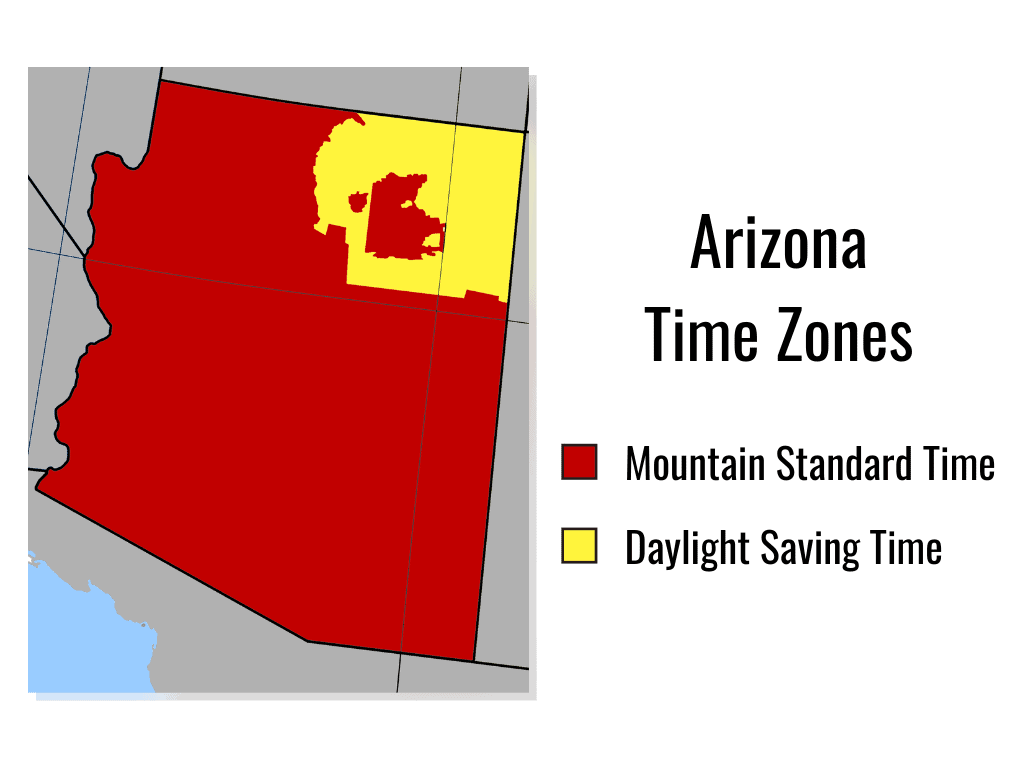
The fundamental aspect of [Arizona]’s time zone status is its unwavering commitment to Mountain Standard Time (MST) throughout the entire year. This decision sets it apart from the majority of the nation, which typically “springs forward” for Daylight Saving Time.
Mountain Standard Time (MST) All Year Round
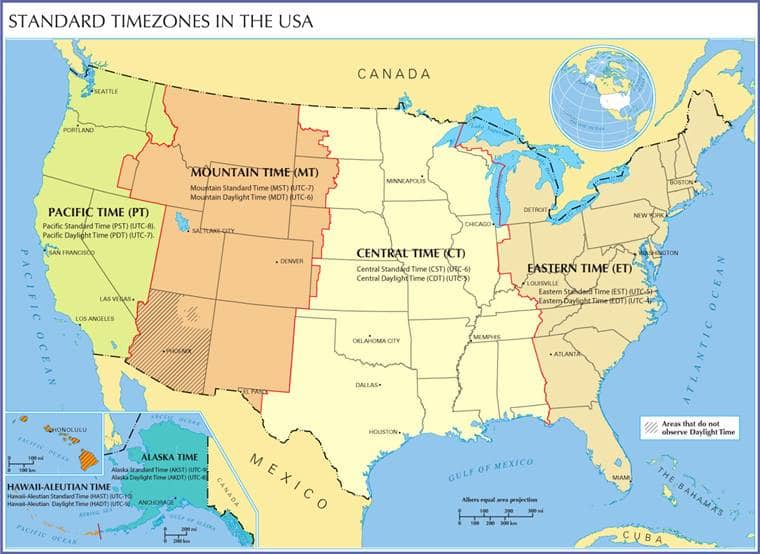
For most of the year, specifically from early November to early March, [Arizona] aligns perfectly with other states observing Mountain Standard Time, such as [Colorado], [Utah], and [New Mexico]. During this period, [Arizona] is one hour ahead of Pacific Standard Time (PST) observed in states like [California] and [Nevada]. However, when the rest of the country adjusts for Daylight Saving Time, typically beginning on the second Sunday in March, [Arizona] remains steadfast. While its neighboring states transition to Mountain Daylight Time (MDT) or Pacific Daylight Time (PDT), [Arizona] stays on MST. This means that from March to November, [Arizona] operates on the same clock as Pacific Daylight Time (PDT). So, if it’s 3 PM in [Los Angeles], [California], it’s also 3 PM in [Phoenix], [Arizona], during the summer months. Conversely, it will be an hour behind [Denver], [Colorado], which moves to MDT. This consistent refusal to observe DST is rooted in practical considerations and has significant implications for residents and tourists alike. The effect is that [Arizona] effectively switches between being one hour ahead of PST in winter and matching PDT in summer.
The Exception: The Navajo Nation
Adding a significant layer of complexity to [Arizona]’s time zone narrative is the exception of the [Navajo Nation]. This expansive semi-autonomous Native American territory, primarily located within northeastern [Arizona], extends into [Utah] and [New Mexico]. Unlike the rest of [Arizona], the [Navajo Nation] does observe Daylight Saving Time. This decision is largely driven by a desire for uniformity with the surrounding states and the other parts of the reservation that fall within those states, simplifying inter-tribal communication, business, and daily life. For instance, if you are planning a trip to a destination like [Page] to visit [Antelope Canyon] or [Horseshoe Bend], you must be acutely aware of this distinction. While [Page] itself is outside the [Navajo Nation] and observes MST year-round, many of the tour operators for attractions within the [Navajo Nation] will operate on the [Navajo Nation]’s time, which will be MDT during the summer. This means there could be an hour difference between the town you are staying in and the starting time of your tour. Always confirm the local time for any specific destination or activity within or near the [Navajo Nation] to avoid missed appointments or confusion. This geographical split often catches unsuspecting travelers off guard, making it perhaps the most critical piece of information when navigating time in [Arizona].
Practical Implications for Travelers and Visitors
Understanding [Arizona]’s unique time zone situation is paramount for anyone planning a visit to the state. Overlooking this detail can lead to missed flights, rescheduled tours, and general inconvenience.
Planning Your Itinerary
When booking flights into or out of [Arizona] airports like [Phoenix Sky Harbor International Airport] or [Tucson International Airport], the time zone consistency can be both a blessing and a curse. For instance, during the summer, if you are flying from [California], there is no time difference, which simplifies calculations. However, if you are flying from a state on Central Daylight Time (CDT) or Eastern Daylight Time (EDT), the time difference will be larger than what you might expect during standard time, as [Arizona] does not “spring forward.” Similarly, for ground transportation or guided tours, especially those venturing near the [Navajo Nation], confirming the correct local time is vital. Imagine booking a [Grand Canyon] tour that departs at 7:00 AM, only to arrive an hour late because the tour operator is on [Navajo Nation] time, and your hotel in [Flagstaff] is not. Always double-check tour start times, meeting points, and reservation details, explicitly asking about time zone observance if there’s any ambiguity, particularly for activities involving [Antelope Canyon], [Monument Valley], or other attractions within or bordering the [Navajo Nation]. Being aware of this discrepancy allows for precise scheduling and a stress-free experience, preventing common travel blunders.
Communication and Scheduling
Beyond travel logistics, the time zone quirk impacts communication. For business travelers needing to connect with colleagues across the country, or families trying to coordinate video calls, the fluctuating time difference can be tricky. During the non-DST months (roughly November to March), [Arizona] is MST, which means it’s 1 hour ahead of PST, 2 hours behind CST, and 3 hours behind EST. However, during DST months (March to November), [Arizona] remains MST, making it effectively equivalent to PDT. This means it’s 0 hours ahead of PDT, 2 hours behind CDT, and 3 hours behind EDT. This subtle shift requires a mental adjustment for anyone communicating with people outside the state. If you regularly contact someone in [Los Angeles], for example, you’ll find there’s no time difference in summer but a one-hour difference in winter. The same applies to scheduling virtual meetings or phone calls. It’s always prudent to explicitly state the time zone when scheduling or confirming appointments with people outside of [Arizona] to avoid any miscommunication. This level of clarity ensures that everyone is literally on the same page.
Digital Devices and Auto-Updates
Most modern smartphones, laptops, and smartwatches are designed to automatically update their time zone based on your geographical location, often using GPS. This feature is generally reliable when crossing traditional time zone boundaries or when DST is observed uniformly. However, in [Arizona], especially when near the [Navajo Nation] border, this automatic adjustment can occasionally become a source of confusion. A device might incorrectly assume DST observance if it briefly detects a cell tower or Wi-Fi signal from a neighboring area that does observe it. Travelers should be proactive in verifying their device’s time settings. It is a good practice to set your device to automatically detect the time zone, but always double-check it against a known, reliable local source, such as a local clock or by asking a resident. If you are extensively traveling within the [Navajo Nation], it might even be wise to manually adjust your device for the duration of your stay there and then revert once you are back in the non-DST-observing part of [Arizona]. Relying solely on auto-updates without verification could lead to minor inconveniences or, in critical situations, missed connections.
Historical Context and Reasons Behind the Choice
[Arizona]’s decision to forgo Daylight Saving Time is not an arbitrary one; it’s deeply rooted in the state’s unique climate and cultural considerations. Understanding these reasons provides valuable insight into this distinctive time zone policy.Why No Daylight Saving Time?
The primary reason [Arizona] does not observe Daylight Saving Time revolves around its notoriously hot climate. The concept of DST, introduced to conserve energy by extending daylight into the evening, makes little sense in a state where intense summer heat is a dominant factor. During the scorching [Arizona] summers, temperatures often soar well above 100 degrees Fahrenheit (38 degrees Celsius). If DST were observed, the sun would set an hour later, effectively extending the hottest part of the day further into the evening. This would mean more hours of peak heat, leading to an increase in air conditioning usage rather than a decrease. For a state where energy consumption for cooling is already substantial, adding an extra hour of daylight heat would be counterproductive and economically inefficient for both residents and businesses. By staying on MST year-round, [Arizona] ensures that the sun sets earlier in the evening during the summer months, allowing temperatures to drop and making outdoor activities more tolerable sooner. This aligns with a more natural rhythm of life adapted to the desert environment, where early mornings are utilized before the midday sun becomes unbearable. The argument against DST is therefore a practical and energy-conscious choice for the state’s residents.
The Navajo Nation’s Perspective
The [Navajo Nation]’s decision to observe Daylight Saving Time, in contrast to the rest of [Arizona], is also driven by practical considerations, albeit different ones. The [Navajo Nation] spans three states: [Arizona], [New Mexico], and [Utah]. Both [New Mexico] and [Utah] observe DST. For the [Navajo Nation], maintaining a consistent time with these neighboring states and with the portions of the reservation that fall within them simplifies governance, inter-tribal relations, and commerce. Many [Navajo] citizens live or work across state lines, or regularly interact with communities in [Utah] and [New Mexico]. If the [Navajo Nation] in [Arizona] did not observe DST, it would create even greater confusion and logistical challenges with their own people and operations within the reservation, which already deals with multiple state jurisdictions. Historically, Native American communities have also often had unique considerations regarding land use, agriculture, and cultural practices that sometimes align differently with federal or state regulations. The [Navajo Nation]’s choice is thus a strategic one, aimed at promoting internal consistency and facilitating smoother interactions with its broader regional context, even if it creates a localized time zone anomaly within [Arizona].
Navigating Time Across Arizona’s Borders
[Arizona]’s time zone choice has distinct implications when traveling to or from its neighboring states, each with its own time zone practices. This border-crossing can be a quick trip from one time to another, demanding attention to detail.Neighboring States and Their Time Zones
[Arizona] shares borders with several states, and understanding their time zone behaviors is critical. To the west, [California] and [Nevada] operate on Pacific Time (PT), observing PST in winter and PDT in summer. During [Arizona]’s winter (MST), it is one hour ahead of PST. However, during [Arizona]’s summer (still MST), it effectively aligns with PDT, meaning there is no time difference between [Arizona] and these states during those months. To the north, [Utah] operates on Mountain Time (MT), observing MST in winter and MDT in summer. This means [Arizona] is on the same time as [Utah] in winter but one hour behind [Utah] in summer. To the east, [New Mexico] and [Colorado] also observe Mountain Time, following the same pattern as [Utah]. To the southeast, [Arizona] borders [Sonora], [Mexico], which generally observes Mountain Time and aligns with [Arizona]’s non-DST policy, though it’s always wise to confirm border town times. This patchwork of time zone observance means that a short drive can quickly change your clock, particularly during the DST period. For instance, traveling from [Phoenix] to [Las Vegas], [Nevada], during summer means no time change, but in winter, you’d gain an hour.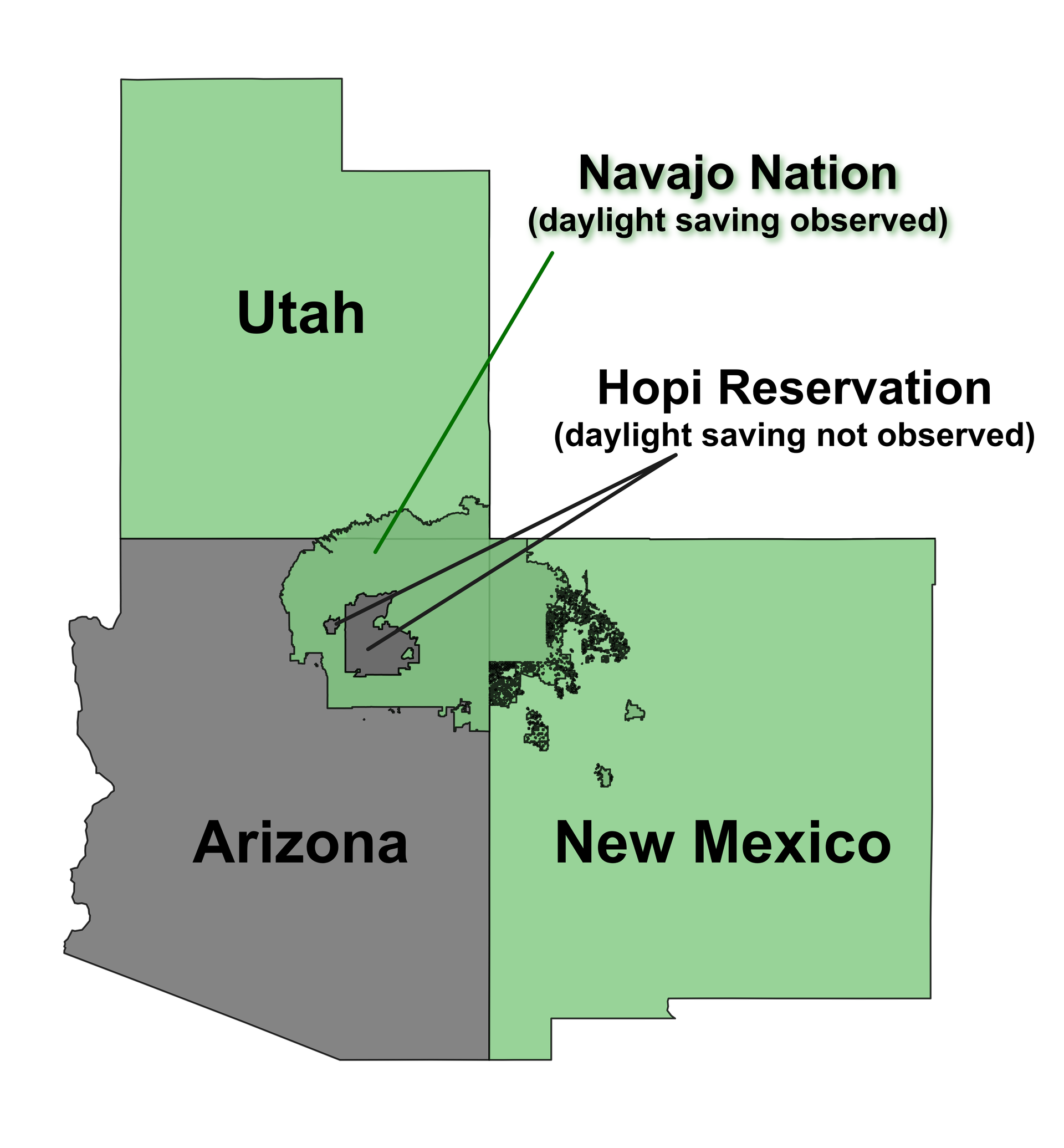
Tips for Seamless Transitions
To avoid any time-related mishaps when crossing [Arizona]’s borders or navigating the [Navajo Nation] exception, a few best practices can prove invaluable. Firstly, always confirm the local time for your destination, especially if it’s a specific attraction or event. A quick phone call or check on a reputable time zone website can save considerable stress. Secondly, use a reliable time zone converter app on your smartphone, particularly one that accounts for Daylight Saving Time rules for specific locations. Many modern apps are excellent at this and can provide peace of the mind. Thirdly, when making plans that involve interactions across time zones, such as reserving a restaurant in [Page] that might operate on [Navajo Nation] time, or coordinating a meet-up with friends from [California], be explicit about the time zone you are referring to. Stating “7 PM MST” or “7 PM PDT” removes all ambiguity. Lastly, be mindful of your car clock and other non-smart devices; they may not automatically adjust. A quick manual check or reset upon entering a new time zone or region is a good habit. By being prepared and proactive, you can ensure your travel through and around [Arizona] is as smooth and timely as possible.
In conclusion, [Arizona]’s unique time zone status, characterized by its year-round observance of Mountain Standard Time with the notable exception of the [Navajo Nation], is a distinctive feature that all travelers should be aware of. While it adds a layer of complexity to itinerary planning and communication, understanding the reasons behind this choice—primarily the state’s climate and the [Navajo Nation]’s need for regional consistency—helps to demystify it. By confirming local times, utilizing reliable tools, and being explicit in communications, visitors can seamlessly navigate the temporal landscape of [Arizona] and fully immerse themselves in its wonders without a minute of unnecessary confusion.
LifeOutOfTheBox is a participant in the Amazon Services LLC Associates Program, an affiliate advertising program designed to provide a means for sites to earn advertising fees by advertising and linking to Amazon.com. Amazon, the Amazon logo, AmazonSupply, and the AmazonSupply logo are trademarks of Amazon.com, Inc. or its affiliates. As an Amazon Associate we earn affiliate commissions from qualifying purchases.