
The pulse of a city is often best measured not just by its skyline, but by the myriad lives that animate its streets, shape its culture, and drive its economy. In the case of New York, the question “What was the population of New York?” delves much deeper than a mere statistical inquiry. It’s an exploration into the very soul of a metropolis that has consistently served as a beacon for dreamers, innovators, and adventurers from every corner of the globe. From its humble origins as a Dutch trading post to its current status as a global epicenter of finance, art, and tourism, the population dynamics of New York City have sculpted its identity, its infrastructure, and the unparalleled lifestyle it offers to both its permanent residents and its millions of annual visitors. Understanding its demographic evolution is crucial to comprehending why New York remains one of the world’s most captivating travel destinations and a challenging yet rewarding place to call home.

A Historical Tapestry: New York’s Population Evolution
The story of New York’s population is a microcosm of human migration and urban development, marked by successive waves of settlers and an unwavering magnetic pull that has transformed it into the ultimate melting pot.
From Lenape Lands to Dutch Colony
Before European contact, the lands that would become New York City were home to indigenous peoples, primarily the Lenape, whose sustainable lifestyle had shaped the region for millennia. Their presence defined the initial “population” of this fertile delta where the Hudson River meets the Atlantic. The narrative shifted dramatically with the arrival of Europeans in the early 17th century. In 1624, Dutch settlers established New Amsterdam on the southern tip of Manhattan, a strategic trading post that quickly attracted a diverse, albeit small, group of traders, farmers, and adventurers from various parts of Europe. By 1626, the famous purchase of Manhattan Island from the Lenape officially solidified the Dutch presence.
The early population of New Amsterdam was remarkably heterogeneous for its time, with records indicating residents speaking 18 different languages as early as 1646. This early commitment to diversity, albeit driven by economic pragmatism, laid the groundwork for the city’s future as a global hub. Despite its initial small size – perhaps only a few hundred people in its infancy – its strategic location destined it for growth. The burgeoning community built rudimentary fortifications and established trade routes, slowly expanding its footprint beyond the southern tip of the island. This era, while less about large numbers, was crucial for establishing the foundational urban planning and diverse character that would define New York.
The British Era and Revolutionary Growth
In 1664, the English seized control of New Amsterdam and renamed it New York, a pivotal moment that accelerated its growth. Under British rule, the port city flourished, becoming a vital commercial center within the American colonies. The population steadily increased, drawing merchants, craftsmen, and indentured servants from England, Scotland, and other parts of Europe. By the mid-18th century, on the eve of the American Revolution, New York City boasted a population of around 25,000 to 30,000 residents, making it one of the largest cities in British North America.
The American Revolution itself brought temporary disruptions, with the city enduring occupation and significant destruction, but its strategic importance ensured its recovery. Post-revolution, as the newly formed United States began to establish itself, New York City briefly served as the nation’s first capital. This period ushered in renewed confidence and accelerated growth, positioning New York as the premier port and economic engine of the young nation. Early censuses conducted in the late 18th and early 19th centuries began to truly capture the rapid expansion, indicating a population that was on the verge of explosive growth, driven by both domestic migration and an increasingly significant influx of immigrants seeking new opportunities.
The 19th Century: Immigration and Industrial Boom
The 19th century was arguably the most transformative period for New York’s population. It witnessed an unprecedented surge driven by a confluence of factors: the industrial revolution, agricultural crises in Europe, and the promise of a better life in America. The construction of the Erie Canal in 1825 solidified New York City’s position as the primary gateway to the vast interior of the United States, funneling immense wealth and people through its port.
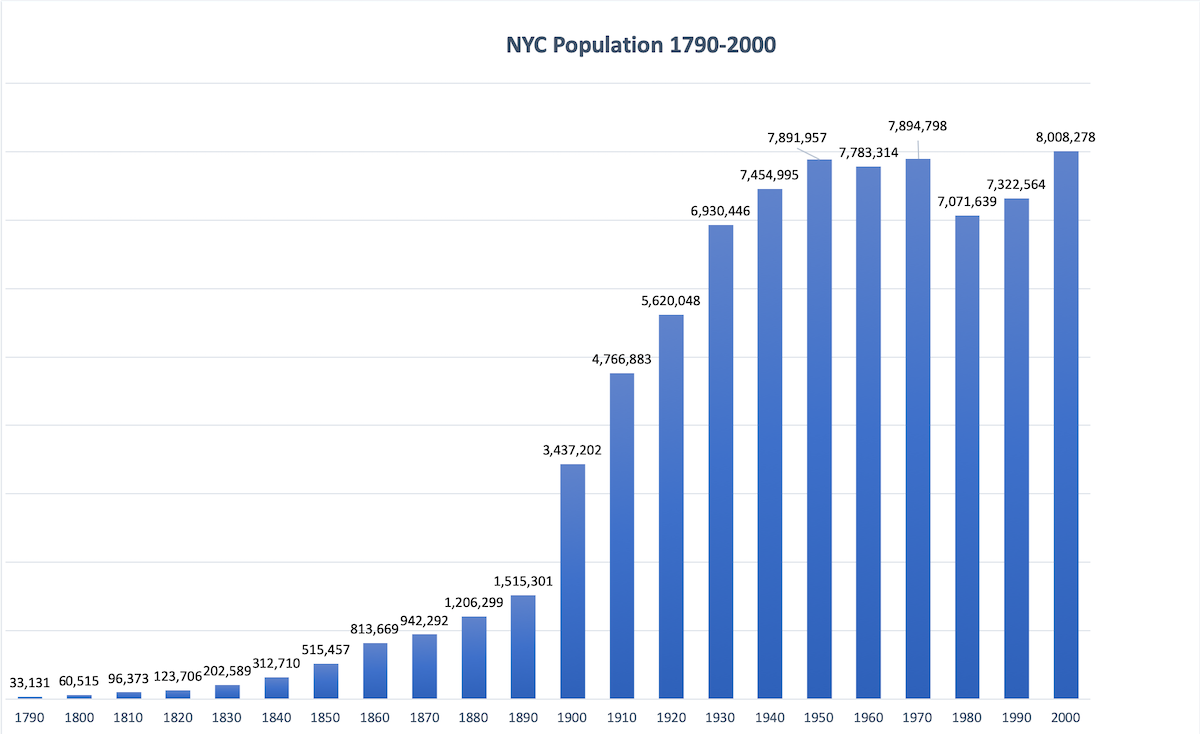
Millions of immigrants, predominantly from Ireland (fleeing the Great Famine) and Germany, poured into the city, dramatically altering its demographic landscape. The population exploded from just over 60,000 in 1800 to more than 3.4 million by 1900. This massive influx led to the rapid development of tenement housing, particularly in Manhattan’s Lower East Side, and presented immense challenges related to sanitation, public health, and social welfare. However, it also fueled an economic boom, providing a vast labor force for factories, docks, and burgeoning industries. The iconic Statue of Liberty and Ellis Island, which opened in 1886 and 1892 respectively, became enduring symbols of this era, welcoming millions of newcomers to the shores of America through New York. These landmarks are now primary attractions for visitors keen to explore the city’s rich immigration history, offering a tangible link to the personal stories that contributed to New York’s demographic growth.
The 20th Century: A Melting Pot Matures
The 20th century continued the trend of population growth and diversification, albeit with shifting patterns. Early in the century, Southern and Eastern European immigrants, particularly from Italy and Eastern European Jewish communities, arrived in huge numbers. The Great Migration saw millions of African Americans move from the rural South to Northern cities, with Harlem in New York City becoming a vibrant center of Black culture and intellectual life.
By the mid-20th century, post-World War II, New York City’s population continued its upward trajectory, peaking around 7.89 million in 1950. However, the latter half of the century saw a period of suburbanization, with many residents moving out of the five boroughs into surrounding areas of New York State, New Jersey, and Connecticut. This led to a slight decline in the city’s core population, accompanied by significant economic and social challenges.
Despite this, the city’s magnetic appeal never truly waned. Immigration policies changes in the 1960s opened doors to new waves of immigrants from Asia, Latin America, and the Caribbean, re-energizing the city and further enriching its cultural mosaic. By the turn of the 21st century, New York City had not only rebounded but continued to grow, solidifying its reputation as a true global metropolis, a testament to its enduring adaptability and appeal.
Population Dynamics and the Urban Landscape
The sheer scale and diversity of New York City’s population have had profound effects on its physical landscape, its unique lifestyle, and the intricate social fabric that binds it all together.
Density, Diversity, and Demographics
Today, New York City remains the most populous city in the United States. While specific numbers fluctuate with each United States Census Bureau estimate, the city consistently hovers around 8.5 to 8.8 million residents across its five boroughs: Manhattan, Brooklyn, Queens, The Bronx, and Staten Island. This makes it one of the most densely populated major cities in the world, a factor that defines much of the New York City experience.

The city’s diversity is unparalleled. More than one-third of New York City residents are foreign-born, and over 200 languages are spoken, making it a truly global microcosm. This demographic richness translates into a vibrant cultural scene, with distinct ethnic enclaves offering authentic culinary experiences, traditional festivals, and unique shopping opportunities that draw both residents and tourists alike. This diversity fuels the city’s dynamism, ensuring a constant flow of new ideas, cuisines, and artistic expressions.
The Impact on Infrastructure and Lifestyle
Such high population density naturally places immense demands on infrastructure. The New York City Subway, one of the largest and oldest public transportation systems in the world, is a direct response to the need to move millions of people efficiently every day. Its intricate network is not just a utility but an integral part of the daily New York lifestyle, enabling residents and tourists to navigate the sprawling city with relative ease.
The intense competition for space has also shaped the city’s distinctive architecture, leading to the iconic skyscrapers that define the skyline, like the Empire State Building and the World Trade Center. These towering structures maximize vertical living and working spaces. The cost of living, particularly accommodation, is famously high, which influences residential choices and encourages a dynamic rental market. For visitors, this translates into a wide array of hotel options, from luxury suites in Manhattan to more budget-friendly apartments in Brooklyn or Queens, reflecting the diverse needs of travelers. The lifestyle is fast-paced, competitive, and constantly evolving, fostering an environment where innovation thrives and opportunities, for those who seek them, seem boundless.
Neighborhoods as Microcosms
Each of New York City’s five boroughs, and indeed its hundreds of neighborhoods, possesses a distinct character largely shaped by its population history and demographics. Manhattan is the dense, commercial, and cultural core, attracting business travelers, luxury tourists, and a high concentration of affluent residents. Brooklyn, once a collection of independent towns, blossomed into a vibrant residential hub with diverse communities and a burgeoning arts scene, drawing a younger, often more creative demographic.
Queens is renowned as the most ethnically diverse urban area in the world, a patchwork of distinct communities each offering a glimpse into different global cultures. The Bronx, the birthplace of hip-hop, boasts significant green spaces and a rich cultural heritage, while Staten Island offers a more suburban feel with impressive views of the Manhattan skyline, attracting families seeking a different pace of life. This mosaic of neighborhoods provides an endless array of experiences for tourists, from local food tours to exploring historical sites, and offers residents a diverse range of lifestyle choices, from urban luxury to community-focused living.
Population, Tourism, and the Economy
The relationship between New York’s population and its colossal tourism industry is deeply symbiotic, with each fueling the other’s growth and vibrancy.
A Magnet for Visitors
The sheer number and diversity of New York City’s residents create an urban environment that is inherently fascinating to outsiders. The city’s population forms the critical mass that supports its unparalleled array of attractions, from Broadway theaters to world-class museums like the Metropolitan Museum of Art. The local population provides the workforce for the hospitality industry, the artists for the cultural scene, and the consumers for the shops and restaurants that visitors flock to.
Annually, tens of millions of people travel to New York City, drawn by its iconic landmarks, vibrant culture, and the palpable energy generated by its inhabitants. This constant flow of tourism in turn sustains countless businesses, provides jobs for a significant portion of the population, and contributes billions to the city’s economy, demonstrating a continuous feedback loop where population size and tourist appeal reinforce each other.
Accommodation and Hospitality
The persistent demand for both permanent residence and temporary accommodation in New York City has led to a highly competitive and innovative hospitality sector. From historic grand hotels like The Plaza Hotel and the Waldorf Astoria catering to luxury travelers, to boutique hotels and a thriving market for short-term apartment rentals, the city offers a vast spectrum of choices. This accommodates a diverse range of lifestyles and budgets, whether for business stays, family trips, or solo budget travel.
The dense urban environment necessitates creative approaches to accommodation, resulting in both sprawling resorts that maximize vertical space and more intimate, experience-focused lodgings. This adaptability in accommodation options is a direct response to the city’s dynamic population trends and its enduring status as a top global travel destination.
Cultural Contributions and Cuisine
The vibrant tapestry of New York’s population is perhaps best experienced through its cultural contributions and, most notably, its food scene. Each wave of immigration has brought with it new traditions, languages, and, crucially, culinary practices. This cumulative effect has resulted in a city where one can find authentic dishes from virtually every corner of the world, often within a few blocks. From humble street food carts serving halal or hot dogs to Michelin-starred restaurants pushing gastronomic boundaries, New York’s food culture is a direct reflection of its diverse population.
Similarly, the arts thrive on this diversity. The city’s myriad theaters, music venues, art galleries, and cultural institutions are not only supported by its large resident population but also enriched by the creative talents drawn from its diverse communities. This rich cultural landscape, born from its people, is a primary driver for tourism, offering experiences ranging from the highbrow to the deeply local and authentic.
Landmarks Born from Growth
Many of New York’s most famous landmarks are direct manifestations of its population growth and the associated ambition, necessity, or celebration. Central Park, an expansive urban oasis, was conceived in the mid-19th century as a response to the city’s rapidly increasing population and the need for public green space. The Brooklyn Bridge, an engineering marvel completed in 1883, was built to connect the burgeoning populations of Manhattan and Brooklyn, facilitating trade and daily commutes. Even modern attractions like the High Line park are adaptive reuses of infrastructure, catering to the leisure and urban exploration desires of a contemporary, dense population. These landmarks not only serve the local population but also become essential destinations for travelers, weaving the story of the city’s growth into its very fabric.
In conclusion, the question “What was the population of New York?” is a gateway to understanding the incredible journey of a city that has consistently redefined itself. From its earliest days as a small trading post to its current incarnation as a bustling global metropolis of nearly nine million people, New York’s population has been its greatest asset. It has driven its physical expansion, fueled its cultural dynamism, and cemented its status as an irresistible hub for travel, tourism, and a unique, vibrant lifestyle. The numbers tell a story of relentless growth, unparalleled diversity, and an enduring magnetism that ensures New York City will remain a captivating enigma for generations to come.
LifeOutOfTheBox is a participant in the Amazon Services LLC Associates Program, an affiliate advertising program designed to provide a means for sites to earn advertising fees by advertising and linking to Amazon.com. Amazon, the Amazon logo, AmazonSupply, and the AmazonSupply logo are trademarks of Amazon.com, Inc. or its affiliates. As an Amazon Associate we earn affiliate commissions from qualifying purchases.