
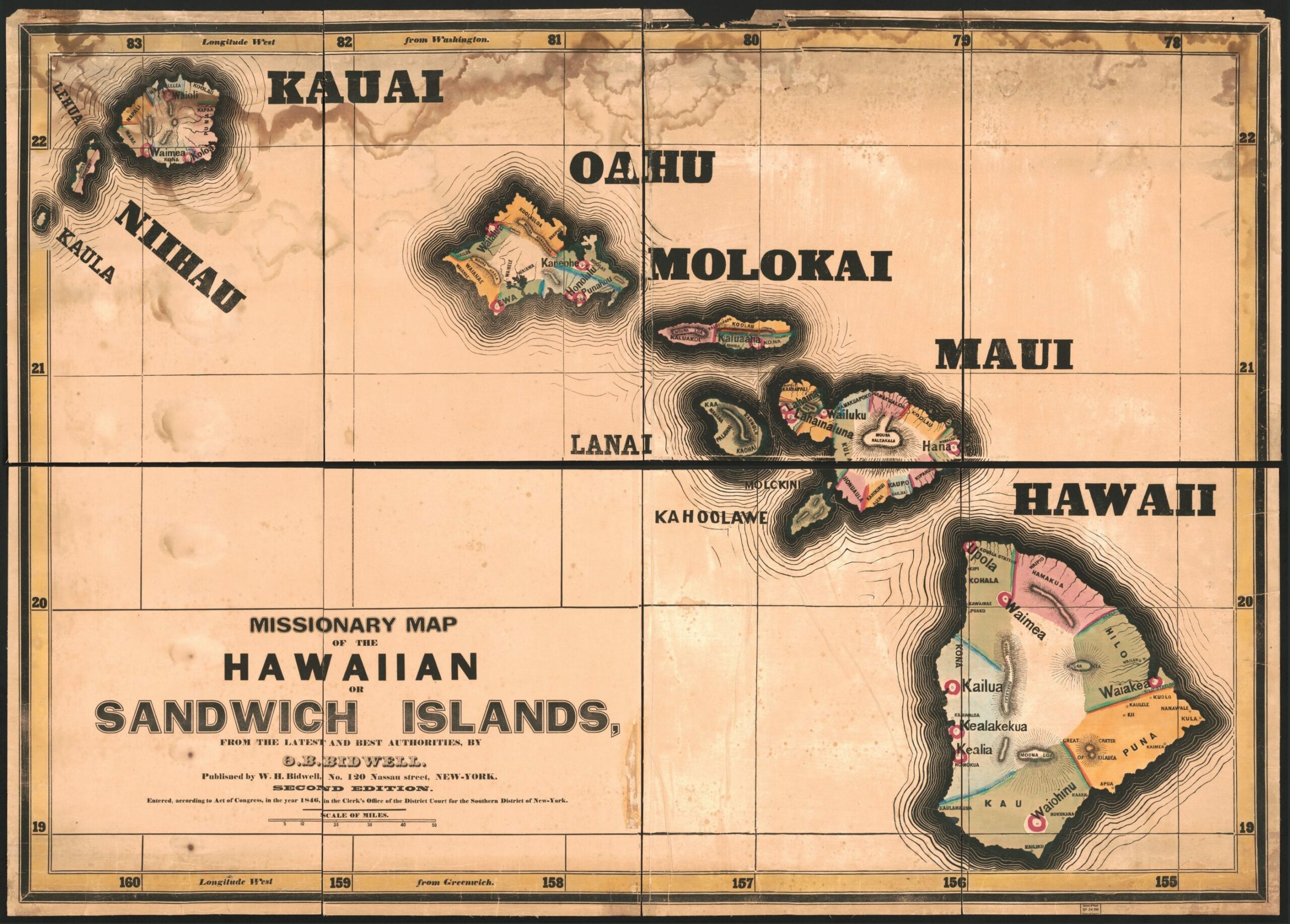
The story of how Hawaii, a vibrant archipelago nestled in the heart of the Pacific Ocean, became a territory, and eventually a state, of the United States is a complex tapestry woven with threads of economic ambition, strategic foresight, political maneuvering, and cultural exchange. Far from a simple annexation, the acquisition of Hawaii was the culmination of decades of evolving relationships and a clear manifestation of America’s burgeoning imperial aspirations at the close of the 19th century. To understand the profound reasons behind this pivotal moment in history, one must delve into the multifaceted objectives that propelled the United States to extend its reach across the vast ocean, forever altering the destiny of the islands and their indigenous people.
At its core, the purpose of acquiring Hawaii was a convergence of several powerful motives: the safeguarding and expansion of American commercial interests, primarily in the booming sugar industry; the imperative to secure a strategic naval and coaling station in the Pacific amidst rising global competition; and the underlying belief in manifest destiny, which fueled a desire for territorial expansion and regional dominance. Each of these drivers played a crucial role, intertwining to create an irresistible pull toward annexation that ultimately proved too strong for the sovereign Kingdom of Hawaii to resist. The decision was not without controversy, marked by ethical debates and the forceful overthrow of a legitimate monarchy, yet from the perspective of American policymakers and business magnates of the era, the acquisition represented a logical and necessary step in securing their nation’s future prosperity and power on the world stage.
The Dawn of American Influence: Early Encounters and Economic Footholds
The story of American interest in Hawaii did not begin with the idea of annexation but rather with the gradual establishment of cultural and economic ties that deepened over the 19th century. From the initial encounters with Western explorers, the islands’ fertile lands, strategic location, and unique culture began to attract outsiders, laying the groundwork for a transformative relationship.
Missionary Zeal and the Whaling Industry
The first significant wave of American presence in Hawaii arrived in the early 19th century in the form of Protestant missionaries from New England. Driven by a fervent desire to convert the indigenous population to Christianity, these missionaries embarked on journeys from cities like Boston, establishing churches, schools, and printing presses. While their primary goal was spiritual, their influence quickly extended into the political and social fabric of the Kingdom of Hawaii. They introduced Western laws, educational systems, and cultural norms, often inadvertently undermining traditional Hawaiian practices and governance. Their descendants, many of whom became prominent landowners and businessmen, would later form the core of the annexationist movement.
Concurrently, Hawaii emerged as a vital hub for the burgeoning Pacific whaling industry. Its sheltered harbors, particularly around Honolulu on the island of Oahu and Lahaina on Maui, provided essential stopping points for whaling ships needing to resupply, repair, and rest their crews. This brought thousands of American sailors and merchants to the islands, integrating them further into the global maritime economy. The influx of foreign currency and goods, alongside the cultural exchange (and sometimes conflict) with the local population, further cemented American influence and made Hawaii an increasingly familiar and valuable asset in the American commercial imagination.
The Sweet Lure of Sugar and Growing Economic Ties
However, it was the cultivation of sugar cane that truly solidified American economic interest in Hawaii and became the primary economic engine driving the push for annexation. American entrepreneurs, many of whom were descendants of the early missionaries, recognized the immense potential of Hawaii’s volcanic soil and tropical climate for large-scale sugar production. By the mid-19th century, vast plantations sprawled across islands like Oahu, Maui, Kauai, and Hawaii Island (often known as the Big Island), transforming the landscape and economy. These plantations were largely owned and operated by American businessmen, who imported laborers from China, Japan, and the Philippines to work the fields, creating a multi-ethnic society that persists to this day.
The economic dependence of the sugar industry on the United States market was immense. In 1875, the landmark Treaty of Reciprocity was signed between the Kingdom of Hawaii and the United States, granting Hawaiian sugar duty-free access to American markets in exchange for similar concessions for American goods in Hawaii. This treaty was a huge boon for Hawaiian sugar producers, making their product highly competitive and profitable. However, it also came with a significant clause: Hawaii agreed not to lease or alienate any port or territory to any other foreign power. This clause implicitly granted the United States exclusive rights to a potential naval base at Pearl Harbor on Oahu, demonstrating that even early economic agreements were laced with strategic implications. The reciprocal trade relationship underscored the financial vulnerability of Hawaii to American policy and fueled the desire among American planters for political union to ensure the long-term stability and profitability of their enterprises, particularly when later tariff changes threatened their competitive edge.
A Strategic Gem in the Pacific: Geopolitical Imperatives
Beyond economic considerations, the strategic value of Hawaii in the vast expanse of the Pacific Ocean played an equally, if not more, significant role in the United States’ drive for acquisition. In an era of burgeoning global imperialism, securing strategic outposts was paramount for naval power projection, trade protection, and national security.
The Promise of Pearl Harbor
The natural deep-water harbor of Pearl Harbor on the island of Oahu was perhaps the single most compelling strategic asset that drew American attention. Its unique geography—a spacious, sheltered lagoon with multiple channels—made it an ideal location for a naval base. The 1875 Treaty of Reciprocity had already granted the United States exclusive rights to use Pearl Harbor as a coaling and repair station, effectively preempting any other nation from establishing a presence there.
As the United States expanded its naval capabilities and looked westward across the Pacific, the necessity of a forward operating base became increasingly clear. A strong naval presence at Pearl Harbor would allow the United States to protect its burgeoning trade routes to Asia, particularly with China and Japan. It also provided a vital defensive outpost for its own West Coast, particularly the growing ports of California, Oregon, and Washington. The ability to refuel, repair, and provision warships and commercial vessels thousands of miles from the mainland was an invaluable strategic advantage that no other location in the central Pacific could match.
A Coaling Station and Naval Stronghold
In the late 19th century, naval power was transitioning from sail to steam. Coal-fired warships required frequent refueling, making a network of coaling stations across the globe absolutely essential for projecting power over long distances. Hawaii, situated almost equidistant between the Americas and Asia, was the perfect “stepping stone” or “crossroads of the Pacific.” Establishing permanent control over Hawaii would guarantee the United States an indispensable coaling station, ensuring that its fleet could operate effectively in the Pacific without relying on the goodwill or infrastructure of other colonial powers.
Beyond coaling, Pearl Harbor offered the potential for a full-fledged naval stronghold capable of supporting an entire fleet. This vision aligned with the influential naval strategist Alfred Thayer Mahan‘s theories, which emphasized the critical importance of sea power and strategic naval bases for national greatness. For American leaders keen on asserting their nation’s influence as a global power, control over Hawaii and its premier harbor was not merely desirable; it was seen as a geopolitical necessity for securing dominance in the Pacific and beyond.
Guarding Against Other Global Powers
The late 19th century was a period of intense imperial competition among global powers. Great Britain, France, Germany, and increasingly Japan, were all actively expanding their colonial empires and seeking strategic footholds across the world. The United States viewed Hawaii as a crucial territory that could potentially fall into the hands of a rival power if not secured.
This fear of foreign encroachment was a powerful motivator for annexation. American policymakers worried that if the United States did not act, another nation would establish a presence in Hawaii, thereby threatening American commercial interests and naval security in the Pacific. The prospect of a hostile European or Asian power controlling the crossroads of the Pacific was considered an unacceptable risk. By acquiring Hawaii, the United States sought to preempt such a scenario, consolidate its regional influence, and ensure unchallenged access to vital sea lanes and markets. This defensive strategic posture, intertwined with expansionist desires, underscored the geopolitical purpose of making Hawaii an integral part of the American sphere of influence.

The Road to Annexation: Political Intrigue and the Overthrow of the Monarchy
The path to annexation was not a smooth political process but rather a tumultuous journey marked by internal conflicts within Hawaii and persistent pressure from American interests. The sovereignty of the Hawaiian monarchy was gradually eroded, culminating in its forceful overthrow and the eventual absorption of the islands into the United States.
The Bayonet Constitution and Diminished Sovereignty
A critical turning point in the erosion of Hawaiian sovereignty occurred in 1887 with the imposition of the so-called “Bayonet Constitution.” Forced upon King Kalākaua by a group of armed American and European businessmen and their allies, this constitution drastically limited the monarch’s power and transferred significant authority to the legislature, which was dominated by foreign (primarily American) residents. It also disenfranchised most native Hawaiians and Asian laborers, while granting voting rights to non-citizen Caucasians.
The “Bayonet Constitution” effectively stripped the Hawaiian monarchy of its executive authority and placed political control largely in the hands of the very individuals who sought annexation. This event clearly demonstrated the formidable power wielded by American sugar planters and businessmen, signaling their willingness to use coercive tactics to secure their economic and political dominance, paving the way for future annexation efforts by weakening the existing government from within. It highlighted the fragility of Hawaiian independence in the face of powerful foreign interests.
The Overthrow of Queen Liliʻuokalani
The most dramatic and ethically contentious event leading to annexation was the overthrow of Queen Liliʻuokalani, Hawaii’s last reigning monarch. Ascending to the throne in 1891, Queen Liliʻuokalani was a staunch nationalist determined to restore power to the Hawaiian monarchy and her people. She proposed a new constitution that would revoke the “Bayonet Constitution,” restore voting rights to native Hawaiians, and strengthen the monarch’s authority.
Her efforts to restore Hawaiian sovereignty were met with fierce resistance by the “Committee of Safety,” a group of American and European businessmen and residents, many of whom were descendants of missionaries and prominent sugar planters, led by figures like Sanford B. Dole. Fearing the loss of their political and economic control, and actively seeking annexation by the United States, the Committee of Safety orchestrated a coup. On January 17, 1893, with the tacit support and presence of armed U.S. Marines from the USS Boston, they overthrew the Queen Liliʻuokalani’s government. The Queen, wishing to avoid bloodshed, yielded under protest, appealing to the United States for justice. This act of blatant intervention by American forces, though unauthorized by Washington, was a decisive step towards the American acquisition of Hawaii, demonstrating a willingness to dismantle a sovereign government to achieve strategic and economic goals.
The Republic of Hawaii and Persistent Calls for Annexation
Following the overthrow, the Committee of Safety quickly established a provisional government, declaring Sanford B. Dole as its president. Their immediate goal was annexation to the United States. However, the initial attempt to secure annexation faced a significant hurdle: President Grover Cleveland, a Democrat, was deeply troubled by the undemocratic nature of the overthrow. He launched an investigation, which concluded that the coup was illegal and called for the restoration of the monarchy. Cleveland refused to annex Hawaii, condemning the actions of the American minister and the provisional government.
Despite this setback, the provisional government persisted, declaring itself the Republic of Hawaii in 1894. For the next four years, the Republic, still led by Dole, maintained its control over the islands, continuously lobbying Washington for annexation. The local American business interests were well-organized and well-funded, tirelessly advocating for the merger, seeing it as the only way to secure their investments and ensure political stability under American protection. Their persistence, combined with shifting political tides in the United States, kept the issue of Hawaiian acquisition alive, setting the stage for its eventual absorption into the American sphere.
The Final Act: Manifest Destiny and the Spanish-American War
The ultimate act of acquiring Hawaii was influenced by a resurgence of expansionist fervor in the United States and the opportune timing of a global conflict. These factors provided the necessary political will and justification to overcome earlier objections and formalize the annexation.
Renewed Urgency Amidst Global Conflicts
By the late 1890s, the political climate in the United States had shifted significantly. The concept of “Manifest Destiny,” the belief in America’s divine right to expand its territory across the continent and beyond, was experiencing a powerful resurgence. Proponents of imperialism, including powerful senators and businessmen, argued for the expansion of American influence and territories overseas to compete with European colonial powers. They saw Hawaii as a natural and necessary extension of this vision.
The election of President William McKinley in 1896, a staunch advocate for expansion, signaled a new era. Unlike his predecessor, McKinley was sympathetic to the annexationist cause, viewing Hawaii as a crucial strategic asset for America’s emerging role as a global power. The arguments for securing Hawaii as a military and commercial outpost were no longer marginal but had moved to the forefront of national policy debates, fueled by a growing sense of American exceptionalism and the perceived need to project power globally. This renewed urgency and ideological shift played a critical role in galvanizing support for the final push towards annexation.
Hawaii’s Legacy as a US Territory and State
The decisive moment came with the outbreak of the Spanish-American War in 1898. As the United States engaged Spain in conflicts across the Caribbean (Cuba, Puerto Rico) and the Pacific (Philippines, Guam), the strategic importance of Hawaii became undeniable. The islands served as a critical staging point for American troops and supplies en route to the Philippines, proving their invaluable role in projecting military power across the Pacific.
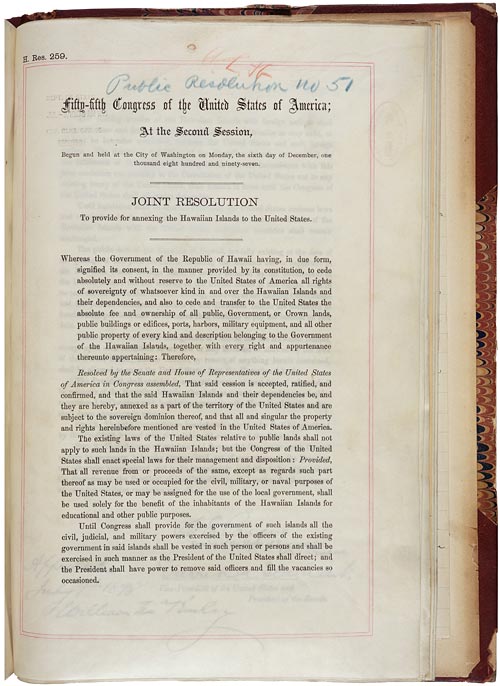
The war effectively silenced most anti-annexation arguments. Supporters argued that it was a wartime necessity to secure Hawaii to prevent it from falling into hostile hands and to support American military operations. On July 7, 1898, President McKinley signed the Newlands Resolution, annexing Hawaii as a U.S. territory. Unlike a treaty, which required a two-thirds vote in the Senate, a joint resolution only needed a simple majority in both houses of Congress, making it an easier legislative path to bypass previous opposition.
The annexation of Hawaii marked a significant turning point in American history, symbolizing its emergence as a Pacific power and a player on the global stage. It cemented the United States’ control over the Pacific and ensured the long-term protection of American commercial and military interests. Though achieved through controversial means, the acquisition of Hawaii was seen by its proponents as fulfilling a grand purpose—to secure a vital economic stronghold, establish an indispensable strategic outpost, and realize America’s destiny as a preeminent global power. On August 21, 1959, Hawaii officially became the 50th state of the United States, solidifying its place in the American mosaic and transforming it into the world-renowned travel destination it is today, rich with a history that continues to shape its unique culture and appeal.
LifeOutOfTheBox is a participant in the Amazon Services LLC Associates Program, an affiliate advertising program designed to provide a means for sites to earn advertising fees by advertising and linking to Amazon.com. Amazon, the Amazon logo, AmazonSupply, and the AmazonSupply logo are trademarks of Amazon.com, Inc. or its affiliates. As an Amazon Associate we earn affiliate commissions from qualifying purchases.