
The annals of American history are replete with foundational documents, but few hold the distinction and enduring significance of the Fundamental Orders of Connecticut. Adopted in 1639 by the early settlers of Hartford, Windsor, and Wethersfield, these “Orders” represent a pivotal moment in the development of self-governance in the New World. More than just a set of rules for local administration, they embodied a revolutionary spirit, laying the groundwork for a government derived from the consent of the governed and establishing a robust framework for representative democracy. Often hailed as the first written constitution in North America, the Fundamental Orders of Connecticut serve as a historical landmark, a testament to the innovative political thought that characterized the colonial period and profoundly shaped the future of the United States.
The Dawn of Self-Governance: A Historical Overview
The early 17th century saw a tide of English Puritan migration to New England, driven by a desire for religious freedom and the opportunity to establish societies built on their ideals. While many initially settled in the Massachusetts Bay Colony, some sought even greater autonomy and fertile lands to the west. This quest led to the establishment of the River Towns, the nascent communities that would eventually form the Colony of Connecticut.
Fleeing for Freedom: The Context of Early Colonial Connecticut
The journey to what would become Connecticut was born out of both ambition and dissent. Beginning around 1633, English settlers, including those from the Massachusetts Bay Colony, started migrating into the fertile Connecticut River Valley. This migration was partly fueled by the allure of rich agricultural lands, but also by a desire for a more liberal political and religious environment than that found in the more tightly controlled Massachusetts. The Massachusetts government, led by figures like John Winthrop, was characterized by a close intertwining of church and state and a limited franchise. The settlers who moved south sought a greater voice in their own governance and a system that prioritized the well-being of the community above strict ecclesiastical control.
Thomas Hooker‘s Vision: Preaching the Principles of Consent
Central to the formation of Connecticut and the crafting of the Fundamental Orders was the influential Puritan minister Thomas Hooker. Having arrived in Massachusetts in 1633 and moving to Hartford in 1636, Hooker was a powerful advocate for democratic principles. In a famous sermon delivered on May 31, 1638, he articulated a radical concept for his time: that “the foundation of authority is laid in the free consent of the people.” This idea, that government derived its legitimacy from the governed, was a profound departure from the prevailing European model of divine right monarchy. Hooker’s sermon effectively laid the philosophical groundwork for the political framework that the River Towns would soon adopt. His vision spurred the towns to unite under a common set of laws, ensuring stability and establishing their collective independence from outside authority.
Crafting a Groundbreaking Document: The Orders’ Core Tenets
On January 14, 1639, the inhabitants of Hartford, Windsor, and Wethersfield formally adopted the Fundamental Orders of Connecticut. Penned primarily by Roger Ludlow, an educated lawyer and one of the founders of Windsor, these Orders were remarkable for their clarity, scope, and revolutionary approach to governance. Unlike other colonial charters granted by the Crown, the Fundamental Orders were a self-generated agreement among the people, establishing a system of government based on their own authority.
A Government by the People: Representation and Elections
One of the most striking features of the Fundamental Orders was their emphasis on popular sovereignty and representative government. The document established a system whereby freemen (male property owners who were members of approved churches) from each town would elect representatives to a General Court. This General Court was granted broad powers, including the authority to make laws, levy taxes, and declare war. Crucially, the Orders also provided for the annual election of a Governor and six Magistrates, selected by the freemen. This direct election of key officials was highly progressive, ensuring that leaders remained accountable to the populace. The powers of the Governor were explicitly limited, preventing the accumulation of excessive authority by any single individual—a direct safeguard against the potential for tyranny that the colonists had experienced or observed in England.
Limiting Power: Safeguarding Against Tyranny
The Fundamental Orders were innovative in their clear division and limitation of governmental powers. While the General Court held significant legislative authority, it was also bound by the framework established in the Orders. The document enumerated specific powers for the magistrates, effectively creating an executive and judicial branch. Importantly, it stated that the Governor could not serve consecutive terms, a measure designed to prevent any single person from becoming too powerful or entrenched in office. This principle of rotating leadership was a deliberate attempt to distribute power and prevent the emergence of an aristocratic or authoritarian class, reflecting a deep-seated distrust of concentrated power stemming from their experiences with the English monarchy under King Charles I.
The Role of Law: Justice and Order in the New World
Beyond establishing the structure of government, the Fundamental Orders also articulated the importance of law and order for the fledgling Connecticut Colony. They provided for the establishment of courts, the administration of justice, and the peaceful resolution of disputes among the settlers. The Orders aimed to create a stable society where citizens’ rights were protected and where disputes could be settled according to established legal principles. This robust legal framework was essential for attracting new settlers, fostering economic growth, and maintaining harmony within the burgeoning communities, distinguishing the Connecticut settlements from the less organized frontier outposts.
Enduring Legacy: The “Constitution State” and American Democracy
The impact of the Fundamental Orders of Connecticut stretched far beyond the Connecticut River Valley, leaving an indelible mark on the political landscape of America. Their principles resonated through subsequent generations, influencing the very formation of the United States as an independent nation.
A Precedent for the United States Constitution
Historians widely consider the Fundamental Orders a direct precursor to the United States Constitution. Their emphasis on written law, popular sovereignty, limited government, and representative democracy provided a practical model for future constitutional development. The idea that a government’s authority derived from the consent of the governed, rather than from a monarch, was revolutionary and became a cornerstone of American political thought. The very concept of a written document outlining the powers and limitations of government, rather than relying on unwritten traditions or royal decrees, set a vital precedent that would be followed by the states and eventually the federal government. This innovative approach to governance earned Connecticut the proud moniker “The Constitution State.”
The Fundamental Orders Today: A Symbol of Innovation
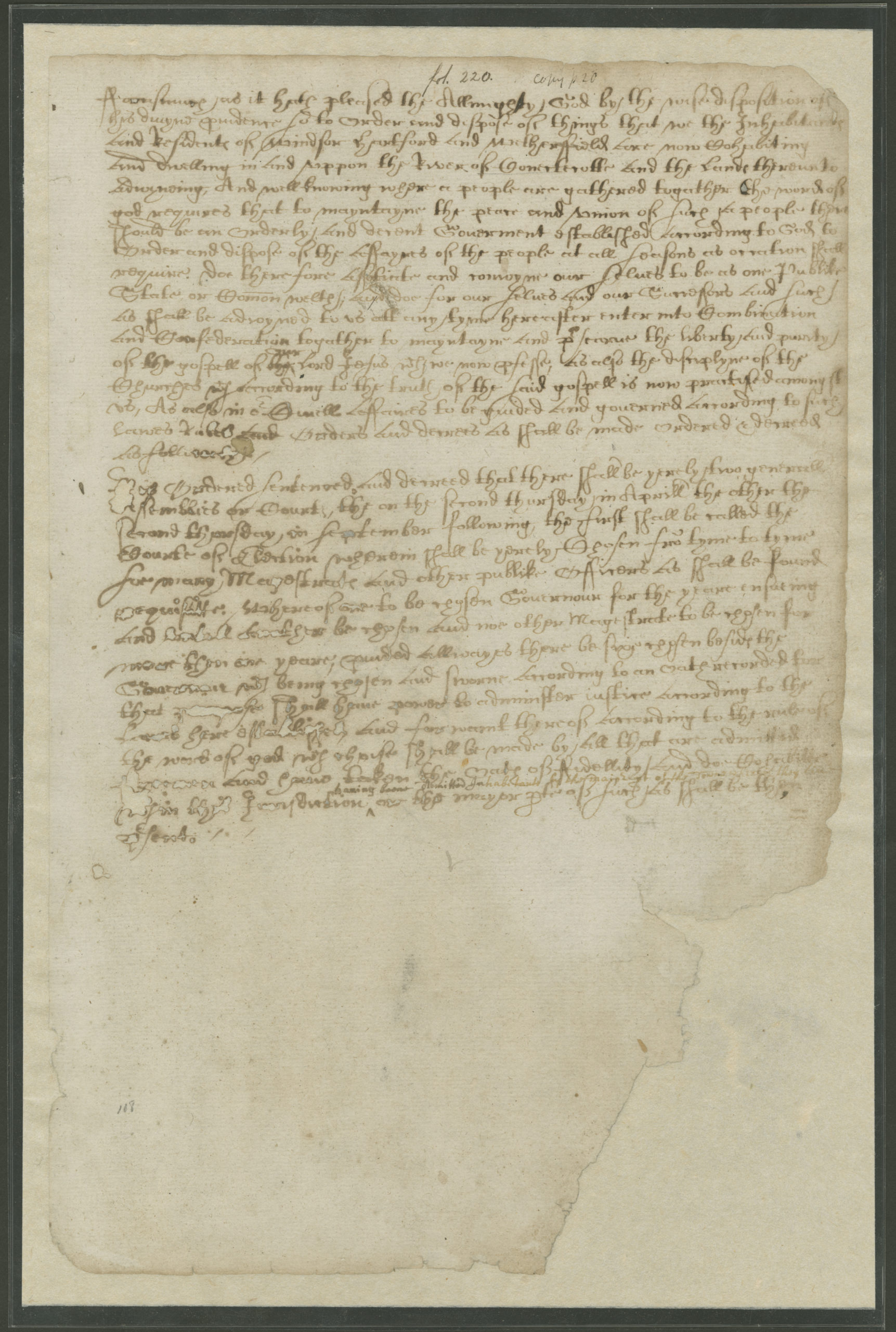
Today, the original manuscript of the Fundamental Orders of Connecticut is a treasured artifact, carefully preserved at the Connecticut State Library in Hartford. It stands as a tangible link to the earliest expressions of American democratic ideals. Its historical significance is taught in schools across the state and nation, serving as a reminder of the enduring legacy of ingenuity and determination that defined the colonial period. The document continues to inspire reflection on the principles of self-governance and the ongoing commitment to a government “of the people, by the people, for the people.”
Visiting the Historical Heart of Connecticut
For those interested in exploring this pivotal piece of American history, a visit to Hartford offers a unique opportunity. The Connecticut State Library, home to the Museum of Connecticut History, provides an accessible venue to view the original Fundamental Orders and learn more about the era in which they were created. Nearby, the Old State House, designed by Charles Bulfinch, stands on the site where colonial governance took root, offering further insights into Connecticut’s rich political past. Exploring these sites allows visitors to connect directly with the historical landmarks that shaped the trajectory of American democracy.
Debates and Interpretations: A Continuous Historical Dialogue
While the historical significance of the Fundamental Orders is undisputed, their exact nature and origins have been subjects of ongoing academic discussion. Historians continue to analyze their unique characteristics and compare them with other colonial experiments in self-governance.
The Question of Originality: Plymouth Colony and Other Influences
Some historical scholarship posits that the claim of the Fundamental Orders being the “first written constitution” requires nuance. Critics often point to the Mayflower Compact of 1620, signed by the Pilgrims of Plymouth Colony, as an earlier example of self-governance. However, the distinction lies in their scope and detail: the Mayflower Compact was primarily an agreement to form a civil body politic and abide by its laws, while the Fundamental Orders meticulously outlined the structure, powers, and limitations of an actual operating government. Similarly, other colonial documents existed, but none established such a comprehensive framework for a representative government independent of direct royal authority. The Fundamental Orders stand out for their foresight in creating a full governmental apparatus with clearly defined branches and powers, distinguishing them as genuinely constitutional in nature.
Church and State: A Nuanced Separation
Another area of historical debate revolves around the relationship between church and state as depicted in the Fundamental Orders. While Thomas Hooker’s sermon advocated for placing civil authority above ecclesiastical power—a significant departure from the Massachusetts Bay Colony’s model—the Fundamental Orders did not establish a complete separation. The franchise was limited to “freemen” who were implicitly understood to be members of approved churches, and the laws of the colony were certainly guided by Puritan moral principles. Nevertheless, the explicit removal of church membership as a legal prerequisite for voting, and the establishment of an independent civil government, represented a crucial step towards religious freedom and a more secular political sphere, a move that would ultimately pave the way for the later robust separation enshrined in the United States Constitution.

Conclusion: The Fundamental Orders’ Place in History
The Fundamental Orders of Connecticut are far more than a dusty relic of the past; they are a vibrant landmark in the history of democratic thought and practice. Born from a desire for greater autonomy and guided by the enlightened principles of leaders like Thomas Hooker, these Orders established a pioneering framework for self-government in the New World. Their commitment to popular sovereignty, limited government, and representative democracy served as a critical blueprint for the future United States.
Visiting the places where these profound ideas took root, from the historic River Towns to the archives in Hartford, offers a compelling journey into the heart of American identity. The Fundamental Orders of Connecticut stand as a powerful reminder that the foundations of liberty and justice were carefully crafted, not inherited, by visionary individuals committed to creating a society governed by the consent of its people. As such, they remain an invaluable historical landmark, inviting continuous study and appreciation for their enduring contribution to the democratic tradition.
LifeOutOfTheBox is a participant in the Amazon Services LLC Associates Program, an affiliate advertising program designed to provide a means for sites to earn advertising fees by advertising and linking to Amazon.com. Amazon, the Amazon logo, AmazonSupply, and the AmazonSupply logo are trademarks of Amazon.com, Inc. or its affiliates. As an Amazon Associate we earn affiliate commissions from qualifying purchases.