
The Defining Year: 1959 and the Completion of the American Map
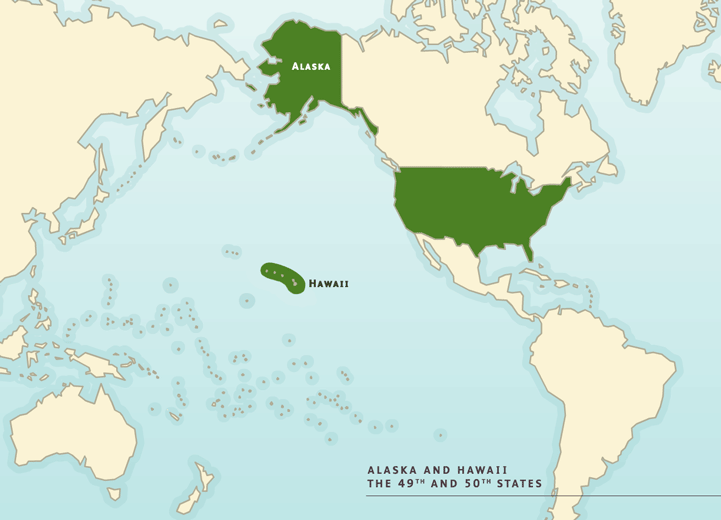
The year 1959 stands as a monumental landmark in the history of the United States, marking the admission of its 49th and 50th states: Alaska and Hawaii. These two distinct and geographically remote territories, one an arctic frontier and the other a tropical archipelago, embarked on their statehood journeys with unique challenges and aspirations. Their inclusion profoundly reshaped the nation’s political, economic, and cultural landscape, concluding a century and a half of continental expansion and setting the stage for modern America. Understanding the historical context surrounding their admission is crucial to appreciating these regions not just as destinations, but as living landmarks embodying distinct chapters of American heritage.

Alaska was officially admitted into the Union as the 49th state on January 3, 1959, while Hawaii followed seven and a half months later, becoming the 50th state on August 21, 1959. This dual entry, occurring within the same calendar year, underscored a pivotal moment when the concept of the contiguous United States expanded to embrace distant, non-contiguous territories, integrating vastly different cultures, economies, and strategic assets into the national fabric. The path to statehood for both was long and arduous, reflecting decades of advocacy, political maneuvering, and a shifting global power dynamic, particularly in the post-World War II and nascent Cold War eras.
Alaska: The Last Frontier’s Arduous Path to the Union
Alaska’s journey to statehood is a compelling narrative of resourcefulness, strategic importance, and the persistent vision of its inhabitants. Acquired from Russia in 1867 for $7.2 million, a transaction often derisively called “Seward’s Folly,” this vast northern territory spent decades as a district, then a territory, struggling for recognition and self-governance. Its sheer size – larger than Texas, California, and Montana combined – and its extreme climate presented unique challenges for development and integration.
Early arguments for Alaska becoming a state centered on its rich natural resources: the Klondike Gold Rush of the late 19th century brought a surge of population and economic activity, highlighting the potential wealth in timber, fishing, and later, oil. However, its sparse population and distance from the rest of the United States often left it politically marginalized. The territorial government, established in 1912, continuously petitioned Congress, emphasizing the unfairness of taxation without full representation and the need for local control over its vast resources.
The advent of World War II dramatically altered perceptions of Alaska’s strategic value. The Japanese invasion of the Aleutian Islands underscored its critical role in national defense, particularly against threats from Asia. Military bases expanded, infrastructure developed, and population grew as a result of the war effort. This newfound geopolitical importance, combined with the escalating Cold War and the perceived threat from the Soviet Union across the Bering Strait, gave significant momentum to the statehood movement. Advocates like Governor Ernest Gruening tirelessly campaigned, arguing that statehood was essential for economic self-sufficiency and the defense of the nation’s northern flank. On July 7, 1958, President Dwight D. Eisenhower signed the Alaska Statehood Act into law, paving the way for its official admission on January 3, 1959. This pivotal moment solidified Alaska’s identity as a rugged, resource-rich landmark, a vast wilderness deeply intertwined with national security and the spirit of exploration. Today, historical sites like the Iditarod National Historic Trail and the various gold rush towns such as Skagway serve as tangible connections to this foundational history.
Hawaii: The Pacific Paradise’s Seamless Integration
Hawaii’s path to statehood, while also long, was culturally and politically distinct from Alaska’s. A sovereign kingdom until the late 19th century, Hawaii was overthrown by American business interests in 1893 and annexed by the United States in 1898. For over six decades, it functioned as a territory, its economy dominated by pineapple and sugar plantations, with a diverse population of indigenous Hawaiians, American settlers, and immigrants from Asia.
The push for Hawaii statehood faced different obstacles. While its strategic military importance in the Pacific Ocean was undeniable, particularly after the attack on Pearl Harbor in 1941, racial prejudices and fears of non-white political dominance played a significant role in delaying its admission. Southern senators, concerned about the potential impact of a state with a predominantly non-white population on the balance of power in Congress, frequently blocked statehood bills. Powerful plantation owners also feared that statehood would empower labor unions and lead to increased wages and taxes.
Despite these challenges, the post-World War II era saw a growing national consensus that Hawaii deserved statehood. Its residents had consistently demonstrated loyalty and patriotism, and the territory’s economic and military contributions to the nation were substantial. The Cold War also played a part, as admitting Hawaii was seen as a powerful symbol of American democracy and its inclusive ideals, particularly in contrast to communist regimes. With increasing support from both Democratic and Republican parties, President Eisenhower signed the Hawaii Admission Act on March 18, 1959. Following a resounding public vote in Hawaii approving statehood, the islands officially joined the United States on August 21, 1959. This event cemented Hawaii’s status as a unique cultural landmark, a vibrant fusion of East and West, and a testament to natural beauty and resilience. Iconic historical sites such as Iolani Palace, the only official residence of royalty in the United States, and the USS Arizona Memorial at Pearl Harbor, profoundly illustrate this rich and complex history.

A Shared Legacy: Connecting History to Modern Landmarks
The admission of Alaska and Hawaii in 1959 completed the modern map of the United States, integrating two vastly different, non-contiguous regions into the national framework. Their statehood was a testament to the evolving nature of American identity and power, extending its reach across the Pacific and into the Arctic. Both states brought unique contributions: Alaska with its vast energy resources and strategic northern defense capabilities, and Hawaii with its critical Pacific military presence and unparalleled cultural diversity, serving as a bridge between the United States and Asia.
Beyond the dates, the stories of Alaska and Hawaii becoming states are integral to understanding their current identities as natural, cultural, and historical landmarks. For instance, the oil fields that fueled Alaska’s early economic growth after statehood also led to the creation of the Trans-Alaska Pipeline System, a modern engineering landmark. In Hawaii, the struggle for statehood solidified the diverse ethnic tapestry that makes its culture so vibrant today, reflected in its unique cuisine, festivals, and language.
Visitors to these states today can directly engage with this foundational history. In Alaska, the state capital of Juneau, the historic port city of Seward, and the cultural centers in Anchorage offer insights into the challenges and triumphs of its past. The vast national parks and wilderness areas, such as Denali National Park, stand as natural landmarks whose preservation was significantly influenced by the ability of state residents to advocate for their land and resources.
Similarly, in Hawaii, the historical sites of Honolulu, from Pearl Harbor to Iolani Palace, allow for a profound connection to its journey from kingdom to territory to state. The reverence for Hawaiian culture and language, which faced suppression during the territorial years, has seen a resurgence that underscores the importance of statehood in protecting and promoting indigenous heritage. Exploring these historical landmarks enriches the experience of the modern traveler, offering a deeper appreciation for the unique struggles, sacrifices, and achievements that defined these two extraordinary additions to the United States. Their statehood in 1959 was not merely a bureaucratic change but a profound historical milestone that continues to shape their character and allure as iconic American landmarks.
LifeOutOfTheBox is a participant in the Amazon Services LLC Associates Program, an affiliate advertising program designed to provide a means for sites to earn advertising fees by advertising and linking to Amazon.com. Amazon, the Amazon logo, AmazonSupply, and the AmazonSupply logo are trademarks of Amazon.com, Inc. or its affiliates. As an Amazon Associate we earn affiliate commissions from qualifying purchases.