
In a city defined by its vertical landscape and concrete grid, New York City is accustomed to technological marvels and architectural wonders. Yet, few installations have sparked as much curiosity, debate, and genuine human connection as “The Portal.” Standing as a bridge between disparate worlds, this public art installation has transformed the way New Yorkers interact with the globe, offering a literal window into a life thousands of miles away.
A Global Bridge in the Heart of the Metropolis
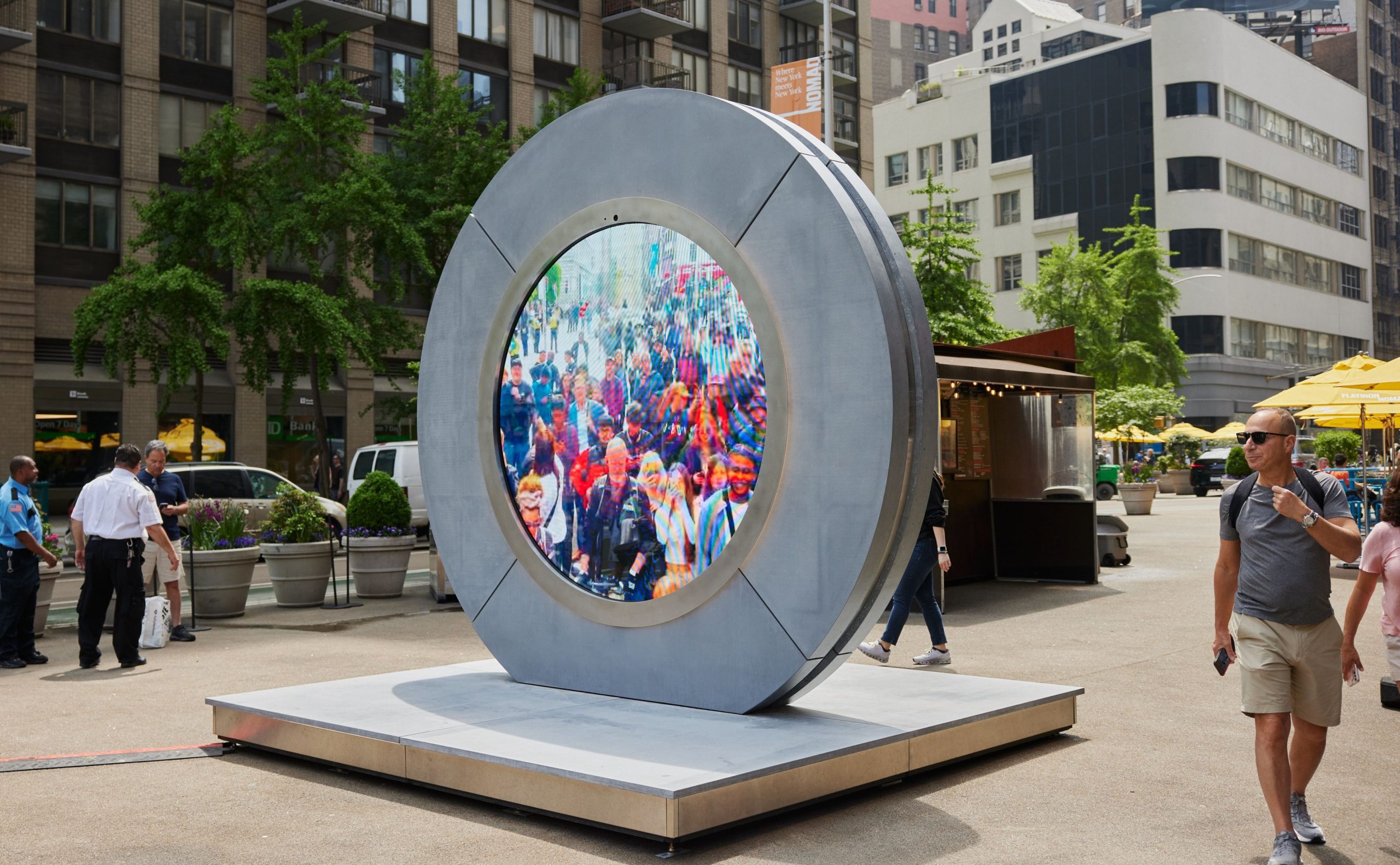
The Portal is not a building or a statue, but a high-definition, real-time livestream sculpture that connects two bustling international hubs. The project, conceived by artist Benediktas Gylys, was designed to foster a sense of “oneness” in an increasingly polarized world. By removing the barriers of borders and time zones, the installation creates an unfiltered, silent connection between the citizens of New York City and Dublin, Ireland.
The Concept of Radical Connectivity
The vision behind the installation is radical in its simplicity: it is a 24/7, high-definition video link. There is no sound, no translation software, and no curated content. Instead, it relies on the spontaneity of human behavior. When you stand in front of the screen in New York City, you are looking directly into a screen located in Dublin. You see people walking, waving, holding up signs, or simply pausing to observe the “other side.” This creates an immediate emotional resonance, turning a public plaza into a theater of humanity.
Why New York City Was Chosen
New York City was selected for this experiment because of its status as the quintessential “global village.” As a melting pot of cultures, it is perhaps the most appropriate setting for a project that seeks to dissolve geographical isolation. Placed in a high-traffic area, the Portal utilizes the city’s inherent energy, ensuring that there is always someone on the other side of the lens ready to make a connection.
Location, Logistics, and Accessibility
For those planning to visit the installation, it is crucial to understand where it sits within the urban fabric of Manhattan. The Portal occupies a prominent space in the Flatiron District, specifically at the Flatiron South Public Plaza near the iconic Flatiron Building.
Navigating to the Portal
Visitors can easily reach the site via public transit. The surrounding area is well-serviced by the New York City Subway, with the 23rd Street Station providing the most direct access. Once you arrive at the plaza, the installation is hard to miss—its circular, glowing frame stands in stark contrast to the historic limestone and terra-cotta facades of the surrounding Flatiron District.
Timing Your Visit
While the Portal operates 24 hours a day, the experience changes drastically depending on when you arrive. During the morning hours in New York City, it is late afternoon in Dublin, making it the most active time for interaction as people finish their workdays. During the dead of night, you might find yourself in a quiet, meditative exchange with a lone night owl in Ireland, a vastly different experience from the high-energy crowds of midday.
The Cultural Impact and Social Experiment

The installation has been met with both enthusiasm and skepticism, serving as a social mirror for the public. Critics have raised concerns about privacy and the potential for inappropriate behavior, while supporters celebrate it as a rare example of “human-first” technology.
Spontaneous Interactions
The beauty of the Portal lies in its unpredictability. It has seen marriage proposals, choreographed dances, children playing “peek-a-boo” across the Atlantic, and political protestors standing in solidarity with counterparts thousands of miles away. These interactions remind us that, despite the vast physical distance, our daily struggles, joys, and curiosities are strikingly similar. It strips away the digital mediation of social media—where we often interact with algorithms—and replaces it with the raw, unedited gaze of a fellow human being.
The Evolution of Public Art
By integrating technology into the Flatiron District, the Portal challenges the traditional definition of a landmark. Historically, landmarks in New York City were static—bronze statues or imposing stone architecture designed to be observed. The Portal is fluid. It evolves with the people who stand before it. It suggests that the future of public art is not just about what we look at, but who we look with.
Tips for the Best Experience
To get the most out of your visit to the Portal, a little preparation goes a long way. This is not a passive viewing experience; it is a participatory one.
1. Bring a Sign
One of the most effective ways to communicate is with simple props. Many visitors arrive with small whiteboards or pieces of paper. Whether you are greeting a stranger in Dublin or asking where they are from, the written word serves as an excellent bridge for the lack of audio.
2. Embrace the Silence
Do not feel the need to perform. Some of the most poignant moments at the Portal happen when people simply sit or stand, observing the life of a distant city. You are witnessing a slice of reality in Ireland—the weather, the fashion, the pace of life—all captured in real-time.
3. Consider the Lighting
If you are visiting in the evening, be aware that the light from the Portal is quite bright. If you plan to take photos or videos, position yourself so the light from the screen illuminates you rather than creating a silhouette.
4. Respect the Space
As with any public landmark in New York City, be mindful of the crowd. During peak hours, the area around the Flatiron Building can become quite congested. Take your turn, be courteous to other visitors, and keep the interaction playful and respectful.

The Future of Connected Tourism
The Portal represents a fascinating intersection of tourism and technology. As we move into an era where travel is increasingly digitized, installations like this offer a hybrid experience. They do not replace the need for physical travel, but they satisfy a craving for connection that standard media cannot reach.
When you walk away from the Flatiron South Public Plaza, you carry with you a small, visceral understanding of what it means to be part of a global society. Whether you view the Portal as a quirky photo opportunity or a profound artistic statement, it succeeds in doing what New York City has always done best: bringing the world to your doorstep. It invites us to stop rushing, to look up from our phones, and to realize that someone, somewhere across the ocean, is looking right back at us.
LifeOutOfTheBox is a participant in the Amazon Services LLC Associates Program, an affiliate advertising program designed to provide a means for sites to earn advertising fees by advertising and linking to Amazon.com. Amazon, the Amazon logo, AmazonSupply, and the AmazonSupply logo are trademarks of Amazon.com, Inc. or its affiliates. As an Amazon Associate we earn affiliate commissions from qualifying purchases.