
The story of how Hawaii became part of the United States is a complex narrative of diplomacy, revolution, and strategic ambition. Unlike many other states that joined the union through westward expansion across North America, the transition of this archipelago in the Pacific Ocean from a sovereign kingdom to an American territory—and eventually the 50th state—was marked by a pivotal series of events in the late 19th century. To understand when America took over Hawaii, one must look specifically at the dates of 1893 and 1898, years that forever changed the cultural and political landscape of these islands.
The Kingdom of Hawaii and the Road to 1893
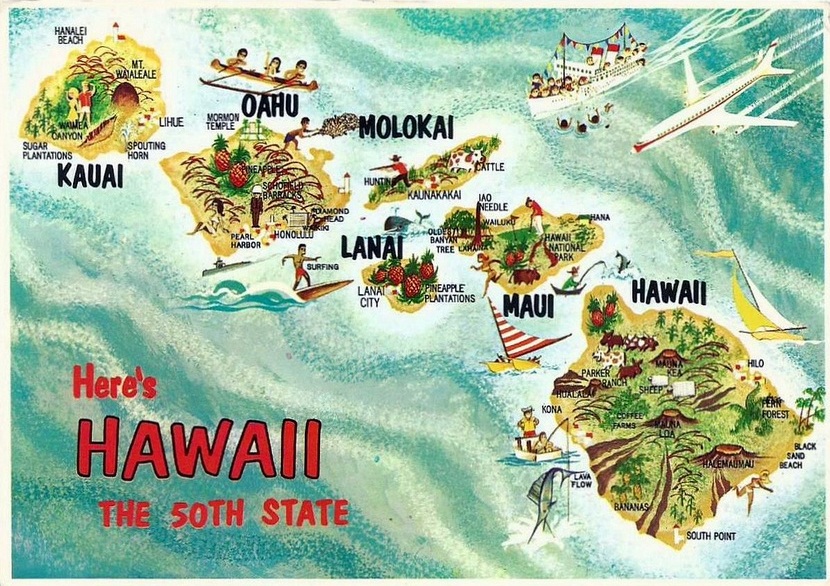
Before it was an American state, Hawaii was a globally recognized sovereign nation. The Kingdom of Hawaii was established by King Kamehameha I in 1810, unifying the major islands of Oahu, Maui, Molokai, Lanai, Kauai, and Niihau. Throughout the 19th century, the kingdom modernized rapidly, establishing diplomatic relations with major world powers and maintaining a literate population and a constitutional monarchy.
However, the late 1800s saw the rise of a powerful merchant class, largely comprised of American and European businessmen. These individuals, often referred to as the “sugar kings,” sought to protect their economic interests, particularly the lucrative export of sugar to the United States. In 1887, this group forced King Kalakaua to sign the “Bayonet Constitution,” which severely limited the power of the monarchy and stripped many Native Hawaiians of their voting rights.
The Overthrow of the Monarchy
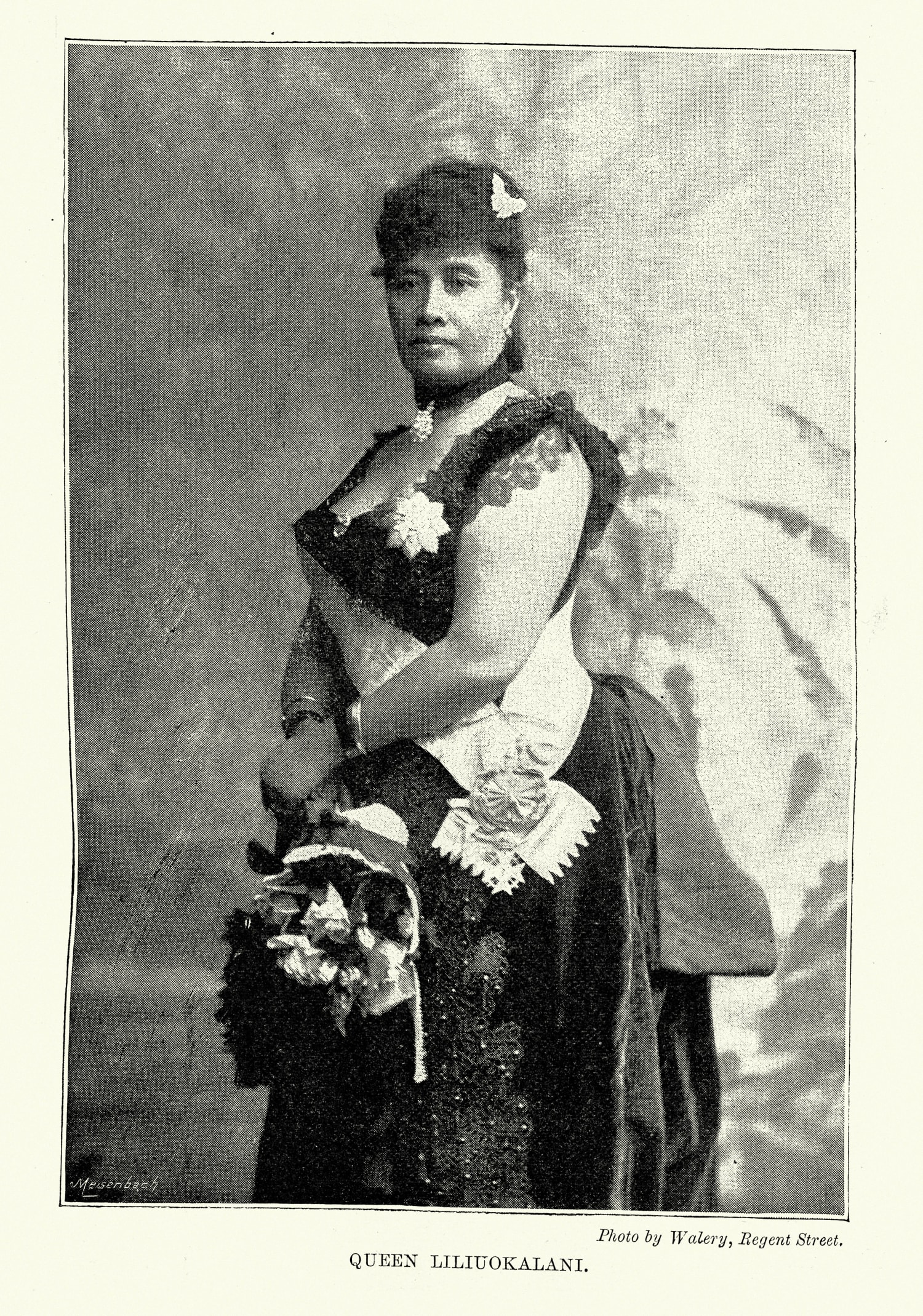
The most critical date in the American takeover is January 17, 1893. By this time, King Kalakaua had passed away, and his sister, Queen Liliuokalani, had ascended to the throne. The Queen, a staunch advocate for her people, proposed a new constitution that would restore power to the monarchy and the voting rights of the indigenous population.
In response, a group of residents known as the Committee of Safety, supported by John L Stevens, the United States Minister to Hawaii, orchestrated a coup. To ensure the success of the overthrow, United States Marines from the USS Boston landed at Honolulu Harbor. Facing the threat of violence and seeking to avoid bloodshed, Queen Liliuokalani surrendered her authority under protest, famously stating that she yielded to the superior force of the United States.
The Provisional Government and the Republic
Following the overthrow, a provisional government was established, led by Sanford B Dole. Their immediate goal was annexation by the United States. However, the move faced a significant roadblock in Washington DC. President Grover Cleveland, an anti-imperialist, conducted an investigation (the Blount Report) which concluded that the overthrow was illegal and that the United States military had played an improper role. President Grover Cleveland refused to support annexation, and for a few years, Hawaii existed as the Republic of Hawaii.
The Annexation of 1898: A Strategic Shift
The political tide turned with the onset of the Spanish American War in 1898. Suddenly, the mid-Pacific location of Hawaii became an essential strategic asset for the United States Navy. The islands were viewed as a necessary coaling station and staging ground for troops heading to the Philippines.
The Newlands Resolution
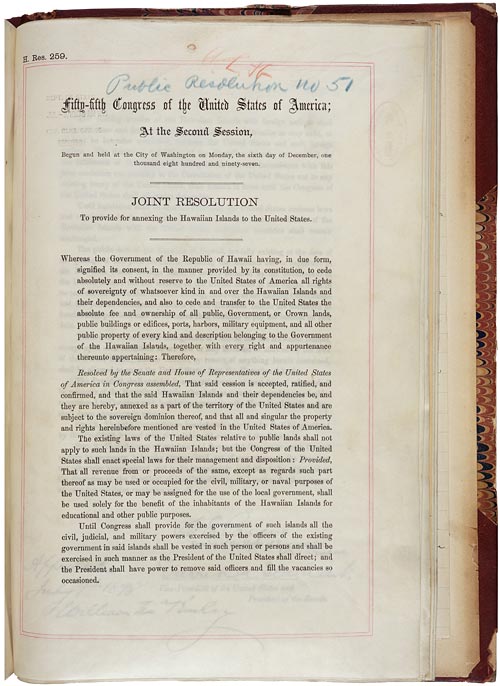
Under the administration of President William McKinley, the United States Congress moved toward formal annexation. Knowing that a formal treaty would likely fail to gain the required two-thirds majority in the United States Senate, proponents used a joint resolution—the Newlands Resolution—which required only a simple majority.
On July 7, 1898, President William McKinley signed the resolution. On August 12, 1898, a ceremony was held at Iolani Palace in Honolulu. The flag of the Kingdom of Hawaii was lowered, and the Stars and Stripes was raised. This moment officially marked the beginning of Hawaii’s status as a territory of the United States, a status that would remain for over sixty years.
The Impact on Indigenous Sovereignty
The annexation remains a point of deep historical contention. Native Hawaiians organized mass petitions, such as the Kuaihelani Campbell petitions, to protest the loss of their nation. Despite their efforts, the Organic Act of 1900 formally established the Territory of Hawaii, providing a government framework and granting American citizenship to many island residents, while also solidifying the dominance of American corporate interests in the region.
Architectural and Historical Landmarks of the Takeover
The transition of power left behind a series of physical landmarks that serve as silent witnesses to these turbulent years. For any visitor or history enthusiast, these sites in Honolulu offer a tangible connection to the events of 1893 and 1898.
Iolani Palace
Located in the heart of downtown Honolulu, Iolani Palace is perhaps the most significant landmark in this story. Completed in 1882 by King Kalakaua, it is the only royal palace on United States soil. The palace was not only the seat of the monarchy but also the site of Queen Liliuokalani’s imprisonment following an attempted restoration of the monarchy in 1895. Visitors can see the “Imprisonment Room” where she remained for nearly a year, composing music and quilting while her kingdom was dismantled.
Aliiolani Hale
Across the street from the palace stands Aliiolani Hale, currently home to the Hawaii State Supreme Court. During the 1893 overthrow, this building served as the headquarters for the Committee of Safety. It was from the steps of Aliiolani Hale that the proclamation was read ending the monarchy. In front of the building stands the iconic gold-leafed statue of King Kamehameha I, a symbol of Hawaiian unity and strength that stands in stark contrast to the nearby sites of political change.
Washington Place
Not far from the palace is Washington Place, the former private residence of Queen Liliuokalani and her husband, John Owen Dominis. This elegant Greek Revival mansion served as the Queen’s home until her death in 1917. It later became the official residence of the Governor of Hawaii, bridging the gap between the royal era and the territorial era.
Pearl Harbor and the Strategic Legacy
While often associated with World War II, Pearl Harbor on the island of Oahu is fundamentally linked to the takeover. The United States had sought exclusive rights to use the harbor as a naval station since the 1870s. The eventual annexation in 1898 was driven by the desire to secure this deep-water port permanently. Today, the USS Arizona Memorial and the Pearl Harbor National Memorial stand as reminders of how the islands’ strategic value dictated their political fate.
From Territory to the 50th State
The period following the 1898 annexation was one of massive transformation. Hawaii was no longer a remote kingdom; it was an integral piece of the American empire. The economy shifted further toward plantation agriculture, with the Big Five corporations controlling nearly every aspect of island life.
The Path to 1959
The status of “Territory” lasted until 1959. During these decades, the population grew more diverse as workers from Japan, China, the Philippines, and Portugal arrived to work on the sugar and pineapple plantations. The cultural “melting pot” of Hawaii was formed during this territorial period.
After World War II, the push for statehood intensified. Many residents felt that since they paid federal taxes and had fought in the war, they deserved the right to vote for the President of the United States and have full representation in Congress. On August 21, 1959, President Dwight D Eisenhower signed the proclamation making Hawaii the 50th state.
Modern Reflection and the Apology Resolution
The “takeover” of Hawaii is not just a footnote in history; it is a living part of the island’s identity. In 1993, on the 100th anniversary of the overthrow, the United States Congress passed the “Apology Resolution” (Public Law 103-150). Signed by President Bill Clinton, the resolution acknowledged that the overthrow of the Kingdom of Hawaii occurred with the active participation of agents and citizens of the United States and that the Native Hawaiian people never directly relinquished their claims to their inherent sovereignty.
Today, places like the Bernice Pauahi Bishop Museum in Honolulu help preserve this history, showcasing the royal crowns, cloaks, and documents of the kingdom era. For visitors, understanding when America took over Hawaii—and how it happened—adds a layer of profound depth to the natural beauty of the Polynesian landscape. From the volcanic peaks of Diamond Head to the halls of Iolani Palace, the history of 1893 and 1898 remains etched into the very soil of the islands.
LifeOutOfTheBox is a participant in the Amazon Services LLC Associates Program, an affiliate advertising program designed to provide a means for sites to earn advertising fees by advertising and linking to Amazon.com. Amazon, the Amazon logo, AmazonSupply, and the AmazonSupply logo are trademarks of Amazon.com, Inc. or its affiliates. As an Amazon Associate we earn affiliate commissions from qualifying purchases.